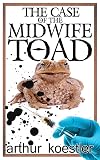
The Case of the Midwife Toad
by Arthur Koestler
On This Page
Description
On September 23, 1926, and Austrian experimental biologist named Dr. Paul Kammerer blew his brains out on a footpath in the Austrian mountains. His suicide was the climax of a great evolutionary controversy which his experiments had aroused. The battle was between the followers of Lamarck, who maintained that acquired characteristics could be inherited, and the neo-Darwinists, who upheld the theory of chance mutations preserved by natural selection. Dr. Kammerer's experiments with various show more amphibians, including salamanders and the midwife toad (Alytes obstetricans), lent much weight to the Lamarckian argument and drew upon him the full fury of the orthodox neo-Darwinists. Arthur Koestler had known about Dr. Kammerer's work when he himself was a student in Vienna, and he has always been interested in this tragic story. He gives a fascinating description of the venomous atmosphere in which the battle was fought and of the lengths to which apparently respectable scholars would go to discredit their opponents. Heading the attack on Kammerer was a British scientist, William Bateson, who hinted that the Viennese's experiments were fakes, but who failed to examine the evidence, including the so-called nuptial pads of Kammerer's last remaining specimen of the midwife toad. It was a young American scientist who delivered the coup de grace; on a visit to Vienna, he discovered that the discoloration of the nuptial pads was due not to natural causes but to the injection Indian ink. When his findings were published, Kammerer shot himself. Mr. Koestler, whose recent writings, in books such as The Act of Creation and The Ghost in the Machine, have been in part concerned with evolutionary theory, decided to investigate this old mystery. When he started on his researches, he expected to relate the tragedy of a man who had betrayed his calling, for Kammerer's suicide was accepted as a confession of guilt and his work was discredited from that day to this. Instead, as Mr. Koestler read the contemporary papers, corresponded with Kammerer's daughter, Bateson's son, and the surviving scientists who attended Kammerer's lecture in Cambridge, he found himself writing a vindication of a man who in all probability was himself betrayed. The story that emerges is, on one level, fascinating piece of scientific detection; on another, it is a moving and human narrative about a much abused, brilliant and lovable figure. Though no Lamarckian himself, Mr. Koestler ends the book with an appeal to biologists to repeat Kammerer's experiments with an open mind in order to verify or refute them. If Kammerer's claims were posthumously confirmed our outlook on evolution would be significantly changed. A superb intellectual thriller whose implications still reverberate today, The Case of the Midwife Toad is an entirely new kind of book for Mr. Koestler, and perhaps only he could have written it, for it required expert knowledge and familiarity with the academic world of science, combined with the creativity and imaginative insight of an outstanding novelist. Annotation Published: March 2016. show lessTags
Recommendations




































Member Reviews
Kammerer is usually held up as an example of scientific fraud, but I'm not so sure. His midwife toads may have had a genetic plasticity that was completely beyond the understanding of the day, but which he hit with an extreme and obsessive degree of artificial selection. Hence his results might have been real, but their meaning badly misunderstood by both sides at the time. We'll never know for sure.
This is a fascinating book for anyone interested in the history of science, particularly the history of evolutionary biology. There is much food for thought about fraud, the perception of fraud, scientific politics, and the impact of wider politics on scientists and their thinking.
I'd strongly recommend it to anyone interested in such show more topics, but it may be a bit hard to find. show less
This is a fascinating book for anyone interested in the history of science, particularly the history of evolutionary biology. There is much food for thought about fraud, the perception of fraud, scientific politics, and the impact of wider politics on scientists and their thinking.
I'd strongly recommend it to anyone interested in such show more topics, but it may be a bit hard to find. show less
Arthur Koestler found the idea of evolution by natural selection unsatisfying, if not disturbing, and spent years trying to promote non-selectionist mechanisms. In this book, he attempted to resurrect Paul Kammerer's reputation along with what he saw as his neo-Lamarckian views. In so doing, he had to battle against the evidence that Kammerer faked the results in the famous midwife toad experiment. Chief among the alternative explanations that Koestler promotes are that someone else at Kammerer's lab injected the single remaining specimen with India ink to make it appear that the toad had developed nuptial pads. As a hypothesis with no evidence to support it, Koestler's opinion must be regarded as untestable speculation.
On the positive show more side, Koestler delves deeply into the relevant correspondence and other evidence in an attempt to tease out the explanation for the alleged fraud. Likewise, he offers a detailed account of Kammerer's life and career, and offers a popularized account of the historical controversy. On the negative side, Koestler is far from an objective observer. He goes to great lengths to present Kammerer as an unfortunate victim of scientific orthodoxy of his day, particularly as represented by British and American scientists. Knowledgeable scientists will find Koestler's interpretations labored, convoluted, and less-than-plausible, and his arguments for a non-Darwinian mechanisms weak and unconvincing. Unfortunately, Koestler lacks the necessary scientific knowledge to make a convincing case. What's more, he was insufficiently grounded in evolutionary science to characterize the opposing views accurately. Bateson (whom he paints as an orthodox Darwinian) held heretical ideas of his own, including his view that saltation accounted for evolutionary change. Meanwhile, as Gliboff (2006) noted in her paper in Biology Reviews, "Koestler also exaggerated the threat that Kammerer's results posed to the theory of natural selection, for most of them can be explained in selectionist terms." Far from being a "Lamarckian" in the modern sense, Kammerer sought to reconcile Darwinian selection with genetics, while paying due credit to the very effects of environment that Darwin invoked. As a side note, one can note that a notable gap in Koestler's account lies in his omission of Kammerer's outlandish claims to have modified reproductive modes of lizards and salamanders by maintaining them under altered conditions.
This book enjoyed some popular attention when it first came out, but is unreliable as a disinterested guide to the controversy, much less to the relevant science involved. Koestler sought to use the Kammerer incident in an attempt to discredit modern evolutionary science, and in this respect his book is better regarded as a polemic than as a guide to the historical controversy. show less
On the positive show more side, Koestler delves deeply into the relevant correspondence and other evidence in an attempt to tease out the explanation for the alleged fraud. Likewise, he offers a detailed account of Kammerer's life and career, and offers a popularized account of the historical controversy. On the negative side, Koestler is far from an objective observer. He goes to great lengths to present Kammerer as an unfortunate victim of scientific orthodoxy of his day, particularly as represented by British and American scientists. Knowledgeable scientists will find Koestler's interpretations labored, convoluted, and less-than-plausible, and his arguments for a non-Darwinian mechanisms weak and unconvincing. Unfortunately, Koestler lacks the necessary scientific knowledge to make a convincing case. What's more, he was insufficiently grounded in evolutionary science to characterize the opposing views accurately. Bateson (whom he paints as an orthodox Darwinian) held heretical ideas of his own, including his view that saltation accounted for evolutionary change. Meanwhile, as Gliboff (2006) noted in her paper in Biology Reviews, "Koestler also exaggerated the threat that Kammerer's results posed to the theory of natural selection, for most of them can be explained in selectionist terms." Far from being a "Lamarckian" in the modern sense, Kammerer sought to reconcile Darwinian selection with genetics, while paying due credit to the very effects of environment that Darwin invoked. As a side note, one can note that a notable gap in Koestler's account lies in his omission of Kammerer's outlandish claims to have modified reproductive modes of lizards and salamanders by maintaining them under altered conditions.
This book enjoyed some popular attention when it first came out, but is unreliable as a disinterested guide to the controversy, much less to the relevant science involved. Koestler sought to use the Kammerer incident in an attempt to discredit modern evolutionary science, and in this respect his book is better regarded as a polemic than as a guide to the historical controversy. show less
Read as a teenager, and still memorable and inspirational for its focus on questioning evidence, scientific methods, and controversies of evolutionary biology. It reinforced my early interest in history of science, philosophy of science, and scientific culture, today better wrapped up in the academic subject STS (Science and Technology Studies).
An attempt to exonerate a famous scientist accused of fraud. It works well, gradually introducing evidence and maintaining interest. Personally, I felt the author withheld some information until later in the book to try to bolster his case. I remain unconvinced,but somewhat doubtful and enjoyed the read
Koestler's take on the scientific controversy of Paul Kammerer. Extremely well written and terribly interesting (if you like mysteries, biology, or philosophy of science). Worth it just for the way Koestler writes.
Just to be clear, no one here, including Koestler, a non-scientist, was disputing the fact of evolution. The debate was about the mechanisms of evolution.
The latest research suggests that Kammerer was not a fraud but rather made an extraordinary discovery about midwife toads. Extraordinary claims require remarkable proof, so that strong doubt about his unverified claim was fully appropriate. His Lamarckian view of the mechanism of evolution, which he was attempting to prove, was wrong, although recent advances show that epigenetic mechanisms may be heritable, uncommon in higher organisms and unrelated to our toad.
The latest research suggests that Kammerer was not a fraud but rather made an extraordinary discovery about midwife toads. Extraordinary claims require remarkable proof, so that strong doubt about his unverified claim was fully appropriate. His Lamarckian view of the mechanism of evolution, which he was attempting to prove, was wrong, although recent advances show that epigenetic mechanisms may be heritable, uncommon in higher organisms and unrelated to our toad.
Koestler gives a history of Kammerer's attempt to deceive evolutionary biologists by faking frog speciments using ink.
Members
- Recently Added By
Lists

BingoDOG - Scientists in Fiction
111 works; 17 members

The Great Courses: The Darwinian Revolution
50 works; 1 member
Author Information

118+ Works 13,146 Members
Arthur Koestler was born on September 5, 1905 in Budapest, Hungary and studied at the University of Vienna. Koestler was a Middle East correspondent for several German newspapers, wrote for the Manchester Guardian, the London Times and the New York Herald Tribune. Koestler wrote Darkness at Noon, which centers on the destructiveness of politics, show more The Act of Creation, a book about creativity, and The Ghost in the Machine, which bravely attacks behaviorism. Arthur Koestler died in London on March 3, 1983. (Bowker Author Biography) show less
Awards and Honors
Notable Lists
Common Knowledge
- Original publication date
- 1971
Classifications
Statistics
- Members
- 316
- Popularity
- 101,230
- Reviews
- 9
- Rating
- (3.50)
- Languages
- 6 — Danish, English, French, German, Hungarian, Spanish
- Media
- Paper
- ISBNs
- 14
- ASINs
- 6