The Boats of the "Glen Carrig"
by William Hope Hodgson
There is 1 current discussion about this work.
On This Page
Description
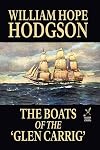
The Boats of the Glen Carrig is horror writer William Hope Hodgson's 1907 novel. Written in an archaic style and presented as a true record and account, the story is narrated by a passenger of the Glen Carrig, a ship lost at sea after a supposed collision with a hidden rock. The survivors abandon the sinking hull in two lifeboats, but their most horrific and terrifying experiences are yet to come. The Boats of the Glen Carrig evokes a lost world and gives an engrossing study in human show more relationships submitted to pressure and fear.. show less
Tags
Recommendations






















Member Reviews
Sort of a prototype of Hodgson's later novel 'The Night Land'. Similar archaic language, similar tone and style.
Like The Night Land, The Boats of the "Glen Carrig" is wildly uneven in quality - the earlier half of the book is much superior to the second, and is a masterful work of tone and lurking dread, with incredibly and uniquely imaginative maybe-supernatural horrors. The book is very visual; you can see in your mind great empty gray wastes shrouded in fog, blasted marshes, the mysteriously fleshy bleeding trees, the meat-creature smashing doors and boat windows between flashes of lightning, the terror of swarms of 'weed people'. Only Lovecraft surpassed Hodgson in coming up with monsters.
Botched the landing, unfortunately, the show more second half of the book drags quite a bit, but it's worth it to get to the end. It's not like the story is particularly long. show less
Like The Night Land, The Boats of the "Glen Carrig" is wildly uneven in quality - the earlier half of the book is much superior to the second, and is a masterful work of tone and lurking dread, with incredibly and uniquely imaginative maybe-supernatural horrors. The book is very visual; you can see in your mind great empty gray wastes shrouded in fog, blasted marshes, the mysteriously fleshy bleeding trees, the meat-creature smashing doors and boat windows between flashes of lightning, the terror of swarms of 'weed people'. Only Lovecraft surpassed Hodgson in coming up with monsters.
Botched the landing, unfortunately, the show more second half of the book drags quite a bit, but it's worth it to get to the end. It's not like the story is particularly long. show less
This was a totally creepy story about a ship’s crew that becomes stranded on a mysterious continent, where the waters are choked with weeds and teem with creatures that seem to be part worm, part octopus, and all disgusting. I enjoyed this story very much, particularly with the author’s judicious use of overt horror. Much easier to be scared when the horror is lurking in the corner of your eye rather than getting up in your face all the time. There were several occasions that prompted cries of disgust and surprise! The only complaint I have is that the story seemed to end rather abruptly. Otherwise, recommended.
The 'Boats of the "Glen Carrig"' begins with the narrator and a group of survivors travelling in lifeboats in search of supplies and a way home. The book details their visits to various islands, and the strange creatures and vegetation they found there. The edition I read called it a science fiction classic, but I think it's better described as an adventure story with monsters.
Hodgson had experience as a sailor, and it shows in his writing, in the naming and technical description of the parts of the boats and their uses. The other descriptive aspects of the book are similarly mechanically-focused: the reader has no idea about what the other passengers look like or their personalities (apart from scant treatment of the bo'sun/boatswain show more and later female characters), however many pages are devoted to detailed description of e.g. how the boats were prepared against a storm, or how a device was constructed and operated in a rescue attempt. However, Hodgson does spend a good deal of effort on conveying the horror and fear the narrator experiences in encountering the various strange monsters, and of the landscape the smells and the feelings that it evoked, and so the reading is not as completely dry as might be expected in the absence of character depth, and the almost-laborious descriptions of mechanical devices, inventory, and other daily goings-on, do help place the reader into the experiences of the narrator and to connect with the action where it occurs.
The monsters and situations are thrilling to be sure, but they have none of the existential dread and cosmic implications of horror authors like Lovecraft (whose association with Hodgson led me to read the latter's work). If it were not for the archaic language, I would say that the subject matter and treatment would be best enjoyed by older children. However, as it stands, it's probably best served as light nostalgic or escapist reading for adult fans of older literature; and on that level I enjoyed it immensely. show less
Hodgson had experience as a sailor, and it shows in his writing, in the naming and technical description of the parts of the boats and their uses. The other descriptive aspects of the book are similarly mechanically-focused: the reader has no idea about what the other passengers look like or their personalities (apart from scant treatment of the bo'sun/boatswain show more and later female characters), however many pages are devoted to detailed description of e.g. how the boats were prepared against a storm, or how a device was constructed and operated in a rescue attempt. However, Hodgson does spend a good deal of effort on conveying the horror and fear the narrator experiences in encountering the various strange monsters, and of the landscape the smells and the feelings that it evoked, and so the reading is not as completely dry as might be expected in the absence of character depth, and the almost-laborious descriptions of mechanical devices, inventory, and other daily goings-on, do help place the reader into the experiences of the narrator and to connect with the action where it occurs.
The monsters and situations are thrilling to be sure, but they have none of the existential dread and cosmic implications of horror authors like Lovecraft (whose association with Hodgson led me to read the latter's work). If it were not for the archaic language, I would say that the subject matter and treatment would be best enjoyed by older children. However, as it stands, it's probably best served as light nostalgic or escapist reading for adult fans of older literature; and on that level I enjoyed it immensely. show less
As with much of Hodgson's writing, there is no dialogue in The Boats of the 'Glen Carrig', the story being presented as a witness account from one person's viewpoint, with few of the characters, including the narrator, being named. I've read some reviews which criticise him for this form, it being, undeniably, monotone in effect and, for some, it may come off as rather flat, if not to say boring. In the present case, throw in the reserved language of an earlier era and a surfeit of nautical jargon and the result might be of remoteness and impenetrability. However, that's a view for others, as I love Hodgson's work and find in the faults ascribed by others a well-crafted style, well-suited to the atmosphere he seeks to create.
The story show more begins without preamble with the narrator and his companions already adrift in their lifeboats. It's never explained how the 'Glen Carrig' came to founder, nor exactly where nor when. It is to be assumed that the narrator's fictional audience know these details, the loss of a vessel and the unexpected return of the survivors having undoubtedly been a widely-reported sensation. Depending upon your temperament, this, and other, unexplained incidents may be frustrating or evocative. I'll pass on from narrative style, though, by restating that it suits my own taste.
I don't think it's giving too much away to say that the 'horror' in the story is not of the supernatural variety, such as in Hodgson's The Ghost Pirates, but is rather in the macabre/weird vein, with the 'Glen Carrig' survivors contending with mundane, if strange, eerie and malevolent, forces. That said, it's little surprise that H.P. Lovecraft admired Hodgson's writing, and the dangers faced by the survivors could easily have crawled out of the Cthulhu bestiary (though Hodgson wrote during the generation before Lovecraft).
The ingenuity and occasional foolishness of the survivors is appealing and, despite knowing the characters mainly as sketches rather than fully-formed persons, I nonetheless found myself engaged with and drawn into their struggle for survival.
Hodgson having been a sailor for many years, he writes what he knows, which includes a lot of nautical jargon. I think it's rarely necessary to know the specifics of the terms, as they're generally adding flavour, though there are those times when it seemed to me he could have explained himself in more lubberly terms for the sake of his non-fictional audience (really, my only small criticism). The upshot (if you've not served time on a square-rigged sailing so) is that you either blithely pass over the nautical terms or have a good dictionary to hand, speaking of which...
Some nautical nomenclature that I've had to look up to be sure of what I'm reading:
Thwart: [page 2] A seat across a boat, on which the rower sits; a rower's bench (ok, I knew this one, but then doubted myself).
Bo'sun [page 3] (Well, yes, it's short for 'boatswain', one of a ship's officers, but what are their duties?) An officer in a ship who has charge of the sails, rigging, etc., and whose duty it is to summon the men to their duties with a whistle.
Scuttle: [page 9] A square or rectangular hole or opening in a ship's deck, smaller than a hatchway, furnished with a movable cover or lid, used as a means of communication between deck and deck. (From which is derived the act of sinking a vessel by cutting a hole, or 'scuttle', into the bottom of the hull).
Lazarette: [page 10] A space between decks, in some merchant vessels, used as a storeroom.
Breaker: [page 11] A small keg.
Caboose: [page 16] The cook-room of merchantmen on deck.
Brig: [page 25] A vessel with two masts square-rigged like a ship's fore and main masts, but carrying also on her main-mast a lower fore-and-aft sail with a gaff and boom. (I'm not sure I'll remember this technical description of what makes vessel a brig.)
Whaleback: [page 32] Interestingly, there is no definition for this particular usage of the word in my dictionaries, nor on the internet. From what Hodgson describes, it appears to be a large piece of curved timber which can be stowed on a boat, which he says is erected using supports and stay ropes to act as a framework for sailcloth, the sailcloth being nailed to the gunnels and the whole acting as a roof to the boat to prevent water washing into the vessel during a storm.
Bends: [page 47] The wales of a boat. With 'wales', in turn, meaning either the gunwales (the topmost planking of the vessel's sides) or, most likely in this case, the horizontal planks or timbers, broader and thicker than the rest, which extend along a ship's sides at different heights, from stem to stern.
Shroud: A set of ropes, usually in pairs, leading from the head of a mast and serving to relieve the latter of lateral strain.
Futtock-shroud: [page 106] One of the small shrouds which secure the lower dead-eyes and futtock-plates of topmast rigging to a band around the lower mast. Futtock-plate: One of the iron plates crossing the sides of the top-rim perpendicularly, to which the futtock-shrouds are secured. Dead-eye: A round, laterally flattened wooden block, pierced with three holes through which a lanyard is reeved,used for extending the shrouds.
Sennit: [page 106] Plaited grass used to make hats, though in Hodgson's usage, also twine.
Frap: [page 109] To bind tightly.
Flake down: [page 110] to lay out rope in long flat flakes, or fakes, each one overlapping the previous one, so that it is ready for running. A Flake is a coil of rope ready to be run out.
Kedge: [page 166] A small anchor which, being attached to a hawser and cast out, is hauled upon to move a boat in lieu of sail or oar. To kedge is to propel a boat in this fashion. show less
The story show more begins without preamble with the narrator and his companions already adrift in their lifeboats. It's never explained how the 'Glen Carrig' came to founder, nor exactly where nor when. It is to be assumed that the narrator's fictional audience know these details, the loss of a vessel and the unexpected return of the survivors having undoubtedly been a widely-reported sensation. Depending upon your temperament, this, and other, unexplained incidents may be frustrating or evocative. I'll pass on from narrative style, though, by restating that it suits my own taste.
I don't think it's giving too much away to say that the 'horror' in the story is not of the supernatural variety, such as in Hodgson's The Ghost Pirates, but is rather in the macabre/weird vein, with the 'Glen Carrig' survivors contending with mundane, if strange, eerie and malevolent, forces. That said, it's little surprise that H.P. Lovecraft admired Hodgson's writing, and the dangers faced by the survivors could easily have crawled out of the Cthulhu bestiary (though Hodgson wrote during the generation before Lovecraft).
The ingenuity and occasional foolishness of the survivors is appealing and, despite knowing the characters mainly as sketches rather than fully-formed persons, I nonetheless found myself engaged with and drawn into their struggle for survival.
Hodgson having been a sailor for many years, he writes what he knows, which includes a lot of nautical jargon. I think it's rarely necessary to know the specifics of the terms, as they're generally adding flavour, though there are those times when it seemed to me he could have explained himself in more lubberly terms for the sake of his non-fictional audience (really, my only small criticism). The upshot (if you've not served time on a square-rigged sailing so) is that you either blithely pass over the nautical terms or have a good dictionary to hand, speaking of which...
Some nautical nomenclature that I've had to look up to be sure of what I'm reading:
Thwart: [page 2] A seat across a boat, on which the rower sits; a rower's bench (ok, I knew this one, but then doubted myself).
Bo'sun [page 3] (Well, yes, it's short for 'boatswain', one of a ship's officers, but what are their duties?) An officer in a ship who has charge of the sails, rigging, etc., and whose duty it is to summon the men to their duties with a whistle.
Scuttle: [page 9] A square or rectangular hole or opening in a ship's deck, smaller than a hatchway, furnished with a movable cover or lid, used as a means of communication between deck and deck. (From which is derived the act of sinking a vessel by cutting a hole, or 'scuttle', into the bottom of the hull).
Lazarette: [page 10] A space between decks, in some merchant vessels, used as a storeroom.
Breaker: [page 11] A small keg.
Caboose: [page 16] The cook-room of merchantmen on deck.
Brig: [page 25] A vessel with two masts square-rigged like a ship's fore and main masts, but carrying also on her main-mast a lower fore-and-aft sail with a gaff and boom. (I'm not sure I'll remember this technical description of what makes vessel a brig.)
Whaleback: [page 32] Interestingly, there is no definition for this particular usage of the word in my dictionaries, nor on the internet. From what Hodgson describes, it appears to be a large piece of curved timber which can be stowed on a boat, which he says is erected using supports and stay ropes to act as a framework for sailcloth, the sailcloth being nailed to the gunnels and the whole acting as a roof to the boat to prevent water washing into the vessel during a storm.
Bends: [page 47] The wales of a boat. With 'wales', in turn, meaning either the gunwales (the topmost planking of the vessel's sides) or, most likely in this case, the horizontal planks or timbers, broader and thicker than the rest, which extend along a ship's sides at different heights, from stem to stern.
Shroud: A set of ropes, usually in pairs, leading from the head of a mast and serving to relieve the latter of lateral strain.
Futtock-shroud: [page 106] One of the small shrouds which secure the lower dead-eyes and futtock-plates of topmast rigging to a band around the lower mast. Futtock-plate: One of the iron plates crossing the sides of the top-rim perpendicularly, to which the futtock-shrouds are secured. Dead-eye: A round, laterally flattened wooden block, pierced with three holes through which a lanyard is reeved,used for extending the shrouds.
Sennit: [page 106] Plaited grass used to make hats, though in Hodgson's usage, also twine.
Frap: [page 109] To bind tightly.
Flake down: [page 110] to lay out rope in long flat flakes, or fakes, each one overlapping the previous one, so that it is ready for running. A Flake is a coil of rope ready to be run out.
Kedge: [page 166] A small anchor which, being attached to a hawser and cast out, is hauled upon to move a boat in lieu of sail or oar. To kedge is to propel a boat in this fashion. show less
Sure, it has "longeurs," but this Hodgson novel, like all his work, has moments of stark raving terror that make the whole thing worthwhile. To this day, I can't call to mind the chapter about "The Thing that Made Search," without shuddering. And the description of the storm is great (I think Lovecraft said this -- and that that's where I'm getting it -- but he was right).
'The Boats of the Glen Carrig' starts with a group of shipwreck survivors already in the lifeboats and looking for a safer landfall. The first land they find is anything but safe; later, they leave that place, survive a storm and finally sail through a sea of vegetation to find an island where they can plan their escape from danger. In between times, they endure attacks by a variety of strange sea creatures. China Miéville’s introduction to the omnibus edition where I read this warned me that Hodgson indulged in nautical techno-babble (and provided a hilarious example of such from Jonathan Swift), but despite that and the relative simplicity of the plot, the imagery is remarkable. But the imagery is just plonked into the story for show more effect – ‘we rowed past this ship that was in the grip of a giant octopus’ sort of thing. It’s utterly memorable; but as for where the giant octopus came from, why it was attacking the ship, or indeed where any of the weird and not-so-wonderful creatures came from is never made clear. They are just strange things that happen at sea. Indeed, this seems to be a recurrent theme in Hodgson’s writing. Also a recurrent theme is the sudden reveal, although these are not exactly gasp-inducing plot twists. Towards the end, we find out that our narrator was a passenger on board the Glen Carrig, not one of the crew. Lest anyone accuse me of dropping spoilers into the discussion, let me add that that does not affect the plot one tiny bit. show less
Prior to selecting The Boats of the ‘Glen Carrig’ as my next read on Serial Reader, I was unaware that William Hope Hodgson was a source of inspiration for Lovecraft. In fact, as I devoured the novel, I remember remarking to myself how much it felt like something Lovecraft would write – and no wonder!
The Boats of the ‘Glen Carrig’ is written in first-person point of view and feels largely epistolary in form (though it is actually a travelogue). There is no dialogue and readers only know what Winterstraw writes. The story follows a marooned ship and its crew first as they encounter an odd island and then as they end up stranded in what appears as a Hell on Earth – or in this case, the sea. There, they discover another ship show more entangled in seaweed for seven years (yeah, I don’t get that either, but hey who’s judging?).
Oddly enough, despite the myriad oddities that those aboard the Glen Carrig encounter, it is the second ship they find that truly bewilders me and crosses me as unbelievable. I’m all for the time of creatures this group encounters, but I cannot fathom how it is possible that so many individuals survived on ship that was, for the most part, dead in the water. I kept waiting and waiting for something to go wrong, for something truly disturbing to happen in regards to the other boat and well… there was nothing.
Even though I feel disappointed by the outcome of things with the other ship, overall I found The Boats of the ‘Glen Carrig’ a fun read. For fans of H. P. Lovecraft, it is a must-read. The Wildside Press publication of this book, as well as several other public domain publications, are available on Amazon, free of charge. An audio version can be found on Librivox, an organization comprised of volunteers that come together to record audiobooks of titles that are in the Public Domain. show less
The Boats of the ‘Glen Carrig’ is written in first-person point of view and feels largely epistolary in form (though it is actually a travelogue). There is no dialogue and readers only know what Winterstraw writes. The story follows a marooned ship and its crew first as they encounter an odd island and then as they end up stranded in what appears as a Hell on Earth – or in this case, the sea. There, they discover another ship show more entangled in seaweed for seven years (yeah, I don’t get that either, but hey who’s judging?).
Oddly enough, despite the myriad oddities that those aboard the Glen Carrig encounter, it is the second ship they find that truly bewilders me and crosses me as unbelievable. I’m all for the time of creatures this group encounters, but I cannot fathom how it is possible that so many individuals survived on ship that was, for the most part, dead in the water. I kept waiting and waiting for something to go wrong, for something truly disturbing to happen in regards to the other boat and well… there was nothing.
Even though I feel disappointed by the outcome of things with the other ship, overall I found The Boats of the ‘Glen Carrig’ a fun read. For fans of H. P. Lovecraft, it is a must-read. The Wildside Press publication of this book, as well as several other public domain publications, are available on Amazon, free of charge. An audio version can be found on Librivox, an organization comprised of volunteers that come together to record audiobooks of titles that are in the Public Domain. show less
Members
- Recently Added By
Lists

Lovecraft's 'Supernatural Horror in Literature' Reading List
216 works; 8 members

Jones and Newman's Horror: Another 100 Best Books
100 works; 7 members

Ballantine Adult Fantasy Series
85 works; 8 members

Books Read in 2017
4,249 works; 130 members

Best Horror Mega-List
342 works; 6 members
Talk Discussions
Current Discussions
See Serpent! in Good Show Sir! — bad science fiction and fantasy covers (September 2025)
Author Information

255+ Works 6,096 Members
Some Editions
Awards and Honors
Notable Lists
Series
Belongs to Publisher Series
Work Relationships
Common Knowledge
- Canonical title
- The Boats of the "Glen Carrig"
- Original title
- The Boats of the "Glen Carrig"
- Alternate titles
- The Boats of the 'Glen Carrig' : Being an account of their Adventures in the Strange places of the Earth, after the foundering of the good ship Glen Carrig through striking upon a hidden rock in the unknown seas to the Southward. As told by John Winterstraw, Gent., to his son James Winterstraw, in the year 1757, and by him committed very properly and legibly to manuscript.
- Original publication date
- 1907
- People/Characters
- John Winterstraw ('Glen Carrig' sailor, gentleman, narrator); James Winterstraw (John's son, writing his father's story); Mary Madison; Bo'sun of the 'Glen Carrig'; George (the 'Glen Carrig''s youngest apprentice); Josh (the 'Glen Carrig''s eldest apprentice) (show all 7); Job the ordinary seaman (still a boy)
- Important places
- The Ocean; The Land of Lonesomeness; a island near the sea of weeds (Sargasso?)
- Epigraph
- MADRE MIA
People may say thou art no longer young
And yet, to me, thy youth was yesterday,
A yesterday that seems
Still mingled with my dreams.
Ah! how the years have o'er thee flung
Their soft mantilla,... (show all) grey.
And e'en to them thou art not over old;
How could'st thou be! Thy hair
Hast scarcely lost its deep old glorious dark:
Thy face is scarcely lined. No mark
Destroys its calm serenity. Like gold
Of evening light, when winds scarce stir,
The soul-light of thy face is pure as prayer. - First words
- Now we had been five days in the boats, and in all this time made no discovering of land.
- Last words
- (Click to show. Warning: May contain spoilers.)Then, maybe, my children come about me, and so we change to other matters; for the little ones love not terror.
- Original language*
- English
- Disambiguation notice
- This is the standalone edition of Boats of the "Glen Carrig", not the Night Shade Press edition which include not only Boats but much additional weird nautical fiction from Hodgson.
*Some information comes from Common Knowledge in other languages. Click "Edit" for more information.
Classifications
- Genres
- Fiction and Literature, Horror, Fantasy, General Fiction
- DDC/MDS
- 823.912 — Literature & rhetoric English & Old English literatures English fiction 1900- 1901-1999 1901-1945
- LCC
- PZ3 .H6685 — Language and Literature Fiction and juvenile belles lettres Fiction and juvenile belles lettres Fiction in English
- BISAC
Statistics
- Members
- 347
- Popularity
- 91,100
- Reviews
- 14
- Rating
- (3.81)
- Languages
- 6 — Czech, English, French, Italian, Polish, Spanish
- Media
- Paper, Audiobook, Ebook
- ISBNs
- 63
- ASINs
- 14