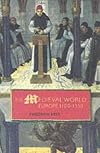
The Medieval World: Europe, 1100-1350
by Friedrich Heer
On This Page
Description
In 1100 Europe was open in boundaries, faith and outlook. By the middle of the fourteenth century it was 'closed'-by Mongol and Turkish invasions, by the rift with Byzantium, by the intolerant dogmatism of the Church. Friedrich Heer's tour de force of scholarship and originality recreates that world: the daily life of aristocrats and peasants, town-dwellers and countryfolk; the growth of serfdom and the flowering of chivalry; the roles of cleric and courtier, painter and poet, king and show more philosopher. In it we can see our own world in embryo. As Professor Heer writes: 'History is the present, the present is history'. show lessTags
Recommendations



























Member Reviews
My mind was formed with an appreciation of the relatively tidy Middle Ages available to the English speaker, the history of the island of Great Britain. This is a differing view of the larger questions that arise with an education arising from a Central European framework. It is an essential book to the previous generation of medievalists. Though there are some signs that this work was originally begun under the Nazi regime, the framework demonstrated here is a valuable item in creating a broader world view than the strictly British/North American focus.
2413 The Medieval World: Europe 1100-1350, by Friedrich Heer translated from the German by Janet Sondheimer (read 30 Sep 1991) This is a superlative book, though it has some disturbing things on medieval intolerance one doesn't often hear about. The first chapter drug some, but one can only stand in amazement at some of the chapters which display the author's sure command of his subject. The book is full of interesting things. I don't remember ever hearing of Ramon Lull before (1235-1315), who is a fascinating character and still has an article in today's Britannica. He was stoned to death in Tunis in 1315 at the age of 80. The book is full of fascinating insights.
Friedrich Heer was a professor of the History of Ideas at the University of Vienna and in this book he looks at western european medieval history from 1150 - 1350 (the Early Middle Ages).
He integrates a lot of information very successfully - the Angevins, Italian banking, the Hanseatic League, but over it all he shows that this was still a time of fluidity in religion and the formation of states. Catholicism fought with revivalist religions (Cathars etc.) and dynastic control ebbed and flowed over the whole region ( e.g. the conquest of England by the Dukes of Normandy or later Angevin rule including England and Provence). Extreme religious and nationalist intolerance came in the later Middle Ages.
It's complex and OTT in places but an show more interesting book written by a knowledgeable enthusiast. show less
He integrates a lot of information very successfully - the Angevins, Italian banking, the Hanseatic League, but over it all he shows that this was still a time of fluidity in religion and the formation of states. Catholicism fought with revivalist religions (Cathars etc.) and dynastic control ebbed and flowed over the whole region ( e.g. the conquest of England by the Dukes of Normandy or later Angevin rule including England and Provence). Extreme religious and nationalist intolerance came in the later Middle Ages.
It's complex and OTT in places but an show more interesting book written by a knowledgeable enthusiast. show less
香港大學歷史系
INDEX; BIBLIOGRAPHY
Ratings
Members
- Recently Added By
Lists

In Our Time books
4,934 works; 2 members
Author Information

Some Editions
Series
Belongs to Publisher Series
Common Knowledge
- Canonical title
- The Medieval World: Europe, 1100-1350
- Original title
- Mittelalter von 1100 bis 1350
- Original publication date
- 1961
- People/Characters
- Cid Campeador 'El Cid' (ref p.18)
- Important places
- Novgorod Cathedral (doors extant from 1059 ref pg 17)
- Original language
- German
Classifications
Statistics
- Members
- 690
- Popularity
- 41,609
- Reviews
- 5
- Rating
- (3.37)
- Languages
- 5 — Dutch, English, German, Italian, Swedish
- Media
- Paper
- ISBNs
- 15
- ASINs
- 25