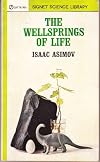
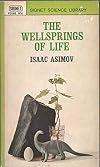
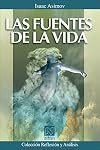
The Wellsprings of Life
by Isaac Asimov
On This Page
Description
El origen del hombre ha sido y es una fuente inagotable de inspiración para el arte, la ciencia, la sabiduría popular y la religión. Este volumen presenta una visión diferente sobre el misterio de la existencia del hombre. Ayuda al lector a distinguir las fronteras entre la realidad y la fantasía.Tags
Recommendations



















Member Reviews
Asimov is most famous as a science fiction author, with good reason as he contributed some of the classic works of the genre: Foundation, The Caves of Steel and others. However, Asimov was probably a better science writer than science fiction writer. His straightforward and simple style translates better to conveying useful information than it does to creating eloquent fictional prose.
The Wellsprings of Life is a basic guide to biology and evolution. There isn't really anything here that one would not learn in a well-run high school biology class, there wasn't anything I hadn't seen before and I never progressed beyond high school biology. There were details I didn't remember (after all, how many people who don't go on to work in some show more biology-related field remember the names of the various phases of cell division), but there wasn't anything that I could not pick up quickly. The book is, of course, limited to the state of the science as it existed in 1960, when it was written, so a couple of nuances are missing, but there is nothing incorrect in the material presented (since our understanding of basic biology has not changed significantly since then - more advanced stuff, sure, for example, since it had not been discovered yet, Asimov misses much about the genetic code, but that doesn't detract from the material he does cover).
Despite this, I found the book very interesting and informative. Not because it provided new information, but because it presented it in an easy to follow manner, and, more importantly to me, organized it and showed it in context. Where the book excels is where it links up the various discoveries and shows how they relate to one another - Asimov is at his best when discussing how Darwin, Mendel, and other giants of the history of biology relate to one another, and linking their disparate discoveries into an overall framework for the reader. Unlike many basic science courses where various elements are treated individually, Asimov tried to show how each discovery built upon the others, and also show where advances in the field were ignored or derided due to personal animosities or political turf wars between those in the field.
In an educational environment where foolishness like "Intelligent Design" is being touted as a valid alternative to be taught alongside actual science, there can never be enough clearly written, concise books that provide actual scientific knowledge in a succinct and easy to follow manner. This book does that, and for that, I recommend it highly.
This review has also been posted to my blog Dreaming About Other Worlds. show less
The Wellsprings of Life is a basic guide to biology and evolution. There isn't really anything here that one would not learn in a well-run high school biology class, there wasn't anything I hadn't seen before and I never progressed beyond high school biology. There were details I didn't remember (after all, how many people who don't go on to work in some show more biology-related field remember the names of the various phases of cell division), but there wasn't anything that I could not pick up quickly. The book is, of course, limited to the state of the science as it existed in 1960, when it was written, so a couple of nuances are missing, but there is nothing incorrect in the material presented (since our understanding of basic biology has not changed significantly since then - more advanced stuff, sure, for example, since it had not been discovered yet, Asimov misses much about the genetic code, but that doesn't detract from the material he does cover).
Despite this, I found the book very interesting and informative. Not because it provided new information, but because it presented it in an easy to follow manner, and, more importantly to me, organized it and showed it in context. Where the book excels is where it links up the various discoveries and shows how they relate to one another - Asimov is at his best when discussing how Darwin, Mendel, and other giants of the history of biology relate to one another, and linking their disparate discoveries into an overall framework for the reader. Unlike many basic science courses where various elements are treated individually, Asimov tried to show how each discovery built upon the others, and also show where advances in the field were ignored or derided due to personal animosities or political turf wars between those in the field.
In an educational environment where foolishness like "Intelligent Design" is being touted as a valid alternative to be taught alongside actual science, there can never be enough clearly written, concise books that provide actual scientific knowledge in a succinct and easy to follow manner. This book does that, and for that, I recommend it highly.
This review has also been posted to my blog Dreaming About Other Worlds. show less
Ratings
Members
- Recently Added By
Author Information

2,398+ Works 293,325 Members
Isaac Asimov was born in Petrovichi, Russia, on January 2, 1920. His family emigrated to the United States in 1923 and settled in Brooklyn, New York, where they owned and operated a candy store. Asimov became a naturalized U.S. citizen at the age of eight. As a youngster he discovered his talent for writing, producing his first original fiction at show more the age of eleven. He went on to become one of the world's most prolific writers, publishing nearly 500 books in his lifetime. Asimov was not only a writer; he also was a biochemist and an educator. He studied chemistry at Columbia University, earning a B.S., M.A. and Ph.D. In 1951, Asimov accepted a position as an instructor of biochemistry at Boston University's School of Medicine even though he had no practical experience in the field. His exceptional intelligence enabled him to master new systems rapidly, and he soon became a successful and distinguished professor at Columbia and even co-authored a biochemistry textbook within a few years. Asimov won numerous awards and honors for his books and stories, and he is considered to be a leading writer of the Golden Age of science fiction. While he did not invent science fiction, he helped to legitimize it by adding the narrative structure that had been missing from the traditional science fiction books of the period. He also introduced several innovative concepts, including the thematic concern for technological progress and its impact on humanity. Asimov is probably best known for his Foundation series, which includes Foundation, Foundation and Empire, and Second Foundation. In 1966, this trilogy won the Hugo award for best all-time science fiction series. In 1983, Asimov wrote an additional Foundation novel, Foundation's Edge, which won the Hugo for best novel of that year. Asimov also wrote a series of robot books that included I, Robot, and eventually he tied the two series together. He won three additional Hugos, including one awarded posthumously for the best non-fiction book of 1995, I. Asimov. "Nightfall" was chosen the best science fiction story of all time by the Science Fiction Writers of America. In 1979, Asimov wrote his autobiography, In Memory Yet Green. He continued writing until just a few years before his death from heart and kidney failure on April 6, 1992. (Bowker Author Biography) show less
Common Knowledge
- Original publication date
- 1961
- Dedication
- To Truman M. Talley, who is Madison Avenue at its best
- First words
- The question of the beginning of life almost forces itself on mankind.
- Last words
- (Click to show. Warning: May contain spoilers.)And from that all else would follow!
Classifications
Statistics
- Members
- 185
- Popularity
- 177,120
- Reviews
- 4
- Rating
- (3.60)
- Languages
- English, Spanish
- Media
- Paper
- ISBNs
- 8
- ASINs
- 9