May Your Life Be Deliciosa
by Michael Genhart
On This Page
Description
Each year on Christmas Eve, Rosie's abuela teaches her not only how to make a delicious tamale, but how to make a delicious life--one filled with love, plenty of spice, and family.Tags
Recommendations











Member Reviews
The aroma of steamy corn deliciousness wraps Abuela’s home in incredible warmth and anticipation.
Alongside mounds of masa, earthy roasted chiles, and seasoned meat, the entire family forms an assembly line of cooperation and laughter. Family stories are shared and passed down to the kids, along with Abuela’s own unique way of creating her tamales. Each step carries a special message of encouragement: “may you always be flexible”; “may you always stand tall and proud”; “may you have lots and lots of hugs.” The tamales are wrapped in their pliable husks stuffed with dreams, hope, and love—and meat and chiles. As they steam, the family waits with paciencia—patience. Music, singing, and storytelling reverberate within show more the walls of Abuela’s home. Finally, the tamales are done. The savory Christmas Eve gifts are unwrapped one by one, and Abuela proclaims as the tamales disappear, “May your life be delicious!” Genhart’s loving tribute to the women of his Mexican American family is heartfelt and sincere. His mother is revealed in the author’s note to be the nieta (granddaughter) of the story, and she continues the family legacy at the book’s end with a new tamalada: “You start with una hoja….” The semibilingual text carries Lora’s illustrations, as they convey organized chaos while flickering between the vibrant colors of Christmas present and gray-toned memories of the past.
The warmth of family love and support wafts enticingly through this homage to tradition. (illustrator’s note) (Picture book. 5-10)
-Kirkus Review show less
Alongside mounds of masa, earthy roasted chiles, and seasoned meat, the entire family forms an assembly line of cooperation and laughter. Family stories are shared and passed down to the kids, along with Abuela’s own unique way of creating her tamales. Each step carries a special message of encouragement: “may you always be flexible”; “may you always stand tall and proud”; “may you have lots and lots of hugs.” The tamales are wrapped in their pliable husks stuffed with dreams, hope, and love—and meat and chiles. As they steam, the family waits with paciencia—patience. Music, singing, and storytelling reverberate within show more the walls of Abuela’s home. Finally, the tamales are done. The savory Christmas Eve gifts are unwrapped one by one, and Abuela proclaims as the tamales disappear, “May your life be delicious!” Genhart’s loving tribute to the women of his Mexican American family is heartfelt and sincere. His mother is revealed in the author’s note to be the nieta (granddaughter) of the story, and she continues the family legacy at the book’s end with a new tamalada: “You start with una hoja….” The semibilingual text carries Lora’s illustrations, as they convey organized chaos while flickering between the vibrant colors of Christmas present and gray-toned memories of the past.
The warmth of family love and support wafts enticingly through this homage to tradition. (illustrator’s note) (Picture book. 5-10)
-Kirkus Review show less
A holiday tradition in many Latin American families, as well as in Texas and across the American Southwest, is the tamale making party. Tamales are generally made with cornmeal dough filled with a variety of savory ingredients like beans, cheese, pork, seasoned meats, or vegetables, and then wrapped and steamed in corn husks. (Each region in Latin America has variations on tamales.)
Tamales were valued by the ancient civilizations of the Aztecs, Mayans, and Incas: appreciated for their versatility, and offered to the gods to symbolize gratitude and abundance. They still play a central role in holidays and celebrations among Latin Americans. As a Houston Food Bank blog post on tamales notes:
“Tamales are more than just a meal—they’re show more an experience. Making tamales is often a family affair, where multiple generations come together to prepare and assemble them. This tradition, known as a ‘tamalada,’ is a time of bonding, storytelling, and passing down recipes. It’s not just about cooking; it’s about community.”
The author was inspired by his own childhood memories of helping the women in his family prepare tamales every Christmas Eve, as both an observer and a participant. He especially treasured the stories his Abuela told at that time, teaching Michael not only his family history, but about the importance of an oral history passed on through the generations.
He shares his memories through a little girl named Rosie, who narrates this heartwarming story.
Some of the words are in Spanish, but they are always translated or used in a way making their meaning obvious to readers. Rosie says:
“My favorite part is when Abuela tells us how to make a tamale.
We already know how. We do it every year.
It’s Abuela’s stories we love to hear again and again.”
As Rosie’s grandmother reviews how to make tamales, she uses each step to impart an analogous message about how to make a rewarding life. For example, Abuela explains that “You start with una hoja, a corn husk. The warm water has made it softer and easier to work with.” She adds, “Rosie, mi nieta [granddaughter], may you always be flexible.” As she fills and folds the tamale, she says to Rosie, “May you have lots and lots of hugs.” The tamales are placed in a large pot, one leaning upon the other. Abuela smiles and says, “May you always have the support of family and community.”
Most of the tamale making is on the left side of the double spread pages, while on the right the sentiment Abuela hopes for is shown in a cultural context.
When the tamales are finally ready to eat, Abuela sings “May your life be delicious!”
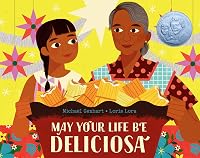
The vibrant and inviting illustrations by Loris Lora were inspired, she tells us in a note, “by the rich tamale-making traditions of my Mexican family and the many generations before us.” She recalls how “friends and family, both young and old, gathered to prepare tamales together.”
Discussion: This wonderful tradition is still celebrated in Tucson, where we lived for years, with many families sharing the fruits of their (very intensive) labors with others in the community. Southern Arizona residents observe other Mexican Christmas traditions as well, such as lighting luminaria (or farolitos), typically made from brown paper bags weighted down with sand and illuminated from within by a lit candle. All of these customs add greatly to the awareness of how our lives are enriched by the contributions of different cultures.
Evaluation: This positive view of immigrant families comes at a much needed time. The story reflects a strong family network of love and support and shows how life-long memories can be made from the bonding and storytelling that characterize family projects at holiday time. show less
Tamales were valued by the ancient civilizations of the Aztecs, Mayans, and Incas: appreciated for their versatility, and offered to the gods to symbolize gratitude and abundance. They still play a central role in holidays and celebrations among Latin Americans. As a Houston Food Bank blog post on tamales notes:
“Tamales are more than just a meal—they’re show more an experience. Making tamales is often a family affair, where multiple generations come together to prepare and assemble them. This tradition, known as a ‘tamalada,’ is a time of bonding, storytelling, and passing down recipes. It’s not just about cooking; it’s about community.”
The author was inspired by his own childhood memories of helping the women in his family prepare tamales every Christmas Eve, as both an observer and a participant. He especially treasured the stories his Abuela told at that time, teaching Michael not only his family history, but about the importance of an oral history passed on through the generations.
He shares his memories through a little girl named Rosie, who narrates this heartwarming story.
Some of the words are in Spanish, but they are always translated or used in a way making their meaning obvious to readers. Rosie says:
“My favorite part is when Abuela tells us how to make a tamale.
We already know how. We do it every year.
It’s Abuela’s stories we love to hear again and again.”
As Rosie’s grandmother reviews how to make tamales, she uses each step to impart an analogous message about how to make a rewarding life. For example, Abuela explains that “You start with una hoja, a corn husk. The warm water has made it softer and easier to work with.” She adds, “Rosie, mi nieta [granddaughter], may you always be flexible.” As she fills and folds the tamale, she says to Rosie, “May you have lots and lots of hugs.” The tamales are placed in a large pot, one leaning upon the other. Abuela smiles and says, “May you always have the support of family and community.”
Most of the tamale making is on the left side of the double spread pages, while on the right the sentiment Abuela hopes for is shown in a cultural context.
When the tamales are finally ready to eat, Abuela sings “May your life be delicious!”
The vibrant and inviting illustrations by Loris Lora were inspired, she tells us in a note, “by the rich tamale-making traditions of my Mexican family and the many generations before us.” She recalls how “friends and family, both young and old, gathered to prepare tamales together.”
Discussion: This wonderful tradition is still celebrated in Tucson, where we lived for years, with many families sharing the fruits of their (very intensive) labors with others in the community. Southern Arizona residents observe other Mexican Christmas traditions as well, such as lighting luminaria (or farolitos), typically made from brown paper bags weighted down with sand and illuminated from within by a lit candle. All of these customs add greatly to the awareness of how our lives are enriched by the contributions of different cultures.
Evaluation: This positive view of immigrant families comes at a much needed time. The story reflects a strong family network of love and support and shows how life-long memories can be made from the bonding and storytelling that characterize family projects at holiday time. show less
This was a sweet book about how family bonds and tradition can remain firm throughout generations and that those things keep people together. This book takes us through Abuela's past as she explains how to make the Tamales.
This is a brightly illustrated narrative of a family making tamales together on Christmas Eve. It shows the abuela teaching the grandchildren every step of making the tamale. I can see this being a good read aloud with K-2nd to talk about writing recipients or telling family stories. Celebrates family, tradition, and Hispanic heritage.
This would be good for grades 2-5.
Beautiful illustrations with some Spanish words integrated in them. This is a story about a granddaughter cooking tamales with her family. Her abuela teaches her the steps of making them and connects them to wishes for her daughter’s futures.
This would be good in a lesson about culture and foods of other cultures.
Beautiful illustrations with some Spanish words integrated in them. This is a story about a granddaughter cooking tamales with her family. Her abuela teaches her the steps of making them and connects them to wishes for her daughter’s futures.
This would be good in a lesson about culture and foods of other cultures.
This book goes through the steps of how to make tamales. The book has a sweet message as the family spends time together that the food is made with love and care. Students in a classroom could benefit from learning about a good from a different culture.
The aroma of steamy corn deliciousness wraps Abuela’s home in incredible warmth and anticipation.
Alongside mounds of masa, earthy roasted chiles, and seasoned meat, the entire family forms an assembly line of cooperation and laughter. Family stories are shared and passed down to the kids, along with Abuela’s own unique way of creating her tamales. Each step carries a special message of encouragement: “may you always be flexible”; “may you always stand tall and proud”; “may you have lots and lots of hugs.” The tamales are wrapped in their pliable husks stuffed with dreams, hope, and love—and meat and chiles. As they steam, the family waits with paciencia—patience. Music, singing, and storytelling reverberate within show more the walls of Abuela’s home. Finally, the tamales are done. The savory Christmas Eve gifts are unwrapped one by one, and Abuela proclaims as the tamales disappear, “May your life be delicious!” Genhart’s loving tribute to the women of his Mexican American family is heartfelt and sincere. His mother is revealed in the author’s note to be the nieta (granddaughter) of the story, and she continues the family legacy at the book’s end with a new tamalada: “You start with una hoja….” The semibilingual text carries Lora’s illustrations, as they convey organized chaos while flickering between the vibrant colors of Christmas present and gray-toned memories of the past.
The warmth of family love and support wafts enticingly through this homage to tradition. (illustrator’s note) (Picture book. 5-10)
-Kirkus Review show less
Alongside mounds of masa, earthy roasted chiles, and seasoned meat, the entire family forms an assembly line of cooperation and laughter. Family stories are shared and passed down to the kids, along with Abuela’s own unique way of creating her tamales. Each step carries a special message of encouragement: “may you always be flexible”; “may you always stand tall and proud”; “may you have lots and lots of hugs.” The tamales are wrapped in their pliable husks stuffed with dreams, hope, and love—and meat and chiles. As they steam, the family waits with paciencia—patience. Music, singing, and storytelling reverberate within show more the walls of Abuela’s home. Finally, the tamales are done. The savory Christmas Eve gifts are unwrapped one by one, and Abuela proclaims as the tamales disappear, “May your life be delicious!” Genhart’s loving tribute to the women of his Mexican American family is heartfelt and sincere. His mother is revealed in the author’s note to be the nieta (granddaughter) of the story, and she continues the family legacy at the book’s end with a new tamalada: “You start with una hoja….” The semibilingual text carries Lora’s illustrations, as they convey organized chaos while flickering between the vibrant colors of Christmas present and gray-toned memories of the past.
The warmth of family love and support wafts enticingly through this homage to tradition. (illustrator’s note) (Picture book. 5-10)
-Kirkus Review show less
Members
- Recently Added By
Lists

Youth: DEI
296 works; 2 members

Children's Picture Books
188 works; 1 member

Youth: Seasonal
55 works; 1 member
Author Information

13 Works 606 Members
Awards and Honors
Classifications
Statistics
- Members
- 93
- Popularity
- 345,804
- Reviews
- 7
- Rating
- (4.47)
- Languages
- English, Spanish
- Media
- Paper, Ebook
- ISBNs
- 3
- ASINs
- 1