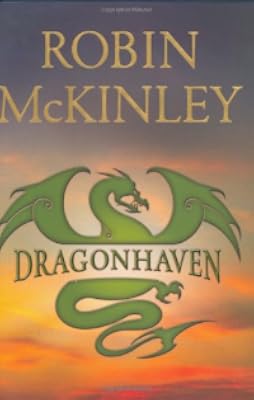
Dragonhaven
by Robin McKinley
On This Page
Description
When Jake Mendoza, who lives in the Smokehill National Park where his father runs the Makepeace Institute of Integrated Dragon Studies, goes on his first solo overnight in the park, he finds an infant dragon whose mother has been killed by a poacher.Tags
Recommendations




Member Recommendations

Member Reviews
What is it that Robin McKinley has that other fantasy writers don't? I can't quite put my finger on it, but I think it has to do with the fact that her characters are so REAL and she puts the reader straight inside the characters' heads. And then there's her uncanny ability to set a scene so totally that even your sense of smell gets a workout (especially in this book). Maybe the fairy of language presided over her birth and from then on she just had it.
Whatever the cause, "Dragonhaven" measures up to the best of her work, and also is a change of pace in that it features a male protagonist. I so enjoy her take on modern American society, in which this book and her previous, "Sunshine," take place. (with, of course, a fantasy twist to show more mix things up)
Here, she explores the idea of "What if dragons truly existed and we'd nearly caused their extinction, until they were limited to a few wildlife preserves?" and then creates a whole scientific background for this premise. The story is told from the point of view of a kid who was born at the research institute within the preserve. His whole life is centered around these creatures, and becomes even MORE so as the story unfolds, due to events that I won't spoil for you. "Dragonhaven" is a startlingly emotional, stirring account of what happens when a young person is thrust into strange responsibility, and a gripping narrative of ethical/environmental themes. show less
Whatever the cause, "Dragonhaven" measures up to the best of her work, and also is a change of pace in that it features a male protagonist. I so enjoy her take on modern American society, in which this book and her previous, "Sunshine," take place. (with, of course, a fantasy twist to show more mix things up)
Here, she explores the idea of "What if dragons truly existed and we'd nearly caused their extinction, until they were limited to a few wildlife preserves?" and then creates a whole scientific background for this premise. The story is told from the point of view of a kid who was born at the research institute within the preserve. His whole life is centered around these creatures, and becomes even MORE so as the story unfolds, due to events that I won't spoil for you. "Dragonhaven" is a startlingly emotional, stirring account of what happens when a young person is thrust into strange responsibility, and a gripping narrative of ethical/environmental themes. show less
{Stand-alone. Urban fantasy} (2007)
I'm still hoping that we'll see more books in McKinley's Damar series and although I've picked up some of her other books for my shelves, I admit I've been a bit tentative about reading them. But it's been a while since I've re-read a Damar book so I thought I'd give Dragonhaven a go.
This is set on an alternative Earth in a similar timeline to ours so, while dragons (and griffins and Loch Ness monsters and so on) exist, so do computers and the internet. The premise is that dragons were discovered in Australia about two hundred and fifty years ago (Cook landed in Botany Bay in 1770, for reference) and some were taken over to zoos in America and eventually Smokehill National Park was established for them show more to live in, about ninety years before the story starts, where they then kept very much to themselves. They are an endangered species and many groups want the land for development or mining or want the dragons destroyed or to poach them for the 'medicinal' value of their organs or are worried that dragons might fly out and so there is a protective fence around the park which has the side effect of nullifying a lot of modern technology inside its boundaries. The story is narrated by eighteen year old Jake Mendoza who is writing a book about events that started five years previously (and the epilogue is written five years after that although the narrative style doesn’t change).
Fourteen year old Jake was the son of the Director of the Institute at Smokehill which studied dragons (he's very insistent that Draco australiensis is the only true dragon) and had recently lost his mother. While on his first solo hiking trip in the park, he discovered a mother dragon who had been killed with only one just-born baby dragon surviving. Being used to animals at the small zoo and orphanage at the Institute, Jake rescued the baby and took her home to raise. But, of course, no one knew anything about dragons, much less baby dragons; Lois (as he named her) had imprinted on him and wouldn't let anyone else carry her; and because of the laws surrounding dragons, nobody else could know about her so she had to be raised in secret from the rest of the world; and she could start breathing fire at any moment.
This is the story of Jake raising Lois; the overwhelming responsibility for a fourteen year old subsumed in rescuing a wild creature that no one knew much about and then the adventure that followed when she grew older and he needed to find dragons to reintroduce her to her species.
The writing style takes a while to get used to; it's very chatty (hah - imagine my seventeen year old son being chatty; but then again, you can't stop my twelve year old son talking) to the extent it's like my sister and I talking to each other, with lots of asides (in fact, we sometimes have to ask the other person to get to the point) and it took the first fifty or so pages (a chapter and a half out of eleven) before anything happened (Jake discovering the mother and baby dragons) and the story finally took off. It took me a bit longer than that to really get used to the chatty style, though (please see preceding sentence).
The story is information dense along the way (although it’s possible - and occasionally obvious - that some information is exaggerated by the ‘teenaged’ narrator); though my book came to 338 pages I feel that the print was smaller than usual so it took longer than I had anticipated to finish this book but I did like the story. For [[Lewis Carrol]] fans, there are a few Alice in Wonderland and Jabberwock references scattered about and are the origin of Lois's name.
The premise and the putative science behind it (a lot of which is worked out as the story develops, since this is the first baby dragon to be raised - or even seen - by humans) work. It's similar to learning to raise pandas: I recently caught part of a documentary observing baby pandas in the wild demonstrating behaviours that people hadn't realised are normal - like climbing high into a tree and staying there for a week while mama panda went foraging. They discovered that the black and white colouring is surprisingly effective against the light sky when the baby is sitting high in the branches of a tree bare of leaves. So now they're going to incorporate that into the way they raise captive pandas.
Well worth sticking with this book.
April 2021
4 stars show less
I'm still hoping that we'll see more books in McKinley's Damar series and although I've picked up some of her other books for my shelves, I admit I've been a bit tentative about reading them. But it's been a while since I've re-read a Damar book so I thought I'd give Dragonhaven a go.
This is set on an alternative Earth in a similar timeline to ours so, while dragons (and griffins and Loch Ness monsters and so on) exist, so do computers and the internet. The premise is that dragons were discovered in Australia about two hundred and fifty years ago (Cook landed in Botany Bay in 1770, for reference) and some were taken over to zoos in America and eventually Smokehill National Park was established for them show more to live in, about ninety years before the story starts, where they then kept very much to themselves. They are an endangered species and many groups want the land for development or mining or want the dragons destroyed or to poach them for the 'medicinal' value of their organs or are worried that dragons might fly out and so there is a protective fence around the park which has the side effect of nullifying a lot of modern technology inside its boundaries. The story is narrated by eighteen year old Jake Mendoza who is writing a book about events that started five years previously (and the epilogue is written five years after that although the narrative style doesn’t change).
Fourteen year old Jake was the son of the Director of the Institute at Smokehill which studied dragons (he's very insistent that Draco australiensis is the only true dragon) and had recently lost his mother. While on his first solo hiking trip in the park, he discovered a mother dragon who had been killed with only one just-born baby dragon surviving. Being used to animals at the small zoo and orphanage at the Institute, Jake rescued the baby and took her home to raise. But, of course, no one knew anything about dragons, much less baby dragons; Lois (as he named her) had imprinted on him and wouldn't let anyone else carry her; and because of the laws surrounding dragons, nobody else could know about her so she had to be raised in secret from the rest of the world; and she could start breathing fire at any moment.
I was sure Lois would be brokenhearted if she woke up one morning and discovered she'd fried me in her sleep ... but what if she did?
This is the story of Jake raising Lois; the overwhelming responsibility for a fourteen year old subsumed in rescuing a wild creature that no one knew much about and then the adventure that followed when she grew older and he needed to find dragons to reintroduce her to her species.
The writing style takes a while to get used to; it's very chatty (hah - imagine my seventeen year old son being chatty; but then again, you can't stop my twelve year old son talking) to the extent it's like my sister and I talking to each other, with lots of asides (in fact, we sometimes have to ask the other person to get to the point) and it took the first fifty or so pages (a chapter and a half out of eleven) before anything happened (Jake discovering the mother and baby dragons) and the story finally took off. It took me a bit longer than that to really get used to the chatty style, though (please see preceding sentence).
You don't go near a dying dragon. They can fry you after they're dead. The reflex that makes chickens run around after their heads are cut off makes dragons cough fire. Quite a few people have died this way, including one zoo-keeper. I suppose I wasn't thinking about that. I was thinking about the fact that she was dying, and that her babies were going to die because they had no mother, and that she'd know that. I boomeranged into thinking about my own mother again. They wanted to tell us, when they found her, that she must have died instantly. Seems to me, if she really did fall down that cliff, she'd've had time to think about it that Dad and I were going to be really miserable without her.
How do I know what a mother dragon thinks or doesn't think? But it was just so sad. I couldn't bear it. I went up to her. Went up to her head, which was likely nearly as big as a Ranger's cabin. She watched me coming. She watched me. I had to walk up most of the length of her body, so I had to walk past her babies, these little blobs that were baby dragons. They were born and everything. But they were already dead. So she was dying knowing her babies were already dead. I started to cry and I didn't even know it.
The story is information dense along the way (although it’s possible - and occasionally obvious - that some information is exaggerated by the ‘teenaged’ narrator); though my book came to 338 pages I feel that the print was smaller than usual so it took longer than I had anticipated to finish this book but I did like the story. For [[Lewis Carrol]] fans, there are a few Alice in Wonderland and Jabberwock references scattered about and are the origin of Lois's name.
The premise and the putative science behind it (a lot of which is worked out as the story develops, since this is the first baby dragon to be raised - or even seen - by humans) work. It's similar to learning to raise pandas: I recently caught part of a documentary observing baby pandas in the wild demonstrating behaviours that people hadn't realised are normal - like climbing high into a tree and staying there for a week while mama panda went foraging. They discovered that the black and white colouring is surprisingly effective against the light sky when the baby is sitting high in the branches of a tree bare of leaves. So now they're going to incorporate that into the way they raise captive pandas.
Well worth sticking with this book.
April 2021
4 stars show less
This is not another cutesy story about telepathic dragons. This story is about how anybody ever succeeds in communicating. McKinley is remarkabley convincing in her teenage protagonist and his first person story.
The concentration on the theme of communications is what makes this different and intriguing. The narrator's constant attempts to find ways to tell us, the readers, the story are echoed in his attempts to reach the dragons. It is rare to find such a clear portrayal of the difficulties of presentation and interpretation of information and ideas between truely different parties.
Language shapes how (and what) people can think. Concepts exist in some languages that are unthinkable in others. Languages reflect what is important to show more their native speakers. That is what we refer to in the old example of all of the various words for snow and its different conditions in the Eskimo tongue. Anyone who has attempted to do translations from one language to another is familiar with the problem.
How we might communicate with an alien species must be, at heart, a speculation on what they would find important and worthy of description and of contemplation. I find it quite believable that the dragons of Shadowhill would think so differently from us that interpretation or translation would be virtually impossible. McKinley makes it clear to us how inadequate our language is in this process. She shows us how perhaps the only way such a communications chasm might be overcome is by having infants and children reared 'bilingually'.
McKinley's prose has, in past, been impressive. Clear, evocative, moving, frequently poetic. The fact that this book is written the way it is reflects her expression of the inadequacy of language in the story the narrator has to tell. This point could never have been made so persuaively in easy flowing narration. As readers, we are forced to recognize the difficulty a teenager, a misfit (and what teenager has not felt like one), and a human being has at trying to convey what, in essence, is a first contact with an alien culture.
Every character in the book is shown in terms of their deficiencies in their abilities to communicate. From the Native American who won't speak English to the grief stricken father. Shadowhill can't communicate with the outside world any better than the outside world's media can reach the public.
What better a subject for a young adult novel? show less
The concentration on the theme of communications is what makes this different and intriguing. The narrator's constant attempts to find ways to tell us, the readers, the story are echoed in his attempts to reach the dragons. It is rare to find such a clear portrayal of the difficulties of presentation and interpretation of information and ideas between truely different parties.
Language shapes how (and what) people can think. Concepts exist in some languages that are unthinkable in others. Languages reflect what is important to show more their native speakers. That is what we refer to in the old example of all of the various words for snow and its different conditions in the Eskimo tongue. Anyone who has attempted to do translations from one language to another is familiar with the problem.
How we might communicate with an alien species must be, at heart, a speculation on what they would find important and worthy of description and of contemplation. I find it quite believable that the dragons of Shadowhill would think so differently from us that interpretation or translation would be virtually impossible. McKinley makes it clear to us how inadequate our language is in this process. She shows us how perhaps the only way such a communications chasm might be overcome is by having infants and children reared 'bilingually'.
McKinley's prose has, in past, been impressive. Clear, evocative, moving, frequently poetic. The fact that this book is written the way it is reflects her expression of the inadequacy of language in the story the narrator has to tell. This point could never have been made so persuaively in easy flowing narration. As readers, we are forced to recognize the difficulty a teenager, a misfit (and what teenager has not felt like one), and a human being has at trying to convey what, in essence, is a first contact with an alien culture.
Every character in the book is shown in terms of their deficiencies in their abilities to communicate. From the Native American who won't speak English to the grief stricken father. Shadowhill can't communicate with the outside world any better than the outside world's media can reach the public.
What better a subject for a young adult novel? show less
I like the ideas in this book: the concept of dragons, the way humans might respond to them if they existed as animals in our own world. And I can admire McKinley's ability to create a convincing written-by-a-teenage-boy record of that teenage boy's experiences. But what makes the voice convincing is also what makes the book so difficult to read. The teenage boy's story meanders and curls around favorite topics, hitches and snarls in half-thought reactions to events, and in attempting to express the how-do-I-write-this-amazing-thing, takes too bloody long to get to the interesting bits. Though Dragonhaven is written by one of my favorite storytellers, it reads uncomfortably like the teenage-written memoir it's pretending to be. If I'd show more listened to an audiobook version, I think the narrative flow would've been clearer and easier to follow, but with all the tangents---and a frustrating lack of punctuation---I had to struggle sometimes just to understand what was going on. show less
Lots of echoes of Diana Wynne Jones' 'Dragon Reserve, Home Eight' - or at least, what I remember of it. Now I need to go look that one up and see if they really relate at all. Dragonhaven is a lot richer and more filled-in, anyway - McKinley took Dragon Reserve and ran with it. Very interesting voice in the story - the fact that he's writing it afterward and reluctantly...I'd like to come back to that world in about 100 years and see what's happened.
Reread - but I didn't remember ever reading it before. It's a great story of culture clash - two human cultures (inside and outside the park) and the dragons. Lots of neat questions raised, very few answers - I'd (still) love to read a story set about a hundred years later. It is a somewhat show more odd voice - not only that he's writing it well after the fact, but that during the events he was pretty well out of it one way or another the whole time. Scientist parents do help with instinctive note-taking, though. Lots of very interesting people, human and otherwise. Darn, I thought I'd found a new McKinley...ah well, it was almost as good as new. show less
Reread - but I didn't remember ever reading it before. It's a great story of culture clash - two human cultures (inside and outside the park) and the dragons. Lots of neat questions raised, very few answers - I'd (still) love to read a story set about a hundred years later. It is a somewhat show more odd voice - not only that he's writing it well after the fact, but that during the events he was pretty well out of it one way or another the whole time. Scientist parents do help with instinctive note-taking, though. Lots of very interesting people, human and otherwise. Darn, I thought I'd found a new McKinley...ah well, it was almost as good as new. show less
This is a very well-written book - it's Robin McKinley, so it couldn't be otherwise - but it's very different from McKinley's usual offerings. It's set in present-day America, for one thing, not in a remote time or place. It is an alternate reality, though, because the narrator, a young man named Jake, lives on the dragon preserve of Smokehill. In this world, dragons are an endangered species, and the people of Smokehill (a five-million-acre park in Wyoming) are trying to preserve and study them. Initially, Jake simply grumbles about the ignorance of tourists and the inadequacy of government funding. He also admits that hardly anyone ever sees a real dragon, and even then only from a distance. That all changes one day, though, when Jake show more takes a solo walk in the woods and discovers a dead human and a dying dragon who has just given birth. One of the baby dragons is still alive, and Jake unthinkingly rescues it. The rest of the book shows Jake's relationship with the dragonlet, and how that brings him into the world of dragons itself, and how the Smokehill Institute and the wider world respond to the "dragon issue." Not a lot happens in this book, which made it very slow-moving. Jake's voice was entertaining, though, and the descriptions of dragons are very McKinley-esque. I'm glad I read it, but it's definitely not my favorite by this author. show less
About a page and a half into Dragonhaven, I put the book down and thought to myself, "She can't really keep up this annoying first person narration the whole book, can she?" When I think of Robin McKinley, I think of measured, deeply beautiful, polished prose - with a kind of intense, crystalline quality that has always lent itself well to the fairy-tale aspect of her stories. But Dragonhaven is written in the slangy, talky patter of its contemporary teenage narrator, Jake Mendoza. And she really does keep it up the whole way through.
I did eventually grow to like it (McKinley is a wonderful writer, after all, even if this isn't her usual style), but the depth and beauty of the story seems to peek through the clutter of language, rather show more than channel directly to the reader through the written word. Jake narrates like somebody who is talking a mile a minute and can't stop to catch his breath, let alone go back through to edit and clarify.
The story falls into the popular urban fantasy genre - a recognizable world of today that is subtly skewed by the addition of some fantastical element, in this case the existence of dragons. Jake lives on the only dragon preserve in America, at an institute in the park dedicated to the study of dragons. One day, seemingly by chance, he finds a dragon dying in the woods - a mother dragon killed by a poacher just as she was giving birth. All but one of her baby dragons are dead, as is the man who killed her. Jake, still trying to cope with the loss of his own mother, looks into the dragon's eye as she is dying and is so moved by what he sees there that he decides to do what he can to save the last of the dragon's litter.
The rest of the book is about raising a baby dragon. It's about the bureaucratic mess caused at the park by the death of the poacher, and the practical and philosophical consequences of Jake's determination to save the baby dragon. It's the kind of story that would be impossibly dull if it weren't so magical, and in this case the breathless pace of the narration counterbalances the steady, grim menace of the government and the long, slow struggle to keep the baby dragon alive. It always feels like a lot is happening, like events are just galloping by, even though there's no real action to speak of.
Things definitely get strange when it comes time for the baby dragon to meet her own kind, but that part of the story is too much fun to spoil.
I really enjoyed Dragonhaven, but it didn't move me the way that some of McKinley's other books have (The Blue Sword, Beauty, Sunshine). I'd give it three and a half stars if I could, and I'm rounding up out of a sense of loyalty. show less
I did eventually grow to like it (McKinley is a wonderful writer, after all, even if this isn't her usual style), but the depth and beauty of the story seems to peek through the clutter of language, rather show more than channel directly to the reader through the written word. Jake narrates like somebody who is talking a mile a minute and can't stop to catch his breath, let alone go back through to edit and clarify.
The story falls into the popular urban fantasy genre - a recognizable world of today that is subtly skewed by the addition of some fantastical element, in this case the existence of dragons. Jake lives on the only dragon preserve in America, at an institute in the park dedicated to the study of dragons. One day, seemingly by chance, he finds a dragon dying in the woods - a mother dragon killed by a poacher just as she was giving birth. All but one of her baby dragons are dead, as is the man who killed her. Jake, still trying to cope with the loss of his own mother, looks into the dragon's eye as she is dying and is so moved by what he sees there that he decides to do what he can to save the last of the dragon's litter.
The rest of the book is about raising a baby dragon. It's about the bureaucratic mess caused at the park by the death of the poacher, and the practical and philosophical consequences of Jake's determination to save the baby dragon. It's the kind of story that would be impossibly dull if it weren't so magical, and in this case the breathless pace of the narration counterbalances the steady, grim menace of the government and the long, slow struggle to keep the baby dragon alive. It always feels like a lot is happening, like events are just galloping by, even though there's no real action to speak of.
Things definitely get strange when it comes time for the baby dragon to meet her own kind, but that part of the story is too much fun to spoil.
I really enjoyed Dragonhaven, but it didn't move me the way that some of McKinley's other books have (The Blue Sword, Beauty, Sunshine). I'd give it three and a half stars if I could, and I'm rounding up out of a sense of loyalty. show less
Members
- Recently Added By
Lists

Best Fantasy Novels
821 works; 361 members

Best Young Adult
399 works; 101 members

Best Urban Fantasy
632 works; 78 members

Here There Be Dragons
143 works; 23 members
Speculative Fiction to Read
706 works; 31 members

Fantastical/Mythological Creatures in the Title
37 works; 2 members

Books Read in 2017
4,249 works; 130 members

Newbery Adjacent
747 works; 3 members

Summer Reading
30 works; 1 member
Author Information

42+ Works 50,667 Members
Some Editions
Common Knowledge
- Original publication date
- 2007
- People/Characters
- Jake Mendoza; Lois the dragon; Martha
- Important places
- Smokehill National Park
- Dedication
- To Holly, Hazel, and Rowan
- First words
- I keep having these conversations with Dad. I'm at my computer. He says, "What are you doing?" I mutter something, because the screen has a lot of squiggles on it, so he already knows what I'm doing.
- Quotations
- The usual sorts of field surveys just don't work with dragons. Uh-huh, you say, thirty to eighty feet long (plus tail), flies, breathes fire, and you can't find them to count? Yup. That's right. You can't. After Old ... (show all)Pete opened the cages, they didn't just wander off, they disappeared. That's one of the reasons that a few people - Old Pete included - started wondering if dragons were, you know, intelligent.
Well, the mainstream scientists weren't having any of that, of course, humans are humans and animals are animals and anyone who says it's not that simple is a sentimental fool and a Bad Scientist. There is nothing you can say to a scientist that's worse than accusing them of being a Bad Scientist. They'd rather be arrested for bank robbery than for sentimentality. - Last words
- (Click to show. Warning: May contain spoilers.)Us humans have sure messed up a lot of stuff but we haven't quite finished the job so maybe we can still unmess it a little. Maybe with some help from dragons. And Eleanor as president. Maybe in time for our babies to grow up into a slightly less comprehensively messed-up world. And, forgive my Latin, I can't help myself, but I hope I've got the subjunctive right:
Madeline Sophia Mendoza
born 11 April, 4:25 A.M.
at Dragon Central
seven pounds six ounces
Donato Francis Mendoza
born 6 May, 5:10 P.M.
at Dragon Central
eight pounds nine ounces
Arcadiae vias peregrinentur - Original language
- English
Classifications
Statistics
- Members
- 1,404
- Popularity
- 16,861
- Reviews
- 56
- Rating
- (3.51)
- Languages
- English, French
- Media
- Paper, Audiobook, Ebook
- ISBNs
- 21
- ASINs
- 11