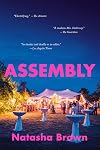
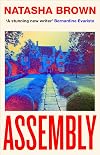
Assembly
by Natasha Brown
On This Page
Description
"The narrator of Assembly is a black British woman. She is preparing to attend a lavish garden party at her boyfriend's family estate, set deep in the English countryside. At the same time, she is considering the carefully assembled pieces of herself. As the minutes tick down and the future beckons, she can't escape the question: is it time to take it all apart? Assembly is a story about the stories we live within--those of race and class, safety and freedom, winners and losers. And it is show more about one woman daring to take control of her own story, even at the cost of her life"-- show lessTags
Recommendations



























Member Recommendations

Member Reviews
An unnamed Black British woman navigates her personal life and job dealing with everyday microaggressions and how she presents herself to the world.
The narrative is sparse in this novella, which takes place in a day or two leading up to a garden party given by the woman's boyfriend's parents. Only a few characters are named - the boyfriend's parents insist our character call them by their first names. And then there is Lou, a rather mediocre white man who says he is "sharing" the promotion with our main character, who has it because the bank they work for needed to showcase more diversity. Meanwhile, the woman is also deciding what treatment, if any, to get for a recent cancer diagnosis. It's a powerful examination of how constant show more racism and sexism can pick apart one's sense of self. Natasha Brown doesn't give the reader any easy answers, or even full closure, just a lot of questions about how the world works and why those in power keep it this way. show less
The narrative is sparse in this novella, which takes place in a day or two leading up to a garden party given by the woman's boyfriend's parents. Only a few characters are named - the boyfriend's parents insist our character call them by their first names. And then there is Lou, a rather mediocre white man who says he is "sharing" the promotion with our main character, who has it because the bank they work for needed to showcase more diversity. Meanwhile, the woman is also deciding what treatment, if any, to get for a recent cancer diagnosis. It's a powerful examination of how constant show more racism and sexism can pick apart one's sense of self. Natasha Brown doesn't give the reader any easy answers, or even full closure, just a lot of questions about how the world works and why those in power keep it this way. show less
I do not pick up many novellas, but this is one of the best I have read. It is a powerful story about racism in the UK, as told by an unnamed black female protagonist. She and her unnamed white boyfriend plan to attend a garden party at his parents’ estate in the English countryside.
As the title implies, this book is made up of vignettes that, when assembled, portray the challenges she faces on a daily basis. Some show her at work, being criticized for having it easier than her white colleagues. Others describe visits to her doctor, and their disagreements over her treatment. She gives motivational presentations to college students, encouraging them to work their way to success, but internally, she questions whether she is giving them show more good advice.
The writing is stellar. It gives the reader a sense of what the protagonist’s life is like and it inspires empathy. It is cultural critique containing microaggressions, sexual harassment, and casual racism. It is creative, fresh, and relevant. Highly recommended.
A couple of my favorite passages:
“I will be watched, that’s the price of admission. They’ll want to see my reactions to their abundance: polite restraint, concealed outrage, and a base, desirous hunger beneath. I must play this part with a veneer of new-millennial-money coolness; serving up savage witticisms alongside the hors d’oeuvres…. My thoughts, my ideas – even my identity – can only exist as a response to the partygoers’ words and actions. Articulated along the perimeter of their form. Reinforcing both their self-hood, and its centrality to mine. How else can they be certain of who they are, and what they aren’t? Delineation requires a sharp, black outline."
“Always, the pressure is there. Assimilate, assimilate… Dissolve yourself into the melting pot. And then flow out, pour into the mould. Bend your bones until they splinter and crack and you fit. Force yourself into their form. Assimilate, they say it, encouraging. Then frowning. Then again and again. And always there, quiet, beneath the urging language of tolerance and cohesion – disappear!” show less
As the title implies, this book is made up of vignettes that, when assembled, portray the challenges she faces on a daily basis. Some show her at work, being criticized for having it easier than her white colleagues. Others describe visits to her doctor, and their disagreements over her treatment. She gives motivational presentations to college students, encouraging them to work their way to success, but internally, she questions whether she is giving them show more good advice.
The writing is stellar. It gives the reader a sense of what the protagonist’s life is like and it inspires empathy. It is cultural critique containing microaggressions, sexual harassment, and casual racism. It is creative, fresh, and relevant. Highly recommended.
A couple of my favorite passages:
“I will be watched, that’s the price of admission. They’ll want to see my reactions to their abundance: polite restraint, concealed outrage, and a base, desirous hunger beneath. I must play this part with a veneer of new-millennial-money coolness; serving up savage witticisms alongside the hors d’oeuvres…. My thoughts, my ideas – even my identity – can only exist as a response to the partygoers’ words and actions. Articulated along the perimeter of their form. Reinforcing both their self-hood, and its centrality to mine. How else can they be certain of who they are, and what they aren’t? Delineation requires a sharp, black outline."
“Always, the pressure is there. Assimilate, assimilate… Dissolve yourself into the melting pot. And then flow out, pour into the mould. Bend your bones until they splinter and crack and you fit. Force yourself into their form. Assimilate, they say it, encouraging. Then frowning. Then again and again. And always there, quiet, beneath the urging language of tolerance and cohesion – disappear!” show less
112 pages. I read it in one sitting. Not because this was an easy read, or a plot-driven page turner. But it demanded my attention and I had to read it without an interlude, could not step away from the internal world of the narrator as she travels into the dark night of her soul.
Natasha Brown’s Assembly is startling, original, and unsettling.
A young woman has arrived. She has a high power job, a posh life, a boyfriend with a rich heritage. But, cost is too much to bear. She is exhausted.
It’s how the men at work treat her, how strangers come on to her. It’s how she must be in constant control to project the right image. It’s how she is a made an example of success.
Be the best. Work harder, work smarter. Exceed every expectation. show more But also, be invisible, imperceptible. Don’t make anyone uncomfortable. from Assembly by Natasha Brown
She is a black woman in Britain. And that makes all the difference. A person of color from a previously colonized country. Her very color is a stigma. Her very success makes her a target for white jealously and hate.
She struggles with a life or death question, keeping the news secret from her boyfriend who takes her to his ancestral home and imagines a life together.
Why endure my own dehumanization? from Assembly by Natasha Brown
As an American, I had not realized how in 2021 British view people from the countries they once dominated and plundered, that ‘keep Britain white’ and ‘go home’ were chants of hate.
Confronted by the truth of one woman’s life, we reevaluate our own story, our own culture, and our own participation in systemic racism.
Readers of the best literary fiction will love this novel.
I received a free egalley from the publisher through NetGalley. My review is fair and unbiased. show less
Natasha Brown’s Assembly is startling, original, and unsettling.
A young woman has arrived. She has a high power job, a posh life, a boyfriend with a rich heritage. But, cost is too much to bear. She is exhausted.
It’s how the men at work treat her, how strangers come on to her. It’s how she must be in constant control to project the right image. It’s how she is a made an example of success.
Be the best. Work harder, work smarter. Exceed every expectation. show more But also, be invisible, imperceptible. Don’t make anyone uncomfortable. from Assembly by Natasha Brown
She is a black woman in Britain. And that makes all the difference. A person of color from a previously colonized country. Her very color is a stigma. Her very success makes her a target for white jealously and hate.
She struggles with a life or death question, keeping the news secret from her boyfriend who takes her to his ancestral home and imagines a life together.
Why endure my own dehumanization? from Assembly by Natasha Brown
As an American, I had not realized how in 2021 British view people from the countries they once dominated and plundered, that ‘keep Britain white’ and ‘go home’ were chants of hate.
Confronted by the truth of one woman’s life, we reevaluate our own story, our own culture, and our own participation in systemic racism.
Readers of the best literary fiction will love this novel.
I received a free egalley from the publisher through NetGalley. My review is fair and unbiased. show less
I do not pick up many novellas, but this is one of the best I have read. It is a powerful story about racism in the UK, as told by an unnamed black female protagonist. She and her unnamed white boyfriend plan to attend a garden party at his parents’ estate in the English countryside.
As the title implies, this book is made up of vignettes that, when assembled, portray the challenges she faces on a daily basis. Some show her at work, being criticized for having it easier than her white colleagues. Others describe visits to her doctor, and their disagreements over her treatment. She gives motivational presentations to college students, encouraging them to work their way to success, but internally, she questions whether she is giving them show more good advice.
The writing is stellar. It gives the reader a sense of what the protagonist’s life is like and it inspires empathy. It is cultural critique containing microaggressions, sexual harassment, and casual racism. It is creative, fresh, and relevant. Highly recommended.
A couple of my favorite passages:
“I will be watched, that’s the price of admission. They’ll want to see my reactions to their abundance: polite restraint, concealed outrage, and a base, desirous hunger beneath. I must play this part with a veneer of new-millennial-money coolness; serving up savage witticisms alongside the hors d’oeuvres…. My thoughts, my ideas – even my identity – can only exist as a response to the partygoers’ words and actions. Articulated along the perimeter of their form. Reinforcing both their self-hood, and its centrality to mine. How else can they be certain of who they are, and what they aren’t? Delineation requires a sharp, black outline."
“Always, the pressure is there. Assimilate, assimilate… Dissolve yourself into the melting pot. And then flow out, pour into the mould. Bend your bones until they splinter and crack and you fit. Force yourself into their form. Assimilate, they say it, encouraging. Then frowning. Then again and again. And always there, quiet, beneath the urging language of tolerance and cohesion – disappear!” show less
As the title implies, this book is made up of vignettes that, when assembled, portray the challenges she faces on a daily basis. Some show her at work, being criticized for having it easier than her white colleagues. Others describe visits to her doctor, and their disagreements over her treatment. She gives motivational presentations to college students, encouraging them to work their way to success, but internally, she questions whether she is giving them show more good advice.
The writing is stellar. It gives the reader a sense of what the protagonist’s life is like and it inspires empathy. It is cultural critique containing microaggressions, sexual harassment, and casual racism. It is creative, fresh, and relevant. Highly recommended.
A couple of my favorite passages:
“I will be watched, that’s the price of admission. They’ll want to see my reactions to their abundance: polite restraint, concealed outrage, and a base, desirous hunger beneath. I must play this part with a veneer of new-millennial-money coolness; serving up savage witticisms alongside the hors d’oeuvres…. My thoughts, my ideas – even my identity – can only exist as a response to the partygoers’ words and actions. Articulated along the perimeter of their form. Reinforcing both their self-hood, and its centrality to mine. How else can they be certain of who they are, and what they aren’t? Delineation requires a sharp, black outline."
“Always, the pressure is there. Assimilate, assimilate… Dissolve yourself into the melting pot. And then flow out, pour into the mould. Bend your bones until they splinter and crack and you fit. Force yourself into their form. Assimilate, they say it, encouraging. Then frowning. Then again and again. And always there, quiet, beneath the urging language of tolerance and cohesion – disappear!” show less
A truly haunting tiny tale, barely 100 pages, of a Black British woman being brutalized at her competitive corporate job and being urged into marriage by a wealthy white boyfriend who might be able to make her troubles vanish. Well, maybe not all of them - she's been diagnosed with a virulent cancer and is so dispirited that she can't even agree to undergoing treatment and saving her life, which she considers worthless and irreparable. She shares instances of blatant racism that are so hard to even fathom, no less read, but help anyone not Black to understand her ambivalence about saving herself.
Quotes: "I have lived life by the principle that when I face a problem, I must work to find an action I can take to overcome it; or show more accommodate it; or forge a new path around it; excavate the ground beneath it, even. This is how we teach our children to approach obstacle after obstacle: work twice as hard, be twice as good. And always, assimilate."
"The unquestioned assumption is of something given; something unearned, taken, from a deserving and hardworking - "
"Why live? Why subject myself further to their reductive gaze? Why endure my own dehumanization? To carry on, now that I have a choice, is to choose complicity."
"At any moment, any of them could appear, could demand to know who I am, what I'm doing. Who told me I could do that here?" show less
Quotes: "I have lived life by the principle that when I face a problem, I must work to find an action I can take to overcome it; or show more accommodate it; or forge a new path around it; excavate the ground beneath it, even. This is how we teach our children to approach obstacle after obstacle: work twice as hard, be twice as good. And always, assimilate."
"The unquestioned assumption is of something given; something unearned, taken, from a deserving and hardworking - "
"Why live? Why subject myself further to their reductive gaze? Why endure my own dehumanization? To carry on, now that I have a choice, is to choose complicity."
"At any moment, any of them could appear, could demand to know who I am, what I'm doing. Who told me I could do that here?" show less
4.5 - the style is a bit confusing - stream of consciousness and fluid time, a la Mrs. Dalloway, per one reviewer. But the topic requires a little fluidity as the narrator tries to navigate her way through post-imperialist Britain as a young black woman. She is an unnamed narrator, working her way up the finance ladder after a stellar education and early promotions which her co-workers pin on 'diversity.' She is dating a young white man, dabbling in politics, who comes from 'old' money, complete with country home, etc. Together they are headed to his parents' 40th anniversary garden party at their manor house. This is the main narrative, but the line is criss-crossed and looped over and through by the narrator's thoughts - about work, show more about being a woman, about being a minority, about systems that keep the old order safely in place, and about her own health issues (which don't really come to the forefront). The writing is lyrical - almost like prose poetry - and told episodically and from memory, rather than as a straight line narrative. The writer is extremely talented and some of the observations that come through the character are deeply thought-provoking: "The quiet here is absolute. I feel unobserved. Though I know what is to come, and what is expected of me, at tomorrow's party. I understand the function I'm here to perform. There's a promise of enfranchisement and belonging, yes. A narrative peak in the story of my social ascent. Of course, they - the family, even the guests - knew I could not turn down such an invitation. I will be watched, that's the price of admission." (70) The title refers to the way the narrator constructs her life - carefully, with proscribed directions, at once as clear and as obfuscated as Ikea furniture handouts. Short, but jam-packed with meaning, nuance, and understanding. show less
This, for me, transcends even Morrison's Recitatif. Every emotion is so palpable behind her carefully crafted words, it feels like poetry, having just an unfortunate reason to have to write one. "This is not home" really hit a nerve that we had almost successfully numbed down with painkillers. What a melancholic masterpiece. Even if I do not identify with her race, I'm still a woman, and this constant struggle to just "divert a failure" is no stranger to me. I didn't realise how important this book is while going into it, but a part of me deeply believes in its "transcendence" and "assimilation" into a future classic.
Members
- Recently Added By
Lists

Top Five Books of 2021
604 works; 181 members

Anticipated 2021 Reads
231 works; 7 members

Books Read in 2022
5,168 works; 114 members

Netgalley Reads
460 works; 3 members

Western & Northern Europe
60 works; 1 member

Books Read in 2021
5,361 works; 114 members
Author Information

2 Works 868 Members
Some Editions
Awards and Honors
Awards
Distinctions
Notable Lists
Common Knowledge
- Canonical title*
- Zusammenkunft
- Original title
- Assembly
- Original publication date
- 2019; 2021-02
- Important places
- Reunion Island
- Epigraph
- This too is meaningless,
a chasing after the wind. - First words
- You have to stop this, she said.
- Quotations*
- Es gibt keinen Erfolg, nur das vorläufige Abwenden von Versagen (S. 37)
Da ist das denkende, rationalisierende Selbst (ich). Und das ausführende, das erlebende, sie. (S. 51)
Aber immer kommt was Neues: Die nächste Forderung, die nächste Kritik. Dieses endlose Entsprechen, Erreichen, Übertreffen - warum? (S. 56) - Last words*
- (Click to show. Warning: May contain spoilers.)Plötzlich, so unsicher.
- Publisher's editor
- Thompson, Hermione
- Blurbers
- Evaristo, Bernardine; Smith, Ali; Taylor, Brandon; Evans, Diana; Mendez, Paul; Mackintosh, Sophie (show all 9); Doshi, Avni; Sudjic, Olivia; Castillo, Elaine
- Original language
- English UK
*Some information comes from Common Knowledge in other languages. Click "Edit" for more information.
Classifications
Statistics
- Members
- 690
- Popularity
- 41,459
- Reviews
- 39
- Rating
- (3.73)
- Languages
- 10 — Catalan, Danish, Dutch, English, French, German, Polish, Portuguese (Portugal), Spanish, Swedish
- Media
- Paper, Audiobook, Ebook
- ISBNs
- 28
- ASINs
- 8