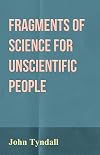
Fragments of Science for Unscientific People: A Series of Detached Essays, Lectures, and Reviews
by John Tyndall
On This Page
Description
This book contains a series of dedicated introductory essays, lectures, and reviews covering a wide range of topics. Written with the desire to extend sympathy for science beyond the limits of the scientific public, these pieces have been written with the layperson in mind and, although most of the essays are of a purely scientific nature, the author has endeavoured to exclude every word which may have caused needless irritation. Conveyed in an engaging and accessible manner, this show more fascinating text is a must-have for any aspiring student of science. John Tyndall was an influential 19th century physicist. Originally published in 1871, this text is republished now with an introductory biography of the author." show lessTags
Recommendations











Member Reviews
I didn't expect to like Fragments of Science, a collection of writings by the 19th-century physicist John Tyndall very much (it was originally published as Fragments of Science for Unscientific People in 1871; I read the 6th edition of 1879), but Tyndall turns out to be a pretty good scientific writer, and thoughtful to boot. I mean, there are long stretches of scientific detail that aren't very interesting, especially to a modern reader, but he still lands the occasional hit. Of course, he was wrong about the "luminiferous aether": "The notion of this medium must not be considered as a vague or fanciful conception on the part of scientific men. Of its reality most of them are as convinced as they are of the existence of the sun and show more moon." But the idea that science might need something mathematically that we can't and won't ever see is one we certainly still believe, and how awesome is this description of a star beyond the aether itself?
"If the aether have a boundary, masses of ponderable matter might be conceived to exist beyond it, but they could emit no light. Beyond the aether dark suns might burn; there, under proper conditions, combustion might be carried on; fuel might consume unseen, and metals be fused in invisible fires. A body, moreover, once heated there, would continue for ever heated; a sun or planet once molten, would continue for ever molten. For, the loss of heat being simply the abstraction of molecular motion by the aether, where this medium is absent no cooling could occur. A sentient being on approaching a heated body in this region, would be conscious of no augmentation of temperature. The gradations of warmth dependent on the laws of radiation would not exist, and actual contact would first reveal the heat of an extra ethereal sun."
There's a piece of early science fiction (or even steampunk) that I'd love to read!
His jokes that ridicule late-19th-century spiritualism are also worth laughing at, and the warnings contained therein worth remembering.
The best part of Fragments of Science is without a doubt the infamous Belfast Address of 1874, laying out Tyndall's vision of science. Though I think you can quibble quite a bit with his history of scientific thought, it builds to an absolutely triumphal conclusion, trumpeting the power and possibilities of scientific thinking in a way that I doubt is true, though I hope it is:
"Science has already to some extent leavened the world; it will leaven it more and more. I should look upon the mild light of science breaking in upon the minds of the youth of Ireland, and strengthening gradually to the perfect day, as a surer check to any intellectual or spiritual tyranny which may threaten this island, than the laws of princes or the swords of emperors. We fought and won our battle even in the Middle Ages: should we doubt the issue of another conflict with our broken foe?"
It just makes you want to grab some science and go fight ignorance and tyranny! I wouldn't recommend reading all of Fragments of Science unless you really want to know what people used to think germs were, but there's some good stuff in here about thinking like a scientist: "Scientific Materialism" (1868), "Scientific Use of the Imagination" (1870), and the Belfast Address and its sequels (1874) are all energizing, determined writing. show less
"If the aether have a boundary, masses of ponderable matter might be conceived to exist beyond it, but they could emit no light. Beyond the aether dark suns might burn; there, under proper conditions, combustion might be carried on; fuel might consume unseen, and metals be fused in invisible fires. A body, moreover, once heated there, would continue for ever heated; a sun or planet once molten, would continue for ever molten. For, the loss of heat being simply the abstraction of molecular motion by the aether, where this medium is absent no cooling could occur. A sentient being on approaching a heated body in this region, would be conscious of no augmentation of temperature. The gradations of warmth dependent on the laws of radiation would not exist, and actual contact would first reveal the heat of an extra ethereal sun."
There's a piece of early science fiction (or even steampunk) that I'd love to read!
His jokes that ridicule late-19th-century spiritualism are also worth laughing at, and the warnings contained therein worth remembering.
The best part of Fragments of Science is without a doubt the infamous Belfast Address of 1874, laying out Tyndall's vision of science. Though I think you can quibble quite a bit with his history of scientific thought, it builds to an absolutely triumphal conclusion, trumpeting the power and possibilities of scientific thinking in a way that I doubt is true, though I hope it is:
"Science has already to some extent leavened the world; it will leaven it more and more. I should look upon the mild light of science breaking in upon the minds of the youth of Ireland, and strengthening gradually to the perfect day, as a surer check to any intellectual or spiritual tyranny which may threaten this island, than the laws of princes or the swords of emperors. We fought and won our battle even in the Middle Ages: should we doubt the issue of another conflict with our broken foe?"
It just makes you want to grab some science and go fight ignorance and tyranny! I wouldn't recommend reading all of Fragments of Science unless you really want to know what people used to think germs were, but there's some good stuff in here about thinking like a scientist: "Scientific Materialism" (1868), "Scientific Use of the Imagination" (1870), and the Belfast Address and its sequels (1874) are all energizing, determined writing. show less
Ratings
Members
- Recently Added By
Lists

Trinity College Booklist (1951): Class One, Natural Science
98 works; 2 members
Author Information

30+ Works 252 Members
Work Relationships
Common Knowledge
- Canonical title
- Fragments of Science for Unscientific People: A Series of Detached Essays, Lectures, and Reviews
- Original publication date
- 1871
Classifications
Statistics
- Members
- 24
- Popularity
- 1,110,681
- Reviews
- 1
- Rating
- (4.00)
- Languages
- English
- Media
- Paper, Ebook
- ISBNs
- 6
- ASINs
- 3