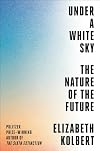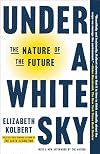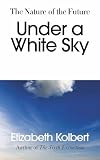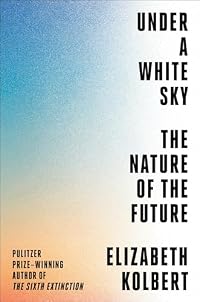
Under a White Sky: The Nature of the Future
by Elizabeth Kolbert
On This Page
Description
"The Pulitzer Prize-winning author of The Sixth Extinction returns to humanity's transformative impact on the environment, now asking: After doing so much damage, can we change nature, this time to save it? That man should have dominion "over all the earth, and over every creeping thing that creepeth upon the earth" is a prophecy that has hardened into fact. So pervasive are human impacts on the planet that it's said we live in a new geological epoch: the Anthropocene. In Under a White Sky, show more Elizabeth Kolbert takes a hard look at the new world we are creating. She meets scientists who are trying to preserve the world's rarest fish, which lives in a single, tiny pool in the middle of the Mojave. She visits a lava field in Iceland, where engineers are turning carbon emissions to stone; an aquarium in Australia, where researchers are trying to develop "super coral" that can survive on a hotter globe; and a lab at Harvard, where physicists are contemplating shooting tiny diamonds into the stratosphere in order to reflect sunlight back to space and cool the earth. One way to look at human civilization, says Kolbert, is as a ten-thousand-year exercise in defying nature. In The Sixth Extinction, she explored the ways in which our capacity for destruction has reshaped the natural world. Now she examines how the very sorts of interventions that have imperiled our planet are increasingly seen as the only hope for its salvation. By turns inspiring, terrifying, and darkly comic, Under a White Sky is an utterly original examination of the challenges we face"-- show lessTags
Recommendations



















Member Reviews
Elizabeth Kolbert takes readers on a journey around the world in search of the latest scientific thinking with regard to reversing the damage done to the planet by humankind. Climate change is only one of the areas of focus. She also covers invasive species and other interventions that may have been intended to help, but have actually hurt, the environment and must now be contained, or reversed, if possible.
It reads as a collection of essays. I was particularly interested in the method of extracting carbon dioxide from the atmosphere and injecting it underground where pressure turns it into calcium carbonate. The section on solar geoengineering is excellent. The pandemic seems to have halted Kolbert’s travels just as the she was show more getting into an in-depth analysis of cores taken in the Greenland ice sheet. Other topics include Asian carp in Illinois’ waters, desert fish in Nevada, flooding in the Mississippi Delta, genetic engineering using CRISPR, invasive cane toads in Australia, and the decline of coral reefs.
I had previously read and very much enjoyed Kolbert’s The Sixth Extinction. This book takes a similar approach, shedding light on some of our global issues and what is being done to address them. There is some optimism to be found here; however, it will require people working together and agreeing on solutions, and as the author points out, we do not have a great track record. I found it informative and relevant. show less
It reads as a collection of essays. I was particularly interested in the method of extracting carbon dioxide from the atmosphere and injecting it underground where pressure turns it into calcium carbonate. The section on solar geoengineering is excellent. The pandemic seems to have halted Kolbert’s travels just as the she was show more getting into an in-depth analysis of cores taken in the Greenland ice sheet. Other topics include Asian carp in Illinois’ waters, desert fish in Nevada, flooding in the Mississippi Delta, genetic engineering using CRISPR, invasive cane toads in Australia, and the decline of coral reefs.
I had previously read and very much enjoyed Kolbert’s The Sixth Extinction. This book takes a similar approach, shedding light on some of our global issues and what is being done to address them. There is some optimism to be found here; however, it will require people working together and agreeing on solutions, and as the author points out, we do not have a great track record. I found it informative and relevant. show less
Fascinating read, so fascinating one almost forgets that what we are talking about is our impending doom. It’s hopeful in a fatalistic way, but fascinating in the detail and history of lessons learned and lessons ignored. I devoured this book in a day.
Kolbert explores aspects of what the natural world will look like as we enter fully into the anthropocene. You know about carbon, but did you know that human fertilizer plants and legume crops fix more nitrogen than the rest of the terrestrial ecosystem, or that we routinely cause earthquakes? People outweigh wild animals by eight to one, and it’s 22 to one if you add in domestic animals. The consequences of our changes are well underway. Louisiana has shrunk by over 2000 square miles since the 1930s, more than Delaware or Rhode Island. Debates over gene editing now must include that the alternative for animals is likely extinction, as well as that our previous attempts at moving genomes around the world in animals or plants have show more often been disastrous. She talks to a researcher who thinks we need to think about carbon dioxide like sewage: we understand that it wouldn’t help to punish people if they went to the bathroom too often, but we also don’t let them shit on the sidewalk. So she also talks to people who propose geoengineering mitigation solutions, though she characterizes at least some as being like “treating a heroin habit with amphetamines.” But most of her interviewees say some version of: geoengineering is like chemotherapy; you don’t use it because you have better options. One says: “We live in a world where deliberately dimming the fucking sun might be less risky than not doing it.” But only might be. show less
A brief book about (in Kolbert’s words) “people trying to solve problems created by people trying to solve problems.” Kolbert is worried about the planet, but she’s not a finger-wagger, and she knows there are no simple solutions to these problem. She has a good sense of humor and humility and she’s a great writer, lots of the book is just plain fun to read, although in the background there is a lot of sadness for what the world has lost and what more we continue to lose. But there’s also admiration for people struggling to understand what is going wrong and to try to develop methods to help.
Wow! This is the best thing I've read this year so far. This was my first foray into the subject of geo-engineering so I wasn't sure what to expect but it kind of felt like reading science fiction as non-fiction. This books is exhilarating and uplifting but also a bit unsettling. Through her admittedly over-zealous travel around the world Elozabeth Kolbert has compiled and presented a wealth of knowledge about the future we may find ourselves living in one day due to climate change and our own efforts to alter our course. Kolbert delves with an open-mind into varying topics surrounding modern efforts to geo-engineer the environment. But she also seeks to caution and temper our expectations that any of these solutions may be executed show more coherently and that mistakes along the way could have intended consequences. show less
Will we science our way out of the climate crisis? Kolbert’s omnibus on extinction and speciation opens with a lesson from Chicago. After taming typhoid in 1900 by reversing the Chicago River, locks now are electrified to stop the Asian carp introduced to control sewage downstream. Our ingenuity constantly circles back on itself, forcing us to innovate past unintended consequences. We have no other choice.
“Yes, people have fundamentally altered the atmosphere. And, yes, this is likely to lead to all sorts of dreadful consequences. But people are ingenious. They come up with crazy, big ideas, and sometimes these actually work.”
Kolbert burst onto the scene with the Pulitzer Prize winning The Sixth Extinction. A book I enjoyed immensely. She has returned here with a collection of eight essays, exploring the ways in which our capacity for destruction has reshaped the natural world and how scientists and biologists are fighting back. These very inventive measures may only slow the bleeding but it is at least a start. Kolbert traveled the world for these stories and did not mind getting her hands dirty along the way. It must be tough to be show more a science writer in 2021 but she has pulled it off once again, with this eye-opener. show less
Kolbert burst onto the scene with the Pulitzer Prize winning The Sixth Extinction. A book I enjoyed immensely. She has returned here with a collection of eight essays, exploring the ways in which our capacity for destruction has reshaped the natural world and how scientists and biologists are fighting back. These very inventive measures may only slow the bleeding but it is at least a start. Kolbert traveled the world for these stories and did not mind getting her hands dirty along the way. It must be tough to be show more a science writer in 2021 but she has pulled it off once again, with this eye-opener. show less
Members
- Recently Added By
Lists

Climate Change
87 works; 7 members

Obama Reads
181 works; 3 members

Books recommended by Barack Obama
295 works; 28 members

Washington Post The 10 Best Books of 2021
10 works; 1 member

Barack Obama's Summer Reading List 2021
11 works; 2 members

Science: Earth
109 works; 1 member
Author Information

19+ Works 7,143 Members
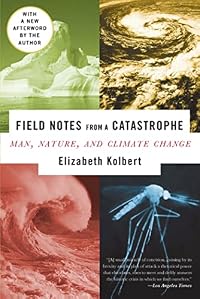
Elizabeth Kolbert is a staff writer for The New Yorker. Her series on global warming, The Climate of Man, won the American Association for the Advancement of Science's magazine writing award and a National Academies communications award. She is a two-time National Magazine Award winner. She has written several books including Catastrophe: Man, show more Nature, and Climate Change and The Sixth Extinction: An Unnatural History, which won the 2015 Pulitzer Prize for Nonfiction. (Bowker Author Biography) show less
Some Editions
Awards and Honors
Awards
Distinctions
Notable Lists
Common Knowledge
- Canonical title*
- Sotto un cielo bianco. La natura del futuro
- Original title
- Under a White Sky: The Nature of the Future
- Original publication date
- 2021
- Epigraph
- Sometimes he runs his hammer along the walls, as though to give the signal to the great waiting machinery of rescue to swing into operation. It will not happen exactly in this way--the rescue will begin in its own time, irres... (show all)pective of the hammer--but it remains something, something palpable and graspable, a token, something one can kiss, as one cannot kiss rescue.
Franz Kafka - Dedication
- To my boys
- Original language
- English
- Canonical DDC/MDS
- 304.28
*Some information comes from Common Knowledge in other languages. Click "Edit" for more information.
Classifications
- Genres
- Science & Nature, General Nonfiction, Nonfiction
- DDC/MDS
- 304.28 — Society, government, & culture Social sciences, sociology & anthropology Factors affecting social behavior Human ecology
- LCC
- GF75 .K65 — Geography, Anthropology and Recreation Human ecology. Anthropogeography Human ecology. Anthropogeography Human influences on the environment
- BISAC
Statistics
- Members
- 777
- Popularity
- 35,819
- Reviews
- 27
- Rating
- (4.08)
- Languages
- 9 — Dutch, English, French, German, Italian, Polish, Portuguese (Portugal), Spanish, Swedish
- Media
- Paper, Audiobook, Ebook
- ISBNs
- 21
- ASINs
- 5