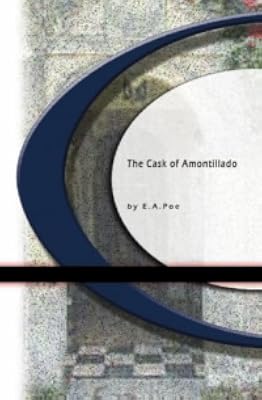
The Cask of Amontillado [short story]
by Edgar Allan Poe
On This Page
Description
First published in a 1846 edition of Godey's Lady's Book, The Cask of Amontillado is widely considered to be one of the most perfect short stories ever written. Told by the unreliable narrator Montresor-a man who sought vengeance against his acquaintance for an insult that the reader is not privy to-the story details how Montresor accomplished his revenge.Tags
Recommendations















Member Reviews
Typically this is considered a tale of revenge. I'm going to go out on a limb and argue that it's not. The only notion we have of revenge--of the narrator, Montresor, actually being wronged--comes in the wonderfully vague opening sentence: "The thousand injuries of Fortunato I had borne as I best could; but when he ventured upon insult, I vowed revenge." It's Montresor himself who insists this is a revenge tale, but of course he's the ultimate unreliable narrator, so we shouldn't take him at his word. Notice that we get not a single detail concerning any of these injuries or insults. Typically you'd expect someone plotting revenge to stew over all those little details ad nauseam. Instead, we only know that Fortunato is a wine show more connoisseur and that "[i]n painting and gemmary Fortunato, like his countrymen, was a quack." It seems that, at some level, Montresor simply doesn't like Fortunato (or perhaps doesn't like all Italians, especially Fortunato) and decides to kill him for no other reason than that. You also get the sense that Fortunato is more successful than the narrator (his name, Fortunato, isn't particularly subtle), so perhaps the killing is simply the result of jealousy. There's also that wonderful scene where Fortunato makes a Masonic sign, which the narrator doesn't understand (and call "grotesque"), and Montresor replies by producing a trowel from beneath his clothes and saying he's a mason, too. A grim joke, but one that points again to the jealousy burning inside him.
OK, enough argument! The most important point is that this a wonderfully macabre tale that reprises several of Poe's major themes. I won't spoil the ending. I'll just say that it's a tale that leaves you thinking long after the reading is done. Not just thinking, but feeling: the damp caverns, the piles of bones, and the ever thickening "nitre" that "hangs like moss upon the vaults." show less
OK, enough argument! The most important point is that this a wonderfully macabre tale that reprises several of Poe's major themes. I won't spoil the ending. I'll just say that it's a tale that leaves you thinking long after the reading is done. Not just thinking, but feeling: the damp caverns, the piles of bones, and the ever thickening "nitre" that "hangs like moss upon the vaults." show less
The Cask of Amontillado by Edgar Allan Poe is a classic tale of revenge. Since there are dozens of posts here, my review will take a particular slant: what German pessimistic philosopher Arthur Schopenhauer has to say about the psychology of revenge and how the revengeful narrator in Poe’s tale relates to Schopenhauer’s insights.
Schopenhauer says we all suffer as the result of nature or chance but, as humans, we recognizes that is simply the way life works. He then writes, “Suffering caused by the will of another, on the other hand, includes a quite peculiar and bitter addition to the pain or injury itself, namely the consciousness of someone else’s superiority, whether in point of strength or of cunning, together with that of show more one’s own impotence.”
It’s that person to person dynamic that gives us the real sting; someone intentionally shoves or hits us, humiliates or insults us, and, for whatever reason, we simply take it. This is what happened in the aristocrat-narrator’s mind – he was insulted by Fortunato. I say ‘in the aristocrat-narrator’s mind’ since we as readers don’t know if Fortunato actually intended to insult him.
Schopenhauer sees two phases of compensation for the person who has suffered at the hands of another. 1) direct and legal – a stranger hits us and we take him to court and win a settlement 2) revenge – to deal with the psychological afterglow of the stranger’s blow. Here are his words: “Recompense, if possible, can cure the injury done; but that bitter addition, the feeling ‘and that is what I have to put up with from you’ which often hurts more than the injury itself, can be neutralized only by revenge.”
The narrator says his is not of a nature to merely threat. Being an aristocrat himself, that is, someone who is accustom to living life and having life on his own terms, he will not even consider direct or legal action or a mere threat. His first step is revenge, and a revenge where he will never be discovered or punished for exacting his revenge and a revenge where Fortunato will be fully aware he is the avenger.
Here is the payoff for the avenger as Schopenhauer sees it: “By returning the injury, either by force or by cunning, we demonstrate our superiority over him who has injured us and thereby annul the proof he gave of his superiority over us. Thus the heart acquires the satisfaction it thirsted for. Where, consequently there is much pride or much vanity, there will also be much reveangefulness.”
This is where the philosopher’s insights fit the characters in Poe’s tale like a finely made Italian glove. Fortunato is a pompous aristocrat, a man full of himself, a man who, in the course of the story, calls another man by the name of Luchresi an ignoramus since Luchresi cannot tell Amontillado from Sherry. The narrator, in turn, with his vaults and wines, his family crest and family motto, is filled to the brim with pride and vanity. And as he locks Fortunato to the damp wall and seals him up in the cold, dark nave, we as readers get the feeling his revenge is as sweet as sweet can be. As Alfred Hitchcock said, “Revenge is sweet and not fattening.”
Schopenhauer’s words on the psychology of the avenger are penetrating. He writes, “But, as every fulfilled desire reveals itself more or less as a delusion, so does that for revenge. Usually the pleasure we hoped for from it is made bitter by the pity we afterwards feel; indeed, an exacted revenge will often subsequently break the heart and torment the conscience; we no longer feel the motivation which drove us to it, but the proof of our wickedness remains visibly before us.”
Poe’s tale ends with the narrator-avenger completing his stone and plaster task and feeling his heart grow sick from the dampness of the catacombs. But this is the rub. He feels his heart grow sick but it this truly caused by the dampness of the catacombs? Might the narrator-avenger experience pity and hear-break and a torment of consciousness in the days, weeks and years to come? If he is not mad, then perhaps; if he is mad, then perhaps not. Since this is a tale written by Edgar Allan Poe, madness is always a real possibility. Thus, we can imagine the narrator-avenger spending his remaining days drinking wine from his vaults with a smug, satisfied smile, knowing there is one more pile of bones in his collection. show less
I have read this story probably a dozen times and today I realized something I had missed in all those readings--they were young. Montresor and Fortunato were young men when this happened. And that has changed my entire perception of this story, making it even more horrible than it has ever been to me.
One of my favorite Poe stories, I find it so revealing of both men's characters. False pride and hubris drive them both. I marvel at how Poe can not only sketch a story, but also a character, in so few pages.
One of my favorite Poe stories, I find it so revealing of both men's characters. False pride and hubris drive them both. I marvel at how Poe can not only sketch a story, but also a character, in so few pages.
No one will ever accuse me of single-minded perseverance. I just started a new book, West Heart Kill (it's very good by the way), and I hadn't gone in more that 10-20 pages when the author suddenly mentions Poe's, The Cask of Amontillado. Of course, I immediately set WHK aside, to Google, download and read a copy of TCOA (available everywhere, and here). Who knows? Maybe it will be a clue? Or forshadowing? Maybe I just can't resist a short story by Poe? Maybe, I just can't resist a short story, or maybe all of the above?
Anyway, I enjoyed this blast from the past (I don't mean I was around way back in 1846, I mean when I was a teen in 19xx). Poe is so twisted, in the most delectable way. Heir to the House of Montresor has been offended show more by his friend (watch your back Fortunato) and devises the best kind of vengeance - the subtle kind that will (probably) never be exposed - that is unless a developer buys his castle and tears it down to make room for the new neighborhood he/she is building (or show less
Anyway, I enjoyed this blast from the past (I don't mean I was around way back in 1846, I mean when I was a teen in 19xx). Poe is so twisted, in the most delectable way. Heir to the House of Montresor has been offended show more by his friend (watch your back Fortunato) and devises the best kind of vengeance - the subtle kind that will (probably) never be exposed - that is unless a developer buys his castle and tears it down to make room for the new neighborhood he/she is building (or show less
Probably my favorite piece by Poe. I know everyone loves Lovecraft, and there's little doubt as to his influence on the genre and he did write some great works, but I'd take Poe any day. But then it's always subjective, isn't it? The first time I read this, I was in high school and it seriously creeped me out. But then I had grown up a sheltered youth, so perhaps that's understandable because while still an excellent story, it doesn't hold the creep factor it once did after having read so much nightmarish crap, both fictional and real. Nonetheless, strongly recommended.
This is in an excellent pamphlet edition by Helios House Press for the Miskatonic Literary Society for the H.P.L.H.S. Nice typography and black-and-white illustrations by Hester Aspland. A classic tale and one almost every schoolchild in the U.S.A. has to read in English class at some point. I thought it cool when I first read it years ago, and so here again. Poe's prose is tight and he draws his characters so well. A rightly justified classic.
This is probably my favorite Poe work. I don't really like his writing style all that much but this story was still good. Retribution is an easy topic to make interesting and Poe did an admirable job.
Members
- Recently Added By
Lists

Best Revenge Stories
69 works; 9 members

1970s
657 works; 23 members

Overdue Podcast
806 works; 9 members

Favourite Short Stories
153 works; 9 members

Books Read in 2016
110 works; 1 member

Recommended Reading : 600 Classics Reviewed, Editors of Salem Press, 2015
634 works; 6 members
Author Information

3,812+ Works 107,596 Members
Edgar Allan Poe was born in Boston, Massachusetts on January 19, 1809. In 1827, he enlisted in the United States Army and his first collection of poems, Tamerlane and Other Poems, was published. In 1835, he became the editor of the Southern Literary Messenger. Over the next ten years, Poe would edit a number of literary journals including the show more Burton's Gentleman's Magazine and Graham's Magazine in Philadelphia and the Broadway Journal in New York City. It was during these years that he established himself as a poet, a short story writer, and an editor. His works include The Fall of the House of Usher, The Tell-Tale Heart, The Murders in the Rue Morgue, The Mystery of Marie Roget, A Descent into the Maelstrom, The Masque of the Red Death, and The Raven. He struggle with depression and alcoholism his entire life and died on October 7, 1849 at the age of 40. (Bowker Author Biography) show less
Some Editions
Awards and Honors
Work Relationships
Is contained in
The Fall of the House of Usher and Other Writings: Poems, Tales, Essays, and Reviews (Penguin Classics) by Edgar Allan Poe
Great Tales of Terror from Europe and America: Gothic Stories of Horror and Romance 1765-1840 by Peter Haining
Edgar Allan Poe: Collected Stories and Poems (Collector's Library Editions) by Edgar Allan Poe (indirect)
The Complete Tales of Mystery and Imagination; The Narrative of Arthur Gordon Pym; The Raven and Other Poems by Edgar Allan Poe (indirect)
The Fall Of The House Of Usher: And Other Tales And Prose Writings of Edgar Allan Poe by Edgar Allan Poe
The Fall of the House of Usher. Ligeia. The Black Cat. The Pit and the Pendulum. The Cask of Amontillado. The Assignation. The Gold-Bug. MS. found in a Bottle by Edgar Allan Poe
The Works of Edgar Allen Poe in One Volume: Poems, Tales, Essays, Criticisms with New Notes by Edgar Allan Poe
The Best Known Works of Edgar Allan Poe in One Volume: Poems, Tales, Essays, Criticisms by Edgar Allan Poe
The Complete Tales and Poems of Edgar Allan Poe with Selections from His Critical Writings by Edgar Allan Poe
The annotated tales of Edgar Allan Poe edited with an introduction, notes, and a bibliography by Edgar Allan Poe
Masters of Horror & Suspense (The Interlopers The Specter The Tell-Tale Heart The Cask of Amontillado) by Uncredited
The Best of Poe: The Tell-Tale Heart, The Raven, The Cask of Amontillado, and 30 Others by Edgar Allan Poe
The fall of the House of Usher and other stories (Classics of mystery & suspense) by Edgar Allan Poe
The Fall of the House of Usher / The Pit and the Pendulum / Other Tales of Mystery and Imagination by Edgar Allan Poe
Is retold in
Has the adaptation
Inspired
Has as a commentary on the text
Has as a student's study guide
Common Knowledge
- Canonical title
- The Cask of Amontillado [short story]
- Original title
- The Cask of Amontillado
- Alternate titles
- The Casque of Amontillado
- Original publication date
- 1846-11
- People/Characters
- Fortunato; Montresor; Luchesi
- Important places
- Italy
- First words
- The thousand injuries of Fortunato I had borne as I best could, but when he ventured upon insult I vowed revenge.
- Last words
- (Click to show. Warning: May contain spoilers.)In pace requiescat!
- Original language
- English
- Disambiguation notice
- This is a short story. Do NOT combine with any collections.
Classifications
Statistics
- Members
- 1,052
- Popularity
- 24,488
- Reviews
- 56
- Rating
- (3.89)
- Languages
- 6 — English, French, German, Italian, Spanish, Swedish
- Media
- Paper, Audiobook, Ebook
- ISBNs
- 81
- ASINs
- 19