On This Page
Description
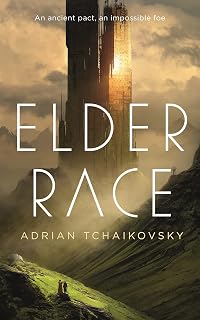
Lynesse is the lowly Fourth Daughter of the queen, and always getting in the way. But a demon is terrorizing the land, and now she's an adult (albeit barely) with responsibilities (she tells herself). Although she still gets in the way, she understands that the only way to save her people is to invoke the pact between her family and the Elder sorcerer who has inhabited the local tower for as long as her people have lived here (though none in living memory has approached it). But Elder Nyr show more isn't a sorcerer, and he is forbidden to help, and his knowledge of science tells him the threat cannot possibly be a demon ... show lessTags
Recommendations












Member Reviews
I wonder if Adrian Tchaikovsky is capable of writing a book I will not like?
Oh, how I savoured this…
The world comes alive, even though the details are few. I really liked the mixture of sci-fi and fantasy, with one POV character being in the sci-fi story, while others are in a fantasy book.
The characters are lovingly drawn. Watch them stumble through, trying to understand each other, speaking almost the same language, but not in the same way. Lonely and depressed Nyr, who wants to belong, and who should really stop using that DCS. Lyn – the fiery, courageous, rebellious Lyn, who does the right thing, the hard thing, just because there is nothing else to do. What about the night when Lyn, Esha, Allwer and Nyr told each other stories show more to keep darkness at bay? That was beautiful.
There was a classic sci-fi feel about this novella, and I mean it in all the best ways. At times I could have sworn I was reading Le Guin. show less
Oh, how I savoured this…
The world comes alive, even though the details are few. I really liked the mixture of sci-fi and fantasy, with one POV character being in the sci-fi story, while others are in a fantasy book.
The characters are lovingly drawn. Watch them stumble through, trying to understand each other, speaking almost the same language, but not in the same way. Lonely and depressed Nyr, who wants to belong, and who should really stop using that DCS. Lyn – the fiery, courageous, rebellious Lyn, who does the right thing, the hard thing, just because there is nothing else to do. What about the night when Lyn, Esha, Allwer and Nyr told each other stories show more to keep darkness at bay? That was beautiful.
There was a classic sci-fi feel about this novella, and I mean it in all the best ways. At times I could have sworn I was reading Le Guin. show less
Lynesse is an adventuring princess, come to claim the aid of a legendary sorcerer against a foul demon which threatens her world.
Nyr is an anthropologist, last remaining member of a planetary observation team, drifting through the centuries in suspended animation and waiting for world from Earth. And he's also Lynesse's sorcerer, a man who's knowledge of science, defensive implants, and ability to communicate with legacy technology from the colonization effort gives him uncanny powers.
The story is told in alternating chapters. Lynesse trying to live up to the demands of royal statecraft which have never suited her and ancient legends which are impossible to live up to. Nyr is torn between his ethical mission not to interfere, the role show more the locals have placed in him, and his own depression, barely kept at bay by a Disassociative Cognition System, which blanks out all those pesky emotions and enables him to make logical decisions.
This story is at its best in the dual uses of language, how when Nyr says "scientist" Lynesse hears "wizard", and how a matter of fact account of a generation ship becomes a mythic voyage across the stars. The plot isn't that original, and I think falls apart in never adequately explaining the nature of the demon, but huge points for picking a story and writing only the necessary parts when the genre tends towards long and overwritten epics.
This is my first Tchaikovsky, and if the rest are anywhere comparable, I've got a lot of popcorn to enjoy. show less
Nyr is an anthropologist, last remaining member of a planetary observation team, drifting through the centuries in suspended animation and waiting for world from Earth. And he's also Lynesse's sorcerer, a man who's knowledge of science, defensive implants, and ability to communicate with legacy technology from the colonization effort gives him uncanny powers.
The story is told in alternating chapters. Lynesse trying to live up to the demands of royal statecraft which have never suited her and ancient legends which are impossible to live up to. Nyr is torn between his ethical mission not to interfere, the role show more the locals have placed in him, and his own depression, barely kept at bay by a Disassociative Cognition System, which blanks out all those pesky emotions and enables him to make logical decisions.
This story is at its best in the dual uses of language, how when Nyr says "scientist" Lynesse hears "wizard", and how a matter of fact account of a generation ship becomes a mythic voyage across the stars. The plot isn't that original, and I think falls apart in never adequately explaining the nature of the demon, but huge points for picking a story and writing only the necessary parts when the genre tends towards long and overwritten epics.
This is my first Tchaikovsky, and if the rest are anywhere comparable, I've got a lot of popcorn to enjoy. show less
A princess goes on a quest to save her world from a strange illness that's spreading through their world and she starts with going on a quest to get some help from a sorcerer only the sorcerer is actually an anthropologist who has been spending a lot of his time in cryosleep, alone and without any communication from earth.
Sufficiently advanced technology resembles magic a lot here and it's interesting, with a touch a body horror attached. The complications of being a long observer are well observed here. I enjoyed it.
Sufficiently advanced technology resembles magic a lot here and it's interesting, with a touch a body horror attached. The complications of being a long observer are well observed here. I enjoyed it.
I wish I hadn't put off reading this one for so long. I should know by now I'll enjoy basically anything Adrian Tchaikovsky writes.
What a great take on the old Clarke-ism, "Any sufficiently advanced technology is indistinguishable from magic." The alternating perspectives really did well to highlight how much different backgrounds and cultural understandings can affect interpretations of events. The book length was also pretty perfect for this story, any longer and I think the message would have been too watered down or lost in the plot.
What a great take on the old Clarke-ism, "Any sufficiently advanced technology is indistinguishable from magic." The alternating perspectives really did well to highlight how much different backgrounds and cultural understandings can affect interpretations of events. The book length was also pretty perfect for this story, any longer and I think the message would have been too watered down or lost in the plot.
Holy crap, is this a _fun_ read! Anyone and everyone that enjoys SFF in its various flavors should read this.
Again, Tchaikovsky has taken elements that have long existed in SFF and careful concocted something fresh and delightful. Interweaving two separate narrative perspectives of the same story, one hard-SF and one more sword-and-sorcery, is the master stroke that makes this so compulsively readable throughout. A pugnacious princess and a scientist/sorcerer plagued by self-doubt are nice spins for narrative voices, too. This novella is hardly more than a short story for this author, but it's exactly the right length to get where it's going and just deeply enough told to do the job without getting padded.
Huz-zah.
Again, Tchaikovsky has taken elements that have long existed in SFF and careful concocted something fresh and delightful. Interweaving two separate narrative perspectives of the same story, one hard-SF and one more sword-and-sorcery, is the master stroke that makes this so compulsively readable throughout. A pugnacious princess and a scientist/sorcerer plagued by self-doubt are nice spins for narrative voices, too. This novella is hardly more than a short story for this author, but it's exactly the right length to get where it's going and just deeply enough told to do the job without getting padded.
Huz-zah.
Tchaikovsky, Adrian. Elder Race. Tordotcom, 2021.
Adrian Tchaikovsky loves to explore the effects of cultural evolution and devolution. Elder Race is a clever abandoned colony story in which the planted culture has lost its science and treats unexpected events as the products of magic. When people and animals start to die unexpectedly, Lynesse, the Fourth Daughter of the Queen from whom not much is expected, climbs to a remote wizard’s tower in the mountains to get some magical help. The wizard in question is Nyr, an anthropologist, who has lost contact with Earth for more than two hundred years and has survived only with the help of self-maintaining technology that allows for long periods of hibernation. He has implants that help him show more fight depression, but he still worries that he is violating his version of the Prime Directive when he talks to Lynesse. When he tries to explain that he is a scientist and not a wizard, he finds translation exceptionally difficult. If you liked Tchaikovsky’s The Expert System’s Brother, you will probably like this one, as I did. 4 stars. show less
Adrian Tchaikovsky loves to explore the effects of cultural evolution and devolution. Elder Race is a clever abandoned colony story in which the planted culture has lost its science and treats unexpected events as the products of magic. When people and animals start to die unexpectedly, Lynesse, the Fourth Daughter of the Queen from whom not much is expected, climbs to a remote wizard’s tower in the mountains to get some magical help. The wizard in question is Nyr, an anthropologist, who has lost contact with Earth for more than two hundred years and has survived only with the help of self-maintaining technology that allows for long periods of hibernation. He has implants that help him show more fight depression, but he still worries that he is violating his version of the Prime Directive when he talks to Lynesse. When he tries to explain that he is a scientist and not a wizard, he finds translation exceptionally difficult. If you liked Tchaikovsky’s The Expert System’s Brother, you will probably like this one, as I did. 4 stars. show less
I have lived a long, long life and it has meant nothing, and I'm on a fucking quest with a couple of women who don't understand things like germs or fusion power or anthropological theories of value.
An anthropological observer from an advanced but lost culture must team up with a princess from a more primitive one who insists on seeing him as a wizard. Pretty enjoyable but I never found it as arresting as I did some other stuff on the Hugo ballot this year. I think it had some interesting things to say (how different cultures process the same things), but I also felt like it could have been richer thematically. I kept comparing it unfavorably to Le Guin.
An anthropological observer from an advanced but lost culture must team up with a princess from a more primitive one who insists on seeing him as a wizard. Pretty enjoyable but I never found it as arresting as I did some other stuff on the Hugo ballot this year. I think it had some interesting things to say (how different cultures process the same things), but I also felt like it could have been richer thematically. I kept comparing it unfavorably to Le Guin.
Members
- Recently Added By
Lists

2022 Hugo Awards -- Eligible Works -- Novellas
19 works; 7 members

Anticipated SFF 2021
86 works; 3 members

Books Read in 2021
5,361 works; 114 members

Books Read in 2022
5,168 works; 114 members

Library Fantasy/Science Fiction
159 works; 2 members
Author Information

133+ Works 27,883 Members
Adrian Tchaikovsky is a British fantasy and science fiction author, born on June 14, 1972 in Woodhall Spa, Lincolnshire. He studied Zoology and Psychology at the University of Reading. His career focus changed to law and has worked as a Legal Executive in both Reading and Leeds. He's the author of the Shadows of the Apt series, and his standalone show more novel Children of Time is the winner of the 2016 Arthur C Clarke Award for Best Science Fiction Novel. (Bowker Author Biography) show less
Awards and Honors
Awards
Series

Belongs to Publisher Series
Une heure-lumière (46)
Common Knowledge
- Canonical title
- Elder Race
- Original title
- Elder Race
- Original publication date
- 2021-11-16
- People/Characters
- Lynesse Fourth Daughter; Nyr Illim Tevitch
- Important places*
- Sophos 4
- Dedication
- Dedicated to the memory of Gene Wolfe, one of the great masters, whose story "Trip, Trap" was a major inspiration for this book
- First words
- Nobody climbed the mountain beyond the war-shrine.
- Quotations*
- N'est-ce pas une des pires choses que se croire sage et constater que l'on est aussi ignorant que ceux qui se savent idiots ?
- Last words
- (Click to show. Warning: May contain spoilers.)Lyn grins at me, and I lift the cognitive shielding, and for a moment I am happy.
- Publisher's editor
- Harris, Lee
- Blurbers
- Chu, John; McAvoy, James; Ness, Patrick
- Original language*
- Anglais britannique
*Some information comes from Common Knowledge in other languages. Click "Edit" for more information.
Classifications
Statistics
- Members
- 855
- Popularity
- 31,963
- Reviews
- 38
- Rating
- (3.98)
- Languages
- 5 — Catalan, Dutch, English, French, Spanish
- Media
- Paper, Audiobook, Ebook
- ISBNs
- 8
- ASINs
- 3