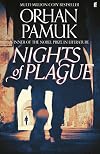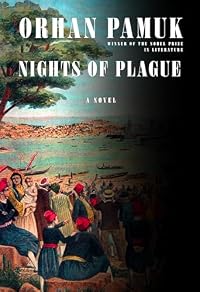
Nights of Plague
by Orhan Pamuk
On This Page
Description
"A new book by the winner of the Nobel Prize in Literature. Part detective story, part historical epic-a bold and brilliant novel that imagines a plague taking over a fictional island in the Ottoman Empire. It is April 1900, in the Levant, on the imaginary island of Mingeria-the 29th state of the Ottoman Empire-located in the eastern Mediterranean between Crete and Cyprus. Half the population is Muslim, the other half are Orthodox Greeks, and tension is high between the two. When a plague show more arrives-brought either by Muslim pilgrims returning from the Mecca, or by merchant vessels coming from Alexandria-the island revolts. To stop the epidemic, the Ottoman sultan Abdul Hamid II sends his most accomplished quarantine expert to the island-an Orthodox Christian. Some of the Muslims, including followers of a popular religious sect and its leader Sheikh H, refuse to take precautions or respect the quarantine. And the sultan's expert is murdered. As the plague continues its rapid spread, the sultan sends a second doctor to the island, this time a Muslim, and strict quarantine measures are declared. But the incompetence of the island's governor and local administration and the people's refusal to respect the bans dooms the quarantine to failure, and the death count continues to rise. Faced with the danger that the plague might spread to the West and to Istanbul, the sultan bows to international pressure and allows foreign and Ottoman warships to blockade the island. Now the people of Mingeria are on their own, and they must find a way to defeat the plague themselves. Steeped in history and rife with suspense, Nights of Plague is an epic story set more than one hundred years ago with themes that feel remarkably contemporary"-- show lessTags
Recommendations















Member Reviews
Translated from the Turkish by Ekin Oklap.
Nobel Prize-winning author Orhan Pamuk constructs 79 chapters—plus preface and 50-page epilogue—recounting an outbreak of plague in a fictional Mediterranean island in 1901. Along the way he portrays authoritarian government tactics in suppressing its population; backward religious scruples proscribing life-saving modern medicine; and the jingoistic tendency of inferior historians to hew their stories to align with beloved legends, and thereby to get things hilariously wrong. It’s an impressive rendering of an ingenious and captivating tale.
In the fictional eastern Mediterranean island of Mingheria, which at the beginning of 1901 is a province of the Ottoman Empire, bubonic plague breaks show more out, and the imperial government in Istanbul sends a medical official, a doctor celebrated in political as well as medical circles, to impose a quarantine. News of his arrival spreads quickly on the island, but he is very soon summarily despatched, murdered by a faction that wants no measures taken against the epidemic nor anything else to do with modern medicine.
We soon learn that this violence stems from some combination of Islamic teaching and a desire to intimidate the Orthodox Greeks—half the island’s population— into leaving and returning to Greece. The authorities then send another doctor, a Muslim, one famous for his administration of quarantines in other Ottoman provinces, and this one is newly married to an out-of-favor Ottoman princess. He labors mightily with the provincial governor to bring both the fundamentalist fanatics and the disease under control.
Through a series of unlikely events which nonetheless lead to inevitable human responses, the Mingherians cut themselves off from all communications from the Ottoman empire, declare their independence, and set up a new government. Before very long, the work of controlling the epidemic is shot to hell when a leading sheikh stages a coup and becomes briefly the head of state. All quarantine measures are abolished and the plague increases in virulence and begins a new terrible rampage through the population.
In describing these events, Pamuk demonstrates his mastery of human motivation and emotion; he holds up for our edification the idiocy, the venality, and the lust for power which drive politics. To get a flavor for his tone and stance toward these proceedings, understand that the governor leans heavily on a secret police service called the “Scrutinia,” and its director is called the “Chief Scrutineer.” His take of government ethics is an oppressive classic: in Mingheria, political enemies are routinely arrested and held without charge or due process. The sectarian regime which briefly holds power looks very much the same.
I felt for a time while reading that the story was a miniature treatment of the Ottoman Empire itself, a microcosm. The author mentions more than once that the empire was referred to as “The Sick Man of Europe,” and I took the pestilence as a stand-in for the decay that infected it. But the issues of authoritarianism, and the utter failure of regimes which take their legitimacy from religion, are much bigger than one outdated empire. They are for all time, in all places.
Pamuk wraps his story up in a framework of a serious historian working with primary sources, and thus adds a clever layer of play for the reader: the light, almost tongue-in-cheek tone of the preface contrasts with the serious theme of the strife between the old and hackneyed against the new and proven. He also wants to poke fun at the writing of history, by presenting an apparently rigorous treatment of what happened and how these events represent a confluence of historical forces, while also poking jabs at how often history is simply a colorful embellishing of outright falsehoods.
I’m impressed that this author can clothe such a sustained narrative in garments of fancy, while still weighing in so bluntly on superstition, murderous greed, and official criminality. Clearly it holds manifold attractions for today’s discerning reader. Its depth and breadth lead to length, but the sustained energy and interest are also quite worth it.
https://bassoprofundo1.blogspot.com/2022/11/nights-of-plague-by-orhan-pamuk.html show less
Nobel Prize-winning author Orhan Pamuk constructs 79 chapters—plus preface and 50-page epilogue—recounting an outbreak of plague in a fictional Mediterranean island in 1901. Along the way he portrays authoritarian government tactics in suppressing its population; backward religious scruples proscribing life-saving modern medicine; and the jingoistic tendency of inferior historians to hew their stories to align with beloved legends, and thereby to get things hilariously wrong. It’s an impressive rendering of an ingenious and captivating tale.
In the fictional eastern Mediterranean island of Mingheria, which at the beginning of 1901 is a province of the Ottoman Empire, bubonic plague breaks show more out, and the imperial government in Istanbul sends a medical official, a doctor celebrated in political as well as medical circles, to impose a quarantine. News of his arrival spreads quickly on the island, but he is very soon summarily despatched, murdered by a faction that wants no measures taken against the epidemic nor anything else to do with modern medicine.
We soon learn that this violence stems from some combination of Islamic teaching and a desire to intimidate the Orthodox Greeks—half the island’s population— into leaving and returning to Greece. The authorities then send another doctor, a Muslim, one famous for his administration of quarantines in other Ottoman provinces, and this one is newly married to an out-of-favor Ottoman princess. He labors mightily with the provincial governor to bring both the fundamentalist fanatics and the disease under control.
Through a series of unlikely events which nonetheless lead to inevitable human responses, the Mingherians cut themselves off from all communications from the Ottoman empire, declare their independence, and set up a new government. Before very long, the work of controlling the epidemic is shot to hell when a leading sheikh stages a coup and becomes briefly the head of state. All quarantine measures are abolished and the plague increases in virulence and begins a new terrible rampage through the population.
In describing these events, Pamuk demonstrates his mastery of human motivation and emotion; he holds up for our edification the idiocy, the venality, and the lust for power which drive politics. To get a flavor for his tone and stance toward these proceedings, understand that the governor leans heavily on a secret police service called the “Scrutinia,” and its director is called the “Chief Scrutineer.” His take of government ethics is an oppressive classic: in Mingheria, political enemies are routinely arrested and held without charge or due process. The sectarian regime which briefly holds power looks very much the same.
I felt for a time while reading that the story was a miniature treatment of the Ottoman Empire itself, a microcosm. The author mentions more than once that the empire was referred to as “The Sick Man of Europe,” and I took the pestilence as a stand-in for the decay that infected it. But the issues of authoritarianism, and the utter failure of regimes which take their legitimacy from religion, are much bigger than one outdated empire. They are for all time, in all places.
Pamuk wraps his story up in a framework of a serious historian working with primary sources, and thus adds a clever layer of play for the reader: the light, almost tongue-in-cheek tone of the preface contrasts with the serious theme of the strife between the old and hackneyed against the new and proven. He also wants to poke fun at the writing of history, by presenting an apparently rigorous treatment of what happened and how these events represent a confluence of historical forces, while also poking jabs at how often history is simply a colorful embellishing of outright falsehoods.
I’m impressed that this author can clothe such a sustained narrative in garments of fancy, while still weighing in so bluntly on superstition, murderous greed, and official criminality. Clearly it holds manifold attractions for today’s discerning reader. Its depth and breadth lead to length, but the sustained energy and interest are also quite worth it.
https://bassoprofundo1.blogspot.com/2022/11/nights-of-plague-by-orhan-pamuk.html show less
Loved this - great writing and seemed very appropriate for the time (no putting 21st century thinking on top of historical events). Set in an imaginary island under the control of the Sultan of the Ottoman Empire in Istanbul. A young doctor who recently married the Sultan's niece is sent to the island to investigate and help with a plague. There is a murder mystery, a love story, real historical characters and an interesting look at how people respond to pandemics depending on religion and culture.
Actually times haven't changed all that much.
Actually times haven't changed all that much.
This is my first book by this Turkish, Nobel Prize-winning writer, so I don’t know if it’s representative of his work, but I found it somewhat tedious.
The setting is 1901 on the fictional Eastern Mediterranean island of Mingheria which is part of the Ottoman Empire. A plague has broken out so a quarantine expert, Bonkowski Pasha, is sent to bring the outbreak to an end. He is murdered shortly after arrival, so the Sultan sends his niece, Princess Pakize, daughter of the brother he deposed, and her husband, Dr. Nuri, to control the spread of the plague and to discover the identity of Bonkowski Pasha’s murderer. What follows is a detailed description of attempts to stop the plague and the social and political upheaval resulting from show more those attempts.
In a preface, the supposed author claims that she is writing “both a historical novel and a history written in the form of a novel.” She has access to letters written by Princess Pakize during her time on Mingheria, but, though the novel gives the princess’s perspective of events, that of other characters is also given: the governor of the island, Sami Pasha; Bonkowski Pasha; Dr. Nuri; the leader of her security detail, Major Kâmil; and Sheikh Hamdullah, among others.
What is noteworthy is the world-building. Readers cannot but be convinced that Mingheria exists because we are told about its history, geography, economics, and politics. The island’s ethnic (Greek, Turkish, Mingherian) and religious (Muslim, Orthodox Christian) groups are detailed. Businesses, buildings, and streets in the capital of Arkaz are described.
The effects of the plague on the island’s residents are detailed but so are the measures taken to control its spread. What I found especially interesting is that many of those measures are identical to those we recently faced with our own pandemic: distancing, isolation, quarantine, alcohol-based disinfectants, closing businesses, suspending religious gatherings, restricting the size of gatherings, ventilation, curfews, and masking. Dr. Nuri admits “how frighteningly vague the medical community’s understanding of the plague was.”
The concerns expressed read like those we heard during Covid: “There were also people who were exposed to the microbe that didn’t fall ill or even realize they had it” and “the hospitals will run out of beds, and there won’t be enough doctors to deal with the sick” and shops “stationed someone at their door to spray disinfectant” and “plague victims might cough in your face at any moment and infect you too” and ever-changing “new measures were added every day” and “’Do you think the plague can be passed through food?’ and “the fear of the disease meant that nobody was really greeting and embracing each other” and “many other diseases had similar symptoms” and “Personal bonds had weakened, friendships had suffered” and “need to disinfect or sanitize things like paper, letters, and books” and whether the disease will disappear with the arrival of a new season.
The reactions of the people to the measures are also identical to those seen in the last couple of years. Some worry about the effect of closures on their businesses, “complaining that quarantine was damaging their profits”; some “mothers and fathers could not stay at home to look after [children]”; and “some shopkeepers and bakers had taken to stockpiling goods, while others were hiking up their prices.” Some people follow the rules, “never left their homes anymore, and wouldn’t come in for work,” while others are plague deniers who continue to live as normal. Some flout the rules. Some believe they will be immune if they carry prayer sheets or wear amulets or perform certain rituals. There are rumours and conspiracy theories about the origins of the plague; the doctors who come to the island to help are accused of bringing the plague with them. Politicians, medical professionals, and citizens disagree about what measures need to be taken, and protests against plague measures are held. People who flee the city to a rural region “were quickly driven away by locals who accused them of having the plague.” Human nature seems not to have changed, and we seem not to have learned from history.
At 700+ pages, this is a lengthy book. Its slow pace meant I often struggled to maintain interest. There is a great deal of telling, as opposed to showing, and many digressions. More than once the author makes comments like “Our readers must not think that we are straying too far from our story if we too take a moment now to examine . . .” and has characters deliver “a needlessly elaborate disquisition.” Irrelevant information is included. For instance, when the governor’s armoured landau is first described, do we really need to know that “he had commissioned Bald Kudret, Arkaz’s most famous blacksmith to make the required sheets of armor”? Do we have to be told about a bee that flies into the landau on one trip? What is the purpose of being told about the ships that blockade the harbour: “the French Amiral Baudin, launched in 1883, was one hundred meters long; the British HMS Prince George, launched in 1895, was excellent in artillery”? Do we have to know that a judge “had long, slender fingers, and delicate handwriting”? There is such a thing as too much information!
There is a lot of needless repetition. Almost every time Dr. Nuri appears, his complete title is given: Prince Consort Doctor Nuri. Another character’s felt hat is mentioned 25 times. Sentences are sometimes overly long: “The judge (and former kadı) who would have ordinarily conducted the trial was Muzaffer Effendi, sent from Istanbul to handle important cases involving murder, serious injury, the abduction of young women for marriage, and blood feuds, without these having to be referred to the courts in the Empire’s capital, but Muzaffer Effendi was currently in the Maiden’s Tower, having been sent there by rowboat in the middle of the night along with the insufficiently revolutionary mayor of Teselli, Rahmetullah Effendi, so instead Sami Pasha had the elderly Christofi Effendi of the rich Yannisgiorgis family, whom he knew through the French consul, and who happened to be the only person on the island who’d studied law in Europe (specifically in Paris), brought to the former State Hall and current Ministerial Headquarters in his armored landau, instructing him upon his arrival to kindly produce a judgment ‘in the European style.’” I count 148 words in that one sentence.
The book is critical of politicians of every stripe. The governor pays for his landau “with money taken from the municipality’s eternally underfunded coffers”; another leader, rather than focusing on the plague, is concerned “to see this own likeness and the landscapes of Mingheria reproduced on these postage stamps” and “fantasizing about all the new names he was going to give these places”; and another “spent more time discussing [a predecessor’s] funeral arrangements, the future of the Halifiye sect and lodge, and the emblems of the Queen.” There is certainly a criticism of modern Turkey: “We should also note that the custom of gunning journalists and writers down on the street with the tacit backing of the state – a tradition that has now persisted for more than a hundred years – was first born under the new regime of ‘freedom.’” (There is no doubt that the plague also serves as a metaphor for the collapse of the Ottoman Empire.)
The book has 79 chapters and an overlong epilogue. (I found it rather ironic that in Chapter 56, only two-thirds of the way through the book, the author states, “as we approach the end of our novel-cum-history, I suppose I should finally reveal . . . “) I finished it only because I felt obligated to do so since I received a galley from the publisher in return for a review. It is too long and dense and perhaps, for me, too much a reminder of the Covid pandemic which has not yet ended.
Note: I received a digital galley from the publisher via NetGalley.
Please check out my reader's blog (https://schatjesshelves.blogspot.com/) and follow me on Twitter (@DCYakabuski). show less
The setting is 1901 on the fictional Eastern Mediterranean island of Mingheria which is part of the Ottoman Empire. A plague has broken out so a quarantine expert, Bonkowski Pasha, is sent to bring the outbreak to an end. He is murdered shortly after arrival, so the Sultan sends his niece, Princess Pakize, daughter of the brother he deposed, and her husband, Dr. Nuri, to control the spread of the plague and to discover the identity of Bonkowski Pasha’s murderer. What follows is a detailed description of attempts to stop the plague and the social and political upheaval resulting from show more those attempts.
In a preface, the supposed author claims that she is writing “both a historical novel and a history written in the form of a novel.” She has access to letters written by Princess Pakize during her time on Mingheria, but, though the novel gives the princess’s perspective of events, that of other characters is also given: the governor of the island, Sami Pasha; Bonkowski Pasha; Dr. Nuri; the leader of her security detail, Major Kâmil; and Sheikh Hamdullah, among others.
What is noteworthy is the world-building. Readers cannot but be convinced that Mingheria exists because we are told about its history, geography, economics, and politics. The island’s ethnic (Greek, Turkish, Mingherian) and religious (Muslim, Orthodox Christian) groups are detailed. Businesses, buildings, and streets in the capital of Arkaz are described.
The effects of the plague on the island’s residents are detailed but so are the measures taken to control its spread. What I found especially interesting is that many of those measures are identical to those we recently faced with our own pandemic: distancing, isolation, quarantine, alcohol-based disinfectants, closing businesses, suspending religious gatherings, restricting the size of gatherings, ventilation, curfews, and masking. Dr. Nuri admits “how frighteningly vague the medical community’s understanding of the plague was.”
The concerns expressed read like those we heard during Covid: “There were also people who were exposed to the microbe that didn’t fall ill or even realize they had it” and “the hospitals will run out of beds, and there won’t be enough doctors to deal with the sick” and shops “stationed someone at their door to spray disinfectant” and “plague victims might cough in your face at any moment and infect you too” and ever-changing “new measures were added every day” and “’Do you think the plague can be passed through food?’ and “the fear of the disease meant that nobody was really greeting and embracing each other” and “many other diseases had similar symptoms” and “Personal bonds had weakened, friendships had suffered” and “need to disinfect or sanitize things like paper, letters, and books” and whether the disease will disappear with the arrival of a new season.
The reactions of the people to the measures are also identical to those seen in the last couple of years. Some worry about the effect of closures on their businesses, “complaining that quarantine was damaging their profits”; some “mothers and fathers could not stay at home to look after [children]”; and “some shopkeepers and bakers had taken to stockpiling goods, while others were hiking up their prices.” Some people follow the rules, “never left their homes anymore, and wouldn’t come in for work,” while others are plague deniers who continue to live as normal. Some flout the rules. Some believe they will be immune if they carry prayer sheets or wear amulets or perform certain rituals. There are rumours and conspiracy theories about the origins of the plague; the doctors who come to the island to help are accused of bringing the plague with them. Politicians, medical professionals, and citizens disagree about what measures need to be taken, and protests against plague measures are held. People who flee the city to a rural region “were quickly driven away by locals who accused them of having the plague.” Human nature seems not to have changed, and we seem not to have learned from history.
At 700+ pages, this is a lengthy book. Its slow pace meant I often struggled to maintain interest. There is a great deal of telling, as opposed to showing, and many digressions. More than once the author makes comments like “Our readers must not think that we are straying too far from our story if we too take a moment now to examine . . .” and has characters deliver “a needlessly elaborate disquisition.” Irrelevant information is included. For instance, when the governor’s armoured landau is first described, do we really need to know that “he had commissioned Bald Kudret, Arkaz’s most famous blacksmith to make the required sheets of armor”? Do we have to be told about a bee that flies into the landau on one trip? What is the purpose of being told about the ships that blockade the harbour: “the French Amiral Baudin, launched in 1883, was one hundred meters long; the British HMS Prince George, launched in 1895, was excellent in artillery”? Do we have to know that a judge “had long, slender fingers, and delicate handwriting”? There is such a thing as too much information!
There is a lot of needless repetition. Almost every time Dr. Nuri appears, his complete title is given: Prince Consort Doctor Nuri. Another character’s felt hat is mentioned 25 times. Sentences are sometimes overly long: “The judge (and former kadı) who would have ordinarily conducted the trial was Muzaffer Effendi, sent from Istanbul to handle important cases involving murder, serious injury, the abduction of young women for marriage, and blood feuds, without these having to be referred to the courts in the Empire’s capital, but Muzaffer Effendi was currently in the Maiden’s Tower, having been sent there by rowboat in the middle of the night along with the insufficiently revolutionary mayor of Teselli, Rahmetullah Effendi, so instead Sami Pasha had the elderly Christofi Effendi of the rich Yannisgiorgis family, whom he knew through the French consul, and who happened to be the only person on the island who’d studied law in Europe (specifically in Paris), brought to the former State Hall and current Ministerial Headquarters in his armored landau, instructing him upon his arrival to kindly produce a judgment ‘in the European style.’” I count 148 words in that one sentence.
The book is critical of politicians of every stripe. The governor pays for his landau “with money taken from the municipality’s eternally underfunded coffers”; another leader, rather than focusing on the plague, is concerned “to see this own likeness and the landscapes of Mingheria reproduced on these postage stamps” and “fantasizing about all the new names he was going to give these places”; and another “spent more time discussing [a predecessor’s] funeral arrangements, the future of the Halifiye sect and lodge, and the emblems of the Queen.” There is certainly a criticism of modern Turkey: “We should also note that the custom of gunning journalists and writers down on the street with the tacit backing of the state – a tradition that has now persisted for more than a hundred years – was first born under the new regime of ‘freedom.’” (There is no doubt that the plague also serves as a metaphor for the collapse of the Ottoman Empire.)
The book has 79 chapters and an overlong epilogue. (I found it rather ironic that in Chapter 56, only two-thirds of the way through the book, the author states, “as we approach the end of our novel-cum-history, I suppose I should finally reveal . . . “) I finished it only because I felt obligated to do so since I received a galley from the publisher in return for a review. It is too long and dense and perhaps, for me, too much a reminder of the Covid pandemic which has not yet ended.
Note: I received a digital galley from the publisher via NetGalley.
Please check out my reader's blog (https://schatjesshelves.blogspot.com/) and follow me on Twitter (@DCYakabuski). show less
Ostensibly written by Mina, the great granddaughter of the main characters, an Ottoman princess, Pakize, and her husband, Dr. [and prince-consort] Nuri. The story is supposedly based on Pakize's letters. It tells of a Mediterranean island, under the Ottoman Empire--fictitious, but to my mind, based on say, Malta? The couple come to the island prepared to fight a plague ravaging the island, and also, to solve a mysterious death. It chronicles the efforts to fight the plague; also, a revolution takes place in which the island sets itself up as a sovereign nation, and the mystery is solved, however by circumstantial evidence. The novel was interesting, but I thought it bloated in places. One thing that could have been left out were show more parenthetical phrases, generally and the repeating of peoples' titles nearly every time their names were mentioned. show less
This one my first Orhan Pamuk novel and I am thinking it may have not been the best one to start with. The story of a doctor sent to a small island by the Sultan of the Ottoman Empire to curb an plague epidemic and encounters politics and societal breakdown read a bit too much like a text book. The tone was dry and it was hard to care about the characters. The various historical tangents were too many and detracted greatly from the story. Many folks may like this one, it just wasn't for me. Thanks NetGalley for the chance to read and review this book!
Very disappointing. Clearly the editors are unwilling to say "no" to a once great writer. Dull characters and far too long. Why should any reader care about this made up island and it's history? Pamuk certainly didn't make me care.
Abril de 1901. Un barco se dirige hacia la isla de Minguer, la perla del Mediterráneo oriental. A bordo se encuentran la princesa Pakize Sultan, sobrina del sultán Abdülhamit II, y su reciente esposo, el doctor Nuri, pero también un misterioso pasajero que viaja de incógnito: el célebre inspector jefe de sanidad del Imperio otomano, encargado de confirmar los rumores de peste que han llegado hasta el continente. En las animadas calles de la capital portuaria nadie puede imaginar la amenaza, ni la revolución que está a punto de fraguarse.
Desde nuestros días, una historiadora nos invita a asomarnos a los meses más turbadores que cambiaron el rumbo histórico de esta isla otomana, marcada por el frágil equilibrio entre show more cristianos y musulmanes, en un relato que combina historia, literatura y leyenda.
En esta nueva obra del Nobel, destinada a convertirse en uno de los grandes clásicos sobre plagas, Pamuk indaga en las pandemias del pasado. Las noches de la peste es la historia de supervivencia y lucha de unos protagonistas que lidian con las prohibiciones de la cuarentena y la inestabilidad política: un apasionante relato épico de atmósfera asfixiante donde la insurrección y el asesinato conviven con las ansias de libertad, el amor y los actos heroicos. show less
Desde nuestros días, una historiadora nos invita a asomarnos a los meses más turbadores que cambiaron el rumbo histórico de esta isla otomana, marcada por el frágil equilibrio entre show more cristianos y musulmanes, en un relato que combina historia, literatura y leyenda.
En esta nueva obra del Nobel, destinada a convertirse en uno de los grandes clásicos sobre plagas, Pamuk indaga en las pandemias del pasado. Las noches de la peste es la historia de supervivencia y lucha de unos protagonistas que lidian con las prohibiciones de la cuarentena y la inestabilidad política: un apasionante relato épico de atmósfera asfixiante donde la insurrección y el asesinato conviven con las ansias de libertad, el amor y los actos heroicos. show less
Oct 18, 2022Spanish
Members
- Recently Added By
Lists

Unread books
1,063 works; 84 members

Books Read in 2023
5,547 works; 145 members

Anticipated 2022 & Early 2023 Releases
209 works; 4 members

Viral Outbreaks and Pandemics
82 works; 8 members
Author Information

Orhan Pamuk was born in Istanbul, Turkey on June 7, 1952. After graduating from Robert College in Istanbul, he studied architecture at the Istanbul Technical University. After three years, he decided to become a writer and graduated from the Institute of Journalism at the University of Istanbul in 1976. In 1982, he published his first novel Cevdet show more Bey and His Sons, which received both the Orhan Kemal and Milliyet literary prizes. His novel, My Name Is Red, won the French Prix Du Meilleur Livre Etranger, the 2002 Italian Grinzane Cavour, and the 2003 International IMPAC Dublin Literary Award. He has received numerous Turkish and international literary awards for his works including the 2006 Nobel Prize in Literature. His recent work includes A Strangeness in My Mind. (Bowker Author Biography) Orhan Pamuk is the author of six previous novels, including "The White Castle" & "The New Life". He lives in Istanbul with his family. (Publisher Provided) show less
Some Editions
Awards and Honors
Series
Belongs to Publisher Series
Gallimard, Folio (7284)
Keltainen kirjasto (535)
Common Knowledge
- Canonical title
- Nights of Plague
- Original title
- Veba Geceleri
- Original publication date
- 2021
- People/Characters
- Pakize Sultan; Doctor Nuri Bey; Mina Minguerli; Miralay Bonkowski Pasha; Abdul Hamid II or Abdulhamid II, Sultan of the Ottoman Empire
- Important places*
- Impero Ottomano; Isola di Mingher, Impero Ottomano (fictional); Ginevra, Svizzera
- Original language
- Turkish
*Some information comes from Common Knowledge in other languages. Click "Edit" for more information.
Classifications
- Genres
- Fiction and Literature, General Fiction, Historical Fiction
- DDC/MDS
- 894.3533 — Literature & rhetoric Literatures of other languages Literatures of Altaic, Uralic, Hyperborean, Dravidian languages; literatures of miscellaneous languages of south Asia Turkic languages Turkish Turkish fiction 1850–2000
- LCC
- PL248 .P34 .V4313 — Language and Literature Languages and literatures of Eastern Asia, Africa, Oceania Languages of Eastern Asia, Africa, Oceania Turkic languages
- BISAC
Statistics
- Members
- 541
- Popularity
- 54,650
- Reviews
- 9
- Rating
- (3.64)
- Languages
- 17 — Arabic, Bosnian, Catalan, Danish, Dutch, English, Finnish, French, German, Greek, Italian, Korean, Norwegian, Portuguese, Spanish, Swedish, Turkish
- Media
- Paper, Audiobook, Ebook
- ISBNs
- 44
- ASINs
- 8