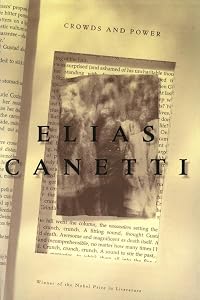
Crowds and Power
by Elias Canetti
On This Page
Description
Crowds and Power is a revolutionary work in which Elias Canetti finds a new way of looking at human history and psychology. Breathtaking in its range and erudition, it explores Shiite festivals and the English Civil war, the finger exercises of monkeys and the effects of inflation in Weimar Germany. In this study of the interplay of crowds, Canetti offers one of the most profound and startling portraits of the human condition.Tags
Recommendations












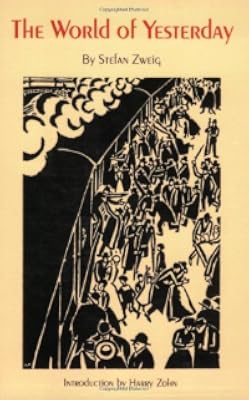
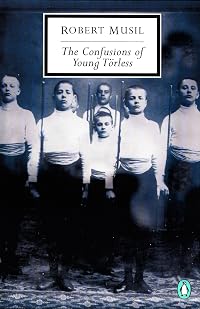
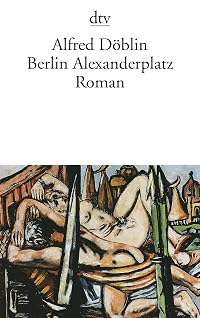



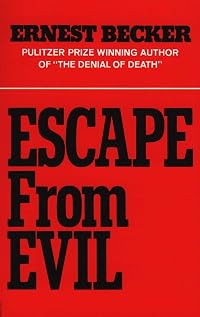






Member Recommendations
gust In een van de hoofdstukken geeft Canetti zijn visie op Schreber.
01

Member Reviews
A book written with an individual, literary sense of research (power) backed up by a litany of references from ancient times to the 1950s (crowd), this book is a paradox of prophesy and outdatedness that strikes a chord due to Canetti's excellent writing. Some of the borrowed descriptions of rituals and events in different cultures are fascinating, while Canetti's writing is strongest when it is metaphorical and descriptive. On rare occasions in this monumental book the writing gets slow or old-fashioned, but 'Crowds and Power' is still a well of information and ideas that resonates today as much as when it was published.
While waiting for another book in a library, saw it on an open shelf, and remembered that few times somebody quoted it, but I still had not read it.
Well, I liked the style and language structure, but my German isn't yet good enough to read it fast enough.
So, picked up also the Italian version, and once in a while looked at both.
My main interest was the discussion about "mass", "meute" (pack), and other associated structural elements , as well as the taxonomy of behavioral patterns, as part of my review of material on cultural anthropology for some digital transformation publications.
Hopefully will re-read it in whole in German in due time.
Well, I liked the style and language structure, but my German isn't yet good enough to read it fast enough.
So, picked up also the Italian version, and once in a while looked at both.
My main interest was the discussion about "mass", "meute" (pack), and other associated structural elements , as well as the taxonomy of behavioral patterns, as part of my review of material on cultural anthropology for some digital transformation publications.
Hopefully will re-read it in whole in German in due time.
This is not Margaret Mead's 'Coming of Age in Samoa,' but it does share a lot of the same 'impressionistic' style we also find in Mead's classic. In fact, Crowds and Power reads more like a fictional account at times than a "serious" attempt at anthropology or philosophy. And therein lies its secret perhaps: in essence, this book is a collection of stories, not a collection of essays. It is similar, in that sense, to The Earwitness (https://www.goodreads.com/book/show/1107912.Earwitness), a collection of vignettes.
This hybrid style makes for relatively easy reading: not too many endnotes, although there is an extensive bibliography attached, just so we don't go believing that this man made up everything all by himself. Recommended for show more anyone interested in exploring the universe of so many different types of crowds, and of the objects and tools of power, such as orders, questions, secrets and the command of time. Canetti makes for an eloquent guide into these fascinating, and often dark lands. show less
This hybrid style makes for relatively easy reading: not too many endnotes, although there is an extensive bibliography attached, just so we don't go believing that this man made up everything all by himself. Recommended for show more anyone interested in exploring the universe of so many different types of crowds, and of the objects and tools of power, such as orders, questions, secrets and the command of time. Canetti makes for an eloquent guide into these fascinating, and often dark lands. show less
Even though I did not understand this book entirely, it made a considerable change in my way of thinking and looking at matters concerning not only crowds and power, but also other human activities and behaviors. I hope I will reread this book after a few years with a more improved and developed mind, and will be able to grasp better the concepts explained by this Nobel winning author.
Canetti’s triumph lies in the dissemination of all this information and putting it as an interesting read. This book is more akin to The Golden Bough by Sir James Fraser.
A deductive study of the human psyche within all of us. The author leads the reader through the maze of human thought using detailed reports of the behavior of primitive cultures, well documented historical figures and mental health patients. Pealing back the protective shell we all construct around ourselves he reveals the hidden 'survivor' within each of us, the desire to be the last one standing. He shows how the 'survivor' reaches the highest form in tribal leaders, kings, despots and politicians, the most dangerous being the paranoid despot.
Interesting view of the behavior of crowds and leaders and how they interact and grow. Uses many anthropoligical examples, although some links are more tenuous than others. Extremely interesting.
Members
- Recently Added By
Lists

Política - Clásicos
164 works; 2 members

The Joe Rogan Experience Library
254 works; 3 members

Tom's Bookstore
346 works; 2 members

Books in the Bibliography of The Dawn of Everything by Graeber & Wengrow
478 works; 2 members
Author Information

93+ Works 10,502 Members
Elias Canetti was born in Rustschuk, Bulgaria on July 25, 1905 into a Sephardic Jewish family. He was educated in Germany, Switzerland, and Austria and received a Ph.D. in chemistry from the University of Vienna in 1929. He wrote novels and plays in German. His works explored the emotions of crowds, the psychopathology of power, and the position show more of the individual at odds with the society around him. His novels include Auto-da- Fé and Masse und Macht. His plays include Hochzeit, Komödie der Eitelkeit, and Die Befristeten. He also published excerpts from his notebooks, a book of character sketches, and an autobiography. He received numerous awards including the Vienna Prize in 1966, the Critics Prize (Germany) in 1967, the Great Austrian State Prize in 1967, the Buchner Prize in 1972, the Sachs Prize in 1975, the Hebbel Prize in 1980, and the Nobel Prize for Literature in 1981. He died on August 14, 1994. (Bowker Author Biography) show less
Some Editions
Awards and Honors
Series
Belongs to Publisher Series
Gli Adelphi [Adelphi] (474)
Fischer Taschenbuch (6544)
Work Relationships
Common Knowledge
- Canonical title
- Crowds and Power
- Original title
- Masse und Macht
- Original publication date
- 1960
- Important places*
- Oostenrijk; Roese, Bulgarije; Bulgarije
- Quotations
- There is nothing that man fears more than the touch of the unknown.
- Publisher's editor*
- Cilvēks un sabiedrība
- Original language*
- Duits
*Some information comes from Common Knowledge in other languages. Click "Edit" for more information.
Classifications
- Genres
- Sociology, Nonfiction, Philosophy, General Nonfiction, History
- DDC/MDS
- 302.33 — Society, government, & culture Social sciences, sociology & anthropology Mass Communication & Media Social interaction within groups Social interaction in abstract and temporary groups
- LCC
- HM281 .C3613 — Social sciences Sociology (General) Sociology These are obsolete numbers no longer used
- BISAC
Statistics
- Members
- 1,597
- Popularity
- 14,298
- Reviews
- 16
- Rating
- (4.17)
- Languages
- 20 — Czech, Danish, Dutch, English, Estonian, Finnish, French, German, Greek, Hebrew, Hungarian, Italian, Latvian, Norwegian (Bokmål), Romanian, Russian, Spanish, Swedish, Turkish, Portuguese (Portugal)
- Media
- Paper, Audiobook, Ebook
- ISBNs
- 73
- ASINs
- 16