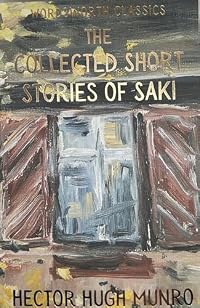
The Short Stories of Saki
by Saki
On This Page
Description
Immerse yourself in a world where the wonderful Stephen Fry reads some of the more memorable short stories of our time. A brilliant combination of reader and writer come together in these seven short stories available on digital download only. Stephen writes "Saki remains, from a distance of a hundred years, just about the sharpest, cruelest, funniest and most elegant short story writer in our language. Hector Hugh Monro, to give him his real name, was an English writer and journalist whose show more life was cut short by the Great War. His stories often oppose nature and civilization, with the more macabre elements of nature usually rising to victory. My favorite of his stories is Sredni Vashtar, as perfect a symbolic tale of the power of adolescence as is imaginable. The triumph of imagination, sexuality and life over the repressive forces of conventionality has never been more perfectly or shockingly expressed. The excellence of Tobermory, the talking cat, of The unrest Cure and the Open Window all reveal that unique blend of Wodehousian social comedy with wicked cruelty. Saki is like a perfect martini but with absinthe stirred in…heady, delicious and dangerous. Enjoy" Stephen Fry 2009 Immerse yourself in a world where the wonderful Stephen Fry reads some of the more memorable short stories of our time. A brilliant combination of reader and writer come together in these seven short stories. show lessTags
Recommendations



















Member Reviews
This is a singular book. For Americans, who might not be familiar with H. H. Munro (known as Saki), it can be a bit surprising the witheringly dry sense of humour that shows throughout the stories. Further, the tendency of his characters to employ sarcasm and outright invective towards the more pretentious members of society (who often seem to be scornful, flighty women), makes his book seem like an unlikely companion to Jane Austen's work. However, while Austen was more masterful in the development of characters that were realistic, Saki's main characters can sometimes seem like the fantastical superheros of a shrinking individual who hopes to vanquish those he deems to be too serious or self-satisfied; a vicarious visualization of show more what he wishes he could do. In that way, he writes much like an introverted adolescent might speak to themselves—after they have had to deal too much with overbearing and foolish adults. If you can get over some of the less delicate definitions of the fairer sex, and dispense with any shred of concern for social conventions, you might find this a rather humorous collection. show less
I started this collection thinking of Saki as a more transparently malicious version of P.G. Wodehouse; he eviscerates pompous society women in a few pen-strokes. The cruelty is always justified by character defect or wrong behavior on the part of the person being skewered, and the lively children (or perpetual-adolescents) — friends of animals — always prevail. I agree with one critic, quoted in the biography of Saki by E.M. Munro: "Munro's understanding of children can only be explained by the fact that he was in many ways a child himself: his sketches betray a harshness, a love of practical jokes, a craze for animals of the most exotic breeds, a lack of mellow geniality that hint very strongly at the child in the man. Manhood has show more but placed in his hands a perfect sense of irony and withheld all other adult traits."
Some of the these stories are masterful. In a few sentences, Saki paints a few characters with precision and sets up a conflict into which the antagonist wanders, usually unaware, with hilarious results.
How do I feel about the collection? The antagonists are often women (although girls are in a different category, apparently), and Saki skewers suffragettes, in particular, with regularity. It is certainly easier to find this humorous now that I can vote, although I admit those weren't my favorite stories. To me the autocratic aunts which haunt these stories and which are drawn from Munro's life seem sad, rather than powerful, making the casual cruelty toward them in bad taste. Am I imagining something that isn't there, or does the sadness come from Saki himself? In 'Excepting Mrs. Pentherby' Saki describes a communal country house where many couples reside for a season, sharing expenses. The house owner hires a woman to be annoying so that everybody's wives quarrel with her and there isn't a constantly shifting set of alliances. This is basically the plot of every reality show ever. At the end, the scheme is revealed to the owner's sister-in-law, who expresses one last burst of anger at the hired woman, but also at her brother-in-law, which Saki tries to deflect ("I think you are the most odious person in the whole world," said Reggie's sister-in-law. Which was not strictly true; more than anybody, more than ever she disliked Mrs. Pentherby. It was impossible to calculate how many quarrels that women had done her out of.) This is not a great, successful, story — the sister-in-law is not ridiculous enough to have deserved the prank, and the entire thing relies on one's supposed assumption that women (more than men) like to quarrel with each other. At the end I felt badly for the sister in law, which was obviously not the stated intention, although that emotion comes from the way that the sister-in-law is portrayed as mostly blameless.
This is the first Saki that I've read, and It probably would have been smarter to start off with a smaller curated collection. But this large volume piqued my interest, and I believe those less-well-known stories gave me a better glimpse of the author. show less
Some of the these stories are masterful. In a few sentences, Saki paints a few characters with precision and sets up a conflict into which the antagonist wanders, usually unaware, with hilarious results.
How do I feel about the collection? The antagonists are often women (although girls are in a different category, apparently), and Saki skewers suffragettes, in particular, with regularity. It is certainly easier to find this humorous now that I can vote, although I admit those weren't my favorite stories. To me the autocratic aunts which haunt these stories and which are drawn from Munro's life seem sad, rather than powerful, making the casual cruelty toward them in bad taste. Am I imagining something that isn't there, or does the sadness come from Saki himself? In 'Excepting Mrs. Pentherby' Saki describes a communal country house where many couples reside for a season, sharing expenses. The house owner hires a woman to be annoying so that everybody's wives quarrel with her and there isn't a constantly shifting set of alliances. This is basically the plot of every reality show ever. At the end, the scheme is revealed to the owner's sister-in-law, who expresses one last burst of anger at the hired woman, but also at her brother-in-law, which Saki tries to deflect ("I think you are the most odious person in the whole world," said Reggie's sister-in-law. Which was not strictly true; more than anybody, more than ever she disliked Mrs. Pentherby. It was impossible to calculate how many quarrels that women had done her out of.) This is not a great, successful, story — the sister-in-law is not ridiculous enough to have deserved the prank, and the entire thing relies on one's supposed assumption that women (more than men) like to quarrel with each other. At the end I felt badly for the sister in law, which was obviously not the stated intention, although that emotion comes from the way that the sister-in-law is portrayed as mostly blameless.
This is the first Saki that I've read, and It probably would have been smarter to start off with a smaller curated collection. But this large volume piqued my interest, and I believe those less-well-known stories gave me a better glimpse of the author. show less
Nice characterization: Witty horror stories somewhat in the style of Stephen King or Brian Evenson.
Mean characterization: Stories for Sadists.
Defense: "You knew what I was when you picked me up."
Me: Yes, I guess I did.
Mean characterization: Stories for Sadists.
Defense: "You knew what I was when you picked me up."
Me: Yes, I guess I did.
"Tell me a story," said the Baroness, staring out despairingly at the rain; it was that light, apologetic sort of rain that looks as if it was going to leave off every minute and goes on for the greater part of the afternoon.
"What sort of story?" asked Clovis, giving his croquet mallet a valedictory shove into retirement.
"One just true enough to be interesting and not true enough to be tiresome," said the Baroness.
Clovis rearranged several cushions to his personal solace and satisfaction; he knew that the Baroness liked her guests to be comfortable, and he thought it right to respect her wishes in that particular.
"Have I ever told you the story of St. Vespaluus?" he asked.
"You've told me stories about grand-dukes and lion-tamers and show more financiers' widows and a postmaster in Herzegovina," said the Baroness, "and about an Italian jockey and an amateur governess who went to Warsaw, and several about your mother, but certainly never anything about a saint."
I just love Saki. My parents had a copy of his stories so I read them when I was quite young and bought my own copy when I moved out.
I found the story 'Gabriel-Ernest' incredibly scary when I first read it as a child, even though nothing much actually happens. It's all down to the atmosphere and what is implied. The other one that really scared me, was 'The Music on the Hill' where Sylvia goes to live in the country and unfortunately manages to upset the Great God Pan.
Most of the stories however, are humorous, and are set in the upper class world of Britain before the Great War, with a lot of them featuring quite cruel practical jokes. Saki had a dark sense of humour and a hatred of Aunts, due to being brought up by two of his aunts while his father was serving in the East.
This book included some very funny tales that hadn't made it into the 'best of' collections that I have read in the past, as well as a few duds. show less
"What sort of story?" asked Clovis, giving his croquet mallet a valedictory shove into retirement.
"One just true enough to be interesting and not true enough to be tiresome," said the Baroness.
Clovis rearranged several cushions to his personal solace and satisfaction; he knew that the Baroness liked her guests to be comfortable, and he thought it right to respect her wishes in that particular.
"Have I ever told you the story of St. Vespaluus?" he asked.
"You've told me stories about grand-dukes and lion-tamers and show more financiers' widows and a postmaster in Herzegovina," said the Baroness, "and about an Italian jockey and an amateur governess who went to Warsaw, and several about your mother, but certainly never anything about a saint."
I just love Saki. My parents had a copy of his stories so I read them when I was quite young and bought my own copy when I moved out.
I found the story 'Gabriel-Ernest' incredibly scary when I first read it as a child, even though nothing much actually happens. It's all down to the atmosphere and what is implied. The other one that really scared me, was 'The Music on the Hill' where Sylvia goes to live in the country and unfortunately manages to upset the Great God Pan.
Most of the stories however, are humorous, and are set in the upper class world of Britain before the Great War, with a lot of them featuring quite cruel practical jokes. Saki had a dark sense of humour and a hatred of Aunts, due to being brought up by two of his aunts while his father was serving in the East.
This book included some very funny tales that hadn't made it into the 'best of' collections that I have read in the past, as well as a few duds. show less
I’ve been meaning to dip into British short story writer Saki’s works for quite a while, and I came across this collection of four of his short stories in the library’s streaming audio collection. I had the impression that Saki’s stories were light and humorous. If he wrote any stories like that, they aren’t in this collection. These stories are macabre and unsettling. They’re good stories, but not what I was expecting.
Hysterically funny with Saki's good old-fashioned dry English wit. A collection of stories with rarely a miss and most will make you laugh out loud if you share Hector Hugh Munro's sense of the ridiculous.
In the introduction to this book is included the statement, “Saki’s short stories of urbane malice are like a fine dessert wine – they should be sipped, and savoured slowly; so intense are they that to read them at one sitting may induce a kind of literary dyspepsia.” I could not agree more. I approached this collection in such a fashion and cannot imagine trying to quickly read through this collection. Each story is a gem, and should be admired and reflected upon similar to the way one approaches gems – looked at from every side in order to fully appreciate the beauty; because these are beautiful pieces and each will have its own resonance and attraction.
Saki’s wry commentaries about life and subtle twists to bring them to show more conclusion are each a crafted work of art. Sure, not all are masterpieces. But, even when not quite hitting the mark, there is still enjoyment in watching the craftsman at work. And just about the time you think you have a handle on Saki’s humor, along comes a chilling story about werewolves, or a ghost story, or a collection about the war that shakes you from the comfortable satire evident in other pieces. It is easy to try and pigeonhole Saki’s work, but this full collection will help anyone broaden their understanding. Nowhere is this more evident than in the novels. Neither is what one would expect from Saki. While the wryness is still evident, neither has the lightheartedness the short stories bring forward. The first (The Unbearable Bassington) tells the tragedy of the British stiff upper lip in regards to a wayward son, and the second (When Willam Came) was an alternate history where Germany had taken over England. I will always retain the image from one of the later chapters where a displaced Englishwoman watches the Union Jack raised in a far away land. At first, I almost lowered the rating of this book because of the inclusion of these pieces. (Saki’s writing becomes a bit much in the short novel format), yet the skill was still there, the stories were still moving, and they have both haunted me after the reading.
Whether just now discovering Saki or already a fan, this is the ultimate book. Collections of complete works often have weak points (no one can always get it right), but the weak points in this one excels the best of most other authors’ works. show less
Saki’s wry commentaries about life and subtle twists to bring them to show more conclusion are each a crafted work of art. Sure, not all are masterpieces. But, even when not quite hitting the mark, there is still enjoyment in watching the craftsman at work. And just about the time you think you have a handle on Saki’s humor, along comes a chilling story about werewolves, or a ghost story, or a collection about the war that shakes you from the comfortable satire evident in other pieces. It is easy to try and pigeonhole Saki’s work, but this full collection will help anyone broaden their understanding. Nowhere is this more evident than in the novels. Neither is what one would expect from Saki. While the wryness is still evident, neither has the lightheartedness the short stories bring forward. The first (The Unbearable Bassington) tells the tragedy of the British stiff upper lip in regards to a wayward son, and the second (When Willam Came) was an alternate history where Germany had taken over England. I will always retain the image from one of the later chapters where a displaced Englishwoman watches the Union Jack raised in a far away land. At first, I almost lowered the rating of this book because of the inclusion of these pieces. (Saki’s writing becomes a bit much in the short novel format), yet the skill was still there, the stories were still moving, and they have both haunted me after the reading.
Whether just now discovering Saki or already a fan, this is the ultimate book. Collections of complete works often have weak points (no one can always get it right), but the weak points in this one excels the best of most other authors’ works. show less
Members
- Recently Added By
Lists

501 Must-Read Books
508 works; 72 members

wilfully eccentric little england (cosy read novels, england)
45 works; 15 members

20th Century Literature
1,161 works; 55 members

Folio Society
831 works; 48 members

Canon de la narrativa universal del siglo XX
254 works; 6 members

Best Laugh Out Loud Books
143 works; 49 members

Classic British Humor
41 works; 8 members

Harold Bloom - The Western Canon: D. The Chaotic Age
833 works; 24 members

Out of Copyright
244 works; 14 members

made me cackle as I read (fiction)
20 works; 3 members

Trinity College Booklist (1951): Class Ten, English Literature
358 works; 5 members

Books Read in 2008
335 works; 7 members

Art of Reading
188 works; 5 members

Books Read in 2024
4,623 works; 126 members
Author Information

318+ Works 6,373 Members
All Editions
Awards and Honors
Series
Belongs to Publisher Series
Work Relationships
Contains
Common Knowledge
- Canonical title
- The Complete Short Stories; Saki: The Complete Short Stories; The Short Stories of Saki
- Original publication date
- 1930
Classifications
Statistics
- Members
- 1,602
- Popularity
- 14,082
- Reviews
- 27
- Rating
- (4.13)
- Languages
- Dutch, English, German, Spanish
- Media
- Paper, Audiobook, Ebook
- ISBNs
- 32
- ASINs
- 50