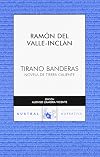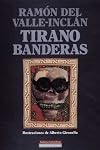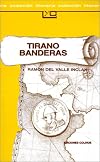
Tyrant Banderas
by Ramón del Valle-Inclán
On This Page
Description
The first great twentieth-century novel of dictatorship, and theavowed inspiration for Garcia Marquez's The Autumn of thePatriarch and Roa Bastos's I, the Supreme, Tyrant Banderasis a dark and dazzling portrayal of a mythical Latin AmericanRepublic in the grip of a monster. Valle-Inclan, one of themasters of Spanish modernism, combines the splintered pointsof view of a cubist painting with the campy excesses of 19thcenturyserial fiction to paint an astonishing picture of a ruthlesstyrant show more facing armed revolt.It is the Day of the Dead, and revolution has broken out, creatingmayhem from Baby Roach's Cathouse to the Harris Circusto the deep jungle of Tico Maipo. The tyrant steps forth,assuring all that he is in favor of freedom of assembly anddemocratic opposition. Meanwhile, his secret police lock up,torture, and execute students and Indian peasants in a sinistercastle by the sea where even the sharks have tired of a diet ofrevolutionary flesh. Then the opposition strikes back. Theybesiege the dictator's citadel, hoping to bring justice to a downtrodden,starving populace.Peter Bush's new translation of Valle-Inclan's seminal novel,the first into English since 1929, reveals a writer whose tragicsense of humor is as memorably grotesque and disturbing asGoya's in his The Disasters of War. show lessTags
Recommendations




















Member Recommendations

Member Reviews
Translation Tuesdays: Tyrant Banderas, by Ramón del Valle-Inclán
A series dedicated to literature in translation whether classic or contemporary.
Originally published as Tirano Banderas (1929)
Translated by Peter Bush
New York Review Books
Published in 1929, Tyrant Banderas, by Ramón del Valle-Inclán is a scabrous satire about the fictional Latin American dictatorship of Sante Fe de Tierra Firme. The combination of cubist perspective and campy excess represents a unique creation in Spanish literary modernism. Ruling his nation from the former monastery of Saint-Martin of the Monstenses, President Don Santos Banderas (aka Kid Santos, aka Tyrant Banderas) has to deal with an armed revolt. To add to the phantasmorgic atmosphere of the show more novel, the action takes place around the Day of the Dead, the political violence colliding with the carnivalesque.
Expertly translated by Peter Bush, the novel flows with a crazy energy, at once demotic, slangy, and lowbrow, combined with high-brow posturing from the military and political elites. As Alberto Manguel mentions in his introduction, the Spanish language versions of Tyrant Banderas usually come with an extensive glossary. Bush has done such a great job in translation that none is required, the various sub-cultural slang and street argot rendered into an easily understandable English that still captures the essence of the Spanish original.
Before proceeding, it is worth exploring the biography of Valle-Inclán. It is a political and literary career as strange as his fictional creations. In 1910, he ran for the Cortes, the people's chamber, having “conservative aristocratic sympathies.” After losing, he switched sides – also losing – this time as a leftist. Besides his leftist affiliations, he adopted Theosophy, a spiritualist philosophy that permeates Tyrant Banderas's narrative structure. Like one of his characters, Del Valle-Inclán had a “spindly frame, cutting wit, long hair, longer beard, black cape, and a single arm (the other having been lost after a fight with a critic).” Like Roberto Bolaño, Del Valle-Inclán was born in Spain but ended up in Mexico. His exile and disillusionment with the dictatorships of Mexico and Spain shaped Del Valle-Inclán's fiction, which he called esperpentos, meaning “grotesque and horrible things.”
The novel exhibits a delicate balance between finely calibrated artifice and barely controlled chaos. The fragmentary nature belies Del Valle-Inclán's Theosophical arrangement, the book and chapter numbers possessing a remarkable narrative and structural symmetry. The novel is arranged in seven parts, including a prologue and epilogue, each part containing three books, except for “Book Four: A Necromantic Amulet,” that contains seven books.
The prose is violent, decadent, and hallucinatory. As if from a Grimm fairytale, the reader hears about the sharks swimming around the Santa Mónica jail, bloated and bored from eating too much flesh of the prisoners being executed. The jail is introduced, “Ghastly legends of poisoned water, of snake-ridden dungeons, torturers' chains, racks, and hooks swathed the Fortress of Santa Mónica, home to countless political prisoners during revolutionary struggles.” The prose exhibits both a breathless melodramatic quality and is an inventory of garish images. In other chapters, the reader gets images reminiscent of a montage in film, itself a groundbreaking technique in the early history of cinema.
On the other end of the spectrum, there is the description of the Spanish Ambassador:
With a high brow stuffed with licentious fantasies, the Baron of Benicarlés, radiated a morbid romanticism, like the vicereine gazing at her own features in her garden mirror. His Excellency Don Mariano Isabel Cristino Queralt y Roca de Togores, Baron de Benicarlés and Master Chevalier of Ronda, chattered like an old spinster and pranced like a prima donna. Bleary eyed, stout, witless, and prattling, he exuded a saccharine sweetness. His hands and throats dripped flab; he parleyed with a French nasal twang; and his fleshy eyelids harbored gelid fantasies from perverse literature. He was a threadbare stuffed shirt, a literary snob, a dabbler in decadent salons redolent with the rites and catechisms of French poetasters.
He's the ultimate hipster, trendy and empty.
Tyrant Banderas is a wonderful addition to the growing literature of Latin American dictatorships. This early example, combining cinematic montage effects with scathing satire and surrealistic imagery, is a novel that confronts the ugliness of tyranny run amok but is also fun to read. The melodrama, the action, and the characters offer the reader a classic novel that is both accessible and entertaining. Too often literary experimentalism gets accolades despite its incomprehensible and impenetrable delivery (see The Cantos by Ezra Pound or the later works of Samuel Beckett). But this reflects the prejudices of the critic more than the worth of the artistic product. With Tyrant Banderas, one could even go so far as recommending it to readers with more mainstream preferences. The novel is remarkable for its excellent translation, capturing the vibrancy and violence of Del Valle-Inclán's language, and its easy accessibility for readers who dislike the term “literary” thrown in their direction. Cowboys, prostitutes, dictators, the Day of the Dead, sharks! There's no excuse not to enjoy that Whitman's Sampler of hallucinatory chaos.
http://driftlessareareview.com/2013/08/20/translation-tuesdays-tyrant-banderas-b... show less
A series dedicated to literature in translation whether classic or contemporary.
Originally published as Tirano Banderas (1929)
Translated by Peter Bush
New York Review Books
Published in 1929, Tyrant Banderas, by Ramón del Valle-Inclán is a scabrous satire about the fictional Latin American dictatorship of Sante Fe de Tierra Firme. The combination of cubist perspective and campy excess represents a unique creation in Spanish literary modernism. Ruling his nation from the former monastery of Saint-Martin of the Monstenses, President Don Santos Banderas (aka Kid Santos, aka Tyrant Banderas) has to deal with an armed revolt. To add to the phantasmorgic atmosphere of the show more novel, the action takes place around the Day of the Dead, the political violence colliding with the carnivalesque.
Expertly translated by Peter Bush, the novel flows with a crazy energy, at once demotic, slangy, and lowbrow, combined with high-brow posturing from the military and political elites. As Alberto Manguel mentions in his introduction, the Spanish language versions of Tyrant Banderas usually come with an extensive glossary. Bush has done such a great job in translation that none is required, the various sub-cultural slang and street argot rendered into an easily understandable English that still captures the essence of the Spanish original.
Before proceeding, it is worth exploring the biography of Valle-Inclán. It is a political and literary career as strange as his fictional creations. In 1910, he ran for the Cortes, the people's chamber, having “conservative aristocratic sympathies.” After losing, he switched sides – also losing – this time as a leftist. Besides his leftist affiliations, he adopted Theosophy, a spiritualist philosophy that permeates Tyrant Banderas's narrative structure. Like one of his characters, Del Valle-Inclán had a “spindly frame, cutting wit, long hair, longer beard, black cape, and a single arm (the other having been lost after a fight with a critic).” Like Roberto Bolaño, Del Valle-Inclán was born in Spain but ended up in Mexico. His exile and disillusionment with the dictatorships of Mexico and Spain shaped Del Valle-Inclán's fiction, which he called esperpentos, meaning “grotesque and horrible things.”
The novel exhibits a delicate balance between finely calibrated artifice and barely controlled chaos. The fragmentary nature belies Del Valle-Inclán's Theosophical arrangement, the book and chapter numbers possessing a remarkable narrative and structural symmetry. The novel is arranged in seven parts, including a prologue and epilogue, each part containing three books, except for “Book Four: A Necromantic Amulet,” that contains seven books.
The prose is violent, decadent, and hallucinatory. As if from a Grimm fairytale, the reader hears about the sharks swimming around the Santa Mónica jail, bloated and bored from eating too much flesh of the prisoners being executed. The jail is introduced, “Ghastly legends of poisoned water, of snake-ridden dungeons, torturers' chains, racks, and hooks swathed the Fortress of Santa Mónica, home to countless political prisoners during revolutionary struggles.” The prose exhibits both a breathless melodramatic quality and is an inventory of garish images. In other chapters, the reader gets images reminiscent of a montage in film, itself a groundbreaking technique in the early history of cinema.
On the other end of the spectrum, there is the description of the Spanish Ambassador:
With a high brow stuffed with licentious fantasies, the Baron of Benicarlés, radiated a morbid romanticism, like the vicereine gazing at her own features in her garden mirror. His Excellency Don Mariano Isabel Cristino Queralt y Roca de Togores, Baron de Benicarlés and Master Chevalier of Ronda, chattered like an old spinster and pranced like a prima donna. Bleary eyed, stout, witless, and prattling, he exuded a saccharine sweetness. His hands and throats dripped flab; he parleyed with a French nasal twang; and his fleshy eyelids harbored gelid fantasies from perverse literature. He was a threadbare stuffed shirt, a literary snob, a dabbler in decadent salons redolent with the rites and catechisms of French poetasters.
He's the ultimate hipster, trendy and empty.
Tyrant Banderas is a wonderful addition to the growing literature of Latin American dictatorships. This early example, combining cinematic montage effects with scathing satire and surrealistic imagery, is a novel that confronts the ugliness of tyranny run amok but is also fun to read. The melodrama, the action, and the characters offer the reader a classic novel that is both accessible and entertaining. Too often literary experimentalism gets accolades despite its incomprehensible and impenetrable delivery (see The Cantos by Ezra Pound or the later works of Samuel Beckett). But this reflects the prejudices of the critic more than the worth of the artistic product. With Tyrant Banderas, one could even go so far as recommending it to readers with more mainstream preferences. The novel is remarkable for its excellent translation, capturing the vibrancy and violence of Del Valle-Inclán's language, and its easy accessibility for readers who dislike the term “literary” thrown in their direction. Cowboys, prostitutes, dictators, the Day of the Dead, sharks! There's no excuse not to enjoy that Whitman's Sampler of hallucinatory chaos.
http://driftlessareareview.com/2013/08/20/translation-tuesdays-tyrant-banderas-b... show less
I found this book fascinating on several levels. First, it is the story of a Latin American dictator of a fictional country, but written by a Spanish author in the 1920s. Second, del Valle-Inclán's writing style is wonderful: he uses a mixture of perspectives, alternating among them, and writes with an almost surrealistic feeling (in these, he set the stage for future Latin American writers). And third, the book has a tight numerical structure. It is divided into seven parts, each made up of three "books," except the fourth part which has seven "books." Each "book" is then divided into a varying number of short sections. There are also a prologue and an epilogue
The novel takes place over a two-day period including, tellingly, the Day show more of the Dead. The reader learns from the prologue that there is a revolt against Tyrant Banderas planned for that day. Then the novel switches to a a complex mixture of voices, from the tyrant himself to his sycophants, the representative of the Spanish crown, other ambassadors, several prostitutes, an opposition leader and his supporters, a betrayer, a student who gets mixed up in the plot and his mother, and many more. Sometimes it takes a while to make sure whose perspective is whose. (The blurb on the back of my NYRB edition describes the writing as "cubist.") Several locations are dramatically described, including the old monastery that the dictator has made his headquarters and home and an old castle by the sea that now serves as the Tyrant's prison (sharks feature in this too). In less than 200 pages, del Valle-Inclán paints a full portrait of a dictator, his crimes, the people fighting against him, and the people who benefit from his rule.
There is much that is chilling in this book, and much that is impressive. show less
The novel takes place over a two-day period including, tellingly, the Day show more of the Dead. The reader learns from the prologue that there is a revolt against Tyrant Banderas planned for that day. Then the novel switches to a a complex mixture of voices, from the tyrant himself to his sycophants, the representative of the Spanish crown, other ambassadors, several prostitutes, an opposition leader and his supporters, a betrayer, a student who gets mixed up in the plot and his mother, and many more. Sometimes it takes a while to make sure whose perspective is whose. (The blurb on the back of my NYRB edition describes the writing as "cubist.") Several locations are dramatically described, including the old monastery that the dictator has made his headquarters and home and an old castle by the sea that now serves as the Tyrant's prison (sharks feature in this too). In less than 200 pages, del Valle-Inclán paints a full portrait of a dictator, his crimes, the people fighting against him, and the people who benefit from his rule.
There is much that is chilling in this book, and much that is impressive. show less
Amazing writing from 1926 -- mold breaking with short, cinematic cutting, tough characters speaking in multiple dialects, no quarter rebellion and repression in an unnamed country but whose Tyrant Banderas is modeled after both Mexico's Profirio Diaz and Spain's Primo De Rivera. Bush translation is very good but misses being exemplary with some odd choices/ too modern in English for these rural folks : "he talks dirty to the babes in low-cut nightgowns,..,. a "braying" piano; Maybe some British-isms that just escaped me: "Big Mama buoys her buttocks..." "the girl on the game covers his mouth..." Now, translation is an impossible task, and Bush is very good, I think this could have been better however. "Press-gang is out and about" show more rounding up Indians? For me that is heavily time and nation marked, almost always about sailors. And "out and about" by a dirt poor Indian? How about something like, "They're out rounding us up..." In fact, it's not even clear from the context whether the Indians are being captured for being Indians or for some kind of deputized service. Anyhoo, it's a good read, alone with say, Lord Jim, or B. Traven's wonderful novels. show less
Visionary book about the inclination of Central and South American countries to dictatorial systems, which certainly can be seen as inherited from Europe.
The spanish used was really complicated, even for a native speaker. The author likes to combine expression from several regions, creating a unique language
8481301418
Members
- Recently Added By
Lists

Books Read in 2016
4,666 works; 199 members

Las 100 Mejores Novelas en Castellano del Siglo XX
105 works; 13 members

Canon de la narrativa universal del s. XX (cicutadry)
499 works; 3 members

España en cien libros
100 works; 1 member
Author Information

238+ Works 3,249 Members
Galician by birth, Madrilenian by adoption, Ramon del Valle-Inclan was Spain's foremost prose stylist of the twentieth century. He is remembered in Spain almost as much for the colorful Bohemian persona he adopted and made famous as for his writings. Valle-Inclan began his career as a decadent aesthete, much influenced by the fin-de-siecle French show more symbolists. The four novels he entitled Sonatas (1902--05)---one for each season of the year---recount four erotic episodes in the life of the Marques de Bradomin, an "ugly, Catholic, sentimental Don Juan." His dramatic trilogy of "barbaric comedies"---Heraldic Eagle (1907), Romance of Wolves (1908), and Silver Face (1922)---powerfully evokes the primitive grandeur of his native Galicia. Long considered unperformable on account of their violence and obscenity, these plays have enjoyed great critical and popular success since Franco's death. The Lamp of Marvels (1916) contains Valle's aesthetic philosophy. The last stage of Valle's career was marked by the creation of a new type of novel he christened the esperpento: a stylized, dehumanized, highly objective satiric form well suited to express the crisis in values occurring all over Europe immediately after World War I. (Bowker Author Biography) show less
Some Editions
Awards and Honors
Series
Belongs to Publisher Series
Common Knowledge
- Canonical title
- Tyrant Banderas
- Original title
- Tirano Banderas: Novela de tierra caliente
- Original publication date
- 1926
- People/Characters
- Santos Banderas; Filomeno Cuevas; Dominiciano de la Gándara; Don Roque Cepeda
- Related movies
- Tirano Banderas (1993)
- First words
- Filomeno Cuevas, criollo ranchero, había dispuesto para aquella noche armar a sus peonadas con los fusiles ocultos en un manigual, y las glebas de los indios, en difusas líneas, avanzaban por los esteros de Ticomaipú. Luna... (show all) clara, nocturnos horizontes profundos de susurros y ecos.
- Publisher's editor*
- Alonso Zamora Vicente (Austral)
- Original language
- Spanish
*Some information comes from Common Knowledge in other languages. Click "Edit" for more information.
Classifications
Statistics
- Members
- 490
- Popularity
- 61,763
- Reviews
- 13
- Rating
- (3.63)
- Languages
- 7 — Danish, English, French, German, Italian, Portuguese, Spanish
- Media
- Paper, Audiobook, Ebook
- ISBNs
- 46
- ASINs
- 16