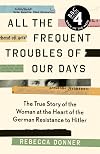
All the Frequent Troubles of Our Days: The True Story of the American Woman at the Heart of the German Resistance to Hitler
by Rebecca Donner
On This Page
Description
Part biography, part political thriller, part scholarly detective story that draws on letters, diary entries, notes smuggled out of a Berlin prison, and other documents, this true story chronicles the life and brutal death of Mildred Harnack, the American leader of one of the largest underground resistance groups in Germany.Tags
Recommendations














































Member Reviews
I am devastated. I am enlightened. I am in awe.
Rebecca Donner has taken a buried life and resurrected it in a narrative nonfiction that grabbed my attention and didn’t let go. Do
Donner is the great-great niece of her subject, Mildred Harnack, an American who traveled to Berlin to study and teach. At University of Wisconsin she fell in love with a fellow student, the German Arvid. They moved to Berlin during a time of great freedom. Mildred runs the English club where the talk is all political.
“Life is good,” Mildred writes. But it is January, 1933 and Hitler’s rise to power is just beginning.
Mildred’s passion was for equality and justice for the common man. The American Literature she taught to German Students books that show more shared her values. As the Nazis rose to power, Mildred and Arvid became a part of the Resistance. Arvid masqueraded as a loyal Nazi government worker, slipping confidential information into the Soviet Union. Mildred’s club became a salon for the resistance.
They were outed by an inexperienced pianist who used their real names instead of code names. The entire Circle was arrested, tortured, imprisoned, and after a kangaroo court trial, beheaded. Because they had been in communication with the Soviets, the United States had little interest in Mildred’s fate, and what information was made public was slanted and incorrect.
Mildred was an amazing woman, strong in her convictions, even when starving, even in solitary confinement and battling TB, up to her last moments which were spend translating Goethe into English with a pencil stub while shackled in a cold cell.
Donner sets Mildred’s story against the rise of Hitler. Those in power thought he was a fool, a crackpot who could be controlled. But Hitler systematically dismantled every check and balance in government, told grand lies to rally the people, affirming his desire for peace while planning for war. It is a terrifying look at history and a warning of how easily one person can topple a government.
I knew that Neville Chamberlain was fooled by Hitler. I had not known that Stalin was also duped, signing a non-aggression pact with Germany while Hitler built up his war machine to attack the Soviet Union.
Famous people appear in the story. There is Arvid’s cousin Dietrich Bonhoeffer, the Lutheran pastor famous for his involvement in the plot to kill Hitler. He was arrested because of his relationship to Arvid. Mildred was friends with the American Ambassador to Berlin’s daughter, Martha Dodd. Martha fell in love with men easily, even Nazis and Soviet spies. She had a relationship with Thomas Wolfe when he returned to Germany to spend the profits from his books that had sold so well there. The Nazi forbade money to leave the country! And, Mildred was a big fan. Later, Wolfe wrote “I Have a Thing To Tell You,” speaking of the changes he had seen in Germany, writing, “What George began to see was a picture of a great people who had been psychically wounded and were now desperately ill with some dread malady of the soul. Here was an entire nation, he now realized, that was infested with the contagion of an ever-present fear.”
Donner’s book is a stand-out not just for Mildred’s powerful story, but also for the scholarship and research that supports it, and for being a mesmerizing tale that is as emotionally impactful as a novel while making history understandable and relevant.
I received a free egalley from the publisher through NetGalley. My review is fair and unbiased. show less
Rebecca Donner has taken a buried life and resurrected it in a narrative nonfiction that grabbed my attention and didn’t let go. Do
Donner is the great-great niece of her subject, Mildred Harnack, an American who traveled to Berlin to study and teach. At University of Wisconsin she fell in love with a fellow student, the German Arvid. They moved to Berlin during a time of great freedom. Mildred runs the English club where the talk is all political.
“Life is good,” Mildred writes. But it is January, 1933 and Hitler’s rise to power is just beginning.
Mildred’s passion was for equality and justice for the common man. The American Literature she taught to German Students books that show more shared her values. As the Nazis rose to power, Mildred and Arvid became a part of the Resistance. Arvid masqueraded as a loyal Nazi government worker, slipping confidential information into the Soviet Union. Mildred’s club became a salon for the resistance.
They were outed by an inexperienced pianist who used their real names instead of code names. The entire Circle was arrested, tortured, imprisoned, and after a kangaroo court trial, beheaded. Because they had been in communication with the Soviets, the United States had little interest in Mildred’s fate, and what information was made public was slanted and incorrect.
Mildred was an amazing woman, strong in her convictions, even when starving, even in solitary confinement and battling TB, up to her last moments which were spend translating Goethe into English with a pencil stub while shackled in a cold cell.
Donner sets Mildred’s story against the rise of Hitler. Those in power thought he was a fool, a crackpot who could be controlled. But Hitler systematically dismantled every check and balance in government, told grand lies to rally the people, affirming his desire for peace while planning for war. It is a terrifying look at history and a warning of how easily one person can topple a government.
I knew that Neville Chamberlain was fooled by Hitler. I had not known that Stalin was also duped, signing a non-aggression pact with Germany while Hitler built up his war machine to attack the Soviet Union.
Famous people appear in the story. There is Arvid’s cousin Dietrich Bonhoeffer, the Lutheran pastor famous for his involvement in the plot to kill Hitler. He was arrested because of his relationship to Arvid. Mildred was friends with the American Ambassador to Berlin’s daughter, Martha Dodd. Martha fell in love with men easily, even Nazis and Soviet spies. She had a relationship with Thomas Wolfe when he returned to Germany to spend the profits from his books that had sold so well there. The Nazi forbade money to leave the country! And, Mildred was a big fan. Later, Wolfe wrote “I Have a Thing To Tell You,” speaking of the changes he had seen in Germany, writing, “What George began to see was a picture of a great people who had been psychically wounded and were now desperately ill with some dread malady of the soul. Here was an entire nation, he now realized, that was infested with the contagion of an ever-present fear.”
Donner’s book is a stand-out not just for Mildred’s powerful story, but also for the scholarship and research that supports it, and for being a mesmerizing tale that is as emotionally impactful as a novel while making history understandable and relevant.
I received a free egalley from the publisher through NetGalley. My review is fair and unbiased. show less
Can I rate a book as 4 stars if I haven't finished it? Well, I did. Rebecca Donner does an excellent job of presenting the almost unbelievable story of her Gr Gr Aunt, Mildred Fish Harnack from WI who was executed in 1943 by Germany for her work in the resistance. I've read other books about this group and time, but this does such a great job of presenting the time period where the Nazi Party comes to power and manged to take over a country that had more rights for women and workers than most others and make it what it became. It was really hard reading that at this time, hence I didn't finish it. May need to own it though so I can finish it some time.
Milwaukee-born Mildred Harnack (nee Fish) met Arvid Harnack in 1926 when both were students at the University of Wisconsin. Arvid was a German student studying on a fellowship in Madison. After a brief engagement, they married, and in 1928, Mildred moved to Germany to live with her husband. Based in Berlin, she spent a number of years working as a professor and translator, and, along with Arvid, involved herself in political activism. With the rise of Hitler and the Nazi party, they began to recruit other like-minded individuals into an underground resistance group. Led by Mildred and her husband, they remained active from 1932 to 1942 when its members were finally rounded up and arrested by the Gestapo.
Over the years, the group show more distributed pamphlets urging resistance against the Nazi government, gathered intelligence to share with the American and Russian spy agencies, and helped Jews to escape Germany. To do so, members of the group (including Arvid) took jobs in different German agencies where they stole information to help bring down the regime. Mildred did the same by tutoring German soldiers needing to learn English for their duties. During this time, she also actively provided information to the American embassy in Berlin.
Rebecca Donner is the great-great-niece of Mildred, and because of this connection, she had access to her family letters. To flesh out the story of Mildred’s activities in Germany, Donner hunted down the letters, notes and memoirs from the collaborators working in the Resistance group. She also plumbed the archival records of the German, Russian, and U.S. governments. And what a fantastic story she tells, one of great courage against overwhelming odds of discovery. After the members were arrested in 1942, they underwent torture and were later put on trial, with most receiving death sentences. Mildred was beheaded by guillotine in 1943.
Mildred Harnack’s story is not well known in this country. One reason for this is that the United States government took pains to bury it, under the impression that both Mildred and her husband were Communist agents. Donner includes individual photographs of the members of the group taken after their arrest. While haunting, they are a testimony to their bravery in a country where opposing the Nazis was more than likely a death sentence. This book not only acknowledges Mildred’s Resistance activities, but honors them. show less
Over the years, the group show more distributed pamphlets urging resistance against the Nazi government, gathered intelligence to share with the American and Russian spy agencies, and helped Jews to escape Germany. To do so, members of the group (including Arvid) took jobs in different German agencies where they stole information to help bring down the regime. Mildred did the same by tutoring German soldiers needing to learn English for their duties. During this time, she also actively provided information to the American embassy in Berlin.
Rebecca Donner is the great-great-niece of Mildred, and because of this connection, she had access to her family letters. To flesh out the story of Mildred’s activities in Germany, Donner hunted down the letters, notes and memoirs from the collaborators working in the Resistance group. She also plumbed the archival records of the German, Russian, and U.S. governments. And what a fantastic story she tells, one of great courage against overwhelming odds of discovery. After the members were arrested in 1942, they underwent torture and were later put on trial, with most receiving death sentences. Mildred was beheaded by guillotine in 1943.
Mildred Harnack’s story is not well known in this country. One reason for this is that the United States government took pains to bury it, under the impression that both Mildred and her husband were Communist agents. Donner includes individual photographs of the members of the group taken after their arrest. While haunting, they are a testimony to their bravery in a country where opposing the Nazis was more than likely a death sentence. This book not only acknowledges Mildred’s Resistance activities, but honors them. show less
American expat Mildred Harnack and her husband, German economist Arvid Harnack, formed a Nazi resistance movement in Berlin and paid with their lives. Drawing from Mildred’s letters, various interviews, and archival documents, Donner pieces together an account of the rise of the Nazi party and the beginning of the Second World War. The use of present tense adds intensity to the narrative. While this approach feels fresh, it also lacks some context of parallel events and personalities who were unknown to Mildred. As Mildred’s great-great-niece, Donner had access to Mildred’s letters and other family material not previously available to other researchers.
This is a book that we know the beginning and the end, even before we turn the cover. Knowing what is going to happen to Rebecca Donner’s Great Great Aunt is terrifying, and all the while reading I kept hoping it wouldn’t happen, but this is a true story, and I can’t change the past. Ah, if one was able to change history, well, not possible.
Through the words of the author, we follow Mildred on her journeys, and her personal effort to thwart the evil that is being perpetrated on Europe.
We meet Mildred as she is leaving her teaching job in America, before she marries Arvid, and her move to Germany. She is totally unaware of the part she is about to play as the a leader in the German resistance.
This should really be required reading, show more walking in her shoes, would I have had the courage to do what she did? I would hope so, but I also hope I never have to make those choices.
This is a powerful read, and you will meet some well know individuals, some I was familiar with and others we get to know. These are remarkable people, who for some risked the ultimate!
I received a copy of this book from the Publisher Little, Brown and Company, and was not required to give a positive review. show less
Through the words of the author, we follow Mildred on her journeys, and her personal effort to thwart the evil that is being perpetrated on Europe.
We meet Mildred as she is leaving her teaching job in America, before she marries Arvid, and her move to Germany. She is totally unaware of the part she is about to play as the a leader in the German resistance.
This should really be required reading, show more walking in her shoes, would I have had the courage to do what she did? I would hope so, but I also hope I never have to make those choices.
This is a powerful read, and you will meet some well know individuals, some I was familiar with and others we get to know. These are remarkable people, who for some risked the ultimate!
I received a copy of this book from the Publisher Little, Brown and Company, and was not required to give a positive review. show less
Mildred Harnock was born and raised in Milwaukee, Wisconsin but after marrying a German student, Arvid, they moved to Berlin in the early 1930s where she taught American literature at the university. But as time passes and she witnesses the rise of Hitler, her outspoken nature ends up costing her her job. She organizes a group known as The Circle and they discuss, clandestinely, what is happening in Germany and how they might help. Needless to say, eventually, the Reich catches up with her, and she is imprisoned and eventually executed for treason. It seems every year I read about another heroic woman who impacted WWII in one way or another. Meticulously researched (Mildred is actually the author's great aunt) and beautifully written, show more this is a heartbreaking story that demonstrates once again the importance of the heroines who operated in Nazi Germany. show less
A true story of an unsung heroine of World War II All the Frequent Troubles of Our Days tells the story of Mildred Harnack, an American woman who goes to Germany in the 1930’s to study in a PhD program and stayed to organize resistance to the Nazi regime.
She organized other Germans into cells, developed a cipher to use for communication between group, distributed anti-Nazi propaganda, and was a spy and courier for the Allies providing them with top secret information. She almost made it, but on the eve of her escape to Sweden she was picked up by the Gestapo and executes in 1943. This woman was crazy brave.
Donner, who is Harnack’s great-great-niece draws on primary sources from Germany, Russia, England and her family archive in the show more US. Interweaving diaries, letters, survivors’ testimonies and declassified documents, Donner relates the story of a remarkable woman who deserves to be recognized and honored. show less
She organized other Germans into cells, developed a cipher to use for communication between group, distributed anti-Nazi propaganda, and was a spy and courier for the Allies providing them with top secret information. She almost made it, but on the eve of her escape to Sweden she was picked up by the Gestapo and executes in 1943. This woman was crazy brave.
Donner, who is Harnack’s great-great-niece draws on primary sources from Germany, Russia, England and her family archive in the show more US. Interweaving diaries, letters, survivors’ testimonies and declassified documents, Donner relates the story of a remarkable woman who deserves to be recognized and honored. show less
Members
- Recently Added By
Lists

Books Read in 2022
5,226 works; 115 members

History: War & Terrorism
64 works; 1 member
Author Information

4 Works 569 Members
Rebecca Donner was born in Vancouver, British Columbia, and received degrees from U.C. Berkeley and Columbia University. She was the literary director of the Fiction Series at New York City's KGB Bar, and is the editor of On the Rocks: The KGB Bar Fiction Anthology
All Editions
Some Editions
Awards and Honors
Awards
Common Knowledge
- Canonical title*
- Mildred ou Le destin exceptionnel d'une résistante américaine dans l'Allemagne nazie
- Original title
- All the frequent troubles of our days
- Original publication date
- 2021-08-03 (1e édition originale américaine, Little, Brown and Company) (1e é | dition originale amé | ricaine, Little, Brown and Company); 2022-10-27 (1e traduction et édition française, Héloïse d'Ormesson) (1e traduction et é | dition franç | aise, Hé | loï | se d'Ormesson)
- People/Characters*
- Mildred Harnack-Fish (1902-1943)
- Important places
- Germany
- Important events
- World War II
- Dedication
- For Mildred and Don
- First words
- [Author's Note] This is a work of nonfiction.
[Introduction] Her aim was self-erasure.
Snow. Fear. Light. One morning in December 1939, a eleven-year-old boy bursts out of the arched front door of an apartment building in Brlin, wondering whether he'll get caught. - Quotations
- We must bear in mind that translation is an art, not a science;
- Last words
- (Click to show. Warning: May contain spoilers.)[Author's Note] On February 16, 1943, he slipped the book into the folds of his robe and smuggled it out.
(Click to show. Warning: May contain spoilers.)[Introduction] He was just a boy when he met Mildred, young enough to be her son. I tracked him down, and implored him: What did she tell you? How did she enter a room? Did you hear her weep? Sing? Did she trust you?
(Click to show. Warning: May contain spoilers.)Don't forget, she told him. - Original language
- English
- Canonical DDC/MDS
- 943.155086092
- Canonical LCC
- DD256.4.B47
*Some information comes from Common Knowledge in other languages. Click "Edit" for more information.
Classifications
- Genres
- History, General Nonfiction, Biography & Memoir, Nonfiction
- DDC/MDS
- 943.155086092 — History & geography History of Europe Central Europe: Germany, Austria, Switzerland, Czech, Poland, Hungary Northeastern Germany Brandenburg and Berlin Berlin Historical periods 1866- 1933-1945 : Third Reich
- LCC
- DD256.4 .B47 — History of Europe, Asia, Africa and Oceania Germany History of Germany History By period Modern, 1519- 19th-20th centuries Revolution and Republic, 1918- Hitler, 1933-1945. National socialism Period of World War II, 1939-1945
- BISAC
Statistics
- Members
- 432
- Popularity
- 71,444
- Reviews
- 15
- Rating
- (4.27)
- Languages
- 6 — Catalan, English, French, Italian, Spanish, Swedish
- Media
- Paper, Audiobook, Ebook
- ISBNs
- 17
- ASINs
- 5