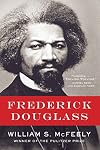
Frederick Douglass
by William S. McFeely
On This Page
Description
Explores the life of Frederick Douglass as he achieves stature as a leader in the struggle to transcend the limitations of bondage and race.Tags
Recommendations















Member Reviews
This book took me years to finish — not because it lacked quality, but because I read it during a stretch of life filled with stops, starts, and too many competing threads. Somewhere along the way, I gave myself permission to slow down: a page or two a day, steady as I go. That pace turned out to be exactly right.
Frederick Douglass is a splendid tome. A deeply humanizing biography. It bogged me down a bit in the middle — perhaps more my rhythm than the book’s fault — but by the final third, I couldn’t put it down. The man came alive for me. The words stopped being ink on paper and became a film in my mind. It was as if I was watching the scenes unfold — not just reading them.
The arc of Douglass’s life is epic, but McFeely show more handles it with dignity and restraint. Born in bondage near Chesapeake Bay, Douglass ends his life by returning to that same landscape — this time a free man, an old man, revisiting the shores that once held his boyhood dreams of escape. That full-circle moment hit me hard. It gave the book a quiet majesty.
Douglass is, perhaps, my favorite American in all of history. I was raised in Rochester, New York — his chosen home. As a boy, I asked my parents not to take me to the park or the movies, but to Mount Hope Cemetery to visit his grave. I felt proud to share space with his memory.
This book only deepened that connection. It reminded me why Douglass mattered then — and why he matters now. His voice, his moral clarity, his transformation from enslaved child to national conscience... these things still echo.
If life gives me enough years, I would love to read this book again — slowly, reverently, and with even more appreciation for the greatness it contains. show less
Frederick Douglass is a splendid tome. A deeply humanizing biography. It bogged me down a bit in the middle — perhaps more my rhythm than the book’s fault — but by the final third, I couldn’t put it down. The man came alive for me. The words stopped being ink on paper and became a film in my mind. It was as if I was watching the scenes unfold — not just reading them.
The arc of Douglass’s life is epic, but McFeely show more handles it with dignity and restraint. Born in bondage near Chesapeake Bay, Douglass ends his life by returning to that same landscape — this time a free man, an old man, revisiting the shores that once held his boyhood dreams of escape. That full-circle moment hit me hard. It gave the book a quiet majesty.
Douglass is, perhaps, my favorite American in all of history. I was raised in Rochester, New York — his chosen home. As a boy, I asked my parents not to take me to the park or the movies, but to Mount Hope Cemetery to visit his grave. I felt proud to share space with his memory.
This book only deepened that connection. It reminded me why Douglass mattered then — and why he matters now. His voice, his moral clarity, his transformation from enslaved child to national conscience... these things still echo.
If life gives me enough years, I would love to read this book again — slowly, reverently, and with even more appreciation for the greatness it contains. show less
Frederick Douglass was a towering figure, at once consummately charismatic and flawed. His Narrative of the Life of Frederick Douglass (1845) galvanized the antislavery movement and is one of the truly seminal works of African-American literature. In this masterful and compelling biography, William S. McFeely captures the many sides of Douglass―his boyhood on the Chesapeake; his self-education; his rebellion and rising expectations; his marriage, affairs, and intense friendships; his bitter defeat and transcendent courage―and recreates the high drama of a turbulent era.
A good, solid biography of Frederick Douglass. His whole story is told well, with solid research in primary and secondary sources. Douglass was a great man, and this biography shows you why he was a great man. Which is what a good biography should do. (I want to read David W. Blight's recent Frederick Douglass: Prophet of Freedom soon to compare the two.)
One issue. The author, McFeely, gets very Freudian many times. Every chapter or so, someone is gazing at Douglass sexually or homosexually or some incident is imbued with sexual feeling, repressed or subconscious. While that might sometimes be the case, it is mere supposition on McFeely's part. McFeely often puts the whippings of slaves as punishment in sexual terms. To paraphrase show more Freud, sometimes a whipping is just a whipping. Antebellum Southern slavery had a lot of sexual elements (Douglass's account of his bare-breasted auntie being whipped was definitely a case of sexual jealousy, for instance), but it was not a conspiracy of repressed bisexuals wishing they could have sex with their male slaves (Covey's beating of Douglass probably wasn't sexual in the least, however McFeely may suggest it was). (Shouldn't someone named "McFeely" be wary of Freudian interpretations?) show less
One issue. The author, McFeely, gets very Freudian many times. Every chapter or so, someone is gazing at Douglass sexually or homosexually or some incident is imbued with sexual feeling, repressed or subconscious. While that might sometimes be the case, it is mere supposition on McFeely's part. McFeely often puts the whippings of slaves as punishment in sexual terms. To paraphrase show more Freud, sometimes a whipping is just a whipping. Antebellum Southern slavery had a lot of sexual elements (Douglass's account of his bare-breasted auntie being whipped was definitely a case of sexual jealousy, for instance), but it was not a conspiracy of repressed bisexuals wishing they could have sex with their male slaves (Covey's beating of Douglass probably wasn't sexual in the least, however McFeely may suggest it was). (Shouldn't someone named "McFeely" be wary of Freudian interpretations?) show less
Very good condtion. Clean pages. Very minor creasing on cover.
Ratings
Members
- Recently Added By
Author Information

8+ Works 1,271 Members
McFeely has written the Pulitzer Prize-winning biography Grant, as well as other important works of history. He lives in Wellfleet, Massachusetts. (Bowker Author Biography)
Awards and Honors
Common Knowledge
- Canonical title
- Frederick Douglass
- Original publication date
- 1991
- People/Characters
- Frederick Douglass
- Important events
- Abolitionist Movement
Classifications
- Genres
- Nonfiction, Biography & Memoir, History, General Nonfiction
- DDC/MDS
- 973.7 — History & geography History of North America United States Civil War Era (1857-1865)
- LCC
- E449 .D75 .M374 — History of the United States United States Revolution to the Civil War, 1775/1783-1861 Slavery in the United States. Antislavery
- BISAC
Statistics
- Members
- 415
- Popularity
- 74,304
- Reviews
- 4
- Rating
- (4.16)
- Languages
- English
- Media
- Paper, Audiobook, Ebook
- ISBNs
- 9
- ASINs
- 9