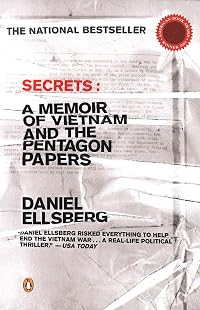
Secrets: A Memoir of Vietnam and the Pentagon Papers
by Daniel Ellsberg
On This Page
Description
Daniel Ellsberg began his career as a U.S. Marine company commander, a Pentagon official, and a staunch supporter of America's battle against Communist expansion. But in October 1969, Ellsberg--fully expecting to spend the rest of his life in prison--set out to turn around American foreign policy by smuggling out of his office the seven-thousand-page top-secret study, known as the Pentagon Papers, of U.S. decision making in Vietnam. Ellsberg tells the full story of how and why he became one show more of the nation's most impassioned and influential antiwar activists--and how his actions helped alter the course of U.S. history. Covering the decade between his entry into the Pentagon and Nixon's resignation, Secrets is Ellsberg's meticulously detailed insider's account of the secrets and lies that shaped American foreign policy during the Vietnam era. Ellsberg provides a vivid eyewitness account of the two years he spent behind the lines in Vietnam as a State Department observer--an experience that convinced him of the hopelessness of Johnson's policies and profoundly altered his own political thinking. As Ellsberg recounts with drama and insight, the release of the Pentagon Papers, first to The New York Times and The Washington Post, set in motion a train of events that ultimately toppled a president and helped to end an unjust war. Infused with the political passion and turmoil of the Vietnam era, Secrets is at once the memoir of a committed, daring man, an insider's expose of Washington, and a meditation on the meaning of patriotism under a government intoxicated by keeping secrets. show lessTags
Recommendations











Member Reviews
Ellsberg certainly likes himself in this revealing memoir, although I didn't care for the way the audiobook shifted back and forth between a narrator and Ellsberg himself. That being said, it's clear that Ellsberg, however laudable his motives, revels in rationalization for his actions. I was surprised by the role Neil Sheehan (author of the excellent https://www.goodreads.com/book/show/417640.A_Bright_Shining_Lie) played in spiriting off with a complete set of the documents he swiped from the apartment where Ellsberg was hiding the copies. Sheehan delivered them to the Times where they spent weeks going over everything in preparation for their publication. Ellsberg found this out only during the depositions for his trial when the show more infamous Howard Hunt's safe was found to contain evidence showing what Sheehan had been up to.
Once the Times had hold of the documents and had begun publishing, the Nixon administration went to court to get an injunction against publishing, the first time the press had been subject to prior restraint according to Ellsberg. I seem to remember the case of Near v Minnesota in which the Supreme Court had ruled prior restraint unconstitutional, but perhaps the erroneous clarion call of "national security" made the difference. In any case the Supreme Court in New York Times v United States ruled they could publish. One result was an awakening of the somnolent newspaper industry which had been mostly regurgitating government handouts with regard to foreign policy. A longer term effect was the steady erosion of unquestioning support for not just the war, but government itself.
Bob Haldeman had predicted as much in a conversation with Nixon:
To the ordinary guy, all this is a bunch of gobbledygook. But out of the gobbledygook comes a very clear thing.... You can't trust the government; you can't believe what they say; and you can't rely on their judgment; and the – the implicit infallibility of presidents, which has been an accepted thing in America, is badly hurt by this, because It shows that people do things the president wants to do even though it's wrong, and the president can be wrong.
The recent publication by the Post of the Afghanistan Papers reveals a similar pattern of mendacity and prevarication on the part of the government and military; the "we have just turned the corner," syndrome.
By that time it was all really moot anyway, as Ellsberg had, with the help of many friends who helped hide him and his wife while the FBI was looking for him, distributed sets to more than a dozen other papers. In fact, for a while Ellsberg must have felt he was living in a spy novel. He was hidden by friends who communicated in codes and talked only on pay phones (I wonder how that would go today -- I suppose the equivalent would be burner phones.)
Among the secrets revealed was that the president and his men kept two sets of books. Often even the pilots were unaware they were bombing in areas they had been told were off limits like Laos and North Vietnam. It got so bad that a lowly sergeant reported to his senator that everyone was lying. He was assuming the president didn't know, but it was the president who was orchestrating the whole thing.
By this time Ellsberg had been arrested and charged. Ironically, the U.S. did not have an Official Secrets Act. In fact Congress had specifically excluded whistle-blowers when it was debating what to do about leakers, although neither Ellsberg nor his attorneys knew that at the time.
I have to admit that Ellsberg probably should have gotten a medal simply for the fortitude in standing over an early Xerox machine to make copies of 7,000 pages. That, in itself, was punishment. show less
Once the Times had hold of the documents and had begun publishing, the Nixon administration went to court to get an injunction against publishing, the first time the press had been subject to prior restraint according to Ellsberg. I seem to remember the case of Near v Minnesota in which the Supreme Court had ruled prior restraint unconstitutional, but perhaps the erroneous clarion call of "national security" made the difference. In any case the Supreme Court in New York Times v United States ruled they could publish. One result was an awakening of the somnolent newspaper industry which had been mostly regurgitating government handouts with regard to foreign policy. A longer term effect was the steady erosion of unquestioning support for not just the war, but government itself.
Bob Haldeman had predicted as much in a conversation with Nixon:
To the ordinary guy, all this is a bunch of gobbledygook. But out of the gobbledygook comes a very clear thing.... You can't trust the government; you can't believe what they say; and you can't rely on their judgment; and the – the implicit infallibility of presidents, which has been an accepted thing in America, is badly hurt by this, because It shows that people do things the president wants to do even though it's wrong, and the president can be wrong.
The recent publication by the Post of the Afghanistan Papers reveals a similar pattern of mendacity and prevarication on the part of the government and military; the "we have just turned the corner," syndrome.
By that time it was all really moot anyway, as Ellsberg had, with the help of many friends who helped hide him and his wife while the FBI was looking for him, distributed sets to more than a dozen other papers. In fact, for a while Ellsberg must have felt he was living in a spy novel. He was hidden by friends who communicated in codes and talked only on pay phones (I wonder how that would go today -- I suppose the equivalent would be burner phones.)
Among the secrets revealed was that the president and his men kept two sets of books. Often even the pilots were unaware they were bombing in areas they had been told were off limits like Laos and North Vietnam. It got so bad that a lowly sergeant reported to his senator that everyone was lying. He was assuming the president didn't know, but it was the president who was orchestrating the whole thing.
By this time Ellsberg had been arrested and charged. Ironically, the U.S. did not have an Official Secrets Act. In fact Congress had specifically excluded whistle-blowers when it was debating what to do about leakers, although neither Ellsberg nor his attorneys knew that at the time.
I have to admit that Ellsberg probably should have gotten a medal simply for the fortitude in standing over an early Xerox machine to make copies of 7,000 pages. That, in itself, was punishment. show less
Words of James Madison, drafter of the First Amendment:
“A popular government, without popular information or the means of acquiring it, is but a prologue to a farce or a tragedy; or, perhaps, both. Knowledge will forever govern ignorance: And a people who mean to be their own governors must arm themselves with the power knowledge gives."
Words of H. R. Haldeman spoken to President Nixon, Oval Office tapes, June 14, 1971, on the impact of the Pentagon Papers:
"To the ordinary guy, all this is a bunch of gobbledygook. But out of the gobbledygook comes a very clear thing: you can’t trust the government; you can’t believe what they say; and you can’t rely on their judgement. And the implicit infallibility of presidents, which has been show more an accepted thing in America, is badly hurt by this, because it shows that people do things the president wants to do even though it’s wrong, and the president can be wrong.”
Ellsberg’s story of his deed is well told. Here is a man who risked his life for his country and then threw away his career and potentially his freedom to end a fruitless and murderous war. Score a point for the good guys. show less
“A popular government, without popular information or the means of acquiring it, is but a prologue to a farce or a tragedy; or, perhaps, both. Knowledge will forever govern ignorance: And a people who mean to be their own governors must arm themselves with the power knowledge gives."
Words of H. R. Haldeman spoken to President Nixon, Oval Office tapes, June 14, 1971, on the impact of the Pentagon Papers:
"To the ordinary guy, all this is a bunch of gobbledygook. But out of the gobbledygook comes a very clear thing: you can’t trust the government; you can’t believe what they say; and you can’t rely on their judgement. And the implicit infallibility of presidents, which has been show more an accepted thing in America, is badly hurt by this, because it shows that people do things the president wants to do even though it’s wrong, and the president can be wrong.”
Ellsberg’s story of his deed is well told. Here is a man who risked his life for his country and then threw away his career and potentially his freedom to end a fruitless and murderous war. Score a point for the good guys. show less
Although it is long and exhaustive and, can be argued, at times way too detailed, it is ultimately a compelling and fascinating story of how Ellsberg moved from an advisor to those running the Vietnam war to releasing the Pentagon Papers to try and stop it. Despite the slowish start, I ended up completely engrossed and really enjoying reading it. I'm looking forward to bookclub discussions.
The story of the man who helped bring down Richard Nixon and bring an end to the Vietnam War. This is an amazing book detailing the time he spent in Vietnam and researching for the Rand Corporation. What he finds is scandalous - the government was deceiving us and engaging in a massive cover-up that not only cost taxpayer dollars, but wrought a horrible price in human life in Indochina. A hero for our times who made "the truth shall set us free" a war cry.
Read this when I was in graduate school (2004) and it reinforces my opinion that well written non fiction can oftentimes be more compelling than fiction.
Ratings
Members
- Recently Added By
Lists

Recommend the 20 best books you've read in the last five years
2,168 works; 606 members

r/History Recommended Reading List
603 works; 12 members
Author Information

11+ Works 1,233 Members
Daniel Ellsberg, a Harvard graduate, ex-Marine, and Rand Corporation analyst, was recruited to serve in the Pentagon during the Johnson administration. Now a prominent speaker, writer, and activist, Ellsberg lives in California and Washington, D.C.
Awards and Honors
Awards
Notable Lists
Common Knowledge
- Original publication date
- 2002-10-15
- People/Characters
- Daniel Ellsberg; Richard M. Nixon
- Important places
- Vietnam
- Important events
- Vietnam War; Pentagon Papers
- Dedication
- To my children, Robert, Mary, and Michael,
my grandchildren, Julio, Nicholas, Ana, Catherine, and Christina,
my brother, Harry,
and the love of my life, Patricia - First words
- In the fall of 1961 it didn't take very long to discover in Vietnam that we weren't likely to be successful there.
- Last words
- (Click to show. Warning: May contain spoilers.)Congress was stopping the bombing, and the war was going to end.
- Blurbers
- Sheen, Martin
- Canonical DDC/MDS
- 959.7043373
- Canonical LCC
- DS558.E44
Classifications
- Genres
- History, Nonfiction, General Nonfiction, Biography & Memoir
- DDC/MDS
- 959.7043373 — History & geography History of Asia Southeast Asia: Myanmar, Thailand, Laos, Cambodia, Vietnam Vietnam 1949- 1961–1975 Vietnamese War Participation of countries, localities, groups American participation
- LCC
- DS558 .E44 — History of Europe, Asia, Africa and Oceania Asia History of Asia Southeast Asia French Indochina Vietnam. Annam Vietnamese Conflict
- BISAC
Statistics
- Members
- 603
- Popularity
- 48,407
- Reviews
- 5
- Rating
- (4.04)
- Languages
- English
- Media
- Paper, Audiobook, Ebook
- ISBNs
- 7
- UPCs
- 2
- ASINs
- 5