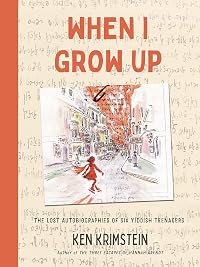
When I Grow Up: The Lost Autobiographies of Six Yiddish Teenagers
by Ken Krimstein
On This Page
Description
When I Grow Up is New Yorker cartoonist Ken Krimstein's new graphic nonfiction book, based on six of hundreds of newly discovered, never-before-published autobiographies of Eastern European Jewish teens on the brink of WWII-found in 2017 hidden in a Lithuanian church cellar. These autobiographies, long thought destroyed by the Nazis, were written as entries for three competitions held in Eastern Europe in the 1930s, just before the horror of the Holocaust forever altered the lives of the show more young people who wrote them. In When I Grow Up, Krimstein shows us the stories of these six young men and women in riveting, almost cinematic narratives, full of humor, yearning, ambition, and all the angst of the teenage years. It's as if half a dozen new Anne Frank stories have suddenly come to light, framed by the dramatic story of the documents' rediscovery. Beautifully illustrated, heart-wrenching, and bursting with life, When I Grow Up reveals how the tragedy that is about to befall these young people could easily happen again, to any of us, if we don't learn to listen to the voices from the past. show lessTags
Recommendations







Member Reviews
This remarkable graphic novel tells the almost lost stories of six Jewish teenagers from Vilnius, Poland, in 1939, who were competing in a writing contest. Their manuscripts were part of an ethnographic study, with a prize of 150 zlotys ($1000 in current US dollars) for the best discourse on the writer's chosen topic, which included family and religious life, the war, friends, family, political organizations, and occupations. As war broke out and Jews were removed from Polish life, the manuscripts were hidden away, along with many others from the YIVO (a school without walls) collection, and these six stories were found in pristine condition in the organ pipes of a derelict cathedral, having been rescued not only from the Nazis, but show more also from Stalin's troops. The author, a graphic artist, has brilliantly illustrated each story, by two girls and four boys who seem older than their years. They have the same difficulties known universally to all teenagers: recalcitrant parents, unfaithful boyfriends and girlfriends, disillusionment with teachers and schools, mean girls, political rivalries, and unfulfilled yearnings - all made more poignant by the reader's knowledge that all the writers are doomed (there is one gratifying survival). The illustrations, in orange and charcoal black, bring vivid, striking drama to the sometimes mundane writings. This collection would make an excellent anthologized series for stage or television. Note: the footnotes are way too tiny to be legible. show less
When I Grow Up: The Lost Autobiographies of Six Yiddish Teenagers by Ken Krimstein is a difficult book, for me, to review. Do I talk about the six stories? The artwork? Or, what makes the work so powerful, the contrast between the optimism and future-looking nature of these young people's stories and the knowledge of what likely happened to most of them and their families?
The autobiographies are wonderful glimpses of a specific place and period in time. Looked at simply as that, they are valuable as historical documents and are enjoyable for readers in the sense that we can feel the exuberance and optimism of youth. It is in the harsh juxtaposition of those youthful feelings with what happened next in all of their lives that the reader show more can feel gut-punched. So much lost, both on personal levels and for the world. These intelligent young people for the most part didn't survive the next five years (I am speaking of the entire recovered collection, not just the six presented here). How can one come away from this collection without a heavy heart?
I don't want to overstate the dark aspect, the shadow that hangs over it. The artwork is very good and presents the stories with humor and compassion. And the recovery and, hopefully, presentation of more of these autobiographies can only do more good than bad. But good isn't always painless. Sharing the human loss, putting human faces to the numbers, keeps the Holocaust from becoming some abstract chapter in history. Real lives, real futures were cut short or profoundly altered and we need to remember both for their sake and for our future sake, we have to remember what can happen when hatred and prejudice becomes institutionalized and government sanctioned.
I highly recommend this to readers of history, the Holocaust, and cultural history.
Reviewed from a copy made available by the publisher via NetGalley. show less
The autobiographies are wonderful glimpses of a specific place and period in time. Looked at simply as that, they are valuable as historical documents and are enjoyable for readers in the sense that we can feel the exuberance and optimism of youth. It is in the harsh juxtaposition of those youthful feelings with what happened next in all of their lives that the reader show more can feel gut-punched. So much lost, both on personal levels and for the world. These intelligent young people for the most part didn't survive the next five years (I am speaking of the entire recovered collection, not just the six presented here). How can one come away from this collection without a heavy heart?
I don't want to overstate the dark aspect, the shadow that hangs over it. The artwork is very good and presents the stories with humor and compassion. And the recovery and, hopefully, presentation of more of these autobiographies can only do more good than bad. But good isn't always painless. Sharing the human loss, putting human faces to the numbers, keeps the Holocaust from becoming some abstract chapter in history. Real lives, real futures were cut short or profoundly altered and we need to remember both for their sake and for our future sake, we have to remember what can happen when hatred and prejudice becomes institutionalized and government sanctioned.
I highly recommend this to readers of history, the Holocaust, and cultural history.
Reviewed from a copy made available by the publisher via NetGalley. show less
17. When I Grow Up: The Lost Autobiographies of Six Yiddish Teenagers by Ken Krimstein
published: 2021
format: 232-page graphic hardcover
acquired: March read: Apr 9-24 time reading: 2:27, 0.6 mpp
genre/style: graphic nonfiction theme random (LT inspired)
locations: 1930’s Yiddish Europe
about the author: A Jewish American cartoonist for the New Yorker, who teaches as DePaul and the Art Institute of Chicago.
It‘s amazing these stories exist. During a cleaning of St George‘s Church, a decommissioned church in Vilna, Lithuania, in 2017, a trove of hidden papers were found in the organ pipes. These were Yiddish biographies of teenagers from the late 1930‘s. They had entered a competition that was never awarded because of WWII. Of course show more there are no more Yiddish teenagers in Europe. The works were hidden from the Nazis and then the Soviets. Krimstein has illustrated 6.
Krimstein calls these stories voices of a lost world. They are not deep elaborate stories, and they of course were not composed under the duress of Holocaust or any awareness of what was over the horizons. So they feel lighter than we might want with our hindsight. They are optimistic, and also on the problems of their lives and era. They touch on tensions with the religious traditions, on Jewish youth groups associated with communist and socialist ideals, your membership largely reflecting your family's economics, and, of course, on teenage crushes. The stories were anonymous, based on the rules of the competition. But not everyone followed this rule. One girl who provided her name and photograph was recognized by her American children. She had emigrated to the US. I felt the graphic aspect was mixed. Some pages felt very unfinished to me, but others are memorable.
After writing this I saw the review by villemezbrown below - who highlights that Krimstein seems to have changed the spirit of these letters. It worth noting.
You can get a feeling for Krimsteins work here: https://www.heyalma.com/the-skater/
And here is one of the original letters translated to English: https://museum.yivo.org/translations/BebaEpsteinEnglish.pdf show less
published: 2021
format: 232-page graphic hardcover
acquired: March read: Apr 9-24 time reading: 2:27, 0.6 mpp
genre/style: graphic nonfiction theme random (LT inspired)
locations: 1930’s Yiddish Europe
about the author: A Jewish American cartoonist for the New Yorker, who teaches as DePaul and the Art Institute of Chicago.
It‘s amazing these stories exist. During a cleaning of St George‘s Church, a decommissioned church in Vilna, Lithuania, in 2017, a trove of hidden papers were found in the organ pipes. These were Yiddish biographies of teenagers from the late 1930‘s. They had entered a competition that was never awarded because of WWII. Of course show more there are no more Yiddish teenagers in Europe. The works were hidden from the Nazis and then the Soviets. Krimstein has illustrated 6.
Krimstein calls these stories voices of a lost world. They are not deep elaborate stories, and they of course were not composed under the duress of Holocaust or any awareness of what was over the horizons. So they feel lighter than we might want with our hindsight. They are optimistic, and also on the problems of their lives and era. They touch on tensions with the religious traditions, on Jewish youth groups associated with communist and socialist ideals, your membership largely reflecting your family's economics, and, of course, on teenage crushes. The stories were anonymous, based on the rules of the competition. But not everyone followed this rule. One girl who provided her name and photograph was recognized by her American children. She had emigrated to the US. I felt the graphic aspect was mixed. Some pages felt very unfinished to me, but others are memorable.
After writing this I saw the review by villemezbrown below - who highlights that Krimstein seems to have changed the spirit of these letters. It worth noting.
You can get a feeling for Krimsteins work here: https://www.heyalma.com/the-skater/
And here is one of the original letters translated to English: https://museum.yivo.org/translations/BebaEpsteinEnglish.pdf show less
This book claims to be nonfiction, presenting the autobiographies of six Jewish youths written in the 1930s when they were mostly 19- or 20-years old, but as I read I started to have a queasy distrust of the presentation, feeling that Ken Krimstein's adaptation was intruding upon or standing between me and the original documents. I was able to find a translation of Beba Epstein's actual autobiography online at https://yivomuseumdev2.wpenginepowered.com/translations/BebaEpsteinEnglish.pdf and as I read through it I could see the massive liberties Krimstein had taken in his dramatization of it. I assume he did the same to the rest of the "autobiographies," and I just wish he and the publisher had been more upfront about that aspect.
I also show more dislike Krimstein's scratchy and blotchy art. show less
I also show more dislike Krimstein's scratchy and blotchy art. show less
This is a fascinating piece of history. The selection of six teens from vastly different backgrounds who are connected only by being Jewish and having entered an essay contest was well done. It is uncanny that the contest winner was due to be announced on the exact date that the Nazis invaded Poland. This book feels like a time capsule. The inclusion of some Yiddish text was interesting to see as well.
Ratings
Members
- Recently Added By
Lists

Favorite graphic novels
17 works; 1 member

Club Read's Graphic Stories Recommendations
127 works; 2 members

Judaism & Israel
104 works; 2 members
Author Information

6+ Works 370 Members
Awards and Honors
Distinctions
Common Knowledge
- Canonical title
- When I Grow Up: The Lost Autobiographies of Six Yiddish Teenagers
- Alternate titles
- When I Grow Up: The Lost Autobiographies of Six Yiddish Teens
- Original publication date
- 2021
- People/Characters
- Beba Epstein; Max Weinreich; Antanas Ulpis; Casimir Pulaski; Meir Dizengoff; Franklin Delano Roosevelt (show all 9); Abraham Cahan; Hershl Goldmakher; Michael Levanthal (son of Beba Epstein)
- Important places
- Yiddishuania; Vilnius, Lithuania; Vilna, Lithuania; Lithuania; Poland
- Dedication
- To these six
- First words
- In the late summer of 2018 I held a miracle in my hands. [Preface]
I was the eighth daughter. - Last words
- (Click to show. Warning: May contain spoilers.)I think I'll simply go crazy with joy.
- Original language
- English
- Disambiguation notice
- Preface: Crossing the Abyss -- The Before -- The Eighth Daughter [19-year-old girl] -- The Letter Writer [20-year-old boy] -- The Folk Singer [19-year-old girl] -- The Rule Breaker [11-and-a-half-year-old girl, Beba Epstein] ... (show all)-- The Boy Who Liked a Girl [20-year-old boy] -- The Skater [19-year-old girl] -- The After -- Acknowledgments -- Some Sources and Suggestions for Further Reading
Classifications
- Genres
- Graphic Novels & Comics, Teen
- DDC/MDS
- 940.5318092 — History & geography History of Europe History of Europe 1918- World War II, 1939-1945 Social, political, economic history; Holocaust Holocaust Standard subdivisions History, geographic treatment, biography Biography
- LCC
- DS135 .L53 .K75 — History of Europe, Asia, Africa and Oceania Asia History of Asia Israel (Palestine). The Jews Jews outside of Palestine
- BISAC
Statistics
- Members
- 100
- Popularity
- 323,668
- Reviews
- 5
- Rating
- (4.15)
- Languages
- English
- Media
- Paper, Ebook
- ISBNs
- 2
- ASINs
- 1