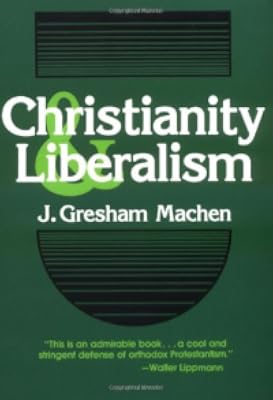
Christianity and Liberalism
by J. Gresham Machen
On This Page
Description
Machen's classic defense of orthodox Christianity established the importance of scriptural doctrine and contrasts the teachings of liberalism and orthodoxy on God and man, the Bible, Christ, salvation, and the church. Though originally published nearly seventy years ago, the book maintains its relevance today. It was named one of the top 100 books of the millennium by World magazine and one of the top 100 books of the century by Christianity Today.Tags
Recommendations






Member Reviews
So, I dug into my Presby roots a little and decided that J. Gresham Machen was made of awesome.
It is fascinating to see how Machen makes his case that early 20th century theological liberalism and (proto-evangelical-coalition) traditional Christianity were essentially two different religions. But, more than that, it's amazing how prescient Machen seems; in 1923, he anticipated much of what has come to divide denominations today (which is fairly continuous with the early Fundamentalist/liberal skirmishes of the last century). I don't think one has to agree with his "two religions" thesis to find the book historically illuminating; and even with that argument, he's not polemical in the way one might expect. I think it's possible that the show more book could provide a basis for a quite interesting dialogue between theologically liberal and traditional Christians.
I thought he was right on target in identifying conception of God and view of human sin as the two primary points of division. show less
It is fascinating to see how Machen makes his case that early 20th century theological liberalism and (proto-evangelical-coalition) traditional Christianity were essentially two different religions. But, more than that, it's amazing how prescient Machen seems; in 1923, he anticipated much of what has come to divide denominations today (which is fairly continuous with the early Fundamentalist/liberal skirmishes of the last century). I don't think one has to agree with his "two religions" thesis to find the book historically illuminating; and even with that argument, he's not polemical in the way one might expect. I think it's possible that the show more book could provide a basis for a quite interesting dialogue between theologically liberal and traditional Christians.
I thought he was right on target in identifying conception of God and view of human sin as the two primary points of division. show less
It would appear that little has changed in the 90 years since this book was first published. Or, perhaps more accurately, the capitulation of large segments of the evangelical church to the relentless tide of what Machen termed "liberalism" has gone unchecked. Either way, the result is the same. Confessing churches have decreasing adherence to their confessions and much of what is labeled as "Christianity" bears little resemblance to the model of faith held up in the Bible.
Machen knows this territory well, being on the faculty of Princeton Seminary when the trustees went all in as the philosophy we know today as Modernity swept through society. As a result, he and several of his colleagues left Princeton to found a seminary and a show more denomination, Westminster Theological Seminary and the Orthodox Presbyterian Church. Their purpose was to continue to teach and uphold those things which had long been essential to the church and were clearly affirmed in its confessions, such as the Westminster and Belgic confessions. Today virtually every denomination that was considered mainline in his day has rolled over to the trends driving society, and the church is infinitely poorer and weaker for it.
I found much in this book that rings true, in part because I am a member of perhaps the last mainline denomination that hasn't gone completely off track. But some days it seems as if we are in a car going through a corner at high speed and with only three wheels on the ground. Rollover seems a heartbeat away. I highly recommend this book for anyone who is in church leadership and wonders about the threat to the church from the culture. It is a threat that feels more immediate today than when Machen wrote these words. Yet I also believe, with Machen, that the church itself will survive, for God has always preserved for himself a remnant of the faithful, to be his witnesses in an unbelieving world. show less
Machen knows this territory well, being on the faculty of Princeton Seminary when the trustees went all in as the philosophy we know today as Modernity swept through society. As a result, he and several of his colleagues left Princeton to found a seminary and a show more denomination, Westminster Theological Seminary and the Orthodox Presbyterian Church. Their purpose was to continue to teach and uphold those things which had long been essential to the church and were clearly affirmed in its confessions, such as the Westminster and Belgic confessions. Today virtually every denomination that was considered mainline in his day has rolled over to the trends driving society, and the church is infinitely poorer and weaker for it.
I found much in this book that rings true, in part because I am a member of perhaps the last mainline denomination that hasn't gone completely off track. But some days it seems as if we are in a car going through a corner at high speed and with only three wheels on the ground. Rollover seems a heartbeat away. I highly recommend this book for anyone who is in church leadership and wonders about the threat to the church from the culture. It is a threat that feels more immediate today than when Machen wrote these words. Yet I also believe, with Machen, that the church itself will survive, for God has always preserved for himself a remnant of the faithful, to be his witnesses in an unbelieving world. show less
5.2 Incredible relevance for a book written 100 years ago. Machen makes perhaps hundreds of irrefutable points about the watering down of Christianity to “make it more palatable” to modern sensibilities. That’s Liberalism and it can be pursued if one chooses. But it’s not Christianity.
Reason read: I saw this book mentioned in World Magazine I think. I set it on the TBR shelf in Hoopla Digital. The book was written in 1923 and is a great reminder that what we think is new today really has been around a long time. There has been a movement of progressive or liberal Christianity. In this book, the author states that Liberalism is not Christianity but a different religion. An example of a progressive Chrisitan was Jimmy Carter. Liberalism has a different view of God and man. In liberalism it is self sacrifice and in Christianity it is what Jesus did, he bore our sins. There are elements of truth but not the whole truth. Today people are afraid of the the fundamentalist and call them the religious right and Christian show more Nationalist and have called them terrorist and dangerous to democracy. Liberalism or progressives want to shame conservative Christians. Conservative Christians should avoid the term Nationalist. There are those that want to make people believe that Christians are extremists. The main thing needs to focus on the gospel. show less
For those who wish to better understand Christianity fundamentally as a system of doctrine rather than an ideal lifestyle; the difference between intellectualism and mysticism; the social gospel and the Biblical gospel; nature of conversion, particularly amongst those raised within Christian homes; the difference between good shepherds and false teachers; the deceptive tactics of wolves; the relationship between one's church to other denominations/ministries; and much more, this book is just for you, written by a mature, sound Christian thinker.
Machen's classic defense of orthodox Christianity establishes the importance of scripural doctrine and contrasts the teachings of liberalism and orthodoxy on God and man, the Bbible, Christ, salvation, and the church. Though originally published nearly seventy years ago, the book maintains its relevance today.
Chistianity and Liberalism
J. Gresham Machen
The main points of the christian faith are clearly exposed by Gresham Machen in order to refute liberalism. This work, though written in 1923, anticipates the controversies faced by christian churchs in recent time, as an effect of the development of liberals ideas. Christian ortodoxy, the author points, is chistianity plain and clear. Christian faith is not a mere way of life. It is a message based on facts and with an achievable meaning. The work great merit consist in explaining the christian message, pointing to the facts in with its based and giving its meaning.
J. Gresham Machen
The main points of the christian faith are clearly exposed by Gresham Machen in order to refute liberalism. This work, though written in 1923, anticipates the controversies faced by christian churchs in recent time, as an effect of the development of liberals ideas. Christian ortodoxy, the author points, is chistianity plain and clear. Christian faith is not a mere way of life. It is a message based on facts and with an achievable meaning. The work great merit consist in explaining the christian message, pointing to the facts in with its based and giving its meaning.
Members
- Recently Added By
Lists

Christianity Books You've Read
179 works; 19 members
Trinity Norman Recommended Christian Readings
170 works; 5 members

Christian Classics (Old and Modern)
53 works; 3 members
Author Information

56 Works 9,018 Members
J. Gresham Machen (1881-1937) was professor of New Testament at Westminster Theological Seminary in Philadelphia. He was also the author of Christian Faith in the Modern World, What Is Faith? and The Origin of Paul's Religion.
Awards and Honors
Notable Lists
Series
Belongs to Publisher Series
Common Knowledge
- Canonical title
- Christianity and Liberalism
- Original title
- Christianity and liberalism
- Alternate titles*
- 基督教真偽辨 : 紀念包義森牧師 ; 基督教與新神學 修訂版
- Original publication date
- 1923
- Dedication
- to My Mother
- First words
- The purpose of this book is not to decide the religious issue of the present day, but merely to present the issue as sharply and clearly as possible, in order that the reader may be aided in deciding it for himself.
- Last words
- (Click to show. Warning: May contain spoilers.)And from under the threshold of that house will go forth a river that will revive the weary world.
*Some information comes from Common Knowledge in other languages. Click "Edit" for more information.
Classifications
Statistics
- Members
- 2,877
- Popularity
- 6,318
- Reviews
- 13
- Rating
- (4.34)
- Languages
- English, German, Portuguese, Spanish
- Media
- Paper, Audiobook, Ebook
- ISBNs
- 30
- UPCs
- 1
- ASINs
- 40