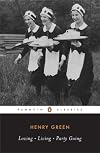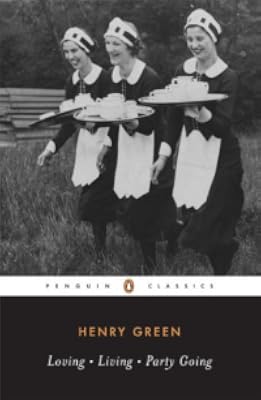
Loving / Living / Party Going
by Henry Green
On This Page
Description
Henry Green, whom W. H. Auden called 'the finest living English novelist', is the most neglected writer of the last century and the one most deserving of rediscovery by a new generation. This volume brings together three of Henry Green's intensely original novels. Green explored class distinctions through the medium of love. Loving brilliantly contrasts the lives of servants and masters in an Irish castle during World War Two, Living of workers and owners in a Birmingham iron foundry. show more LIVING, LOVING, PARTY GOING is a brilliant comedy of manners, presenting a party of wealthy travellers stranded by fog in a London railway hotel while throngs of workers await trains in the station below. show lessTags
Recommendations















Member Recommendations

Member Reviews
This volume contains three of Green’s nine novels. Green’s burden is the high praise that exacting writers such as Auden and Updike have heaped on him. I decided to give him a try anyway.
The books aren’t printed here in chronological order; the opener, Loving, was the last published of the three. I found it the most accessible, which could explain why it was placed first. Yet even this took a while to get into. It employs much dialogue; punctuation is reduced to a minimum, which means that the phrases are difficult to scan. Once I got the hang of it, I admired how this technique reproduced the way we often talk: elliptically, run-on, colorful phrases interspersed with mundane. At times, the conversations he reports are two show more monologues, spoken past each other. This, too, came to feel true to life.
The setting is familiar to fans of upstairs/downstairs dramas, although Green devotes more attention to downstairs than up.
There is plot development in the novel in the sense that things happen, but these are less important than bringing characters vividly to life. Spoiler alert: the incidental nature of “plot” is brilliantly expressed in the last line.
The second of the three novels, Living, was the earliest published. It is set among the workers of a Birmingham foundry. The owner and his family also appear, including the effete son impatient to introduce his modern management ideas (the real person behind Green’s nom de plume was himself the son of a wealthy industrialist). But again, the author spends more time depicting the workers. It is a wide cast of characters, but by the end, the focus has come down to one in particular, not necessarily the character one would have expected. Elliptical, picturesque dialogue is also evident. In addition, Green forgoes almost all articles. This could be what some have in mind who include him among the modernists such as James Joyce and Virginia Woolf.
In the final book collected here, Party Going, Green turns to the pampered young people he probably moved among in real life. A group gathers to set off on a journey that is delayed when a deep fog enshrouds the station from which their boat train is set to depart. They decamp to the adjoining hotel and spend the next few hours interacting. Then the fog lifts, and they leave. While Green’s dialogue technique is more conventional here than in the other two books, things his characters say are rarely in sync with what they mean or feel. This is expressed in one of the author’s asides that reminds me of Oscar Wilde: “People, in their relation with one another, are continually doing similar things but never for similar reasons.” For the most part, though, Green doesn’t tell, he shows. I found the members of this ensemble “tarsome” to an extreme, and I think this was the author’s intention. The few hours they spend trapped in the fog seem like a season in hell, or at least purgatory, except that the experience doesn’t purge them.
Green’s prose, especially in Party Going, is also remarkable in its use of extended metaphors that suddenly reintroduce the object of comparison to jarring effect.
The peculiarities of Green’s style made the reading slow going, but I found the effort rewarded. show less
The books aren’t printed here in chronological order; the opener, Loving, was the last published of the three. I found it the most accessible, which could explain why it was placed first. Yet even this took a while to get into. It employs much dialogue; punctuation is reduced to a minimum, which means that the phrases are difficult to scan. Once I got the hang of it, I admired how this technique reproduced the way we often talk: elliptically, run-on, colorful phrases interspersed with mundane. At times, the conversations he reports are two show more monologues, spoken past each other. This, too, came to feel true to life.
The setting is familiar to fans of upstairs/downstairs dramas, although Green devotes more attention to downstairs than up.
There is plot development in the novel in the sense that things happen, but these are less important than bringing characters vividly to life. Spoiler alert: the incidental nature of “plot” is brilliantly expressed in the last line.
The second of the three novels, Living, was the earliest published. It is set among the workers of a Birmingham foundry. The owner and his family also appear, including the effete son impatient to introduce his modern management ideas (the real person behind Green’s nom de plume was himself the son of a wealthy industrialist). But again, the author spends more time depicting the workers. It is a wide cast of characters, but by the end, the focus has come down to one in particular, not necessarily the character one would have expected. Elliptical, picturesque dialogue is also evident. In addition, Green forgoes almost all articles. This could be what some have in mind who include him among the modernists such as James Joyce and Virginia Woolf.
In the final book collected here, Party Going, Green turns to the pampered young people he probably moved among in real life. A group gathers to set off on a journey that is delayed when a deep fog enshrouds the station from which their boat train is set to depart. They decamp to the adjoining hotel and spend the next few hours interacting. Then the fog lifts, and they leave. While Green’s dialogue technique is more conventional here than in the other two books, things his characters say are rarely in sync with what they mean or feel. This is expressed in one of the author’s asides that reminds me of Oscar Wilde: “People, in their relation with one another, are continually doing similar things but never for similar reasons.” For the most part, though, Green doesn’t tell, he shows. I found the members of this ensemble “tarsome” to an extreme, and I think this was the author’s intention. The few hours they spend trapped in the fog seem like a season in hell, or at least purgatory, except that the experience doesn’t purge them.
Green’s prose, especially in Party Going, is also remarkable in its use of extended metaphors that suddenly reintroduce the object of comparison to jarring effect.
The peculiarities of Green’s style made the reading slow going, but I found the effort rewarded. show less
Living: What to say about Henry Green? At one point, he was considered by some as “the best English novelist” and – a phrase I quite like – as the “writer’s writer’s writer”. According to Wikipedia, he was always more popular among other writers than the reading public and “none of his books sold more than 10,000 copies”. From the 1950s onwards, his star faded – he died in 1973 – and by the 1980s, he was mostly forgotten… only to be rediscovered in the early 1990s, and omnibuses of his nine novels (three per omnibus) have been in print ever since. And yes, he is every bit as good as his admirers have/had it. Living, his second novel, is set in and around a Birmingham iron foundry in the 1920s – Green actually show more worked as the managing director of his family’s engineering firm in Birmingham – and focuses on a handful of its employees, including the London-based son of the company’s owner. The prose is modernist, and uses definite and indefinite articles sparingly. It takes a bit of getting used to, but Green’s writing is so good it’s highly effective. The dialogue is also written in dialect – although I could never quite make it sound Brummie in my head – which also takes a while to get used to. In terms of plot, there’s not a great deal, just the lives of its central characters, and how they cope with changes to the company’s fortunes. But reading Green just makes me want to push the envelope of my own writing. I don’t want to come up with cleverer plots, or more engaging stories, I want to sharpen my narratives, improve my word-choices, write the best damn prose I can, so that I too can be as lucid, as economical, and yet as lyrical, as Henry Green. Highly recommended.
Party Going: The novel opens with a middle-aged woman entering a London railway station (I don’t think it’s named) and finding a dead pigeon. She picks up the corpse, takes it into the ladies’ toilets, washes it, and then wraps it in brown paper. She’s not entirely sure why. And after she bumps into the young woman she is there to meet (she was in service with her family as a nanny), she throws away the dead pigeon. But then she goes and retrieves it from the bin. The young woman is there to meet up with a bunch of friends who are all heading for the south of France on the boat-train. However, thick fog has closed down the station, and no trains are running. So after the party has gathered, they head into the station hotel to wait for the fog to lift. At which point, the ex-nanny is taken ill (it’s not clear if she’s just had too much to drink or is genuinely ill). Meanwhile, the party settles down in a suite, and the banter begins – mostly focusing on two women and their relationship with the young playboy who’s funding the trip to the Riviera. The fog still hasn’t lifted by five o’clock, and all the commuters have turned up to find their trains home aren’t running. So the management seal off the hotel while the station concourse fills up with angry workers. Green’s prose is beautifully done. There’s very little in the way of exposition, and what there is comes naturally from the characters. The prose is sparse and clear, and often dispenses with definite articles or pronouns in a Modernist style. The characterisation comes purely from the characters’ words and deeds. Green neither shows nor tells. It’s up to the reader to plot what’s going on, to figure out the relationships between the characters, to work out the story-arc (and, to be fair, there usually isn’t one), and to make sense of the situations Green documents. I stumbled across this omnibus of three of Green’s novels in a charity shop and was intrigued by the description of him as “the best English novelist alive” (by WH Auden, in 1952). His prose is indeed superb, and I greatly admire its clarity and its refusal to compromise. The Modernism reads a little quaint these days, and I’d sooner novelists experimented with structure rather than grammar, but every writer worth their salt should try a Green novel at least once. show less
Party Going: The novel opens with a middle-aged woman entering a London railway station (I don’t think it’s named) and finding a dead pigeon. She picks up the corpse, takes it into the ladies’ toilets, washes it, and then wraps it in brown paper. She’s not entirely sure why. And after she bumps into the young woman she is there to meet (she was in service with her family as a nanny), she throws away the dead pigeon. But then she goes and retrieves it from the bin. The young woman is there to meet up with a bunch of friends who are all heading for the south of France on the boat-train. However, thick fog has closed down the station, and no trains are running. So after the party has gathered, they head into the station hotel to wait for the fog to lift. At which point, the ex-nanny is taken ill (it’s not clear if she’s just had too much to drink or is genuinely ill). Meanwhile, the party settles down in a suite, and the banter begins – mostly focusing on two women and their relationship with the young playboy who’s funding the trip to the Riviera. The fog still hasn’t lifted by five o’clock, and all the commuters have turned up to find their trains home aren’t running. So the management seal off the hotel while the station concourse fills up with angry workers. Green’s prose is beautifully done. There’s very little in the way of exposition, and what there is comes naturally from the characters. The prose is sparse and clear, and often dispenses with definite articles or pronouns in a Modernist style. The characterisation comes purely from the characters’ words and deeds. Green neither shows nor tells. It’s up to the reader to plot what’s going on, to figure out the relationships between the characters, to work out the story-arc (and, to be fair, there usually isn’t one), and to make sense of the situations Green documents. I stumbled across this omnibus of three of Green’s novels in a charity shop and was intrigued by the description of him as “the best English novelist alive” (by WH Auden, in 1952). His prose is indeed superb, and I greatly admire its clarity and its refusal to compromise. The Modernism reads a little quaint these days, and I’d sooner novelists experimented with structure rather than grammar, but every writer worth their salt should try a Green novel at least once. show less
Of this volume, I read only Loving, which is tremendous. The other two titles are not on any of my blasted lists but if I can get through my next two bookclub books before this is due, I'll happily read Living and Party-Going as well.
It requires a lot of attention. It's told mostly in dialogue, and has dialogue tags, but if you don't pay attention to who said what how and to whom, all the time, you miss the tension and undercurrents. I went back and reread and rechecked a few times. Also, the servants refer to both their employers and Hitler without names but with only pronouns or referents. When they worry that he'll invade, and use Ireland (where the book is set) as a stepping stone and staging ground to England, okay, it's evident show more they're talking about Hitler.
Like the movie "Gosford Park," it has two points of view, from above and below stairs. (My mental pictures of Edith and Kate, the housemaids, were strongly colored by Emily Watson and whoever played Mary Maceachran--Kelly Macdonald, since I had to look up how to spell the character's name anyway.) Again like an Altman movie, the perspective changes fluidly. There's a scene with the two maids in their attic bedroom, looking out the window, and the perspective slips down to follow the characters they're gossiping about.
The plot, of servants' internecine squabbling and parrying with their employers, and the family's own troubles and fears of the servants dying or leaving to join up, plus everyone's fear of the Irish, the IRA, and Germany, was little more than a trellis to support the burgeoning, twisting ivy of masterful narrative technique.
A great read. show less
It requires a lot of attention. It's told mostly in dialogue, and has dialogue tags, but if you don't pay attention to who said what how and to whom, all the time, you miss the tension and undercurrents. I went back and reread and rechecked a few times. Also, the servants refer to both their employers and Hitler without names but with only pronouns or referents. When they worry that he'll invade, and use Ireland (where the book is set) as a stepping stone and staging ground to England, okay, it's evident show more they're talking about Hitler.
Like the movie "Gosford Park," it has two points of view, from above and below stairs. (My mental pictures of Edith and Kate, the housemaids, were strongly colored by Emily Watson and whoever played Mary Maceachran--Kelly Macdonald, since I had to look up how to spell the character's name anyway.) Again like an Altman movie, the perspective changes fluidly. There's a scene with the two maids in their attic bedroom, looking out the window, and the perspective slips down to follow the characters they're gossiping about.
The plot, of servants' internecine squabbling and parrying with their employers, and the family's own troubles and fears of the servants dying or leaving to join up, plus everyone's fear of the Irish, the IRA, and Germany, was little more than a trellis to support the burgeoning, twisting ivy of masterful narrative technique.
A great read. show less
[Loving]
Charley Raunce has just moved up in the world, assuming the position of Head Butler with the passing of Mr. Eldon, and things are going to change in the Tennant Irish country estate. For starters, Raunce refuses to allow Mrs. Tennant to call him Arthur, as she has called every other Head Butler for decades, regardless of their name. But the changes are not confined to the upstairs world of Mrs. Tennant. Downstairs, amongst the servants, Raunce’s free-wheeling and lusty leadership throw the household staff into chaos, as the nanny retires to her sick-bed, the cook’s young son murders a peacock, and the housemaids vie for Raunce’s romantic attention. Outside, World War II threatens to invade the quiet countryside and the IRA show more lurks at the back door.
First off, as I described the book for my wife, a fan of the wildly popular Downton Abbey, she told me I must be reading the book the series was based upon. So, any Downton Abbey fans should probably find a copy of the book to hold you over between seasons. From what I know about the BBC series, there is a similarity – upstairs/downstairs intrigue in the shadow of World War II.
That said, Henry Green’s novel [Loving] is focused more on the downstairs side of the equation, examining the predicaments and ambitions of the servant class in the absence of all normal authority and rules. Interestingly, Green introduces blossoming love and bohemian beauty in equal parts to the anarchy and chaos that emerge with the departure of the employers and the death of the old butler regime.
[Loving] was mostly a surprise. Told primarily in dialog and devoid of much of a plot, the story was still an interesting read. This is a testament to Green’s skill in producing fascinating characters, no easy task when depending almost completely on what the character says or what someone else says about them.
Bottom Line: Deftly written and interesting character study that will appeal to fans of the British upstairs/downstairs phenomenon.
3 ½ bones!!!! show less
Charley Raunce has just moved up in the world, assuming the position of Head Butler with the passing of Mr. Eldon, and things are going to change in the Tennant Irish country estate. For starters, Raunce refuses to allow Mrs. Tennant to call him Arthur, as she has called every other Head Butler for decades, regardless of their name. But the changes are not confined to the upstairs world of Mrs. Tennant. Downstairs, amongst the servants, Raunce’s free-wheeling and lusty leadership throw the household staff into chaos, as the nanny retires to her sick-bed, the cook’s young son murders a peacock, and the housemaids vie for Raunce’s romantic attention. Outside, World War II threatens to invade the quiet countryside and the IRA show more lurks at the back door.
First off, as I described the book for my wife, a fan of the wildly popular Downton Abbey, she told me I must be reading the book the series was based upon. So, any Downton Abbey fans should probably find a copy of the book to hold you over between seasons. From what I know about the BBC series, there is a similarity – upstairs/downstairs intrigue in the shadow of World War II.
That said, Henry Green’s novel [Loving] is focused more on the downstairs side of the equation, examining the predicaments and ambitions of the servant class in the absence of all normal authority and rules. Interestingly, Green introduces blossoming love and bohemian beauty in equal parts to the anarchy and chaos that emerge with the departure of the employers and the death of the old butler regime.
[Loving] was mostly a surprise. Told primarily in dialog and devoid of much of a plot, the story was still an interesting read. This is a testament to Green’s skill in producing fascinating characters, no easy task when depending almost completely on what the character says or what someone else says about them.
Bottom Line: Deftly written and interesting character study that will appeal to fans of the British upstairs/downstairs phenomenon.
3 ½ bones!!!! show less
This novel frustrated me. On the one hand, I really enjoyed Green's writing and the setting - it was very much Downton Abbey-esque, so much so that I did wonder if Julian Fellowes got some major inspiration from Green. It was also very readable and very easy to get into.
BUT..... it just didn't really go anywhere. There was very little plot to speak of, which is fine if you are able to get lost in the heart and soul of the characters, yet although the characters were interesting somehow I didn't get drawn into them enough.
There are 2 other novels in this particular edition, and I'm sure I'd like them well enough, but life's too short and I feel I need to move on to a page-turner.
3 stars - with a more developed plot this would have been show more an easy 4 stars, but alas.... show less
BUT..... it just didn't really go anywhere. There was very little plot to speak of, which is fine if you are able to get lost in the heart and soul of the characters, yet although the characters were interesting somehow I didn't get drawn into them enough.
There are 2 other novels in this particular edition, and I'm sure I'd like them well enough, but life's too short and I feel I need to move on to a page-turner.
3 stars - with a more developed plot this would have been show more an easy 4 stars, but alas.... show less
Well, just Loving but I liked it lot and plan to read the other two, just not right away. Good for folks who like their modernist lit with a bit of Downton Abbey. I liked the subtle humor.
Loving: Four Stars
Living: Three Stars
Party Going: Three and a Half Stars
Each of these three novels follows multiple characters representing different social strata: the servants and the served in an Irish country house during WWII (Loving), generations of steel foundry workers and owners in Birmingham (Living), and wealthy travelers stuck in a train station hotel (Party Going). The stories can be a little difficult to follow at first: in each, characters are referred to by several names, the narrative jumps around from one situation to another much like a soap opera, and important plot points and aspects of character development are (artfully) revealed through dialogue. These stories are not mysteries (though Loving has what could be show more called a mystery element), but reading them is a little like solving a puzzle. At first, you have to get your bearings. You are presented with many different pieces, and it takes a little while to figure out what you’re looking at. The further you progress, the clearer the picture becomes and the more quickly it goes. By the end, you have something that seems much more than the sum of its parts. I guess this is true of most books to some extent, but I found it especially true here.
My individual ratings for each of these novels are based partly on the author’s craft—which is admirable, partly on how enjoyable they were to read, and partly on how rewarding they were. I don’t mind doing a little bit of work when I’m reading if there’s a great payoff. Loving rates highest on all three of these criteria. As I got further into Loving, I found myself thinking that it’s begging to be made into a film, and wondering if perhaps maybe it HAS been (as far as I can tell, it has not).
The best ad I can give for any and all of these novels comes from Green himself. Of his inspiration for Loving, he told The Paris Review: "I got the idea of Loving from a manservant in the Fire Service during the war. He was serving with me in the ranks, and he told me he had once asked the elderly butler who was over him what the old boy most liked in the world. The reply was: 'Lying in bed on a summer morning, with the window open, listening to the church bells, eating buttered toast with cunty fingers.' I saw the book in a flash." show less
Living: Three Stars
Party Going: Three and a Half Stars
Each of these three novels follows multiple characters representing different social strata: the servants and the served in an Irish country house during WWII (Loving), generations of steel foundry workers and owners in Birmingham (Living), and wealthy travelers stuck in a train station hotel (Party Going). The stories can be a little difficult to follow at first: in each, characters are referred to by several names, the narrative jumps around from one situation to another much like a soap opera, and important plot points and aspects of character development are (artfully) revealed through dialogue. These stories are not mysteries (though Loving has what could be show more called a mystery element), but reading them is a little like solving a puzzle. At first, you have to get your bearings. You are presented with many different pieces, and it takes a little while to figure out what you’re looking at. The further you progress, the clearer the picture becomes and the more quickly it goes. By the end, you have something that seems much more than the sum of its parts. I guess this is true of most books to some extent, but I found it especially true here.
My individual ratings for each of these novels are based partly on the author’s craft—which is admirable, partly on how enjoyable they were to read, and partly on how rewarding they were. I don’t mind doing a little bit of work when I’m reading if there’s a great payoff. Loving rates highest on all three of these criteria. As I got further into Loving, I found myself thinking that it’s begging to be made into a film, and wondering if perhaps maybe it HAS been (as far as I can tell, it has not).
The best ad I can give for any and all of these novels comes from Green himself. Of his inspiration for Loving, he told The Paris Review: "I got the idea of Loving from a manservant in the Fire Service during the war. He was serving with me in the ranks, and he told me he had once asked the elderly butler who was over him what the old boy most liked in the world. The reply was: 'Lying in bed on a summer morning, with the window open, listening to the church bells, eating buttered toast with cunty fingers.' I saw the book in a flash." show less
Members
- Recently Added By
Author Information

16+ Works 4,372 Members
Writing under the pseudonym Henry Green, Henry Vincent Yorke kept his life as a wealthy industrialist separate from his literary persona. Although he had friends who were authors, he did not travel in literary circles and refused to be photographed, to protect his anonymity. Yorke was born in 1905 in Gloucestershire, England, and worked as a show more laborer before becoming managing director of a food engineering firm. From the publication of his first book Blindness (1926), which was begun when he was 17 years old and a student at Eton, he was admired for his unfailing sense of dialogue and characterization for all classes of British life. Green's last novel, Nothing, was published in 1950. Although he is still relatively unknown in the United States, he is recognized by authors such as John Updike and W. H. Auden as a masterful storyteller and one of the greatest English writers of the 20th century. He died in 1973 (Bowker Author Biography) show less
Some Editions
Awards and Honors
Series
Belongs to Publisher Series
Work Relationships
Contains
Common Knowledge
- Canonical title
- Loving / Living / Party Going
- Original title
- Loving • Living • Party Going
- Original publication date
- 1929 (Living) (Living); 1939 (Party Going) (Party Going); 1945 (Loving) (Loving)
- First words
- Once upon a day an old butler called Eldon lay dying in his room attended by the head housemaid.
Classifications
Statistics
- Members
- 893
- Popularity
- 30,155
- Reviews
- 15
- Rating
- (3.52)
- Languages
- English, Finnish
- Media
- Paper, Ebook
- ISBNs
- 6
- ASINs
- 4