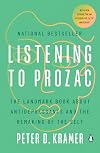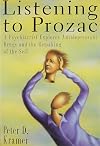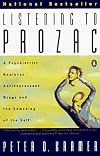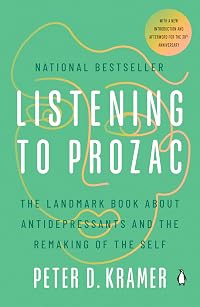
Listening to Prozac
by Peter D. Kramer
On This Page
Description
Weaving together the perspectives of students, counsellors clients and supervisors, Crouch breaks away from traditional methods to present complex theories, difficult concepts and serious information using 'talk' as the main medium.Tags
Recommendations










































Member Reviews
Kramer is fascinated with the possibilities of better living through chemistry. Others have done a better job of delivering the cautions needed in dealing with psychiatric drugs, but none have done a better job of documenting the most intriguing research projects that contribute to our knowledge of brain chemistry. I found of particular interest the study which sought to create leadership in a monkey tribe. A male monkey fed serotonin and placed in a leaderless tribe would instantly become the leader. But the serotonin-enhanced monkey placed in a tribe that already had a leader just couldn't make it past first lieutenant. Kramer also posed a number of ethical questions, such as, Should a doctor prescribe Prozac to a patient who wants it show more to stop biting her fingernails or to be more suitable for a sales job if he wants to give up being a librarian? Where does the clinician's responsibility lie? Interesting stuff. show less
Excellent description of causes and symptoms of depression and why certain medicines can correct the problem. Kinda like getting glasses for nearsightedness.
A look at Prozac and other mood-altering drugs examines the implications of chemical modification of intelligence and personality and what the personality-altering effects of the drug tell us about the nature of character. 30,000 first printing. $30,000 ad/promo. Tour.
Putting people on prozac produces results the same as 10-20 years of therapy. Guess that's the end of ' the talking cure ' ( ? )
Very good book. Easy to read. Informative. Great for the lay person & makes a strong case for antidepressant medication.
Putting people on prozac produces results the same as 10-20 years of therapy. Guess that's the end of ' the talking cure ' ( ? )
“ Listening to Prozac. It’s out of date, and Kramer deliberately did not discuss Prozac’s side effects, being more interested in the social impact of a class of medications that he assumes will eventually be freed of major side effects. He also minimizes the individual differences that could cause a few people to have very bad reactions. Nor can you expect to get the whole story from the manufacturers making money on these enormously profitable medications or the family doctors who are known from research to overestimate the value of the most highly advertised medications.”
From The Highly Sensitive Person: How to Thrive When the World Overwhelms You at 84%
Thus, I will not be reading this book.
From The Highly Sensitive Person: How to Thrive When the World Overwhelms You at 84%
Thus, I will not be reading this book.
Members
- Recently Added By
Lists

Best Medical Nonfiction
79 works; 29 members
Author Information

13+ Works 1,730 Members
Peter D. Kramer is a clinical professor of psychiatry at Brown University.
Awards and Honors
Distinctions
Common Knowledge
- Canonical title
- Listening to Prozac
- Original publication date
- 1993-06-08
- Dedication
- For Eric and Lore
- First words
- Toward the end of 1988, less than a year after the antidepressant drug Prozac was introduced, I had occasion to treat an architect who was suffering from a prolonged bout of melancholy. (Introduction)
My first experience with Prozac involved a woman I worked with only around the issues of medication. - Last words
- (Click to show. Warning: May contain spoilers.)In time, I suspect we will come to discover that modern psychopharmacology has become, like Freud in his day, a whole climate of opinion under which we conduct our different lives.
- Blurbers
- Maggie Scarf
Classifications
- Genres
- Nonfiction, General Nonfiction
- DDC/MDS
- 616.8527061 — Applied science & technology Medicine & health Diseases, Allergies, Skin Conditions Nervous Disorders: Autism, Anorexia, OCD Miscellaneous Neuroses Depression
- LCC
- RC483.5 .F55 .K7 — Medicine Internal medicine Internal medicine Neurosciences. Biological psychiatry. Neuropsychiatry Psychiatry Therapeutics. Psychotherapy
- BISAC
Statistics
- Members
- 957
- Popularity
- 27,585
- Reviews
- 9
- Rating
- (3.41)
- Languages
- 8 — Dutch, English, Finnish, French, German, Portuguese (Portugal), Spanish, Swedish
- Media
- Paper, Audiobook, Ebook
- ISBNs
- 18
- ASINs
- 12