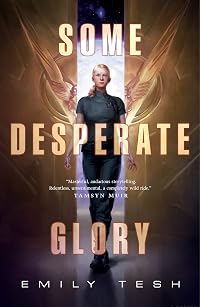
Some Desperate Glory
by Emily Tesh
On This Page
Description
While we live, the enemy shall fear us. Since she was born, Kyr has trained for the day she can avenge the murder of planet Earth. Raised in the bowels of Gaea Station alongside the last scraps of humanity, she readies herself to face the Wisdom, the powerful, reality-shaping weapon that gave the majoda their victory over humanity. They are what's left. They are what must survive. Kyr is one of the best warriors of her generation, the sword of a dead planet. When Command assigns her brother show more to certain death and relegates her to Nursery to bear sons until she dies trying, she knows she must take humanity's revenge into her own hands. Alongside her brother's brilliant but seditious friend and a lonely, captive alien, Kyr escapes from everything she's known into a universe far more complicated than she was taught and far more wondrous than she could have imagined. show lessTags
Recommendations


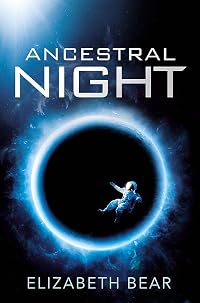


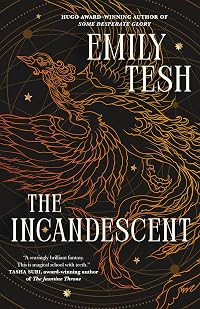

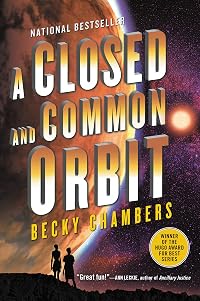
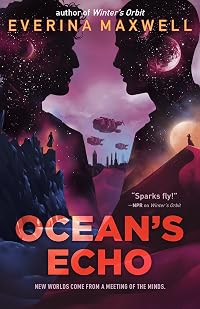
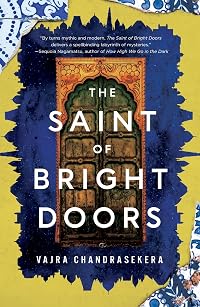
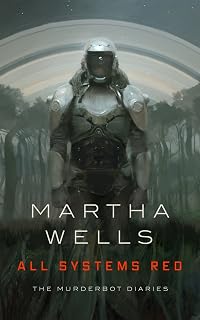
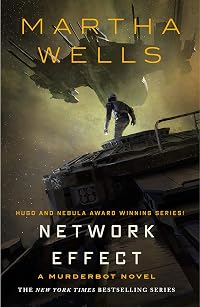
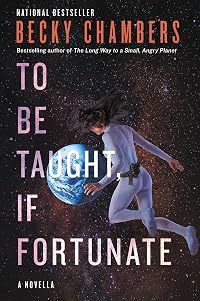
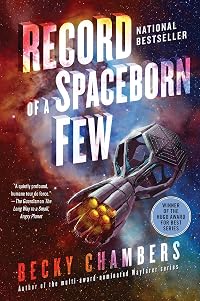

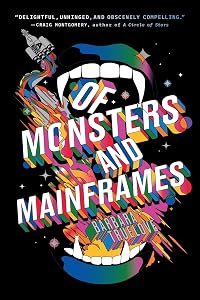
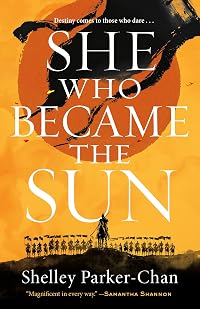
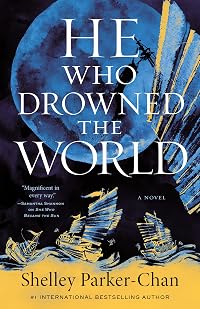





Member Recommendations

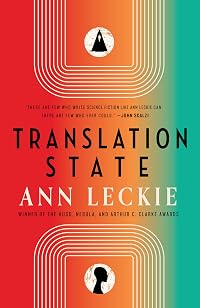
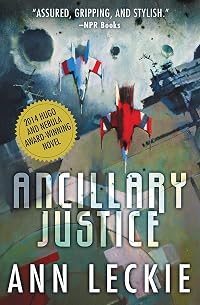
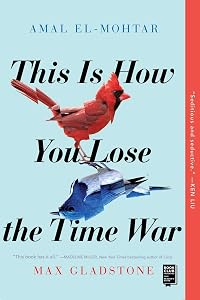
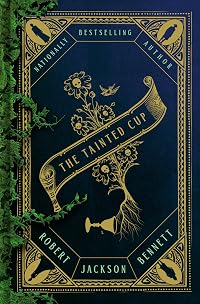
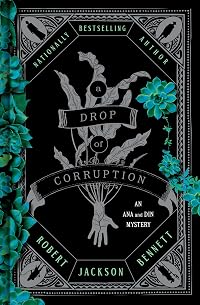
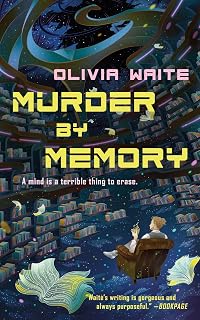
lavaturtle A young woman who excels in her devotion to a militaristic order, only to discover that what she was told about the world is not quite true. Grappling with the aftermath of abuse and what's been done for a cause.
Member Reviews
I do really like when I can encounter books this way, when I can let them work upon me with no expectations or weight at all. As I say around here a lot, part of the appeal of sf is that the world itself is a mystery, and the less you know going in, the better the mystery is!
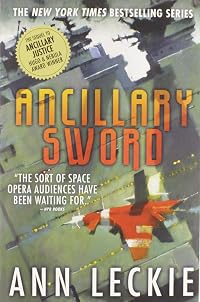
So I am going to undermine the book by telling you what it's like, but hey, if that's a problem for you, you shouldn't be reading reviews on LibraryThing. Another thing I enjoy about sf is articulating subgenre; Some Desperate Glory clearly comes out of the same space/movement as Ancillary Justice, Machineries of Empire, and A Memory Called Empire. Like those works, it's in the space opera zone to some extent, and it's about what makes empire equally appealing and show more horrifying...* although, not quite. While those other works are about a society's outward projection of power, Some Desperate Glory is more about a society's inward projection of power—facsism. How does a society exert power over its own members, shape them into the people they need to be? How does it cause us to shape ourselves, how do we become complicit in this? Our viewpoint character is a fascist who has totally bought into the rhetoric of her own people, but we can see what she cannot, the ways in which this has rendered her shortsighted and awful. This is a little frustrating at first, because it's so obvious that she's in the wrong, but kind of fascinating, too; I think Tesh did a good job inhabiting Valkyr's headspace.
Every now and again something really significant would happen in a very understated way, and this was my biggest actual problem with the book. I would end up missing something really quite important and have to go back! I don't know if these parts were done that way on purpose, or if it's just an unfortunate writing tic, but I found it frustrating. Maybe if I was reading in a less distracted environment, but I am the parent of two children five and under as well as a professor who squeezed the book in small chunks during final week so there's no much I can do about that!
Other than that, I really enjoyed the book. I was getting "this is pretty good vibes" for most of it, but then in ch. 27 (specifically, on p. 357 in my 2023 Orbit paperback) the characters make a ridiculously audacious choice that genuinely made me laugh out loud from the sheer pleasure of it. From then on, I was in love. Like those books I listed above, Some Desperate Glory is about doing the right thing in the face of a society determined to prevent it. What makes this sequence work so well is how far Kyr and the other characters end up going to make this happen, how they learn what matters is not just saving themselves from fascism, but others as well. Lots of great payoffs in the last hundred pages, making ultimately a very satisfying novel about the difficult lengths one has to go to in order to make oneself into the person one ought to have been.
There's more to talk about, harrowing stuff about gender and queerness especially. But I'll leave that for people better equipped to do so.
* The Traitor Baru Cormorant doesn't take place in space, but otherwise it overlaps with these as well; if you like all these space novels, you'll probably like Traitor as well. show less
So I am going to undermine the book by telling you what it's like, but hey, if that's a problem for you, you shouldn't be reading reviews on LibraryThing. Another thing I enjoy about sf is articulating subgenre; Some Desperate Glory clearly comes out of the same space/movement as Ancillary Justice, Machineries of Empire, and A Memory Called Empire. Like those works, it's in the space opera zone to some extent, and it's about what makes empire equally appealing and show more horrifying...* although, not quite. While those other works are about a society's outward projection of power, Some Desperate Glory is more about a society's inward projection of power—facsism. How does a society exert power over its own members, shape them into the people they need to be? How does it cause us to shape ourselves, how do we become complicit in this? Our viewpoint character is a fascist who has totally bought into the rhetoric of her own people, but we can see what she cannot, the ways in which this has rendered her shortsighted and awful. This is a little frustrating at first, because it's so obvious that she's in the wrong, but kind of fascinating, too; I think Tesh did a good job inhabiting Valkyr's headspace.
Every now and again something really significant would happen in a very understated way, and this was my biggest actual problem with the book. I would end up missing something really quite important and have to go back! I don't know if these parts were done that way on purpose, or if it's just an unfortunate writing tic, but I found it frustrating. Maybe if I was reading in a less distracted environment, but I am the parent of two children five and under as well as a professor who squeezed the book in small chunks during final week so there's no much I can do about that!
Other than that, I really enjoyed the book. I was getting "this is pretty good vibes" for most of it, but then in ch. 27 (specifically, on p. 357 in my 2023 Orbit paperback) the characters make a ridiculously audacious choice that genuinely made me laugh out loud from the sheer pleasure of it. From then on, I was in love. Like those books I listed above, Some Desperate Glory is about doing the right thing in the face of a society determined to prevent it. What makes this sequence work so well is how far Kyr and the other characters end up going to make this happen, how they learn what matters is not just saving themselves from fascism, but others as well. Lots of great payoffs in the last hundred pages, making ultimately a very satisfying novel about the difficult lengths one has to go to in order to make oneself into the person one ought to have been.
There's more to talk about, harrowing stuff about gender and queerness especially. But I'll leave that for people better equipped to do so.
* The Traitor Baru Cormorant doesn't take place in space, but otherwise it overlaps with these as well; if you like all these space novels, you'll probably like Traitor as well. show less
I. Loved. This. Book. Kyr is a really compelling protagonist, even though she starts out wrong about a lot of things. (In a way, she reminds me of Adora at the beginning of She-Ra and the Princesses of Power.) She's competent and dedicated and has a lot to learn about people and the world outside what she was taught from childhood. I loved watching her grapple with what to do when reality didn't match her worldview.
And thenthe Wisdom lets Kyr go back and change things , and OMG! That was a huge twist that changed everything, and gave another angle on how we're shaped by our environment and what might have been. And the ending was perfect, just perfect, seeing how Kyr has grown and changed and a chance at a different future for everyone. show more Yes! show less
And then
How about an action movie? How about a ride through a far-future universe where Earth had been obliterated in an interstellar war?
Some of the remaining humans live on Gaea Station, a grim and desolate place built from the remains of four space dreadnoughts. Here, the last soldiers of humanity are bred and trained for vengeance against those who destroyed their world.
The story centers on Kyr, a genetically enhanced supersoldier who has been brainwashed from birth to serve and exact vengeance. Her life on Gaea Station is tough, but straightforward, until her brother Magnus disappears, and she is assigned to the Nursery, destined to become breeding stock until she dies. Kyr refuses. She escapes with the help of her brother's geeky friend show more Avi and a captive alien named Yiso. Once Kyr leaves the only world she has ever known behind, she begins to think about things she has never thought of before. Secrets unravel and realizations hit. What follows is a journey across multiverses and timelines.
Adventures, escapes, dangers, and rescues fly by in quick succession, making it difficult to put the book down. There is also shadowspace technology, which bends time and space, and Wisdom, a god-like AI to end all AI’s. All this sci-fi magic keeps the story going, even if the tech runs on "pure narrativium."
I think that Kyr's character development is what keeps the book together. The reader first sees her as an unlikeable "best fascist girl scout," brainwashed and rigid in her beliefs. Watching her question her conditioning, make bad choices, and ultimately find her strong moral core is fun and satisfying. Kyr's relationship with Yiso, the alien, was touching, as she slowly began to see them as a person rather than an enemy. Unfortunately, the other characters are mainly there to advance the plot and make Kyr react to things. Some of the things they do come out of nowhere (I know, I know, we must think of the plot).
The themes of overcoming cultish conditioning, the abuse of power, and the impact of colonialism are done well for such a fast-paced book. The author does a pretty good job of depicting a fascist society/cult and the psychological manipulation that comes with it. Also, the description of sexual abuse and its consequences is handled with care. However, the balance between these themes and maintaining the action-packed nature of a space opera is not always perfect. Tesh does not address the ethical and psychological implications of certain events. The large-scale destruction that occurs multiple times felt very "videogamey". It might have made me facepalm and cringe, if I was reading slower.
Despite these flaws, "Some Desperate Glory" kept me hooked, and I wanted to know what happened next. Is this book worth a read? Definitely, just don’t expect a sci-fi masterpiece. But you will be entertained!
3.7, rounded up to a weak 4 stars.
P. S. I am puzzled by the Hugo nomination. show less
Some of the remaining humans live on Gaea Station, a grim and desolate place built from the remains of four space dreadnoughts. Here, the last soldiers of humanity are bred and trained for vengeance against those who destroyed their world.
The story centers on Kyr, a genetically enhanced supersoldier who has been brainwashed from birth to serve and exact vengeance. Her life on Gaea Station is tough, but straightforward, until her brother Magnus disappears, and she is assigned to the Nursery, destined to become breeding stock until she dies. Kyr refuses. She escapes with the help of her brother's geeky friend show more Avi and a captive alien named Yiso. Once Kyr leaves the only world she has ever known behind, she begins to think about things she has never thought of before. Secrets unravel and realizations hit. What follows is a journey across multiverses and timelines.
Adventures, escapes, dangers, and rescues fly by in quick succession, making it difficult to put the book down. There is also shadowspace technology, which bends time and space, and Wisdom, a god-like AI to end all AI’s. All this sci-fi magic keeps the story going, even if the tech runs on "pure narrativium."
I think that Kyr's character development is what keeps the book together. The reader first sees her as an unlikeable "best fascist girl scout," brainwashed and rigid in her beliefs. Watching her question her conditioning, make bad choices, and ultimately find her strong moral core is fun and satisfying. Kyr's relationship with Yiso, the alien, was touching, as she slowly began to see them as a person rather than an enemy. Unfortunately, the other characters are mainly there to advance the plot and make Kyr react to things. Some of the things they do come out of nowhere (I know, I know, we must think of the plot).
The themes of overcoming cultish conditioning, the abuse of power, and the impact of colonialism are done well for such a fast-paced book. The author does a pretty good job of depicting a fascist society/cult and the psychological manipulation that comes with it. Also, the description of sexual abuse and its consequences is handled with care. However, the balance between these themes and maintaining the action-packed nature of a space opera is not always perfect. Tesh does not address the ethical and psychological implications of certain events. The large-scale destruction that occurs multiple times felt very "videogamey". It might have made me facepalm and cringe, if I was reading slower.
Despite these flaws, "Some Desperate Glory" kept me hooked, and I wanted to know what happened next. Is this book worth a read? Definitely, just don’t expect a sci-fi masterpiece. But you will be entertained!
3.7, rounded up to a weak 4 stars.
P. S. I am puzzled by the Hugo nomination. show less
Kyr is a happy fascist, proud to be the best girl in her cohort. But when that doesn’t bring her the combat assignment she expects, she disobeys—she knows she has more to give the fight against the aliens who destroyed almost all of humanity. Very rapidly, she learns about the other abuses that shape her existence. She’s a reflexive homophobe—sex without reproduction is unhelpful to the human cause—though she’s willing to work with her brother’s gay friend. Her attitudes change over the course of the book, including for spoiler reasons, but the spoilers are possible because, while Kyr likes being strong and powerful, she also wants to do good—and as her definition of good changes, her concerns widen. Tesh upends the game show more several times during the book, which helps speedrun Kyr through her development, and I ended up having a good time. show less
it's only february but this is absolutely going on my best books of the year shelf. i loved it so, so much. it's a challenging read at times, because it deals with challenging topics, but it deals with them well and also acknowledges that sometimes there are no easy answers. kyr, the main character, starts off life in a space station being trained for a cause she believes in with all her heart. however, the universe is not so simple and there are so many shades of gray and watching her learn and grow and change over the course of the book was so good. and avi!! my favorite character whether he deserves it or not, is such a good example of how escaping something on the outside doesn't mean we've escaped it internally, and how difficult show more that can be to face. ugh, this was just so good. i highly recommend. many thanks to netgalley and the publisher for the advance copy in exchange for an honest review. show less
This was excellent -- just a really solid example of good science fiction. I loved the character growth for Kyr, and the space that the book made for characters to be nuanced and make mistakes because of past trauma without excusing bad decisions.
The book really benefitted from genre awareness and using that to build and then subvert expectations. I, in particular, liked how the dystopian doomsday preppers in outer space, such a common genre, turned out to be a fascist cult led by a charismatic leader with strong analogies to modern religious doomsday prepper cults .
It reads quickly and easily, but left me with a lot to think about and touched on a lot of relevant topics.
The book really benefitted from genre awareness and using that to build and then subvert expectations. I, in particular, liked how the dystopian doomsday preppers in outer space, such a common genre, turned out to be
It reads quickly and easily, but left me with a lot to think about and touched on a lot of relevant topics.
I can't remember who recommended this, but whoever you are, thank you!
It's always a great feeling when you're reading something and it's a solid 4 stars, but then something happens that really impresses you, and then something else etc...
First of all I'd like to say that this book is tagged as "lgbtq", but it's not a story about queer people, it's not a romance detailing some gay relationship. In this case the tag just means that some of the characters are homosexual. Gayness is a very small part of the plot. There are no sex scenes, hetero or homosexual.
This was military space opera, but with some heavy plotting, deep characters, and cool ideas. It wasn't all about new tech (though there was some cool science) or a bunch of new alien show more races or exploring new worlds. I found the plot really original, the characters interesting and the writing exemplary.
I really liked the narrator too. show less
It's always a great feeling when you're reading something and it's a solid 4 stars, but then something happens that really impresses you, and then something else etc...
First of all I'd like to say that this book is tagged as "lgbtq", but it's not a story about queer people, it's not a romance detailing some gay relationship. In this case the tag just means that some of the characters are homosexual. Gayness is a very small part of the plot. There are no sex scenes, hetero or homosexual.
This was military space opera, but with some heavy plotting, deep characters, and cool ideas. It wasn't all about new tech (though there was some cool science) or a bunch of new alien show more races or exploring new worlds. I found the plot really original, the characters interesting and the writing exemplary.
I really liked the narrator too. show less
Members
- Recently Added By
Lists

Best Dystopias
280 works; 276 members

Favorite Science Fiction by Women Authors
737 works; 196 members

Recommend the 20 best books you've read in the last five years
2,168 works; 606 members
LGBTQ+ Speculative Fiction
821 works; 51 members

2024 Hugo Awards -- Eligible Works -- Novels
44 works; 6 members

Top Five Books of 2023
767 works; 317 members

Wishlist
4 works; 1 member

Books Read in 2024
4,623 works; 126 members

Top Five Books of 2024
795 works; 264 members

Books We Couldn't Put Down
443 works; 197 members

Vlogbrothers Book Recommendations
307 works; 4 members

Books Read in 2025
4,091 works; 97 members
Top Five Books of 2025
954 works; 303 members

Favorite Science Fiction
456 works; 218 members

Books Read in 2026
1,942 works; 66 members
Author Information

6+ Works 3,690 Members
Some Editions
Awards and Honors
Awards
Distinctions
Common Knowledge
- Canonical title
- Some Desperate Glory
- Original publication date
- 2023-04-11
- People/Characters
- Valkyr (Kyr/Val/Vallie); Aulus Jole; Magnus (Mags); Avicenna (Avi); Yiso; Cleopatra (Cleo) (show all 12); Zenobia (Zen); Isabella (Lisabel); Artemisia (Arti); Victoria (Vic); Jeanne; Ursa
- Important places
- Gaea Station; Chrysothemis
- Epigraph
- I would rather stand three times in the battle line than give birth to one child.
--Euripides, Medea - Dedication
- Some Desperate Glory contains sexist, homophobic, transphobic, racist, and ableist attitudes; sexual assault, including discussion of forced pregnancy; violence; child abuse; radicalization as child abuse; genocide; su... (show all)icidal ideation; and suicide.
- First words
- Who are the humans?
- Last words
- (Click to show. Warning: May contain spoilers.)“I'm done with the end of the world.”
- Publisher's editor
- Chen, Ruoxi
- Blurbers
- Muir, Tamsyn; Blake, Olivie; Parker-Chan, Shelley; Harrow, Alix E.; Maxwell, Everina; Larkwood, A. K.
- Original language
- English
- Canonical LCC
- PR6120.E84 S66 2023
Classifications
Statistics
- Members
- 1,224
- Popularity
- 20,200
- Reviews
- 41
- Rating
- (3.98)
- Languages
- English, German
- Media
- Paper, Audiobook, Ebook
- ISBNs
- 14
- ASINs
- 6