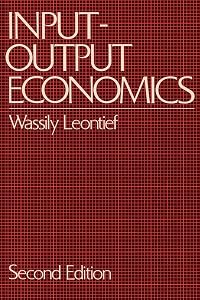
Input-Output Economics
by Wassily Leontief
63 Members (1.00)
On This Page
Description
This collection of writings provides the only comprehensive introduction to the input-output model for which Leontief was awarded the Nobel Prize in 1973. The structural approach to economics developed by Leontief, and known as input-output analysis, paved the way for the transformation ofeconomics into a truly empirical discipline that could utilize modern data processing technology. This thoroughly revised second edition includes twenty essays--twelve of which are new to this show more edition--that reflect the past developments and the present state of the field. Beginning with anintroductory chapter, the book leads the reader into an understanding of the input-output approach--not only as formal theory but also as a research strategy and powerful tool for dealing with a complex modern economy. show lessTags
Recommendations






















Member Reviews
Members
- Recently Added By
Author Information
26+ Works 132 Members
Wassily Leontief is a Russian-born American economist and educator. After graduating from the University of Berlin, he worked briefly as a research associate with the (U.S.) National Bureau of Economic Research, where he did preliminary work on what is now known as an input-output model. He taught at Harvard University and then at New York show more University, where he founded the Institute for Economic Analysis. His Nobel Prize in 1973 was awarded for his work on input-output studies. Input-output analysis is a technique for determining how various sectors of the economy interact. Leontief's first input-output table consisted of a 44-sector model of the U.S. economy arranged in the form of a matrix, with columns and rows for each of the sectors. When purchases in a column are added, the result is the total amount of resources, or "inputs," required by the sector. Sales, or "outputs," in any given row represent the output of the sector. The value of the model is that it provides an overall picture of interdependencies among sectors, so that economists can determine how changes in one sector will affect performance in other sectors. The methodology is described in great detail in Leontief's classic Input-Output Economics (1966); a more specific application of the methodology can be found in his Future Impact of Automation on Workers (1986). The latter explores worker displacement by computer-based automation in U.S. manufacturing, office work, and education and health care industries. Today input-output models have a broad following, with some containing as many as 1,000 sectors. Leontief's models are used by the Pentagon, the World Bank, the United Nations, and over 30 countries for budgeting and economic prediction. Numerous other specialized applications of the model have been used in waste disposal management, pollution control, and even world disarmament. (Bowker Author Biography) show less
Series
Belongs to Publisher Series
Common Knowledge
- Original title
- Input-Output Economics
- Original publication date
- 1966
- Original language*
- Inglés
*Some information comes from Common Knowledge in other languages. Click "Edit" for more information.
Classifications
- Genres
- Economics, Nonfiction, General Nonfiction, Science & Nature
- DDC/MDS
- 339.2 — Society, government, & culture Economics Macroeconomics and related topics Distribution Of Income And Wealth
- LCC
- HB142 .L46 — Social sciences Economic theory. Demography Economic theory. Demography Methodology Mathematical economics. Quantitative methods
- BISAC
Statistics
- Members
- 63
- Popularity
- 493,783
- Rating
- (1.00)
- Languages
- English, Portuguese, Spanish
- Media
- Paper, Ebook
- ISBNs
- 10
- ASINs
- 1