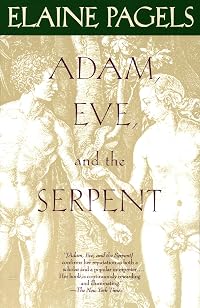
Adam, Eve, and the Serpent: Sex and Politics in Early Christianity
by Elaine Pagels
On This Page
Description
Deepens and refreshes our view of early Christianity while casting a disturbing light on the evolution of the attitudes passed down to us. How did the early Christians come to believe that sex was inherently sinful? When did the Fall of Adam become synonymous with the fall of humanity? What turned Christianity from a dissident sect that championed the integrity of the individual and the idea of free will into the bulwark of a new imperial order--with the central belief that human beings show more cannot not choose to sin? In this provocative masterpiece of historical scholarship Elaine Pagels re-creates the controversies that racked the early church as it confronted the riddles of sexuality, freedom, and sin as embodied in the story of Genesis. And she shows how what was once heresy came to shape our own attitudes toward the body and the soul. show lessTags
Recommendations






Member Reviews
If you're new to Pagels I woud suggest you start with THE GNOSTIC GOSPELS. That is the foundation, it seems to me, on which all of her other works build. ADAM, EVE, AND THE SERPENT focuses on why early Christians came to believe sex was inherently sinful. An excellent question. It begins with more of the fascinating story of the Valentinian gnostics, who were so troublesome to the early church. Apparently, like earlier Talmudic scholars, the gnostics saw little usefulness in Scriptural readings that were not fresh and innovative. (Karen Armstrong goes into this subject at length in her THE CASE FOR GOD.) Such a spur to inventiveness naturally gave rise to widely variant readings. This was at a time when early church fathers Irenaeus, show more Tertullian and others were trying to standardize Scriptural interpretation. The gnostics also believed that clerics were not needed for what was essentially an inward journey of spiritual discovery. Rituals such as baptism and the eucharist they viewed as preliminaries. The gnostics were thus considerably anti-establishment and as such they drove Irenaeus and his fellows a little crazy. So consumed was Irenaeus with the gnostics that he composed a multi-volume refutation of their divergent beliefs. Most useful to this reader was the story in the chapter "The Politics of Paradise" of how Augustine "transformed much of the teaching of the Christian faith" from one that emphasized "freedom of the will and humanity's original royal dignity" . . . "to one of enslavement to sin." Pagels explains how Augustine's own out of control sexually promiscuous youth made it all but impossible for him to understand then prevailing Christian concepts of free will. "Astonishingly," she says, "Augustine's radical views prevailed, eclipsing for future generations of western Christians the consensus of more than three centuries of Christian tradition." There is so much interesting content here. I've just touched on just a few spots. The book is a little denser in terms of its scholarship than other Pagels books. (I've read all but the first two.) I could not get straight through it in one go, but needed a fiction interlude before returning to finish. Nevertheless, highly recommended. show less
In her epilogue to Adam, Eve, and the Serpent Elaine Pagels insists that her ambition in this book is neither to discover nor to indicate the nature of the "real Christianity." In that case, she could have avoided a lot of the confusion raised by her presentation, if only she had been a little bit more skeptical about the original message of "Jesus," whom she quotes--on the basis of the canonical Gospels--as blithely as she cites the writings of Augustine or any of the other Church Fathers. She knows well enough that "the gospels of the New Testament are neither histories nor biographies in our sense of these terms," (5) but she still handles them as though they might serve in those capacities.
Still, for a book that is designed to show more straddle the line between scholarship and popularization, Pagels does a good job. And her topic couldn't be more interesting. She traces the development of Christian interpretations of the Edenic myth of Genesis, and how they were used to formulate and express ideas about sexuality, politics, free will, and guilt. She accepts the Luke-Acts epic as though it were history, and even so, manages to demonstrate important facts about the history of early Christianity: its diversity (with a chapter on "Gnostic Improvisations") and its profound difference from the Augustinian orthodoxy that underlies nearly all modern Christianities.
Her treatment of Augustine is fascinating, and she claims to have been as surprised herself by the results of her research as most of her Christian readers will be. Although she was originally sympathetic to Augustine from her readings in his Confessions, On the Trinity and The City of God, her effort to reopen a conversation forcibly closed by papal authority in April 418 C.E. led her to the dialogue between Augustine and the Pelagian naturalist Julian of Eclanum. In contrast with verdicts from the traditional secondary sources, Pagels finds Julian thoughtful and scripturally attentive. Augustine, whose Opus Imperfectum Contra Julianum has never been published in English translation, seems "idiosyncratic" and tendentious in his novel doctrine of congenital human depravity.
In Pagels' account, the combination of Augustine's theological innovations with the establishment of imperial Christianity resulted in the rejection of an earlier Christian ethos of freedom, and its replacement with one of guilt. This study deserves the careful consideration of everyone who thinks that they have read and understood Genesis 3:16-19, since hardly any readers, medieval or modern, have been able to approach the Edenic myth without the long Augustinian shadow of "original sin" cast upon it. Before Augustine, Justin Martyr could say to the prefect who condemned him to death: "Do what thou wilt: we are Christians." (49) show less
Still, for a book that is designed to show more straddle the line between scholarship and popularization, Pagels does a good job. And her topic couldn't be more interesting. She traces the development of Christian interpretations of the Edenic myth of Genesis, and how they were used to formulate and express ideas about sexuality, politics, free will, and guilt. She accepts the Luke-Acts epic as though it were history, and even so, manages to demonstrate important facts about the history of early Christianity: its diversity (with a chapter on "Gnostic Improvisations") and its profound difference from the Augustinian orthodoxy that underlies nearly all modern Christianities.
Her treatment of Augustine is fascinating, and she claims to have been as surprised herself by the results of her research as most of her Christian readers will be. Although she was originally sympathetic to Augustine from her readings in his Confessions, On the Trinity and The City of God, her effort to reopen a conversation forcibly closed by papal authority in April 418 C.E. led her to the dialogue between Augustine and the Pelagian naturalist Julian of Eclanum. In contrast with verdicts from the traditional secondary sources, Pagels finds Julian thoughtful and scripturally attentive. Augustine, whose Opus Imperfectum Contra Julianum has never been published in English translation, seems "idiosyncratic" and tendentious in his novel doctrine of congenital human depravity.
In Pagels' account, the combination of Augustine's theological innovations with the establishment of imperial Christianity resulted in the rejection of an earlier Christian ethos of freedom, and its replacement with one of guilt. This study deserves the careful consideration of everyone who thinks that they have read and understood Genesis 3:16-19, since hardly any readers, medieval or modern, have been able to approach the Edenic myth without the long Augustinian shadow of "original sin" cast upon it. Before Augustine, Justin Martyr could say to the prefect who condemned him to death: "Do what thou wilt: we are Christians." (49) show less
Adam, Eve, and the Serpent is a baptism into the various debates and controversies that swirled through the first three centuries of Christendom. It’s obvious on every page that Pagels knows the players in the early church (both orthodox and heterodox) like the back of her hand. This book is a popular (but never dumbed-down) distillation of her scholarly work.
The most fascinating aspect of this book was the relationships she drew between three apparently distinct fields: sexual ethics, free will, and politics. Genesis 1-3 was used and abused by theologians and heretic-hunters in their attempt to explain the world. Pagels frees branded heretics like Valentinus and Julian to speak to these fields in their own voice, rather than in the show more caricatured lampooning of orthodoxy.
I do have problems with Pagels, specifically on her view of the Nag Hammadi documents. She seems to believe that they reflect a tradition as ancient as the canonical gospels. After reading documents like the Gospel of Thomas, I can’t help but understand them as secondary spiritualizations of a life and teaching that were far more concrete. Scholars like N. T. Wright have situated Jesus so firmly in first century Judaism, it seems impossible to believe he was a wandering mystic offering enlightenment.
That said, Pagels is a brilliant and honest historian who should be read by anyone with an interest in early Christianity. show less
The most fascinating aspect of this book was the relationships she drew between three apparently distinct fields: sexual ethics, free will, and politics. Genesis 1-3 was used and abused by theologians and heretic-hunters in their attempt to explain the world. Pagels frees branded heretics like Valentinus and Julian to speak to these fields in their own voice, rather than in the show more caricatured lampooning of orthodoxy.
I do have problems with Pagels, specifically on her view of the Nag Hammadi documents. She seems to believe that they reflect a tradition as ancient as the canonical gospels. After reading documents like the Gospel of Thomas, I can’t help but understand them as secondary spiritualizations of a life and teaching that were far more concrete. Scholars like N. T. Wright have situated Jesus so firmly in first century Judaism, it seems impossible to believe he was a wandering mystic offering enlightenment.
That said, Pagels is a brilliant and honest historian who should be read by anyone with an interest in early Christianity. show less
Augustine, arguably Christianity’s greatest teacher, often stressed the sinful nature of sexual desire. Adam’s sin corrupted the whole of nature itself, and infants are infected from the moment of conception with the disease of original sin. When did this idea come about that sex is inherently sinful? When did the fall become the Fall?
In Genesis 1, God gifted the power of earthly rule to Adam. Yet, in the late fourth and fifth centuries, this message began to change. Adam’s prideful desire for self-government led to the fall—I mean, the Fall—of mankind, and ever since, humanity has been sick, helpless, irreparably damaged. Human beings are incapable of self rule, not in any genuinely good way.
Says Augustine, “even the nature show more of the semen from which we were to be propagated” is “shackled by the bond of death.” Every being conceived through semen is born contaminated with sin. Christ alone is born without this sin, this libido. Because of Adam’s disobedience, “the sexual desire of our disobedient members arose in those first human beings.” These members are rightly called pudenda [parts of shame] because they “excite themselves just as they like, in opposition to the mind which is their master, as if they were their own masters.”
Okay, perhaps I have overemphasized Augustine and his hangup about sex. There’s more to the book, and Pagels is a good writer who manages to turn even this dubious topic into a fascinating read. show less
In Genesis 1, God gifted the power of earthly rule to Adam. Yet, in the late fourth and fifth centuries, this message began to change. Adam’s prideful desire for self-government led to the fall—I mean, the Fall—of mankind, and ever since, humanity has been sick, helpless, irreparably damaged. Human beings are incapable of self rule, not in any genuinely good way.
Says Augustine, “even the nature show more of the semen from which we were to be propagated” is “shackled by the bond of death.” Every being conceived through semen is born contaminated with sin. Christ alone is born without this sin, this libido. Because of Adam’s disobedience, “the sexual desire of our disobedient members arose in those first human beings.” These members are rightly called pudenda [parts of shame] because they “excite themselves just as they like, in opposition to the mind which is their master, as if they were their own masters.”
Okay, perhaps I have overemphasized Augustine and his hangup about sex. There’s more to the book, and Pagels is a good writer who manages to turn even this dubious topic into a fascinating read. show less
Fascinating book . . . but, once again, the author's apparent preference for Gnostic thought and traditions clouded her judgment on Orthodoxy. I didn't quite buy her rather dark reading of Augustine. Okay; okay: Sure, he was a dark thinker, deeply disturbed, and, in the end, one of the great Bad Guys of intellectual history, retreating to coercion and torture and murder to solidify an orthodoxy and an empire.
But still, his take on Original Sin doesn't strike me as the imposition on Judeo-Christian source material as it does to Ms. Pagels.
There's a lot of enormously interesting and entertaining material in this book, especially that Gnostic idea that the Serpent in the Garden of Eden was "obviously" the Good Guy, and Yahweh "obviously" show more the Bad Guy, a paranoid liar and jealous tyrant.
I've had occasion to reference this book quite a few times over the years. Read it, and you will too. show less
But still, his take on Original Sin doesn't strike me as the imposition on Judeo-Christian source material as it does to Ms. Pagels.
There's a lot of enormously interesting and entertaining material in this book, especially that Gnostic idea that the Serpent in the Garden of Eden was "obviously" the Good Guy, and Yahweh "obviously" show more the Bad Guy, a paranoid liar and jealous tyrant.
I've had occasion to reference this book quite a few times over the years. Read it, and you will too. show less
In The Simpsons, Ned Flanders, the annoying goody-goody neighbor, notes at one point that he’s tried to be a good Christian by following the Bible – even the stuff that contradicts the other stuff! Similarly, the great poet William Blake comments – “Both read the Bible day and night; but you read black where I read white!” Pagels illustrates some of this in her book Adam, Eve and the Serpent – wildly different interpretations of passages from Genesis, the fight over the meaning of Jesus’ and Paul’s sayings, the early message of Christianity as a religion of moral freedom vs Augustine’s view of the world as unavoidably sinful. Although ostensibly the subject is the story of Adam and Even and how it was interpreted, the show more title doesn’t seem entirely correct as there’s a lot about the history of the early Christians who were persecuted under the Romans. However, the overall point is to examine the various interpretations of the Genesis story during the first centuries of Christianity and how Augustine’s reading came to be the dominant interpretation even today. Sometimes the structure was a little rambling. Although Pagels is great at making close interpretation of Biblical passages and writings of various Christians and pagans very interesting, her discussion of straight history and feuds of different Christian sects was somewhat dry. I’m also unfamiliar with modern views of Augustine so didn’t have too much to compare this to. Still, even her tangents are interesting and I’d be happy to read Pagels rambling on about the whole Bible.
The first chapter looks at Jesus’ radical message and how later gospels and interpreters tried to soften it. Talk of marriage as indissoluble was contradictory to the customs of the Romans and the Jews, where promiscuity (for men), divorce and multiple wives were common. His message to his followers to leave their families was also an uncomfortable one. Paul’s sayings, which also were included in the New Testament, promoted an ascetic message of celibacy and renunciation. Pagels identifies books that today are no longer believed to have been written by Paul and finds a less harsh, pro-family message in them. The interpretations of early Christians pitted the message of asceticism against one of family, marriage and children, with both sides pointing to their analyses of Genesis. Pagels does a good job conveying how weird Jesus’ sayings would have been and describing the profusion of views and arguments. This section certainly was interesting and set up the rest of the book but mentions of Genesis were fleeting.
Next, she analyzes how Christians portrayed their religion when they were a persecuted minority – as a religion of freedom, equality and justice. Her choice of quotes is again enlightening but sometimes I wondered if the people that were described were real or apocryphal. In many cases, it was probably irrelevant – the message of brave Christian martyrs calmly sticking to their beliefs was the important one. Pagels clearly finds Marcus Aurelius a fascinating and admirable character; as in The Origin of Satan, she spends several paragraphs ruminating on his life. It’s not a tangent as his sense of duty is contrasted to the Christians’ but it does seem to be a running theme, as is the examination of the gnostic interpretations of the Genesis story. Some of them are out-and-out bizarre, many take an allegorical or psychological view of the story and some are almost close to Adam & Eve fanfiction. The split between the Gnostics and more orthodox Christians was another fight in the battle over who controlled the interpretation of Christianity.
A chapter on the emphasis on virginity and chastity also seems to be a bit off topic, but relates to how Christians differentiated themselves from the Romans and Jews and also used it as a measure of moral superiority.
The last two chapters examine how Augustine came to define the Genesis story for years to come. Earlier, Pagels emphasizes how Christians defined their religion of one of freedom and justice – citing the Adam story as one of the moral freedom that every person had. As Christianity became a widespread religion, infighting between Christians – rather than Christians defining themselves against other societies – became a source of conflict. John Chrysostom’s interpretations continue the idea of Christianity as a source of freedom and the Genesis story as one of a moral choice but that contrasted with the reality of the religion as the large, corrupt state religion. He believed the earlier Christian view of human nature as one that could choose good and that baptism washed away previous sins. Augustine’s interpretation is compared to that of Chrysostom and is largely negative about human nature in general. The Adam and Eve story to him was one of original sin that forever corrupted mankind. While earlier Christians had deplored the compulsion and violence used by the Romans, Augustine later came to approve of those methods. Pagels’ section on his conflict with Julian has quotes from both that rather make Augustine look bad. Pagels somehow makes theological debates very interesting but oddly the pages of straight history were dry and uninvolving. There were tangents but I didn’t mind them. Another good Pagels. show less
The first chapter looks at Jesus’ radical message and how later gospels and interpreters tried to soften it. Talk of marriage as indissoluble was contradictory to the customs of the Romans and the Jews, where promiscuity (for men), divorce and multiple wives were common. His message to his followers to leave their families was also an uncomfortable one. Paul’s sayings, which also were included in the New Testament, promoted an ascetic message of celibacy and renunciation. Pagels identifies books that today are no longer believed to have been written by Paul and finds a less harsh, pro-family message in them. The interpretations of early Christians pitted the message of asceticism against one of family, marriage and children, with both sides pointing to their analyses of Genesis. Pagels does a good job conveying how weird Jesus’ sayings would have been and describing the profusion of views and arguments. This section certainly was interesting and set up the rest of the book but mentions of Genesis were fleeting.
Next, she analyzes how Christians portrayed their religion when they were a persecuted minority – as a religion of freedom, equality and justice. Her choice of quotes is again enlightening but sometimes I wondered if the people that were described were real or apocryphal. In many cases, it was probably irrelevant – the message of brave Christian martyrs calmly sticking to their beliefs was the important one. Pagels clearly finds Marcus Aurelius a fascinating and admirable character; as in The Origin of Satan, she spends several paragraphs ruminating on his life. It’s not a tangent as his sense of duty is contrasted to the Christians’ but it does seem to be a running theme, as is the examination of the gnostic interpretations of the Genesis story. Some of them are out-and-out bizarre, many take an allegorical or psychological view of the story and some are almost close to Adam & Eve fanfiction. The split between the Gnostics and more orthodox Christians was another fight in the battle over who controlled the interpretation of Christianity.
A chapter on the emphasis on virginity and chastity also seems to be a bit off topic, but relates to how Christians differentiated themselves from the Romans and Jews and also used it as a measure of moral superiority.
The last two chapters examine how Augustine came to define the Genesis story for years to come. Earlier, Pagels emphasizes how Christians defined their religion of one of freedom and justice – citing the Adam story as one of the moral freedom that every person had. As Christianity became a widespread religion, infighting between Christians – rather than Christians defining themselves against other societies – became a source of conflict. John Chrysostom’s interpretations continue the idea of Christianity as a source of freedom and the Genesis story as one of a moral choice but that contrasted with the reality of the religion as the large, corrupt state religion. He believed the earlier Christian view of human nature as one that could choose good and that baptism washed away previous sins. Augustine’s interpretation is compared to that of Chrysostom and is largely negative about human nature in general. The Adam and Eve story to him was one of original sin that forever corrupted mankind. While earlier Christians had deplored the compulsion and violence used by the Romans, Augustine later came to approve of those methods. Pagels’ section on his conflict with Julian has quotes from both that rather make Augustine look bad. Pagels somehow makes theological debates very interesting but oddly the pages of straight history were dry and uninvolving. There were tangents but I didn’t mind them. Another good Pagels. show less
While Pagels often has interesting ideas, she sometimes lets her ideas become conclusions for which she then finds evidence, rather than letting the evidence lead to a conclusion. While her examples can be compelling in support of her theses, there is often a feeling that she could have chosen a different example that would not support her argument. Is it really a simplistic matter that the Catholic Church became hierarchical and oppressive as a result of it being adopted by the Roman Emperors? Sure, that influenced matters, but how can a hierarchical turn of mind in the culture that is an integral part of the Roman Empire be disregarded as a cause in itself? Was Latin adopted as the language of the liturgy because it was the language show more of the ruling class, or because it was the lingua franca of the Mediterranean world?
The discussion of the disagreements between Augustine and Pelagius (and the Pelagians) is fascinating and informative. Pagels is engaging when she is asking questions and analyzing. Her tendency to want to tie up all loose ends without offending anyone is annoying. Thus, her concluding sentence, where she attempts to say that all people, whatever their religious beliefs, are equal in the recognition of a "spiritual dimension in human experience." It sounds a bit like a Miss America contestant saying she wants world peace. I would add the criticism that her observation, however banal, may not be true. show less
The discussion of the disagreements between Augustine and Pelagius (and the Pelagians) is fascinating and informative. Pagels is engaging when she is asking questions and analyzing. Her tendency to want to tie up all loose ends without offending anyone is annoying. Thus, her concluding sentence, where she attempts to say that all people, whatever their religious beliefs, are equal in the recognition of a "spiritual dimension in human experience." It sounds a bit like a Miss America contestant saying she wants world peace. I would add the criticism that her observation, however banal, may not be true. show less
Members
- Recently Added By
Published Reviews
ThingScore 100
added by danielx
Lists

Books That Changed Our Perspective
423 works; 168 members
Author Information

32+ Works 15,566 Members
Elaine Pagels is the Harrington Spear Paine Professor of Religion at Princeton University. She is the recipient of a MacArthur Fellowship best known for her studies and writing on the Gnostic Gospels. Pagels graduated from Stanford University receiving a B.A. in 1964 and an M.A. in 1965. She received a Ph.D in religion from Harvard University in show more 1970. She is the author of The Gnostic Gospels (1979), which won the National Book Award (Religion 1980) and the National Book Critics Circle Award (Criticism 1979). Pagels is also the author of Adam, Eve and the Serpent (1988), The Origin of Satan (1995), Beyond Belief: The Secret Gospel of Thomas (2003), Reading Judas: The Gospel of Judas and the Shaping of Christianity (2007), and Revelations: Visions, Prophecy, and Politics in the Book of Revelation (2012). (Bowker Author Biography) show less
Some Editions
Awards and Honors
Distinctions
Work Relationships
Common Knowledge
- Original publication date
- 1988
- People/Characters
- Serpent; Augustine of Hippo (Saint, 354-430); Irenaeus (Saint, Martyr?, Irenaeus of Smyrna, c. 130-202); John Chrysostom (Saint, c. 349–407); Valentinus (Valentinius, c. 100–c. 160); Tertullian (Quintus Septimius Florens, ca. 155-ca. 220) (show all 11); Adam; Eve; Clement of Alexandria (Saint?, Titus Flavius Clemens, c. 150–c. 215); Jesus of Nazareth; Justin Martyr (Saint, Martyr, Justin the Philosopher, 100-166)
- Important places
- Garden of Eden
- Important events
- Creation of the world; Expulsion from Eden
- Dedication
- To our beloved son, Mark
who for six and a half years
graced our lives with his presence
October 26, 1980—April 10, 1987 - First words
- INTRODUCTION
Abrupt changes in social attitudes have recently become commonplace, especially with respect to sexuality, including marriage, divorce, homosexuality, abortion, contraception, and gender.
(I)
"THE KINGDOM OF
GOD IS AT HAND"
Jesus and his followers lived at a time when the situation of the Jews was particularly turbulent and potentially explosive. - Last words
- (Click to show. Warning: May contain spoilers.)This recognition, after all, is what all participants in Christian tradition, however they disagree, share in common—and share, for that matter, with many people who are involved in Christian tradition only peripherally, or not at all.
- Blurbers
- Norman, Edward; Kelly, J. N. D.
Classifications
- Genres
- Religion & Spirituality, Nonfiction, History, General Nonfiction
- DDC/MDS
- 241.66 — Religion Christian practice & observance Christian ethics Christian ethics not otherwise covered Christian sexual ethics
- LCC
- BS2545 .S36 .P34 — Philosophy, Psychology and Religion The Bible The Bible New Testament Works about the New Testament
- BISAC
Statistics
- Members
- 1,857
- Popularity
- 11,701
- Reviews
- 16
- Rating
- (3.75)
- Languages
- 8 — Danish, Dutch, English, French, German, Italian, Spanish, Swedish
- Media
- Paper, Ebook
- ISBNs
- 17
- ASINs
- 10