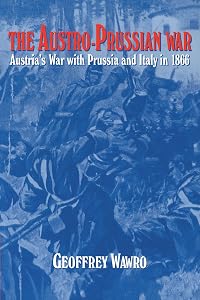
The Austro-Prussian War: Austria's War with Prussia and Italy in 1866
by Geoffrey Wawro
On This Page
Description
This is a history of the Austro-Prussian-Italian War of 1866, which paved the way for German and Italian unification. It is based upon extensive new research in the state and military archives of Austria, Germany, and Italy. Geoffrey Wawro describes Prussia's successful invasion of Habsburg Venetia, and the wretched collapse of the Austrian army in July 1866. Although the book gives a thorough accounting of both the Prussian and Italian war efforts, it is most notable for the light it sheds show more on the Austrians. Through painstaking archival research, Wawro reconstructs the Austrian campaign, blow-by-blow, hour-by-hour. Blending military and social history, he describes the terror and panic that overtook Austria's regiments of the line in each clash with the Prussians. He reveals the unconscionable blundering of the Austrian commandant and his chief deputies who fumbled away key strategic advantages and ultimately lost a war - crucial to the fortunes of the Habsburg Monarchy - that most European pundits had predicted they would win. show lessTags
Recommendations














Member Reviews
A very good analysis of the most imortant war until WWII. Wawro outlines how the invention of the breech loading rifle, coupled with the idea of enveloping one's opponent, set the stage for every major war until 1945. The Napoleonic idea of the massed battalions overwhelming one's enemies by cutting into them with masses of bayonet armed infantry, was dealt a fatal blow by the Prussians in this conflict. His final chapter lays out the following embrace of the Prussian strategy, by all the successful armies until the middle of the twentieth century, played out. I sadly note this book no longer seems in print, perhaps due to the English speaking world is reluctant to embrace a book whose principal focus is a battle fought "Far away, by show more people we know little about" to quote Neville Chamberlain. A very great pity. show less
The Habsburg Empire was a congerie of different peoples, and often suffered for it. Sadly, much the same must be said for this book.
The topic is without doubt fascinating: How the Prussians and Italians attacked Austria-Hungary -- for political reasons in the Prussian case, for purposes of a land grab in the Italian. The Prussians had a disadvantage in manpower, but made up for it with superior technology (breech-loading needle guns) and planning (they had invented staff command, and had plans all worked up in advance; the Austrians were operating by the seat of their pants).
But somehow the tale fails to come together. In reading the narrative, one gets the impression of the Austrians stumbling around the Alps trying to figure out how show more to fight. Which is true in a way -- but there was an overall course of development of the campaign even if there wasn't much of a plan on the Austrian side.
There is a lot of good information here, and quite a few maps (drawn, I think, with the ancient Macintosh program MacDraw). If you go through the index and look up a particular battle, you'll learn a lot. But the outcome of the war of 1866 was to weaken the Habsburg monarchy even more, while allowing Prussia to take a major step toward uniting Germany. And, in reading this book, I found it hard to understand why. show less
The topic is without doubt fascinating: How the Prussians and Italians attacked Austria-Hungary -- for political reasons in the Prussian case, for purposes of a land grab in the Italian. The Prussians had a disadvantage in manpower, but made up for it with superior technology (breech-loading needle guns) and planning (they had invented staff command, and had plans all worked up in advance; the Austrians were operating by the seat of their pants).
But somehow the tale fails to come together. In reading the narrative, one gets the impression of the Austrians stumbling around the Alps trying to figure out how show more to fight. Which is true in a way -- but there was an overall course of development of the campaign even if there wasn't much of a plan on the Austrian side.
There is a lot of good information here, and quite a few maps (drawn, I think, with the ancient Macintosh program MacDraw). If you go through the index and look up a particular battle, you'll learn a lot. But the outcome of the war of 1866 was to weaken the Habsburg monarchy even more, while allowing Prussia to take a major step toward uniting Germany. And, in reading this book, I found it hard to understand why. show less
Ratings
Members
- Recently Added By
Published Reviews
A major strength of the Austro-Prussian War is its recognition of a fact too often overlooked by the 'new military history': wars mean fighting. Wawro's operational chapters, models of their kind, give as good a portrait of the fact of 19th-century battle as anything in print.
added by bgibbard
This is a very good book [on its subject], perhaps the best that has appeared in any language.
added by bgibbard
Geoffrey Wawro's meticulous analyses of battle make The Austro-Prussian War an important book; his pungent judgements make it a lively one.
added by bgibbard
Lists

BOOK WISH LIST
11 works; 1 member
Author Information

10+ Works 1,239 Members
Geoffrey Wawro studied at Brown and Yale and is a professor of history and Director of the Military History Center at the University of North Texas. The author of five books, including Quicksand and The Franco-Prussian War, Wawro lives in Dallas, Texas.
Common Knowledge
- People/Characters
- Albrecht, Archduke, Duke of Teschen; Ludwig Benedek; Otto von Bismarck; Karl Herwarth von Bittenfeld; Enrico Cialdini; Edouard Clam-Gallas (show all 18); Leopold Edelsheim; Franz Joseph I, Emperor of Austria; Friedrich Karl, Prince of Prussia; Friedrich Wilhelm I of Prussia; Ludwig Gablenz; Alfred Henikstein; Gideon Krismanic; Alfonso La Marmora; Helmuth von Moltke the Elder; Napoleon III; Wilhelm Ramming; Wilhelm I, King of Prussia
- Important places
- Austria; Italy; Prussia
- Important events
- Austro-Prussian War (1866); Battle of Custoza (1866-6-24); Battle of Königgrätz (1866-7-3); Battle of Sadowa (1866-7-3)
- Dedication
- To my mother and father
- First words
- Introduction -- The Austro-Prussian War of 1866 would more accurately be called the Austro-Prussian-Italian War, for Italy -- determined to have the Habsburg provinces of Venetia and South Tyrol -- seized the opportunity pres... (show all)ented by Austria's war with Prussia in Bohemia and the German states to invade Austria from the south.
Classifications
- Genres
- History, Nonfiction, General Nonfiction
- DDC/MDS
- 943.076 — History & geography History of Europe Central Europe: Germany, Austria, Switzerland, Czech, Poland, Hungary Historical periods of Germany Confederation 1815-1866
- LCC
- DD438 .W39 — History of Europe, Asia, Africa and Oceania Germany History of Germany Prussia History
- BISAC
Statistics
- Members
- 147
- Popularity
- 223,237
- Reviews
- 2
- Rating
- (4.07)
- Languages
- English
- Media
- Paper
- ISBNs
- 2