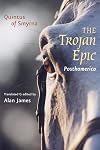
Posthomerica
by Quintus of Smyrna
On This Page
Description
Brilliantly revitalized by James, the Trojan Epic will appeal to a wide range of readers interested in Greek mythology and the legend of Troy.Tags
Recommendations





Member Reviews
Here we have a Roman writing like a Greek about a missing part of a great war that started a new epoch of Greek civilization using the romantic language of the Romans from a civilization who took over and absorbed the other civilization. Quite facinating. Quintus the Roman is filling in the gaps of the end of the Iliad and the start of the Odyssey. Here is where our giant wooden horse and being wary of Greeks bearing gifts finds its formulations. This shows the impact Homer had on Western civilization and that people continued to find value of the greater Western library. The expansion of the story and the need to tie up loose ends shows us that fan fiction has always been part of our anxious nature to not leave stories alone.
Sadly, show more Quintus is no Homer. He does a good job of modeling the stylistic and rhythmic nature of Homer. Right off the bat, there is no invocation of the Muses and the very romantic nature and language found in the tale are not Greek in nature but very Roman. It could be my translation but I used Arthur Way's to keep with the form, however, I found the writing to be confusing over who was speaking and where the focus was. It keeps the book style and the first couple of chapters really show the beauty of Quintus' writing and the Roman romanticism with Achilles falling in love with an Amazon warrior. There are other elements that help explain elements, especially as seen in the Odyssey but a good chunk of the book just continues the futile nature of the war in battle detail. It's not until the last three chapters do we get what we were all reading for. In these chapters, we get elements for the Oresteia stories and some tragic descriptions that Euripides would write about as well.
This took a long time to get through and I didn't enjoy it as much as I did Homer's stories. It was interesting to look at the divergent style that a Roman author brought to it and how we still have today someone who was inspired complete a part of the story from a different people group from a completely different time and in a different style. That's where the value lies. Final Grade - D+ show less
Sadly, show more Quintus is no Homer. He does a good job of modeling the stylistic and rhythmic nature of Homer. Right off the bat, there is no invocation of the Muses and the very romantic nature and language found in the tale are not Greek in nature but very Roman. It could be my translation but I used Arthur Way's to keep with the form, however, I found the writing to be confusing over who was speaking and where the focus was. It keeps the book style and the first couple of chapters really show the beauty of Quintus' writing and the Roman romanticism with Achilles falling in love with an Amazon warrior. There are other elements that help explain elements, especially as seen in the Odyssey but a good chunk of the book just continues the futile nature of the war in battle detail. It's not until the last three chapters do we get what we were all reading for. In these chapters, we get elements for the Oresteia stories and some tragic descriptions that Euripides would write about as well.
This took a long time to get through and I didn't enjoy it as much as I did Homer's stories. It was interesting to look at the divergent style that a Roman author brought to it and how we still have today someone who was inspired complete a part of the story from a different people group from a completely different time and in a different style. That's where the value lies. Final Grade - D+ show less
There is a gap of epic happenings between Homer’s two masterworks, in Ancient Greece there were smaller epics that complete the story but were lost in time then one man rose to the challenge to bridge the gap. The Fall of Troy by Quintus of Smyrna is the rescued remnants of the lost epics between Homer that detail the end of the Trojan War constructed into a single work.
Writing a millennium after the probable date of the first time The Iliad was first written down, Quintus decided to fill in the gap between funeral for Hector and the fall of the Troy by salvaging what was left of the little epics to complete the coverage of the war. Quintus’ quality is nothing compared to Homer, but obviously he knows it and doesn’t try to be show more Homer just to complete the war. Quintus achieves his goal and frankly the rating of the book is based on his decision to even write the book, what could have improved the book is if the publishers of this edition would have had either footnotes or endnotes but just as a general reader it doesn’t really ruin things it just would have enhanced it.
The Fall of Troy finishes the war that ancient western world obsessed about for a millennium and gives readers today a view of how it ended how it ended. show less
Writing a millennium after the probable date of the first time The Iliad was first written down, Quintus decided to fill in the gap between funeral for Hector and the fall of the Troy by salvaging what was left of the little epics to complete the coverage of the war. Quintus’ quality is nothing compared to Homer, but obviously he knows it and doesn’t try to be show more Homer just to complete the war. Quintus achieves his goal and frankly the rating of the book is based on his decision to even write the book, what could have improved the book is if the publishers of this edition would have had either footnotes or endnotes but just as a general reader it doesn’t really ruin things it just would have enhanced it.
The Fall of Troy finishes the war that ancient western world obsessed about for a millennium and gives readers today a view of how it ended how it ended. show less
An interesting book, filling in the Troy Story between the Iliad and the Odyssey. It's difficult to tell whether the problem is in the original or the translation, but the quality of the writing doesn't seem especially good. (I'd guess the problem is mostly in the original -- there are scenes repeated from the Iliad that not only add nothing to them, they aren't even done as well, even when trying to account for potential translation problems.) Still, it's good to read the parts of the Troy Story that one knew was there but had never really seen: Penthesileia, the death of Achilles, the suicide of Aias, the retrieval of Philoctetes, the Trojan Horse and the fall of Troy. The best moment, I thought, was the death of Thersites. He insults show more Achilles, and brutish Achilles isn't satisfied to beat him up as Odysseus did; he just kills him, to general rejoicing, and Thersites is buried separately from everyone else who had fallen. And that's pretty much the last thing Achilles does before he gets killed himself. show less
There seems to have been a more recent translation than this Loeb classical Library edition . A.S. Way was probably an accurate rather than a lively translator. And it was prior to 1913 when completed this continuation of the Iliad. It fills in the gaps. I don't think I've seen a movie version of the Trojan War that gives Smyrnaeus his due.
Agreed but I think there's also a major problem in the translation as periods are missing at the end of several sentences and the like--gives Quintus a bad rap...
Ratings
Members
- Recently Added By
Lists

The Trojan War
109 works; 13 members
Author Information
8+ Works 468 Members
Series
Belongs to Publisher Series
Kodansha Academic Library (1447)
Work Relationships
Common Knowledge
- Canonical title
- Posthomerica
- People/Characters
- Aeneas; Achilles; Ajax; Menelaus; Agamemnon; Diomedes (show all 23); Odysseus; Priam; Paris; Oenone; Penthesilea; Nestor; Ajax the Lesser; Calchas; Neoptolemus; Philoctetes; Polydamas; Deiphobus; Cassandra; Hecuba; Andromache; Memnon; Eurypylus
- Disambiguation notice
- Please use this for translations of the Posthomerica. Editions containing the original Greek text should be put in a separate work entry.
Classifications
- Genres
- Poetry, Fiction and Literature
- DDC/MDS
- 883.01 — Literature & rhetoric Classical & modern Greek literatures Classical Greek epic poetry and fiction Pseudo-Callisthenes
- LCC
- PA4407 .Q5 .E5 — Language and Literature Greek language and literature. Latin language and literature Greek literature Individual authors
- BISAC
Statistics
- Members
- 336
- Popularity
- 94,335
- Reviews
- 5
- Rating
- (3.66)
- Languages
- 5 — English, Greek (Ancient), Italian, Japanese, Spanish
- Media
- Paper, Ebook
- ISBNs
- 14
- ASINs
- 7