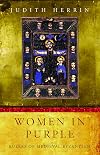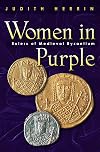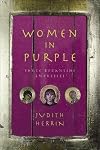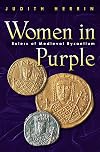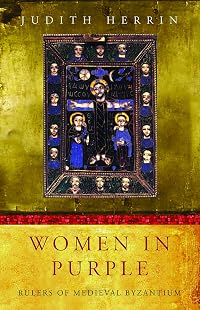
Women in Purple: Rulers of Medieval Byzantium
by Judith Herrin
On This Page
Description
In the eighth and ninth centuries, three Byzantine empresses--Irene, Euphrosyne, and Theodora--changed history. Their combined efforts restored the veneration of icons, saving Byzantium from a purely symbolic and decorative art and ensuring its influence for centuries to come. In this exhilarating and highly entertaining account, one of the foremost historians of the medieval period tells the story of how these fascinating women exercised imperial sovereignty with consummate skill and show more sometimes ruthless tactics. Though they gained access to the all-pervasive authority of the Byzantine ruling dynasty through marriage, all three continued to wear the imperial purple and wield tremendous power as widows. From Constantinople, their own Queen City, the empresses undermined competitors and governed like men. They conducted diplomacy across the known world, negotiating with the likes of Charlemagne, Roman popes, and the great Arab caliph Harun al Rashid. Vehemently rejecting the ban on holy images instituted by their male relatives, Irene and Theodora used craft and power to reverse the official iconoclasm and restore icons to their place of adoration in the Eastern Church. In so doing, they profoundly altered the course of history. The art--and not only the art--of Byzantium, of Islam, and of the West would have been very different without them. As Judith Herrin traces the surviving evidence, she evokes the complex and deeply religious world of Constantinople in the aftermath of Arab conquest. She brings to life its monuments and palaces, its court ceremonies and rituals, the role of eunuchs (the "third sex"), bride shows, and the influence of warring monks and patriarchs. Based on new research and written for a general audience, Women in Purple reshapes our understanding of an empire that lasted a thousand years and splashes fresh light on the relationship of women to power.--Publisher description. show lessTags
Recommendations















Member Reviews
"The three empresses... profoundly altered the course of history"
By sally tarbox on 27 August 2017
Format: Paperback
I got interested in Byzantine history- about which I knew very little - during a visit to Greece.
This is an extremely well-written work, requiring no background knowledge, which focusses on three 9th century empresses - Irene, Euphrosyne and Theodora - and the role they played in restoring icons to a church which had previously banned them. The reader gets a good overview of the empire at this time - the court life, the importance of monasteries (in one of which Euphrosyne grew up, in enforced seclusion with her repudiated mother), the politics, and also the wider world - Arab and Slav invasions and an at-times difficult show more relationship with the West.
I wouldn't call it a heavy read but it requires concentration. You're not going to remember all the events, but I think it leaves the reader with a good general understanding of an era we hear little about. Most informative and interesting. show less
By sally tarbox on 27 August 2017
Format: Paperback
I got interested in Byzantine history- about which I knew very little - during a visit to Greece.
This is an extremely well-written work, requiring no background knowledge, which focusses on three 9th century empresses - Irene, Euphrosyne and Theodora - and the role they played in restoring icons to a church which had previously banned them. The reader gets a good overview of the empire at this time - the court life, the importance of monasteries (in one of which Euphrosyne grew up, in enforced seclusion with her repudiated mother), the politics, and also the wider world - Arab and Slav invasions and an at-times difficult show more relationship with the West.
I wouldn't call it a heavy read but it requires concentration. You're not going to remember all the events, but I think it leaves the reader with a good general understanding of an era we hear little about. Most informative and interesting. show less
Really excellent biography of three empresses of Byzantium—Irene, Euphrosyne and Theodora—who ruled over the course of four generations and who wielded enormous power and influence during one of the most important periods of Byzantine history. Herrin's scholarship is excellent, balanced and considered, carefully piecing together what information we have about a period of history which is not well known, and her prose is very solid.
The only quibble I have with it is that at times, Herrin lapses from the past to the present tense, presumably in an effort to impart a sense of urgency and drama to the narrative. It's really not necessary; it's distracting, and adds nothing to prose which is already recounting some highly interesting show more events. Still, that is a minor quibble, and the scholarship more than makes up for it. Highly recommended if you have any interest in Byzantine or medieval women's history. show less
The only quibble I have with it is that at times, Herrin lapses from the past to the present tense, presumably in an effort to impart a sense of urgency and drama to the narrative. It's really not necessary; it's distracting, and adds nothing to prose which is already recounting some highly interesting show more events. Still, that is a minor quibble, and the scholarship more than makes up for it. Highly recommended if you have any interest in Byzantine or medieval women's history. show less
I'm glad I read this book. Nothing in this review should detract from the ultimate statement that I am glad I read this book, and I do not regret purchasing it. I think Judith Herrin is a remarkable historian, I think her work is important, and I am glad that she wrote this.
I am somewhat frustrated at her methodology, at the realms of speculation which she indulges in (Siria's remark about her use of the present tense as a tool for inducing urgency is, I think, a little generous; Herrin uses the present rather than the conditional when she is making assertions which are backed by her education and informed hypotheses rather than historical documents), at how difficult it was for me to keep track of who was who and who was doing what. show more This is clearly a specialist book, and it was harder for me to read than I was anticipating, even as a trained historian; I have never studied the sixth through ninth centuries in much detail, nor have I ever studied Byzantium seriously, and that is my failing, not Herrin's. But this was less of a pleasure to read than I was anticipating, and I'm left with a somewhat bitter taste in my mouth. show less
I am somewhat frustrated at her methodology, at the realms of speculation which she indulges in (Siria's remark about her use of the present tense as a tool for inducing urgency is, I think, a little generous; Herrin uses the present rather than the conditional when she is making assertions which are backed by her education and informed hypotheses rather than historical documents), at how difficult it was for me to keep track of who was who and who was doing what. show more This is clearly a specialist book, and it was harder for me to read than I was anticipating, even as a trained historian; I have never studied the sixth through ninth centuries in much detail, nor have I ever studied Byzantium seriously, and that is my failing, not Herrin's. But this was less of a pleasure to read than I was anticipating, and I'm left with a somewhat bitter taste in my mouth. show less
Ratings
Members
- Recently Added By
Lists

Further Reading Recommended by Herrin's Byzantium
151 works; 1 member
Author Information

22+ Works 2,735 Members
Judith Herrin was Stanley J. Seeger Professor of Byzantine History, Princeton University, 1991-1995 and is Director for the Centre for Hellenic Studies, King's College, London. (Bowker Author Biography)
Some Editions
Common Knowledge
- Canonical title
- Women in Purple: Rulers of Medieval Byzantium
- Original title
- Women in Purple
- Alternate titles*
- Gynaikes sten porphyra : ēgemones tou Mesaiōnikou
- Original publication date
- 2001-09-13
- People/Characters
- Irene, Empress Consort of Michael II; Michael II, Byzantine Emperor (770 – 2 October 829); Euphrosyne Doukaina Kamatera, Empress Consort of Alexios III Angelos (b. ca. 790); Alexios III Angelos, Byzantine Emperor; Theodora, Empress consort of Theophilos (Saint, 815?-868?); Theophilos, Byzantine Emperor
- Important places
- Byzantine Empire; Europe; Constantinople
- Dedication
- For Eleanor, best of mothers
- First words
- During the fourth century AD the East Mediterranean world which had long formed part of the Roman Empire was dramatically altered by the establishment of a new capital city.
- Last words
- (Click to show. Warning: May contain spoilers.)And more than any other three individuals, it was three women of the imperial purple, Irene, Euphrosyne and Theodora, who were responsible for its triumph.
- Disambiguation notice
- Full title (2001): Women in purple : rulers of Medieval Byzantium / Judith Herrin
*Some information comes from Common Knowledge in other languages. Click "Edit" for more information.
Classifications
- Genres
- History, Nonfiction, General Nonfiction, Sexuality and Gender Studies, Biography & Memoir
- DDC/MDS
- 949.5 — History & geography History of Europe Greece, Albania, Yugoslavia, Serbia, Romania, Bulgaria Greece and the Byzantine Empire
- LCC
- DF586 .H47 — History of Europe, Asia, Africa and Oceania Greece History of Greece Medieval Greece. Byzantine Empire, 323-1453 History Eastern Empire, 323/476-1057. Constantine the Great
- BISAC
Statistics
- Members
- 248
- Popularity
- 131,275
- Reviews
- 3
- Rating
- (3.63)
- Languages
- 6 — Czech, English, Greek, Polish, Romanian, Spanish
- Media
- Paper, Ebook
- ISBNs
- 7