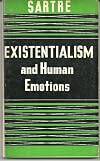
Existentialism and Human Emotions
by Jean-Paul Sartre
On This Page
Description
In this provocative philosophical analysis, Jean-Paul Sartre refutes the idea that existentialism drains meaning from human life, by claiming that the philosophy instead gives man total freedom to achieve his own significance Sartre's Existentialism and Human Emotions is a stirring defense of existentialist thought, which argues that "existence precedes essence." While attacks on existentialism claim that the philosophy leads to a kind of nihilistic gloom, Sartre contends that instead show more existentialism is the only path toward giving man meaning. Sartre ultimately argues that by the very absence of "a priori meaning," an individual can discover and shape his or her own significance and place in the world. Sartre turns the typical nihilistic definition of existentialism on its head in this optimistic take on his best-known theory. show lessTags
Recommendations





























Member Reviews
I read the book twice, but long ago, because I much enjoyed the essay, "The Hole". I've not thought of or looked at a hole the same since.
Wikipedia: Existentialism is a Humanism (L'existentialime est un humanisme) is a 1946 philosophical work by Jean-Paul Sartre. It is seen by many as one of the defining texts in the Existentialist movement.
In his text, Sartre says that the key defining point of Existentialism is that the existence of a person comes chronologically before his or her essence. In simple terms, this means that, although that person exists, there is nothing to dictate that person's character, goals in life, and so on. Only the person himself can define his essence:
Man first of all exists, encounters himself, surges up in the world - and defines himself afterwards.
Thus, Sartre rejects what he calls "deterministic excuses" and claims that all people must take show more responsibility for their behaviour. Sartre defines angst and despair as the emotions people feel once they come to the realize that they are responsible for all of their actions. He also describes forlorness as loneliness atheists feel when they realize that they are all alone, that there is no God to watch over them. This is associated with despair and angst.
The essay has been criticized by some for giving only a superficial overview of the themes of existentialism, and Sartre himself has called its undeveloped morality an "error".
"Existentialism is a Humanism" was also the title of a lecture he gave to a packed audience at Club Maintenant in Paris, on October 29th, 1945. The book is based on the lecture. show less
In his text, Sartre says that the key defining point of Existentialism is that the existence of a person comes chronologically before his or her essence. In simple terms, this means that, although that person exists, there is nothing to dictate that person's character, goals in life, and so on. Only the person himself can define his essence:
Man first of all exists, encounters himself, surges up in the world - and defines himself afterwards.
Thus, Sartre rejects what he calls "deterministic excuses" and claims that all people must take show more responsibility for their behaviour. Sartre defines angst and despair as the emotions people feel once they come to the realize that they are responsible for all of their actions. He also describes forlorness as loneliness atheists feel when they realize that they are all alone, that there is no God to watch over them. This is associated with despair and angst.
The essay has been criticized by some for giving only a superficial overview of the themes of existentialism, and Sartre himself has called its undeveloped morality an "error".
"Existentialism is a Humanism" was also the title of a lecture he gave to a packed audience at Club Maintenant in Paris, on October 29th, 1945. The book is based on the lecture. show less
Excerpts from "Existentialism" (1946), and "Being and Nothingness" (1943).
Ratings
Members
- Recently Added By
Author Information

Sartre is the dominant figure in post-war French intellectual life. A graduate of the prestigious Ecole Normale Superieure with an agregation in philosophy, Sartre has been a major figure on the literary and philosophical scenes since the late 1930s. Widely known as an atheistic proponent of existentialism, he emphasized the priority of existence show more over preconceived essences and the importance of human freedom. In his first and best novel, Nausea (1938), Sartre contrasted the fluidity of human consciousness with the apparent solidity of external reality and satirized the hypocrisies and pretensions of bourgeois idealism. Sartre's theater is also highly ideological, emphasizing the importance of personal freedom and the commitment of the individual to social and political goals. His first play, The Flies (1943), was produced during the German occupation, despite its underlying message of defiance. One of his most popular plays is the one-act No Exit (1944), in which the traditional theological concept of hell is redefined in existentialist terms. In Red Gloves (Les Mains Sales) (1948), Sartre examines the pragmatic implications of the individual involved in political action through the mechanism of the Communist party and a changing historical situation. His highly readable autobiography, The Words (1964), tells of his childhood in an idealistic bourgeois Protestant family and of his subsequent rejection of his upbringing. Sartre has also made significant contributions to literary criticism in his 10-volume Situations (1947--72) and in works on Baudelaire, Genet, and Flaubert. In 1964 he was awarded the Nobel Prize in Literature and refused it, saying that he always declined official honors. (Bowker Author Biography) show less
Some Editions
Common Knowledge
- Canonical title
- Existentialism and Human Emotions
- Original title
- Existentialisme et émotions humaines
- Original publication date
- 1957
- Disambiguation notice
- Do not combine with Existentialism is a Humanism (1945) -- they are completely different works.
Classifications
Statistics
- Members
- 519
- Popularity
- 57,674
- Reviews
- 3
- Rating
- (3.50)
- Languages
- English, German
- Media
- Paper, Ebook
- ISBNs
- 5
- UPCs
- 1
- ASINs
- 17