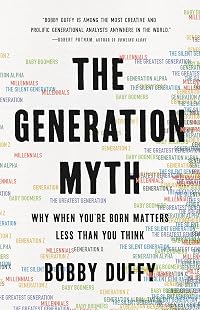
The Generation Myth: Why When You're Born Matters Less Than You Think
by Bobby Duffy
On This Page
Description
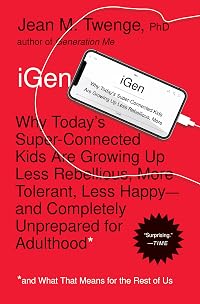
"One of the simplest and most powerful ways we understand people is as members of a generation. Your uncle is a bit racist because he's a baby boomer; your gen x boss is not a good team player; your cousin is constantly trying to go viral because he's gen z, and his generation is obsessed with fame. We also use generations as a tool for tracking how a society's values change over time (baby boomers liberated sex; millennials made it problematic), and how to appeal to the generations that show more hold them. What we assume when we talk about generations is that our values and habits are fixed by the time we turn 18, and that generational conflict is inevitable: a generation matures into adulthood and takes control of our artistic, commercial, and political tastes, which then become obsolete and are replaced by succeeding generations. It's a compelling story - after all, it is natural to think you have more in common with your peers than with your parents. But it is also wrong. Bobby Duffy has spent decades studying how social values and beliefs change. In The Generation Myth, he argues that generations do not have fixed or monolithic identities, nor is one unavoidably distinct from all the rest. Rather, generational identities are fluid, forming and reforming throughout life. Gen xers aren't just a product of the Reagan years - their values have been shaped equally by the Iraq War, two financial collapses, and the simple fact that they have gotten older A generation isn't an identity as much as a process. Duffy shows that differences between generations aren't nearly as sharp as we think. Political engagement, for example, has not declined in younger generations - younger people are always less politically active. Older generations have different expectations of their employers than younger generations simply because they entered different labor markets. Baby boomers had more sex in their youth than millennials, but millennials are actually happier with their sex lives. Young adults are no likelier to buy a product based on the company's ethics than their parents or grandparents. Through these insights, we find not only a truer picture of real generational differences, but a better way of understanding how societies change, and where ours may be headed. An analysis of breathtaking scale, based on data collected from over three million people, The Generation Myth is a vital rejoinder to alarmist books like iGen, The Coddling of the American Mind, and A Generation of Sociopaths. The kids are alright. Their parents are too"-- show lessTags
Recommendations


























Member Reviews
Anyone who has spent even a little time on social media has seen a whole lot of signs suggesting there's a huge battle brewing between the generations - Gen Z is lazy; Millennials are whiners who, if they cut back on the avocado toast, could have it all; Gen X, if you can find anything about them at all, are selfish; and Boomers have ruined, well, everything. The pre-war generations hardly exist at all except as honorary Boomers.
In The Generation Myth: Why When You're Born Matters Less Than You Think, author Bobby Duffy challenges these myths. He calls them lazy thinking and the equivalent of using astrology to define the generations and he backs it up with plenty of documentation and statistics. Yes, he says that when we are born does show more have an effect on our attitudes but not as much as other factors like the economy e.g. the 2008 Recession or the country in which you were born e.g. religion has a much great effect on attitudes across generations in the US than in the UK and, of course, our families and disasters like Covid-19.
In fact, according to Duffy, attitudes toward such issues as racism, gay marriage, abortion, immigration, and climate change have changed over a short period of time for both Boomers and Gen X and are now closer to those of Millennials and Gen Z than to the pre-war generations where attitudes have remained flat. This is not to say the Duffy doesn't think generational thinking isn't important. As he says about writing this book:
This is not because I don't see any value in generational thinking but the opposite: it's too important, particularly right now, to be left to these misdirections. Its importance is not because I see an impending, inevitable crisis or all-out generational war, but because we seen to have lost faith in a better future for our current and future generations of young people. That's risky, and in many ways, it sums up the challenge of our world in the wake of Covid-19. An understanding of generations, including what brings us together as much as what separates us, is vital to our response.
A well-documented book about an increasingly important subject given the times we live in but a surprisingly hopeful one and I recommend it highly.
Thanks to Netgalley & Perseus Books for the opportunity to read this book in exchange for an honest review show less
In The Generation Myth: Why When You're Born Matters Less Than You Think, author Bobby Duffy challenges these myths. He calls them lazy thinking and the equivalent of using astrology to define the generations and he backs it up with plenty of documentation and statistics. Yes, he says that when we are born does show more have an effect on our attitudes but not as much as other factors like the economy e.g. the 2008 Recession or the country in which you were born e.g. religion has a much great effect on attitudes across generations in the US than in the UK and, of course, our families and disasters like Covid-19.
In fact, according to Duffy, attitudes toward such issues as racism, gay marriage, abortion, immigration, and climate change have changed over a short period of time for both Boomers and Gen X and are now closer to those of Millennials and Gen Z than to the pre-war generations where attitudes have remained flat. This is not to say the Duffy doesn't think generational thinking isn't important. As he says about writing this book:
This is not because I don't see any value in generational thinking but the opposite: it's too important, particularly right now, to be left to these misdirections. Its importance is not because I see an impending, inevitable crisis or all-out generational war, but because we seen to have lost faith in a better future for our current and future generations of young people. That's risky, and in many ways, it sums up the challenge of our world in the wake of Covid-19. An understanding of generations, including what brings us together as much as what separates us, is vital to our response.
A well-documented book about an increasingly important subject given the times we live in but a surprisingly hopeful one and I recommend it highly.
Thanks to Netgalley & Perseus Books for the opportunity to read this book in exchange for an honest review show less
Interesting And Well Documented Read. In this book, Duffy shows that what the media so often (and so lazily) proclaims to be "generational" divides... usually aren't really. Yes, there is a generational component to at least some things, but time period (specifically for that "coming of age" period but also more generally throughout the individual's life) and life progression play equally critical roles, and in many cases *more* critical roles, in showing how a particular group of people generally feel about a given issue. One of the things that makes the book a bit interesting is that even while presenting this much more balanced view of this particular field, Duffy exposes himself as a "climate" alarmist/ extremist, either not knowing show more about or outright denying similar work to his own in that particular field. (Ie, work showing that even though media lazily points to one thing, there are actually several different things at play and in some cases far more critical to the issue at hand. One work here on that topic similar to Duffy's on this one is Unsettled by Stephen Koonin, released just 6 months or so prior to this book's publication).
Still, this book is truly a remarkable work in its field (at least to someone who is *not* a fellow academic or in that field at all) and seems to be fairly comprehensive in its focus, even as its primary and secondary national emphases are the UK and the US, respectively. It looks at many, many issues from the social to the political and even to the personal, from housing to gender identity and sexual activity to political leanings and many, many more. This is also a fairly well documented text, with its bibliography clocking in at about 32% of the overall text - while not the *highest* I've noted in my work with advanced review copies, easily among the higher echelons there. Very much recommended. show less
Still, this book is truly a remarkable work in its field (at least to someone who is *not* a fellow academic or in that field at all) and seems to be fairly comprehensive in its focus, even as its primary and secondary national emphases are the UK and the US, respectively. It looks at many, many issues from the social to the political and even to the personal, from housing to gender identity and sexual activity to political leanings and many, many more. This is also a fairly well documented text, with its bibliography clocking in at about 32% of the overall text - while not the *highest* I've noted in my work with advanced review copies, easily among the higher echelons there. Very much recommended. show less
nonfiction audio (8h49m; at 1.2x speed=7h21m) in British English--currency in pounds, 'zed' for 'z'
debunking common myths about generational cohorts using various data from UK and US - I can't say I always agree with which data the author chooses to focus attention on, but there is a lot in here that I found thought provoking, and certainly most of these issues are likely much more complex than people realize.
It was also a lot longer than I cared to read/listen to, though at least I could follow along without having to look at the various charts and graphs (provided in a downloadable pdf with the audiobook). Overall, not bad--just not really ideal for my short attention span. Recommended for people who like statistics.
debunking common myths about generational cohorts using various data from UK and US - I can't say I always agree with which data the author chooses to focus attention on, but there is a lot in here that I found thought provoking, and certainly most of these issues are likely much more complex than people realize.
It was also a lot longer than I cared to read/listen to, though at least I could follow along without having to look at the various charts and graphs (provided in a downloadable pdf with the audiobook). Overall, not bad--just not really ideal for my short attention span. Recommended for people who like statistics.
Ratings
Members
- Recently Added By
Lists

Yet another list
67 works; 1 member
Author Information

9 Works 195 Members
Awards and Honors
Awards
Classifications
Statistics
- Members
- 34
- Popularity
- 799,166
- Reviews
- 3
- Rating
- (3.80)
- Languages
- English
- Media
- Paper, Audiobook, Ebook
- ISBNs
- 6
- ASINs
- 2