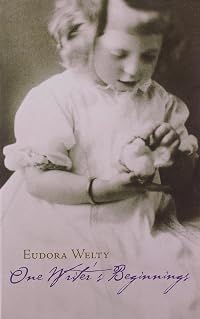
One Writer's Beginnings
by Eudora Welty
On This Page
Description
In a "continuous thread of revelation" Eudora Welty sketches her autobiography and tells us how her family and her surroundings contributed to the shaping not only of her personality but of her writing.Tags
Recommendations










Member Recommendations

Member Reviews
I absolutely loved this inspiring memoir---it's a keeper, for sure! I remember reading, "Why I Live at the PO" in high school and it was really fun and encouraging to read her perspectives on how her life influenced her writing. I love how she deconstructed the conversations and experiences of her childhood to see how they shaped her as a writer. My own has done the same for me...as has all other writers', I assume.
I liked how she talked about listening for stories. When I'm traveling I'm LOOKING for stories. Just another great reminder of the importance of carrying a journal to record experiences as they happen. About two-thirds into the book, I ordered a book of her short stories. I'm looking forward to reading more!
My favorite quote show more came from page 57: "Emotions do not grow old." I read this book while my husband and I were on a visit to Oregon to visit his father. He has a terminal illness and we both knew this very likely could be the last time we'd see him. This quote made me think of Leo and how, though his body is dying, his love for his family is very much alive. I hope I always remember the proud look he had and the shine in his eyes as he introduced my husband to his nurses, "Yes, this is my son." He was so excited and surprised to see my husband show up in the hospital---he didn't know we were coming. There was laughter, tears, frustrations, joys, and more the few days we spent with him---all very real emotions from a family who very much loves and respects their father. I love this quote. It will always make me think of Leo. show less
I liked how she talked about listening for stories. When I'm traveling I'm LOOKING for stories. Just another great reminder of the importance of carrying a journal to record experiences as they happen. About two-thirds into the book, I ordered a book of her short stories. I'm looking forward to reading more!
My favorite quote show more came from page 57: "Emotions do not grow old." I read this book while my husband and I were on a visit to Oregon to visit his father. He has a terminal illness and we both knew this very likely could be the last time we'd see him. This quote made me think of Leo and how, though his body is dying, his love for his family is very much alive. I hope I always remember the proud look he had and the shine in his eyes as he introduced my husband to his nurses, "Yes, this is my son." He was so excited and surprised to see my husband show up in the hospital---he didn't know we were coming. There was laughter, tears, frustrations, joys, and more the few days we spent with him---all very real emotions from a family who very much loves and respects their father. I love this quote. It will always make me think of Leo. show less
It had been startling and disappointing to me to find out that story books had been written by people, that books were not natural wonders, coming up of themselves like grass.
This short, gentle memoir hints at how the writer-Welty was formed. Its three sections (“Listening,” “Learning to See,” and “Finding a Voice”) were adapted from three lectures she gave at Harvard University in 1983. They capture her sweet childhood; her extended family and life in the South; and her education, early writing and reflections on writing.
As you have seen, I am a writer who came of a sheltered life. A sheltered life can be a daring life as well. For all serious daring starts from within.
This short, gentle memoir hints at how the writer-Welty was formed. Its three sections (“Listening,” “Learning to See,” and “Finding a Voice”) were adapted from three lectures she gave at Harvard University in 1983. They capture her sweet childhood; her extended family and life in the South; and her education, early writing and reflections on writing.
As you have seen, I am a writer who came of a sheltered life. A sheltered life can be a daring life as well. For all serious daring starts from within.
Begun as a series of three lectures delivered at Harvard in 1983, Eudora Welty’s One Writer’s Beginnings traces the confluence of events and history, persons and places, that at that late point looking back upon her writing career she takes to constitute her vision or her voice. While much of any writer’s beginnings will inevitably concern their particular childhood — teachers, key events, distant relatives to whom one learns relation — Welty’s lens plays as much upon her parents as upon herself. And so we learn of her father’s move from Ohio to West Virginia, where he met Eudora’s mother. And we learn how the two young newlyweds made a conscious decision to set out for pastures new, settling in Jackson, Mississippi, show more where later Eudora is born and raised and where her parents remain the rest of the lives, barring holiday excursions usually to family back in West Virginia or Ohio.
Welty has an assured and comfortable gait as she wanders amongst these paths of memory. Without appearing to fixate on telling individuals or activities, she gently associates some of her early experiences with characters in her later stories or novels. More important, perhaps, is the insight she draws from such associations, as though through telling her personal past she is reading her own fiction. The effect is one of clear and penetrating analysis without rancour.
The writing is always a pleasure to read and, though brief, it would be hard not to feel at the end as though one had learned a great deal about Welty, as a writer, through this canvassing of some of her important memories. Gently recommended along with a reminder to go back and read Welty’s fiction — all of it. show less
Welty has an assured and comfortable gait as she wanders amongst these paths of memory. Without appearing to fixate on telling individuals or activities, she gently associates some of her early experiences with characters in her later stories or novels. More important, perhaps, is the insight she draws from such associations, as though through telling her personal past she is reading her own fiction. The effect is one of clear and penetrating analysis without rancour.
The writing is always a pleasure to read and, though brief, it would be hard not to feel at the end as though one had learned a great deal about Welty, as a writer, through this canvassing of some of her important memories. Gently recommended along with a reminder to go back and read Welty’s fiction — all of it. show less
As always, I most enjoyed the genealogy and family history she shared. Not being a writer, I found her description of how she found her characters to be unconvincing. Was she deceiving herself though when she wrote that looking back on the life of her parents and family the the steps -almost stepping stones - they chose were inevitable, were the only path that could have been chosen for the family?
Rating: 4.5* of five
The Publisher Says: Eudora Welty was born in 1909 in Jackson, Mississippi. In a "continuous thread of revelation" she sketches her autobiography and tells us how her family and her surroundings contributed to the shaping not only of her personality but of her writing. Homely and commonplace sights, sounds, and objects resonate with the emotions of recollection: the striking clocks, the Victrola, her orphaned father's coverless little book saved since boyhood, the tall mountains of the West Virginia back country that become a metaphor for her mother's sturdy independence, Eudora's earliest box camera that suspended a moment forever and taught her that every feeling awaits a gesture. She has recreated this vanished show more world with the same subtlety and insight that mark her fiction.
Even if Eudora Welty were not a major writer, her description of growing up in the South--of the interplay between black and white, between town and countryside, between dedicated schoolteachers and the public they taught--would he notable. That she is a splendid writer of fiction gives her own experience a family likeness to others in the generation of young Southerners that produced a literary renaissance. Until publication of this book, she had discouraged biographical investigations. It undoubtedly was not easy for this shy and reticent lady to undertake her own literary biography, to relive her own memories (painful as well as pleasant), to go through letters and photographs of her parents and grandparents. But we are in her debt, for the distillation of experience she offers us is a rare pleasure for her admirers, a treat to everyone who loves good writing and anyone who is interested in the seeds of creativity.
My Review: The unassuming, delight-filled, unsparingly un-self-indulgent prose of Miss Eudora's fiction is surpassed in this expansion and revision of her Massey Lecture in the History of American Civilization, delivered at Harvard in 1983. For anyone unacquainted with Miss Eudora's literary output, I recommend starting with short fiction ("The Bride of the Innisfallen" is a good starter, followed by "Why I Live at the P.O."), moving on to her chef d'ouevre, the novel The Ponder Heart; this memoir, all 104pp of it, should come after one knows whether one is able to appreciate the particularities and glories of Miss Eudora's work. While I think she would appeal to any able-minded reader, I know from experience that her beautiful sentences sound like preciosity to some readers: eg, "Over a stronghold of a face, the blue hat of the lady in the raincoat was settled on like an Indian bonnet, or, rather, like an old hat, which it was." (from "The Bride of the Innisfallen")
This, to me, is equalled in English by Nabokov's terse clarity, and by little else; but it has been cited to me several times as unendurably cutesy or simply overwritten. I so completely disagree that it's hard to credit the opinion-havers with a shred of taste; however, there are tastes, and there are tastes, so I move on from my digression.
One Writer's Beginnings is told in a narrative voice much like her fiction; it is constructed like the linear tale that a life is when it is reflected on at leisure; and there are so many things in her history, from 1909 and her birth until her last entry in the lecture, a trip by train to New York during the Great Depression as a WPA junior publicity agent, that clearly formed a consciousness of time and place and rightness of things that she uses to such telling effect in her stories. An anecdote early in the book of her parents' morning routine of whistling and humming back and forth up and down the stairs phrases from "The Merry Widow Waltz" illuminates for me the means by which this shy, never-married lady "got" the signals of relationship that are so necessary to the parties in happiness. Another moment, the discovery of two nickels preserved in a hidden box, teaches me that Miss Eudora never felt any unmixed emotion (I won't tell that story, it must be read to be understood) and that is why The Ponder Heart is such a landmark in Southern ficiton.
The death of Miss Eudora's beloved father in 1931 is simply too painful for her to go into; she elides the details and leaves us to infer her pain. It fits with her lifelong lack of interest in talking about herself, but it leaves the reader without an anchor in what had to be a turbulent passage in her life. I can't fault the lady for her reticence, but in this as in several other areas, it would have behooved Miss Eudora to have let others guide her in preparing these talks so as to answer more questions.
Well, and therein the rub: It was the last thing she ever wanted to do, answer questions, and it's also why she wrote such marvelous stories, to answer them all unasked.
Miss Eudora Welty, thank you for all of it, and a safe journey into the future for your gifts to us who follow along behind you. show less
The Publisher Says: Eudora Welty was born in 1909 in Jackson, Mississippi. In a "continuous thread of revelation" she sketches her autobiography and tells us how her family and her surroundings contributed to the shaping not only of her personality but of her writing. Homely and commonplace sights, sounds, and objects resonate with the emotions of recollection: the striking clocks, the Victrola, her orphaned father's coverless little book saved since boyhood, the tall mountains of the West Virginia back country that become a metaphor for her mother's sturdy independence, Eudora's earliest box camera that suspended a moment forever and taught her that every feeling awaits a gesture. She has recreated this vanished show more world with the same subtlety and insight that mark her fiction.
Even if Eudora Welty were not a major writer, her description of growing up in the South--of the interplay between black and white, between town and countryside, between dedicated schoolteachers and the public they taught--would he notable. That she is a splendid writer of fiction gives her own experience a family likeness to others in the generation of young Southerners that produced a literary renaissance. Until publication of this book, she had discouraged biographical investigations. It undoubtedly was not easy for this shy and reticent lady to undertake her own literary biography, to relive her own memories (painful as well as pleasant), to go through letters and photographs of her parents and grandparents. But we are in her debt, for the distillation of experience she offers us is a rare pleasure for her admirers, a treat to everyone who loves good writing and anyone who is interested in the seeds of creativity.
My Review: The unassuming, delight-filled, unsparingly un-self-indulgent prose of Miss Eudora's fiction is surpassed in this expansion and revision of her Massey Lecture in the History of American Civilization, delivered at Harvard in 1983. For anyone unacquainted with Miss Eudora's literary output, I recommend starting with short fiction ("The Bride of the Innisfallen" is a good starter, followed by "Why I Live at the P.O."), moving on to her chef d'ouevre, the novel The Ponder Heart; this memoir, all 104pp of it, should come after one knows whether one is able to appreciate the particularities and glories of Miss Eudora's work. While I think she would appeal to any able-minded reader, I know from experience that her beautiful sentences sound like preciosity to some readers: eg, "Over a stronghold of a face, the blue hat of the lady in the raincoat was settled on like an Indian bonnet, or, rather, like an old hat, which it was." (from "The Bride of the Innisfallen")
This, to me, is equalled in English by Nabokov's terse clarity, and by little else; but it has been cited to me several times as unendurably cutesy or simply overwritten. I so completely disagree that it's hard to credit the opinion-havers with a shred of taste; however, there are tastes, and there are tastes, so I move on from my digression.
One Writer's Beginnings is told in a narrative voice much like her fiction; it is constructed like the linear tale that a life is when it is reflected on at leisure; and there are so many things in her history, from 1909 and her birth until her last entry in the lecture, a trip by train to New York during the Great Depression as a WPA junior publicity agent, that clearly formed a consciousness of time and place and rightness of things that she uses to such telling effect in her stories. An anecdote early in the book of her parents' morning routine of whistling and humming back and forth up and down the stairs phrases from "The Merry Widow Waltz" illuminates for me the means by which this shy, never-married lady "got" the signals of relationship that are so necessary to the parties in happiness. Another moment, the discovery of two nickels preserved in a hidden box, teaches me that Miss Eudora never felt any unmixed emotion (I won't tell that story, it must be read to be understood) and that is why The Ponder Heart is such a landmark in Southern ficiton.
The death of Miss Eudora's beloved father in 1931 is simply too painful for her to go into; she elides the details and leaves us to infer her pain. It fits with her lifelong lack of interest in talking about herself, but it leaves the reader without an anchor in what had to be a turbulent passage in her life. I can't fault the lady for her reticence, but in this as in several other areas, it would have behooved Miss Eudora to have let others guide her in preparing these talks so as to answer more questions.
Well, and therein the rub: It was the last thing she ever wanted to do, answer questions, and it's also why she wrote such marvelous stories, to answer them all unasked.
Miss Eudora Welty, thank you for all of it, and a safe journey into the future for your gifts to us who follow along behind you. show less
I've been reading one book by Eudora Welty per summer for the past few years. I've been rationing them out, because there aren't many, and I prefer to savor each, rather than greedily devouring them quickly. Her writing is so lovely and evocative and redolent of summer days. But I broke down this summer and took One Writer's Beginnings with me on vacation after having finished The Optimist's Daughter.
The book is a set of three memoir episodes that began as a series of lectures at Harvard in 1983 to inaugurate the William E. Massey lecture series. "Listening" recounts Welty's memories of her early childhood in Jackson, MS; "Learning to See" takes the Welty family and her audience on the road to West Virginia and Ohio where Eudora and her show more family travelled in the summers to visit her parents' families; and in "Finding a Voice," Welty ponders some of her early writing influences. While the third section is interesting, it is in the first two that Welty's storytelling gifts shine. She lets us breathe the air of the post WWI decades of small town and country life in America.
The idea of driving thousands of miles in a 1917 Model T with two children in the back seat absolutely boggles my mind.
Edward and I rode with our legs straight out in front of over some suitcases. The rest of the suitcases rode just outside the doors, trapped on the running boards. Cars weren't made with trunks. The tools were kept under the back seat and were heard from in syncopation with the bumps, we'd jump out of the car so Daddy could get them out and jack up the car to patch and vulcanize a tire, or haul out the tow rope or the tire chains. If it rained so hare we couldn't see the road in from of us, we waited it out, snapped in behind the rain curtains and playing "Twenty Questions." show less
The book is a set of three memoir episodes that began as a series of lectures at Harvard in 1983 to inaugurate the William E. Massey lecture series. "Listening" recounts Welty's memories of her early childhood in Jackson, MS; "Learning to See" takes the Welty family and her audience on the road to West Virginia and Ohio where Eudora and her show more family travelled in the summers to visit her parents' families; and in "Finding a Voice," Welty ponders some of her early writing influences. While the third section is interesting, it is in the first two that Welty's storytelling gifts shine. She lets us breathe the air of the post WWI decades of small town and country life in America.
The idea of driving thousands of miles in a 1917 Model T with two children in the back seat absolutely boggles my mind.
Edward and I rode with our legs straight out in front of over some suitcases. The rest of the suitcases rode just outside the doors, trapped on the running boards. Cars weren't made with trunks. The tools were kept under the back seat and were heard from in syncopation with the bumps, we'd jump out of the car so Daddy could get them out and jack up the car to patch and vulcanize a tire, or haul out the tow rope or the tire chains. If it rained so hare we couldn't see the road in from of us, we waited it out, snapped in behind the rain curtains and playing "Twenty Questions." show less
Eudora Welty, master of the American short story, needs no introduction. Her writing chronicles life in Mississippi before and during the Depression era. This memoir was originally given as three lectures at Harvard University in April, 1983. Together, they constitute a repository of our knowledge of Welty’s upbringing and early adulthood – and importantly, her literary influences.
Welty focuses on her family history and varied inspirations for her characters. Through her family and travels, she saw enough of human life to imagine her distinctive characters. She portrays herself as coming from a “sheltered” background yet clearly imbibed everything from what’s going on around her. She saw Mississippi first-hand by traveling to show more take pictures of real life in the Depression. She also travelled widely – to New York and to school in Wisconsin – and learned from those environments.
She comes off as an ambitious young lady who makes the most of every opportunity handed to her. She learned about life as it came to her, as it presented itself to her. She did not follow a grand plan to success but started with detail. Indeed, after having benefitted from her father’s pre-Depression success in the life insurance industry in Jackson, Mississippi, she eschewed the field of business generally in favor of a writer’s observationally rich yet financially meager life.
In a new edition out in late 2020, Simon and Schuster repackages this work to seek a wider audience of contemporary readers. Literary researchers will find this book especially interesting. Further, a wider audience of writers and book fanatics, who might have been exposed to Welty’s craftsmanship through her short stories or her photographs, might indulge their curiosity by learning about specific experiences that formed this very American writer. To borrow Welty’s imagery, the words flow smoothly from her experiences to the reader. In this “confluence” of a great writer’s mind with their own minds, readers can extend their understanding of the wide world and of deep humanity. show less
Welty focuses on her family history and varied inspirations for her characters. Through her family and travels, she saw enough of human life to imagine her distinctive characters. She portrays herself as coming from a “sheltered” background yet clearly imbibed everything from what’s going on around her. She saw Mississippi first-hand by traveling to show more take pictures of real life in the Depression. She also travelled widely – to New York and to school in Wisconsin – and learned from those environments.
She comes off as an ambitious young lady who makes the most of every opportunity handed to her. She learned about life as it came to her, as it presented itself to her. She did not follow a grand plan to success but started with detail. Indeed, after having benefitted from her father’s pre-Depression success in the life insurance industry in Jackson, Mississippi, she eschewed the field of business generally in favor of a writer’s observationally rich yet financially meager life.
In a new edition out in late 2020, Simon and Schuster repackages this work to seek a wider audience of contemporary readers. Literary researchers will find this book especially interesting. Further, a wider audience of writers and book fanatics, who might have been exposed to Welty’s craftsmanship through her short stories or her photographs, might indulge their curiosity by learning about specific experiences that formed this very American writer. To borrow Welty’s imagery, the words flow smoothly from her experiences to the reader. In this “confluence” of a great writer’s mind with their own minds, readers can extend their understanding of the wide world and of deep humanity. show less
Members
- Recently Added By
Lists

Best Biographies, Autobiographies and Memoirs
465 works; 160 members

Best Autobiographies and Memoirs
370 works; 66 members

500 Great Books by Women
507 works; 60 members

Summer Reading
31 works; 2 members

Books Featured on Readers' Review of the Diane Rehm Show
161 works; 8 members

Non-Fiction Worth Reading
1,015 works; 261 members

Best Biographies of Notable Women
279 works; 101 members
Author Information

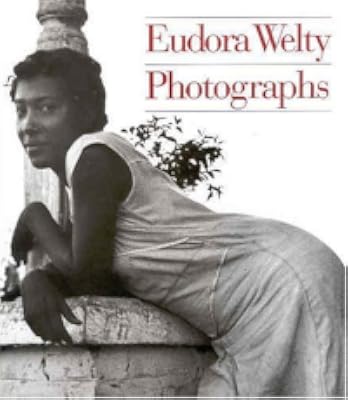
Eudora Welty was born in Jackson, Mississippi on April 13, 1909. She was educated at the Mississippi State College for Women in Columbus, Mississippi, and at the University of Wisconsin. She moved to New York in 1930 to study advertising at the Columbia University business school. After her father's death, she moved back to Jackson in 1931. She show more held various jobs on local newspapers and at a radio station before becoming a publicity agent for the Works Progress Administration (WPA), part of Franklin Roosevelt's New Deal program. Travelling through the state of Mississippi opened her eyes to the misery of the great depression and resulted in a series of photographs, which were exhibited in a one-women show in New York in 1936 and were eventually published as One Time, One Place: Mississippi in the Depression in 1971. She stopped working for the WPA in 1936. Her first stories, Magic and Death of a Travelling Salesman, were published in small magazines in 1936. Some of her better-known short stories are Why I Live at the P.O., Petrified Man, and A Worn Path. Her short story collections include A Curtain of Green, The Golden Apples, The Wide Net and Other Stories, and The Bride of Innisfallen and Other Stories. Her first novel, The Robber Bridegroom, was published in 1942. Her other novels include Delta Wedding, The Ponder Heart, Losing Battles, and The Optimist's Daughter, which won the Pulitzer Prize in 1972. She received the gold medal for fiction from the National Institute of Arts and Letters in 1972. Her nonfiction works include A Snapshot Album, The Eye of the Storm: Selected Essays and Reviews, and One Writer's Beginnings. She died from complications following pneumonia on July 23, 2001 at the age of 92. (Bowker Author Biography) show less
Some Editions
Awards and Honors
Awards
Distinctions
Series
Belongs to Publisher Series
Work Relationships
Common Knowledge
- Canonical title
- One Writer's Beginnings
- Original title
- One Writer's Beginnings
- Original publication date
- 1983 (recorded) (recorded)
- People/Characters
- Eudora Welty
- Important places
- Mississippi, USA; Jackson, Mississippi, USA
- Dedication
- To the memory of my parents / Christian Webb Welty / 1879-1931 / Chestina Andrews Welty / 1883-1966
- First words
- In our house on North Congress Street in Jackson, Mississippi, where I was born, the oldest of three children, in 1909, we grew up to the striking of clocks.
- Quotations
- My mother went out to teach in a one-room school, mountain children little and big alike. The first day, some fathers came along to see if she could whip their children, some of whom were older than she. She told the children... (show all) that she did intend to whip them if they became unruly and refused to learn, and invited the fathers to stay if they liked and she'd be able to whip them too. Having been thus tried out, she was a great success with them after that.
- Last words
- (Click to show. Warning: May contain spoilers.)For all serious daring starts from within.
- Original language*
- Anglais (Etats-Unis) (Etats-Unis)
*Some information comes from Common Knowledge in other languages. Click "Edit" for more information.
Classifications
Statistics
- Members
- 1,874
- Popularity
- 11,477
- Reviews
- 28
- Rating
- (3.97)
- Languages
- 6 — English, French, German, Italian, Portuguese, Spanish
- Media
- Paper, Audiobook, Ebook
- ISBNs
- 24
- ASINs
- 21