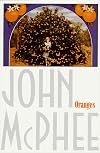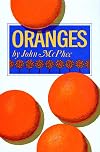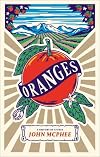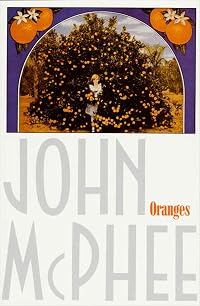
Oranges
by John McPhee
On This Page
Description
McPhee writes about the botany, history, and industry of oranges.Tags
Recommendations























Member Reviews
The subject is oranges, “once the fruit of the gods,” before they finally became “a fruit of the community.” Originally published in 1967, Oranges was a New Yorker article extended into this elegant, entertaining history. The passages about the now diminished Florida orange industry (“nearly fifty million orange trees”) are historical in nature. The state’s yield is a fraction of what it was at the time due to freezes, overdevelopment and disease.
John McPhee, always a compelling writer, traces the history of oranges in culture and art throughout the world. The fruit holds a special significance in Florida, where many of us remember when oranges, and citrus in general, were responsible for a large part of the state’s charm.
John McPhee, always a compelling writer, traces the history of oranges in culture and art throughout the world. The fruit holds a special significance in Florida, where many of us remember when oranges, and citrus in general, were responsible for a large part of the state’s charm.
There's nothing like a fresh orange off the tree. You tear off the skin, it's full of juice, aroma, texture, freshness. Nothing feels wrong about a fresh orange. In the future it might become a tourist industry, one of those experienced-based travel adventures.
I read this book years ago as I embarked on planting several varieties in my father's garden. The book was a chance discovery in an opportunity shop. The other chance encounter was finding a small ambitious local nursery owner who wanted to promote fruit like rare or unusual varieties of oranges grafted by an equally enthusiastic and determined propagator. The oranges are still there, my father is not, neither is the nursery or the propagator. Though I sometimes bump into the show more nursery owner who now a builder. I update him on the size of each year's crop. The five trees keep us in oranges for about four months of the year, eating vast amounts.
The other chance discovery came when I opportunistically bought a box of oranges from a roadside apple seller in central Victoria. I think I missed oranges. So I gave them a try. This was really the spark for the rest of the story. Once we could get a Riverina orange from Mildura or Swan Hill way and it would be sweet and fresh and aromatic. It was the norm. Now (for at least 20 years) they've been musty, old and tasteless, serving the industry that stores them. They often come from the USA too. But they lacked everything except colour. But this box from the side of the highway was magical, everything you'd ever want in an orange. And I tried to track down someone who would send me boxes every season. I couldn't find anyone. Not even the roadside seller could. I missed the taste.
These encounters made me realise that the business of selling oranges is really the business of storing them. Which isn't the same as eating them. So I made it my business to grow them instead. I was furious and couldn't wait to plant them and eat them. I turned my fury into productivity.
These stories intersect only slightly with this book. McPhee is a good writer and journalist. He really gets into the heads of "orange men". He knew the areas where they grew as a child and I could see he missed roadside orange sellers, like I missed the oranges of childhood. Through his writing and observations, you can see the wheels of commerce turning so that in the end, we are stuck with self-serving producers, not really oranges. The product - oranges - has become irrelevant. You could plug any word into the text instead of oranges, say apples, and find a similar story about the degradation of natural products for alternative commercial ends. It all seems pointless. It's tragic, too, unless you have a garden in a zone where they can ripen properly. Melbourne can just manage it. They could be sweeter, and in hot years, they are perfect. But the weather here is variable.
Oh, one last personal point. My father grew up in Greece, on a small cash crop farm. They grew oranges there, including a variety he forgot the name of that came to market early. And they grew the now better known Jaffa variety which we planted in his back yard, thanks to the enthusiastic propagator and nursery owner who wanted to bring it back. It still gives delicious (sometimes very sweet) fruit every year. But that could also be global warming. show less
I read this book years ago as I embarked on planting several varieties in my father's garden. The book was a chance discovery in an opportunity shop. The other chance encounter was finding a small ambitious local nursery owner who wanted to promote fruit like rare or unusual varieties of oranges grafted by an equally enthusiastic and determined propagator. The oranges are still there, my father is not, neither is the nursery or the propagator. Though I sometimes bump into the show more nursery owner who now a builder. I update him on the size of each year's crop. The five trees keep us in oranges for about four months of the year, eating vast amounts.
The other chance discovery came when I opportunistically bought a box of oranges from a roadside apple seller in central Victoria. I think I missed oranges. So I gave them a try. This was really the spark for the rest of the story. Once we could get a Riverina orange from Mildura or Swan Hill way and it would be sweet and fresh and aromatic. It was the norm. Now (for at least 20 years) they've been musty, old and tasteless, serving the industry that stores them. They often come from the USA too. But they lacked everything except colour. But this box from the side of the highway was magical, everything you'd ever want in an orange. And I tried to track down someone who would send me boxes every season. I couldn't find anyone. Not even the roadside seller could. I missed the taste.
These encounters made me realise that the business of selling oranges is really the business of storing them. Which isn't the same as eating them. So I made it my business to grow them instead. I was furious and couldn't wait to plant them and eat them. I turned my fury into productivity.
These stories intersect only slightly with this book. McPhee is a good writer and journalist. He really gets into the heads of "orange men". He knew the areas where they grew as a child and I could see he missed roadside orange sellers, like I missed the oranges of childhood. Through his writing and observations, you can see the wheels of commerce turning so that in the end, we are stuck with self-serving producers, not really oranges. The product - oranges - has become irrelevant. You could plug any word into the text instead of oranges, say apples, and find a similar story about the degradation of natural products for alternative commercial ends. It all seems pointless. It's tragic, too, unless you have a garden in a zone where they can ripen properly. Melbourne can just manage it. They could be sweeter, and in hot years, they are perfect. But the weather here is variable.
Oh, one last personal point. My father grew up in Greece, on a small cash crop farm. They grew oranges there, including a variety he forgot the name of that came to market early. And they grew the now better known Jaffa variety which we planted in his back yard, thanks to the enthusiastic propagator and nursery owner who wanted to bring it back. It still gives delicious (sometimes very sweet) fruit every year. But that could also be global warming. show less
Short and sweet. Not sure I knew what I was getting when I picked this up - but it was excellent nonfiction on the history of oranges and orange products, especially in the US. Published in 1967, the book is dated by now in terms of technology used to produce and harvest oranges, as well as the all male leadership in the orange industry. My actual book copy was that old, and it was fun to have an anachronism in form and content in my hands. I love a deeper look at average objects and this account fulfilled that in McPhee's capable prose. Oranges have their origin in southeast Asia and spread with the Age of Exploration, coming our to our hemisphere with Columbus and to our country with Ponce DeLeon. They have been symbols of fertility, show more prosperity and royalty, have forestalled wars and cemented treaties. They have been "mistaken" as apples in various writings, due to the lack of imagination in the Latin language. Those who study them are pomologists and there is much to study from their breeding to the best way to extract their juices and how best to use all the by-products. While now we can get them anywhere, any time, I can remember in childhood the big box of FL oranges that would arrive as a Christmas gift and it was like sunshine arriving on the doorstep. The FL agriculture scene which is mostly oranges and citrus and cattle takes up the vast interior of the state, above the Everglades and away from the coasts. According to this book, it is full of characters and transplants and millions of acres of orange groves which are their own mini-worlds. A great combo of sweeping historical arcs, fun facts, and science, this "tapestry of oranges" was a worthwhile read. show less
Yup, everything you ever wanted to know about oranges and growing them and turning them into juice...Surprisingly interesting and marvelously readable as always with McPhee. I suspect the orange-growing and concentrate-making industries may have changed in big ways since the mid-60's when this was written, but the best part of this book is the underlying science. That's fascinating even if the technologies and marketing practices have changed.
Written in the '70's, things have changed in Florida and in the orange market, but McPhee's writing is timeless. This book, like many of his works, is a slender volume. I was able to read it in just a couple afternoons. With his lively descriptions and 'first person' style, make it a smooth read and you learn a thing or two to boot!
This little book was recommended by a couple of people in my nonfiction reading group. Although it was published in 1967, it only seems dated in a few places.
McPhee originally started his research intending to write a magazine article about oranges and orange juice but he found enough interesting information to make the article a book. I had no idea that a book about oranges could be so interesting. I learned all kinds of interesting things.
McPhee covers the history of oranges and how and when the spread throughout the world. His focus is on the orange industry in Florida. He covers how orange growing got started in the state and how it expanded despite several devastating freezes over the years.
At the time McPhee wrote this the era show more of frozen orange concentrate was beginning to boom and he laments the preference for that over fresh juice. I grew up drinking orange juice from frozen concentrate but the juice I buy now specifically says 'not from concentrate' on the label.
I loved McPhee's writing style. I learned a lot about oranges. I will seek out more of his work. show less
McPhee originally started his research intending to write a magazine article about oranges and orange juice but he found enough interesting information to make the article a book. I had no idea that a book about oranges could be so interesting. I learned all kinds of interesting things.
McPhee covers the history of oranges and how and when the spread throughout the world. His focus is on the orange industry in Florida. He covers how orange growing got started in the state and how it expanded despite several devastating freezes over the years.
At the time McPhee wrote this the era show more of frozen orange concentrate was beginning to boom and he laments the preference for that over fresh juice. I grew up drinking orange juice from frozen concentrate but the juice I buy now specifically says 'not from concentrate' on the label.
I loved McPhee's writing style. I learned a lot about oranges. I will seek out more of his work. show less
John McPhee might be the best writer of non-fiction ever. He makes every subject fascinating. I learned so much I did not know I didn't know about oranges. The chemistry, the botany, the economics and the geography of oranges. Not to mention the history of orangeries in European palaces. The book was published in 1967 and I am sure the Florida orange industry is not the same as it was over fifty years ago. I wonder if many of the orange groves McPhee visited in the Indian River region are still there?
Members
- Recently Added By
Lists

Mustich's 1000 Books to Read Before You Die: A Life Changing List
1,001 works; 20 members

NTS Book Channel
316 works; 1 member
Author Information

59+ Works 21,095 Members
McPhee was born in Princeton, New Jersey, and educated at Princeton University and Cambridge University. His writing career began at Time magazine and led to his long association with the New Yorker, where he has been a staff writer since 1965. That same year he published his first book, A Sense of Where You Are, with FSG, and soon followed with show more The Headmaster (1966), Oranges (1967), The Pine Barrens (1968), A Roomful of Hovings and Other Profiles (collection, 1969), The Crofter and the Laird (1969), Levels of the Game (1970), Encounters with the Archdruid (1972), The Deltoid Pumpkin Seed (1973), The Curve of Binding Energy (1974), Pieces of the Frame (collection, 1975), and The Survival of the Bark Canoe (1975). Both Encounters with the Archdruid and The Curve of Binding Energy were nominated for National Book Awards in the category of science Since 1977, the year in which McPhee received the Award in Literature from the American Academy of Arts and Letters and The John McPhee Reader and the bestselling Coming into the Country appeared in print, Farrar, Straus and Giroux has published Giving Good Weight (collection, 1979), Basin and Range (1981), In Suspect Terrain (1983), La Place de la Concorde Suisse (1984), Table of Contents (collection, 1985), Rising from the Plains (1986), Heirs of General Practice (in a paperback edition, 1986), The Control of Nature (1989), Looking for a Ship (1990), Assembling California (1993), The Ransom of Russian Art (1994), The Second John McPhee Reader (1996), and Irons in the Fire (1997). Annals of the Former World was published in 1998 and was awarded the Pulitzer Prize in 1999. McPhee has taught at Princeton as Ferris Professor since 1975. (Bowker Author Biography) show less
Some Editions
Awards and Honors
Notable Lists
Common Knowledge
- Original publication date
- 1966 (as an article in The New Yorker) (as an article in The New Yorker); 1967 (as book -- Farrar Straus and Giroux) (as book -- Farrar Straus and Giroux)
- Important places
- Florida, USA
- Dedication
- for Pryde
- First words
- The custom of drinking orange juice with breakfast is not very widespread, taking the world as a whole, and it is thought by many peoples to be a distinctly American habit.
- Last words
- (Click to show. Warning: May contain spoilers.)"It was inside oranges a few minutes ago."
- Original language
- English
Classifications
- Genres
- Nonfiction, General Nonfiction, Science & Nature, Food & Cooking
- DDC/MDS
- 641.3431 — Applied science & technology Home economics & family management Food, Cooking & Recipes / Meals, Picnics Food Orchards, fruits, forestry Citrus and moraceous fruits Oranges
- LCC
- SB370 .O7 .M3 — Agriculture Horticulture. Plant propagation. Plant breeding Plant culture Fruit and fruit culture
- BISAC
Statistics
- Members
- 913
- Popularity
- 29,548
- Reviews
- 13
- Rating
- (4.09)
- Languages
- English, German
- Media
- Paper, Audiobook, Ebook
- ISBNs
- 10
- ASINs
- 10