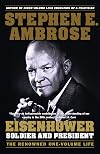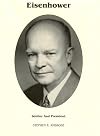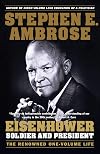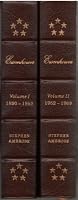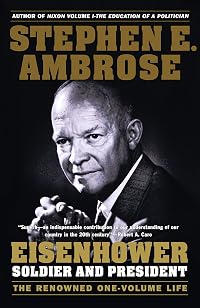
Eisenhower, Volumes 1 & 2: Soldier, General of the Army, President-Elect 1890-1952 / The President 1952-1969
by Stephen E. Ambrose
Ambrose's Eisenhower (Collections and Selections — 1-2)
On This Page
Description
Stephen E. Ambrose draws upon extensive sources, an unprecedented degree of scholarship, and numerous interviews with Eisenhower himself to offer the fullest, richest, most objective rendering yet of the soldier who became president. He gives us a masterly account of the European war theater and Eisenhower's magnificent leadership as Allied Supreme Commander. Ambrose's recounting of Eisenhower's presidency, the first of the Cold War, brings to life a man and a country struggling with issues show more as diverse as civil rights, atomic weapons, communism, and a new global role. Along the way, Ambrose follows the 34th President's relations with the people closest to him, most of all Mamie, his son John, and Kay Summersby, as well as Franklin D. Roosevelt, Winston Churchill, Charles de Gaulle, Harry Truman, Nixon, Dulles, Khrushchev, Joe McCarthy, and indeed, all the American and world leaders of his time. This superb interpretation of Eisenhower's life confirms Stephen Ambrose's position as one of our finest historians. show lessTags
Recommendations









Member Reviews
Stephen Ambrose is certainly among the finest contemporary historians in print. And while he has authored several very good biographies, in my opinion, his best work has been chronicling historic events as opposed to the lives of the participants. His works on the Lewis and Clark expedition and the construction of the transcontinental railroad far surpass any of his biographies. Perhaps this is merely coincidence, though there is certainly a difference in each endeavor.
This particular work is a condensation of an earlier two volume effort. In that respect, it is perfectly adequate and probably more enjoyable than the longer and more detailed work. I can't imagine anything that was not included that I would need to know.
Ambrose is show more certainly an Eisenhower fan, however this does not prevent him from clearly pointing out many of his mistakes and errors, both in the context of his life as Army general and as President. But, while he points out these instances, and many are quite glaring, he nevertheless, unhesitantly, seems to give him an over all pass.
Leadership is a word used quite often by Ambrose in describing Eisenhower. However, in many instances, it is not leadership, but effective administration that proved to be his strongest suit. His ability to serve effectively as Supreme Allied Commander in Europe was more a reflection of his ability to compromise and placate the many different factions involved than it was an indication of leadership, though leadership was certainly involved.
This differentiation became more stark when Eisenhower became President. Leadership becomes more difficult when the followers aren't required by law and army regulations to comply. As President, Eisenhower many times not only failed to display leadership, he quite clearly abrogated responsibility entirely.
In my opinion, Eisenhower's most lasting legacy was steering the country through some of the most turbulent periods of the Cold War without ever having to resort to military power. This at a time when many, if not most, of his advisors were counseling nuclear attack!
It was in the area of civil rights, however, that Ike was most suspect. I try to be very careful in judging historical personages by current standards. To do so is usually unfair. In this case, however, at a time when very many political and social contemporaries were taking stands, Eisenhower disappeared. A case can be made for finessing the issue during the 1956 Presidential campaign, but his failure to "lead" thereafter can only be a tacit endorsement of segregation. Instead of "leading", Eisenhower tried to compromise and bring the parties together, using the same methods that had worked for him in Europe. This was not "leadership", it was abrogation of responsibility.
Perhaps the most distasteful areas of he book are those that attempt to whitewash Eisenhower's relationship with his Army secretary Kay Sommersby. No intelligent human being can doubt that Eisenhower had a sexual relationship with Sommersby, however Ambrose goes through great pains and historical gymnastics to argue that though Ike was infatuated with Sommersby, had multiple opportunities to pursue her sexually, that she was undoubtedly willing and that all the officers around him were conducting extra marital affairs, Ike was innocent of adultery. One of his most laughable assertions was that he simply didn't have time or opportunity to have sex with Sommersby. Shortly thereafter, he documents a train trip to a Mediterranian resort on which Sommersby and several other "army girlfriends" accompanied the staff. At one point, he cites as proof, the fact that he attempted intercourse, but was "flaccid". Please. Simply acknowledge the fact and move on. I don't think any less of Ike's achievements because he had a girlfriend while at war. Ambrose seems to believe that doing so would somehow diminish him in the eyes of many, when instead it would more likely paint him as more human and subject to the same desires and faults as everyone else. I suspect very few will swallow Ambrose's assertions in this area.
Nevertheless, if you're interested in a comprehensive biography on Eisenhower, this is a very good place to go for it. show less
This particular work is a condensation of an earlier two volume effort. In that respect, it is perfectly adequate and probably more enjoyable than the longer and more detailed work. I can't imagine anything that was not included that I would need to know.
Ambrose is show more certainly an Eisenhower fan, however this does not prevent him from clearly pointing out many of his mistakes and errors, both in the context of his life as Army general and as President. But, while he points out these instances, and many are quite glaring, he nevertheless, unhesitantly, seems to give him an over all pass.
Leadership is a word used quite often by Ambrose in describing Eisenhower. However, in many instances, it is not leadership, but effective administration that proved to be his strongest suit. His ability to serve effectively as Supreme Allied Commander in Europe was more a reflection of his ability to compromise and placate the many different factions involved than it was an indication of leadership, though leadership was certainly involved.
This differentiation became more stark when Eisenhower became President. Leadership becomes more difficult when the followers aren't required by law and army regulations to comply. As President, Eisenhower many times not only failed to display leadership, he quite clearly abrogated responsibility entirely.
In my opinion, Eisenhower's most lasting legacy was steering the country through some of the most turbulent periods of the Cold War without ever having to resort to military power. This at a time when many, if not most, of his advisors were counseling nuclear attack!
It was in the area of civil rights, however, that Ike was most suspect. I try to be very careful in judging historical personages by current standards. To do so is usually unfair. In this case, however, at a time when very many political and social contemporaries were taking stands, Eisenhower disappeared. A case can be made for finessing the issue during the 1956 Presidential campaign, but his failure to "lead" thereafter can only be a tacit endorsement of segregation. Instead of "leading", Eisenhower tried to compromise and bring the parties together, using the same methods that had worked for him in Europe. This was not "leadership", it was abrogation of responsibility.
Perhaps the most distasteful areas of he book are those that attempt to whitewash Eisenhower's relationship with his Army secretary Kay Sommersby. No intelligent human being can doubt that Eisenhower had a sexual relationship with Sommersby, however Ambrose goes through great pains and historical gymnastics to argue that though Ike was infatuated with Sommersby, had multiple opportunities to pursue her sexually, that she was undoubtedly willing and that all the officers around him were conducting extra marital affairs, Ike was innocent of adultery. One of his most laughable assertions was that he simply didn't have time or opportunity to have sex with Sommersby. Shortly thereafter, he documents a train trip to a Mediterranian resort on which Sommersby and several other "army girlfriends" accompanied the staff. At one point, he cites as proof, the fact that he attempted intercourse, but was "flaccid". Please. Simply acknowledge the fact and move on. I don't think any less of Ike's achievements because he had a girlfriend while at war. Ambrose seems to believe that doing so would somehow diminish him in the eyes of many, when instead it would more likely paint him as more human and subject to the same desires and faults as everyone else. I suspect very few will swallow Ambrose's assertions in this area.
Nevertheless, if you're interested in a comprehensive biography on Eisenhower, this is a very good place to go for it. show less
Stephen Ambrose is a favorite writer of mine--one of the most readable and insightful of the contemporary historians I've read. He's written extensively on World War II at all levels from the generals to the ordinary soldier serving on the battlefront, as well as writing a respected biography of Richard Nixon. I can't think of anyone more qualified to tackle questions of political and military leadership, this particular era, and Eisenhower as "soldier and president."
I didn't always agree with Ambrose's conclusions. The first sentence in this biography states: Dwight David Eisenhower was a great and good man. He calls Eisenhower one of the "truly great" American presidents. In both his Forward and his Epilogue Ambrose claimed that, show more "Eisenhower gave the nation eight years of peace and prosperity. No other President in the twentieth century could make that claim." Please understand, I believe that within the limits of his time, Eisenhower was a decent man, and by any measure as Supreme Commander important to the victory of the allies in World War II and a good president--I just can't quite rate him as highly as Ambrose does. Partly that's because we use different measuring sticks. Some things Ambrose claims as accomplishments or great aspirations I can't agree with. (For one, I'm not as much an enthusiast for robust internationalism as Ambrose or Eisenhower, who supported a "United States of Europe.") Ambrose himself writes that any "attempt to assess Eisenhower's eight years as President inevitably reveals more about the person doing the assessing than it does about Eisenhower" and to declare him right or wrong on an issue "tends to be little more than a declaration of the current politics and prejudices of the author." And I might add, reader or reviewer. Nevertheless, only a couple of weeks ago, I read Flexner's biography of George Washington, where the author also claimed his subject was a "great and good man," and having read about the accomplishments and qualities of that "soldier and president," I can't see putting Eisenhower on the same pedestal.
However, Ambrose doesn't just present Eisenhower's accomplishments and admirable qualities but his mistakes and flaws as well. They seem to be connected. Eisenhower was, as Ambrose constantly notes, very "middle of the road" and pragmatic in politics. He drove hard for compromise and consensus and during the war he was legendary in demanding complete cooperation and respect between Americans and the British. He could even be described as eager to please--and hated controversy. So much so, that Ambrose named as his greatest mistake of the war that he went too far to "appease" Montgomery, the British general. You can see that same quality in Eisenhower's presidency. Yes, he stood up to the members of the National Security Advisers and Joint Chiefs of Staff that virtually unanimously pushed him to use nuclear weapons--five times in 1954 alone. He ended the conflict in Korea and refused to get involved in Vietnam. On the other hand, it was frustrating to read of how Eisenhower appeased Senator McCarthy (whom Eisenhower did despise) and his weak support of the Civil Rights Movement (about which he felt deeply ambivalent.) On that score Ambrose admits Eisenhower's "unwillingness to grapple with long-term problems and his inability to see clearly moral questions were to cost the nation, his party, and his reputation beyond measure."
At times I did think Ambrose bent over backward in Eisenhower's defense. I agree with one reviewer that said he should have just admitted Eisenhower had a wartime adulterous affair with Kay Summersby and moved on, instead of going through so many contortions trying to deny it. But this is a great biography because Ambrose does provide all the information you need to decide for yourself what you think of Eisenhower and his presidency. His account is based upon extensive research and interviews, some conducted by Ambrose himself. Eisenhower's presidency occurred before I was born, so I can't measure this depiction against my personal experiences. I can say though that within these 576 pages I gained a new appreciation of Eisenhower and the challenges he faced, learned a lot about this time in history, and was never bored, often entertained, and sometimes moved. I can't imagine anyone else writing a more definitive, more insightful and comprehensive biography of Eisenhower than Ambrose in my lifetime. show less
I didn't always agree with Ambrose's conclusions. The first sentence in this biography states: Dwight David Eisenhower was a great and good man. He calls Eisenhower one of the "truly great" American presidents. In both his Forward and his Epilogue Ambrose claimed that, show more "Eisenhower gave the nation eight years of peace and prosperity. No other President in the twentieth century could make that claim." Please understand, I believe that within the limits of his time, Eisenhower was a decent man, and by any measure as Supreme Commander important to the victory of the allies in World War II and a good president--I just can't quite rate him as highly as Ambrose does. Partly that's because we use different measuring sticks. Some things Ambrose claims as accomplishments or great aspirations I can't agree with. (For one, I'm not as much an enthusiast for robust internationalism as Ambrose or Eisenhower, who supported a "United States of Europe.") Ambrose himself writes that any "attempt to assess Eisenhower's eight years as President inevitably reveals more about the person doing the assessing than it does about Eisenhower" and to declare him right or wrong on an issue "tends to be little more than a declaration of the current politics and prejudices of the author." And I might add, reader or reviewer. Nevertheless, only a couple of weeks ago, I read Flexner's biography of George Washington, where the author also claimed his subject was a "great and good man," and having read about the accomplishments and qualities of that "soldier and president," I can't see putting Eisenhower on the same pedestal.
However, Ambrose doesn't just present Eisenhower's accomplishments and admirable qualities but his mistakes and flaws as well. They seem to be connected. Eisenhower was, as Ambrose constantly notes, very "middle of the road" and pragmatic in politics. He drove hard for compromise and consensus and during the war he was legendary in demanding complete cooperation and respect between Americans and the British. He could even be described as eager to please--and hated controversy. So much so, that Ambrose named as his greatest mistake of the war that he went too far to "appease" Montgomery, the British general. You can see that same quality in Eisenhower's presidency. Yes, he stood up to the members of the National Security Advisers and Joint Chiefs of Staff that virtually unanimously pushed him to use nuclear weapons--five times in 1954 alone. He ended the conflict in Korea and refused to get involved in Vietnam. On the other hand, it was frustrating to read of how Eisenhower appeased Senator McCarthy (whom Eisenhower did despise) and his weak support of the Civil Rights Movement (about which he felt deeply ambivalent.) On that score Ambrose admits Eisenhower's "unwillingness to grapple with long-term problems and his inability to see clearly moral questions were to cost the nation, his party, and his reputation beyond measure."
At times I did think Ambrose bent over backward in Eisenhower's defense. I agree with one reviewer that said he should have just admitted Eisenhower had a wartime adulterous affair with Kay Summersby and moved on, instead of going through so many contortions trying to deny it. But this is a great biography because Ambrose does provide all the information you need to decide for yourself what you think of Eisenhower and his presidency. His account is based upon extensive research and interviews, some conducted by Ambrose himself. Eisenhower's presidency occurred before I was born, so I can't measure this depiction against my personal experiences. I can say though that within these 576 pages I gained a new appreciation of Eisenhower and the challenges he faced, learned a lot about this time in history, and was never bored, often entertained, and sometimes moved. I can't imagine anyone else writing a more definitive, more insightful and comprehensive biography of Eisenhower than Ambrose in my lifetime. show less
When I first read this book decades ago, Stephen Ambrose's biography of Dwight Eisenhower was regarded as the most comprehensive account of his life available. At the time I thought it a good book, and I appreciated what I learned from it about a figure whose tenure as president was still undergoing historical reconsideration. In recent years, however, the validity of much of Ambrose's work has come into question, with evidence of everything from plagiarism to fabricated sources. With so much of Ambrose's scholarship on Eisenhower now suspect, readers are better off turning to more up-to-date biographies (such as Jean Edward Smith's [b:Eisenhower in War and Peace|11958983|Eisenhower in War and Peace|Jean Edward show more Smith|https://images.gr-assets.com/books/1333579846s/11958983.jpg|16921250]) to learn about the man and the times in which he lived. show less
One of my favorite biographies by one of my favorite authors. Excellent coverage of his time as Supreme Allied Commander in Europe and how he handled the egos of the Generals working for him. Equally impressive is the details of his presidency. Very readable.
Very readable biography of Dwight Eisenhower and the history of US events/politics during the 1940s,1950s, and 1960s. I liked the length and readability, but for some of the key players surrounding Eisenhower (e.g. John Foster Dulles) it would have been nice to get a bit more background. OVerall very enjoyable and accessible.
I wanted to like it but there were parts where Ambrose seemed too fanatical about Eisenhower.
Although Ambrose is generally classified in the same category as McCullogh this is not of the same caliber or Ambrose is off his game here. The work also may suffer as a compendium of two other books and it has a summarized and cursory tone throughout. Nonetheless, Eisenhower is an enigmatic and unappreciated president during a period of empty suits and this is truly a preeminent individual who achieved a great deal as a successful general as well as leading the country as the only president in the twentieth century to attain eight full years of peace and prosperity.
Members
- Recently Added By
Lists

Biographies of American Presidents
39 works; 4 members
Author Information

72+ Works 43,854 Members
Historian Stephen E. Ambrose grew up in Wisconsin and attended the University of Wisconsin and the University of Louisiana. Ambrose is considered to be one of the foremost historical scholars of recent times and has been a professor for over three decades. He is also the founder and president of the National D-Day Museum in New Orleans. His works show more include D-Day: June 6, 1944: The Climactic Battle of World War II, Citizen Soldiers: The U. S. Army from Normandy Beaches to the Bulge to the Surrender of Germany, June 7, 1944-May 7, 1945, Band of Brothers: E Company, 506th Regiment, 101st Airborne from Normandy to Hitler's Eagle's Nest and Undaunted Courage: Meriwether Lewis, Thomas Jefferson and the Opening of the American West. Abrose served historical consultant on the motion picture Saving Private Ryan. (Bowker Author Biography) show less
Series

Belongs to Publisher Series
Work Relationships
Common Knowledge
- Canonical title
- Eisenhower, Volumes 1 & 2: Soldier, General of the Army, President-Elect 1890-1952 / The President 1952-1969
- Original title
- Eisenhower
- Original publication date
- 1990
- People/Characters
- Dwight D. Eisenhower
- Dedication
- To the Men of D-Day
- First words
- He was born on October 14, 1890, in a small frame house, not much more than a shack, beside the railroad tracks in Denison, Texas.
- Last words
- (Click to show. Warning: May contain spoilers.)He was the President who made a peace and kept the peace and thus provided the conditions that made it possible for the American people to exercise their right to pursue happiness.
- Blurbers
- Keegan, John; Burns, James MacGregor; Caro, Robert A.
- Original language
- English
Classifications
- Genres
- Biography & Memoir, History, Nonfiction, General Nonfiction
- DDC/MDS
- 973.921092 — History & geography History of North America United States 1901- Cold War, Vietnam War, Digital Age (1953-2001) Dwight D. Eisenhower,1st Term (1953-1961) Brown V. Board of Education, Interstate Highway System, Geneva Summit Biography
- LCC
- E836 .A828 — History of the United States United States Twentieth century Eisenhower's administrations, 1953-1961
- BISAC
Statistics
- Members
- 815
- Popularity
- 33,917
- Reviews
- 13
- Rating
- (3.89)
- Languages
- English, Spanish
- Media
- Paper, Ebook
- ISBNs
- 10
- ASINs
- 9