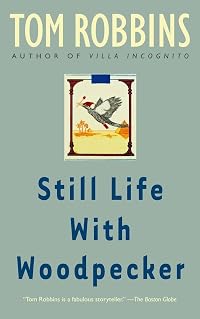
Still Life with Woodpecker
by Tom Robbins
On This Page
Description
“Robbins’s comic philosophical musings reveal a flamboyant genius.”—PeopleStill Life with Woodpecker is a sort of a love story that takes place inside a pack of Camel cigarettes. It reveals the purpose of the moon, explains the difference between criminals and outlaws, examines the conflict between social activism and romantic individualism, and paints a portrait of contemporary society that includes powerful Arabs, exiled royalty, and pregnant cheerleaders. It also deals with the show more problem of redheads. show less
Tags
Recommendations






Member Reviews
Tom Robbins’s Still Life With Woodpecker tells the story of Princess Leigh-Cheri, a social activist, romantic, and impossibly beautiful redhead, and her meeting with the infamous Bernard Wrangle, AKA the Woodpecker, a self-proclaimed outlaw who blows things up because – well, why not? As they fall headfirst into romance, they muse on how to make love stay, the nature of objects, and society at large.
I am going to tell a story that I promise is relevant, if you will just bear with me. When I was 18 or so, I read The Second Sex by Simone de Beauvoir. While I still think it’s a great book, my experience reading it at 18 was almost transcendental. Every sentence captured my attention, seemed mind-blowing and groundbreaking. I reveled show more in each idea, certain that it was new and exciting and wondering how on earth no one had ever noticed these things before. I waxed poetic and was generally insufferable, pestering all of my friends to read it and feeling heartbroken when they admitted that they didn’t understand what all the fuss was about. (For the record, I repeated this with Sometimes a Great Notion, but by then my friends knew to ignore me). From what I gather, most people have that book. For many, it was The Catcher in the Rye by J.D. Salinger. Maybe it was something more obscure. Whatever it was, as a teenager, to whom everything was new, it seemed to be the most rebellious, insightful, and exciting thing in the world.
Still Life With Woodpecker is that experience in book form.
I went in not knowing what to expect, but the blurb on the back assured me in a friendly, just-between-us-readers tone that, “Robbin’s comic philosophical musings reveal a flamboyant genius”. Instead, I found myself struggling to even make it through the book, I was so bored.
Since that’s primarily where my experiences as a teenager come in, let’s start with the “philosophical” part of that statement. I have read that some consider Still Life With Woodpecker to be a modern – or postmodern – fairy tale, and I’ll admit it shares some similarities, but not flattering ones. Fairy tales aren’t known for their characterization. Often the main characters are known only by their description: the princess, the prince, the frog, the witch, etc. Princess Leigh-Cheri and Bernard are almost utterly flat. When I said that Princess Leigh-Cheri was a social activist and romantic, that is precisely what she is: nothing more, nothing less. She could have easily been referred to as “the romantic” throughout with no confusion whatsoever. Bernard is, of course, “the outlaw”. Both of them speak in slick back-and-forth exchanges or long, deep, meaningful monologues – or, at least, they’re meant to be deep and meaningful, but instead they’re just pop-slogans repeated with all the depth of thought of a bumper sticker. Take Bernard’s assertion that, “I’m an outlaw, not a hero. I never intended to rescue you. We’re our own dragons as well as our own heroes, and we have to rescue ourselves from ourselves” (99). I’m not saying that this idea is without merit, but there is never any thoughtful discourse in it – it’s said, it’s done, let’s move on. And that’s how the entire book’s philosophy is: let me introduce a short slogan, the kind that hints at an actual meaningful idea, the kind that invites thoughtful discourse, and let’s move on and forget about it.
There are some interesting ideas in here, like the idea that what we think of as “love” is really just an interest in “mystery” – that when love dies, it’s really the mystery that has died. The last third of the book or so concentrates on the nature of objects and animation. Bernard himself has some ideas on victimization, criminals, and outlaws that are well-worth thinking about, but Robbins never develops any of them, and they move so fast as to not even allow them to be a springboard to independent thought. They remain soundbytes and slogans, told with all the arrogant conviction of a teenager who thinks he (or she) has found something truly new.
As for the “comic” part… there were a few parts I laughed – including a darkly hilarious scene when Bernard sits on an unfortunate Chihuahua and the background adventures of the hapless CIA agent Chuck – but on the whole, I found it more obnoxious than anything. He is of the type of people who think that absurdity and hilarity are the same thing. Many people have noted his writing style, which is wildly imaginative, and I fully agree. There was one line in particular that is so absolutely perfect that I had to pause and read it again for the sheer pleasure of the wordplay: “With Pioneer Inn’s meeting hall in bad state of repair, with cops, newspeople, and curiosity-seekers milling around the place like bargain-minded lemmings at a suicide sale…” (53). That is a truly delightful sentence. I love it. But sometimes his imagination can be off-putting, even gross. There are too many euphemisms for Princess Leigh-Cheri’s vagina to mention, but the top ones included: peachfish, peachclam, and, my personal disfavorite, “the folds of saltmeat and peach” with a “seaweed trigger” (158).
His comedy style is rough, with harsh edges that could stand some polishing down. It feels like a first draft: hectic, whirlwind, with no time to develop anything, be it characterization, philosophical ideas, or humor. Humor builds upon itself and needs a foundation, so while a few parts can be funny, it feels shaky and disjointed as a whole.
Honestly, I have a feeling this is the type of book best read when you’re 18. It teases deep thought, its breakneck pace is exhilarating to a certain age, and its writing is engineered and slick. As a 26-year-old, however, it just wasn’t my cup of tea. Now get off my damn lawn. show less
I am going to tell a story that I promise is relevant, if you will just bear with me. When I was 18 or so, I read The Second Sex by Simone de Beauvoir. While I still think it’s a great book, my experience reading it at 18 was almost transcendental. Every sentence captured my attention, seemed mind-blowing and groundbreaking. I reveled show more in each idea, certain that it was new and exciting and wondering how on earth no one had ever noticed these things before. I waxed poetic and was generally insufferable, pestering all of my friends to read it and feeling heartbroken when they admitted that they didn’t understand what all the fuss was about. (For the record, I repeated this with Sometimes a Great Notion, but by then my friends knew to ignore me). From what I gather, most people have that book. For many, it was The Catcher in the Rye by J.D. Salinger. Maybe it was something more obscure. Whatever it was, as a teenager, to whom everything was new, it seemed to be the most rebellious, insightful, and exciting thing in the world.
Still Life With Woodpecker is that experience in book form.
I went in not knowing what to expect, but the blurb on the back assured me in a friendly, just-between-us-readers tone that, “Robbin’s comic philosophical musings reveal a flamboyant genius”. Instead, I found myself struggling to even make it through the book, I was so bored.
Since that’s primarily where my experiences as a teenager come in, let’s start with the “philosophical” part of that statement. I have read that some consider Still Life With Woodpecker to be a modern – or postmodern – fairy tale, and I’ll admit it shares some similarities, but not flattering ones. Fairy tales aren’t known for their characterization. Often the main characters are known only by their description: the princess, the prince, the frog, the witch, etc. Princess Leigh-Cheri and Bernard are almost utterly flat. When I said that Princess Leigh-Cheri was a social activist and romantic, that is precisely what she is: nothing more, nothing less. She could have easily been referred to as “the romantic” throughout with no confusion whatsoever. Bernard is, of course, “the outlaw”. Both of them speak in slick back-and-forth exchanges or long, deep, meaningful monologues – or, at least, they’re meant to be deep and meaningful, but instead they’re just pop-slogans repeated with all the depth of thought of a bumper sticker. Take Bernard’s assertion that, “I’m an outlaw, not a hero. I never intended to rescue you. We’re our own dragons as well as our own heroes, and we have to rescue ourselves from ourselves” (99). I’m not saying that this idea is without merit, but there is never any thoughtful discourse in it – it’s said, it’s done, let’s move on. And that’s how the entire book’s philosophy is: let me introduce a short slogan, the kind that hints at an actual meaningful idea, the kind that invites thoughtful discourse, and let’s move on and forget about it.
There are some interesting ideas in here, like the idea that what we think of as “love” is really just an interest in “mystery” – that when love dies, it’s really the mystery that has died. The last third of the book or so concentrates on the nature of objects and animation. Bernard himself has some ideas on victimization, criminals, and outlaws that are well-worth thinking about, but Robbins never develops any of them, and they move so fast as to not even allow them to be a springboard to independent thought. They remain soundbytes and slogans, told with all the arrogant conviction of a teenager who thinks he (or she) has found something truly new.
As for the “comic” part… there were a few parts I laughed – including a darkly hilarious scene when Bernard sits on an unfortunate Chihuahua and the background adventures of the hapless CIA agent Chuck – but on the whole, I found it more obnoxious than anything. He is of the type of people who think that absurdity and hilarity are the same thing. Many people have noted his writing style, which is wildly imaginative, and I fully agree. There was one line in particular that is so absolutely perfect that I had to pause and read it again for the sheer pleasure of the wordplay: “With Pioneer Inn’s meeting hall in bad state of repair, with cops, newspeople, and curiosity-seekers milling around the place like bargain-minded lemmings at a suicide sale…” (53). That is a truly delightful sentence. I love it. But sometimes his imagination can be off-putting, even gross. There are too many euphemisms for Princess Leigh-Cheri’s vagina to mention, but the top ones included: peachfish, peachclam, and, my personal disfavorite, “the folds of saltmeat and peach” with a “seaweed trigger” (158).
His comedy style is rough, with harsh edges that could stand some polishing down. It feels like a first draft: hectic, whirlwind, with no time to develop anything, be it characterization, philosophical ideas, or humor. Humor builds upon itself and needs a foundation, so while a few parts can be funny, it feels shaky and disjointed as a whole.
Honestly, I have a feeling this is the type of book best read when you’re 18. It teases deep thought, its breakneck pace is exhilarating to a certain age, and its writing is engineered and slick. As a 26-year-old, however, it just wasn’t my cup of tea. Now get off my damn lawn. show less
Recommended to me by a friend at work. A pretty insane book. I’ve never read anything else like it. The book is more experienced than read, and I whole-heartedly endorse the experience (it is however, incredibly not safe for work). The author reads like a lunatic but a lunatic that makes some sense. Robbins reminds me of Douglas Adams and Kurt Vonnegut combined together and also on cocaine. The book’s main theme is “how do you make love stay” the climax of which was strong enough to make me put down the book when my eyes welled up with tears (moving quickly from observations of camel cigarettes and redheads to the sacrifice of the princess who uses her body to try to shield the outlaw from dynamite). The main plot of the book is show more simple enough, the story of a princess of a deposed monarchy who falls in love with an outlaw with a penchant for dynamite, but the book isn’t really plot driven, it’s driven by the style and random subjects the author happens to think of. The book moves from conspiracy theories to observations about dogma, the moon, and the etymology of the word pumpkin. Robbins frequently takes the reader on detours that somehow flow but also strike a particular chord in the mind (it’s like listening to a brilliant lunatic ramble). Robbins doesn’t write like anyone else I know, frequently breaking the story to talk about the typewriter he’s typing with and using seemingly nonsensical but also natural sounding metaphors. A great read. show less
from Laura:
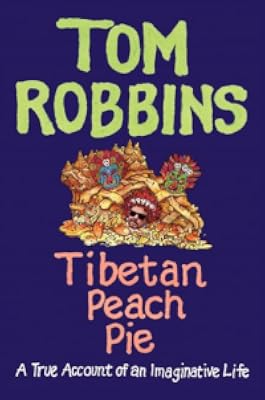
I've been reading one Tom Robbins book per year for a few years now. His books are so philosophically heavy and descriptively zany ("sometimes a woman blowing her nose can sound as soft and poignant as a rubber horse deflating after being punctured by a seashell") that I find I can't read him too often, but I do so enjoy his large ideas and long sentences. In this book, Robbins breaks the fourth wall with the occasional interlude where he discusses the typewriter that he's using to write the book (the Remington SL3), and ends by unplugging the typewriter and finishing in longhand. Still Life With Woodpecker is the favorite Robbins book of a friend's mother, and was highly recommended to me, but I enjoyed Jitterbug Perfume and show more Tibetan Peach Pie more.
Still...favorite quotes:
There is a particularly unattractive and discouragingly common affliction called tunnel vision, which, for all the misery it causes, ought to top the job list at the World Health Organization. Tunnel vision is a disease in which perception is restricted by ignorance and distorted by vested interest. Tunnel vision is caused by an optic fungus that multiplies when the brain is less energetic than the ego. It is complicated by exposure to politics. When a good idea is run through the filters and compressors of ordinary tunnel vision, it not only comes out reduced in scale and value but in its new dogmatic configuration produces effects the opposite of those for which it was originally intended.
Dullards are law-abiding because they choose not to choose. Outlaws, being less frightened by the bewildering variety of experience, being, in fact, slightly mad for encounters new and extreme, will seek to choose even when no choice readily presents itself.
How can one person be more real than any other? Well, some people do hide and others seek. Maybe those who are in hiding--escaping encounters, avoiding surprises, protecting their property, ignoring their fantasies, restricting their feelings, sitting out the Pan pipe hootchy-kootch of experience--maybe those people, people who won't talk to rednecks, or if they're rednecks won't talk to intellectuals, people who're afraid to get their shoes muddy or their noses wet, afraid to eat what they crave, afraid to drink Mexican water, afraid to bet a long shot to win, afraid to hitchhike, jaywalk, honky-tonk, cogitate, osculate, levitate, rock it, bop it, sock it, or bark at the moon, maybe such people are simply inauthentic, and maybe the jackleg humanist who says differently is due to have his tongue fried on the hot slabs of Liar's Hell...But there are folks who want to know and aren't afraid to look and won't turn tail should they find it--and if they never do, they'll have a good time anyway because nothing, neither the terrible truth nor the absence of it, is going to cheat them out of one honest breath of earth's sweet gas.
But having a acquired a taste for solitude, each of them spent days separate and alone, Leigh-Cheri in the attic, Bernard in the pantry. Funny how we think of romance as always involving two, when the romance of solitude can be ever so much more delicious and intense. Alone, the world offers itself freely to us. show less
I've been reading one Tom Robbins book per year for a few years now. His books are so philosophically heavy and descriptively zany ("sometimes a woman blowing her nose can sound as soft and poignant as a rubber horse deflating after being punctured by a seashell") that I find I can't read him too often, but I do so enjoy his large ideas and long sentences. In this book, Robbins breaks the fourth wall with the occasional interlude where he discusses the typewriter that he's using to write the book (the Remington SL3), and ends by unplugging the typewriter and finishing in longhand. Still Life With Woodpecker is the favorite Robbins book of a friend's mother, and was highly recommended to me, but I enjoyed Jitterbug Perfume and show more Tibetan Peach Pie more.
Still...favorite quotes:
There is a particularly unattractive and discouragingly common affliction called tunnel vision, which, for all the misery it causes, ought to top the job list at the World Health Organization. Tunnel vision is a disease in which perception is restricted by ignorance and distorted by vested interest. Tunnel vision is caused by an optic fungus that multiplies when the brain is less energetic than the ego. It is complicated by exposure to politics. When a good idea is run through the filters and compressors of ordinary tunnel vision, it not only comes out reduced in scale and value but in its new dogmatic configuration produces effects the opposite of those for which it was originally intended.
Dullards are law-abiding because they choose not to choose. Outlaws, being less frightened by the bewildering variety of experience, being, in fact, slightly mad for encounters new and extreme, will seek to choose even when no choice readily presents itself.
How can one person be more real than any other? Well, some people do hide and others seek. Maybe those who are in hiding--escaping encounters, avoiding surprises, protecting their property, ignoring their fantasies, restricting their feelings, sitting out the Pan pipe hootchy-kootch of experience--maybe those people, people who won't talk to rednecks, or if they're rednecks won't talk to intellectuals, people who're afraid to get their shoes muddy or their noses wet, afraid to eat what they crave, afraid to drink Mexican water, afraid to bet a long shot to win, afraid to hitchhike, jaywalk, honky-tonk, cogitate, osculate, levitate, rock it, bop it, sock it, or bark at the moon, maybe such people are simply inauthentic, and maybe the jackleg humanist who says differently is due to have his tongue fried on the hot slabs of Liar's Hell...But there are folks who want to know and aren't afraid to look and won't turn tail should they find it--and if they never do, they'll have a good time anyway because nothing, neither the terrible truth nor the absence of it, is going to cheat them out of one honest breath of earth's sweet gas.
But having a acquired a taste for solitude, each of them spent days separate and alone, Leigh-Cheri in the attic, Bernard in the pantry. Funny how we think of romance as always involving two, when the romance of solitude can be ever so much more delicious and intense. Alone, the world offers itself freely to us. show less
“People are never perfect, but love can be. ”
Before getting into this, I had almost no idea what I was getting into. All I knew was that Tom Robbins was a satirist much in the vein of Kurt Vonnegut, and the description of the book was enough to pique my interest.
At its heart, this book is a love story and amidst the flaming hot romance which can be downright grotesque at some points; it attempts to answer a lot of absurd questions and mysteries, some of which you may have wondered about.
Honestly, I haven't felt so entertained, shocked, disgusted and all in all, be in awe with a book for a while. I hate using the word perfect because that is not a very static metric as I enjoy almost all the books I read but this right here... show more this is something special. show less
Before getting into this, I had almost no idea what I was getting into. All I knew was that Tom Robbins was a satirist much in the vein of Kurt Vonnegut, and the description of the book was enough to pique my interest.
At its heart, this book is a love story and amidst the flaming hot romance which can be downright grotesque at some points; it attempts to answer a lot of absurd questions and mysteries, some of which you may have wondered about.
Honestly, I haven't felt so entertained, shocked, disgusted and all in all, be in awe with a book for a while. I hate using the word perfect because that is not a very static metric as I enjoy almost all the books I read but this right here... show more this is something special. show less
This was my first Tom Robbins book, and though I liked it, I think my enthusiasm may have been greater back in my teenage years when I was a big fan of Kurt Vonnegut, a writer to whom Robbins is sometimes compared. But at that time, though I certainly would have appreciated Robbins's brilliant wordplay, humor, and overall excellent writing and intelligence, I wonder if I would have lacked the real-life experience to understand his critique of "last quarter of the twentieth century" materialism, hypocrisy, group-think, political correctness, and environmental and social movements, not to mention his philosophical pinings over "how do you make love stay." Because for all his crazy, drug-induced, or enhanced word-craft, his salty and show more sexual language, and his bizarre musings, this novel deals with serious issues and moral and philosophical questions about what constitutes a life worth living. And while Bernard M. Wrangle, whose real name is Baby, at first turned me off with his aggressive and pre-Me Too Movement courtship of his love interest, princess Leigh Cheri, by the end of the novel I had come to appreciate and like him more and understood that this really is, as the book's title tells you, "A Sort of Love Story." Nevertheless, Robins's characters, are really ciphers for his ideas (and vehicles for some of his better puns). Nothing is really believeable, but it's not supposed to be a realistic novel. It is a fable of sorts. Maybe a truly American version of the sort of magical realism made popular by Central and South American authors. show less
almost indescribable. there is a romance, but it isn't a romantic story. there is the rise and fall of a monarchy, but it isn't a political story. there is a lot of social commentary, but it isn't an anthropological story.
the author has a fascinating way with words, and i will gladly search out his other works. i picked up quite a few great quotes, the favorite being:
those who shun the whimsy of things will experience rigor mortis before death""
the author has a fascinating way with words, and i will gladly search out his other works. i picked up quite a few great quotes, the favorite being:
those who shun the whimsy of things will experience rigor mortis before death""
I tried to write this review in the style of Tom Robbins. I wanted "something more than words. I [wanted] to send my readers armloads of crystals, some of which are the colors of orchids and peonies, some of which pick up radio signals from a secret city which is half Paris and half Coney Island." I soon discovered it can't be done. No one writes in the style of Tom Robbins. All you can do when you find a sentence like that on the very first page is to smile in wonder, and eagerly keep reading. Robbins loves playing with words. His metaphors will make your mind do joyous little dances.
So, OK. The language is wonderful. I would happily read Robbins' account of watching paint dry, or a day filling out tax forms. Even his shopping list is show more probably a million laughs. Fortunately, I don't have to. I have right here a copy of Still Life With Woodpecker.
Who knows how to make love stay? What is the purpose of the moon? Whatever happened to the golden ball? Robbins repeats these questions, and others, several times throughout the novel. Every time, he provides a slightly different answer. The book reads like an improvised jam session. Every seeming return to a main theme leads to a new and surprising conclusion. And, like the very best musicians, Robbins makes it all look effortless.
It's also very funny. It's not just one-liners, though there are plenty of those ("I have a black belt in haiku. And a black vest in the cleaners." "Plato did claim that the unexamined life was not worth living. Oedipus Rex was not so sure.") Robbins' best jokes are entwined within page-long philosophies and digressions, and can not be quoted out of context.
The plot is deceptively simple: Girl meets boy. She's a princess, he's an outlaw. Et cetera. It sounds like a book you've read a thousand times before. The difference is, Tom Robbins wrote this book, so the plot really isn't the point. The ideas, and Robbins' presentation of them, are the real driving force. show less
So, OK. The language is wonderful. I would happily read Robbins' account of watching paint dry, or a day filling out tax forms. Even his shopping list is show more probably a million laughs. Fortunately, I don't have to. I have right here a copy of Still Life With Woodpecker.
Who knows how to make love stay? What is the purpose of the moon? Whatever happened to the golden ball? Robbins repeats these questions, and others, several times throughout the novel. Every time, he provides a slightly different answer. The book reads like an improvised jam session. Every seeming return to a main theme leads to a new and surprising conclusion. And, like the very best musicians, Robbins makes it all look effortless.
It's also very funny. It's not just one-liners, though there are plenty of those ("I have a black belt in haiku. And a black vest in the cleaners." "Plato did claim that the unexamined life was not worth living. Oedipus Rex was not so sure.") Robbins' best jokes are entwined within page-long philosophies and digressions, and can not be quoted out of context.
The plot is deceptively simple: Girl meets boy. She's a princess, he's an outlaw. Et cetera. It sounds like a book you've read a thousand times before. The difference is, Tom Robbins wrote this book, so the plot really isn't the point. The ideas, and Robbins' presentation of them, are the real driving force. show less
Members
- Recently Added By
Published Reviews
added by jww7575
Lists

Favourite Books
1,819 works; 309 members

magic realism novels
44 works; 11 members

1980s
356 works; 23 members

A Novel Cure
742 works; 23 members

Books tagged "feel good"
129 works; 20 members

Blue Pyramid 1,276 Best Books of All Time
1,248 works; 32 members
Animals in the Title
498 works; 11 members

Books With Our Favorite First Lines
168 works; 104 members

Books With the Most Memorable Titles
478 works; 158 members

Favorite Book Titles
35 works; 1 member

BitLife
212 works; 4 members

Books We Love to Reread
688 works; 296 members

1980 great books
63 works; 1 member
Author Information

17+ Works 36,725 Members
Tom Robbins is a writer, novelist, editor, and journalist. He was born in Blowing Rock, North Carolina on July 22, 1936. Robbins studied journalism at Washington and Lee for two years and later graduated from the Richmond Professional Institute in 1961. He attended the Graduate School of Far Eastern Studies at the University of Washington. From show more 1957 to 1960, Robbins served in the U.S. Air Force stationed in Korea as a meteorologist. During his years in the service he took courses in Japanese culture and aesthetics in Tokyo. After the military, Robbins took a job as a copy editor at the Richmond Times-Dispatch. Robbins later worked as feature editor and art critic at the Seattle Times and part time at the Seattle Post-Intelligencer. Robbins published the novel, Another Roadside Attraction in 1971. Other books include Even Cowgirls Get the Blues and Still Life With Woodpecker. Even Cowgirls Get the Blues was made into a 1996 film directed by Gus Van Sant. Robbins has also acted in such films as Made in Heaven and Mrs. Parker and the Vicious Circle. A documentary entitled, Tom Robbins: A Writer in the Rain was made in 1997. In 2014, his title Tibetan Peach Pie: A True Account of an Imaginative Life, made The New York Times Best Seller List. (Bowker Author Biography) Tom Robbins is a Southerner by birth, Robbins has lived in & around Seattle since 1962. (Publisher Provided) show less
Some Editions
Awards and Honors
Awards
Series
Belongs to Publisher Series
Work Relationships
Has as a teacher's guide
Common Knowledge
- Canonical title*
- Buntspecht
- Original title
- Still Life with Woodpecker
- Original publication date
- 1980
- Epigraph
- You don't need to leave your room.
Remain sitting at your table and listen.
Don't even listen, simply wait.
Don't even wait.
Be quite still and solitary.
The world will freely offer itself to you.
To be un... (show all)masked, it has no choice.
It will roll in ecstasy at your feet.
—Franz Kafka
Here should be a picture of my favorite apple.
It is also a nude & bottle.
It is also a landscape.
There are no such things as still lifes.
—Erica Jong - Dedication
- To the memory of
Keith Wyman and Betty Bowen:
if there is a place where people
go after death, its proprietors have
got their hands full with those two.
To everybody whose letters
I haven’t answered.<... (show all)br> and to G. R., special delivery. - First words
- In the last quarter of the twentieth century, at a time when Western civilization was declining too rapidly for comfort and yet too slowly to be very exciting, much of the world sat on the edge of an increasingly expensive th... (show all)eater seat, waiting—with various combinations of dread, hope, and ennui—for something momentous to occur.
PROLOGUE
If this typewriter can't do it, then fuck it, it can’t be done.
This is the all-new Remington SL3, the machine that answers the question, “Which is harder, trying to read The Brothers Karamazov while listen... (show all)ing to Stevie Wonder records or hunting for Easter eggs on a typewriter keyboard?” This is the cherry on top of the cowgirl. The burger served by the genius waitress. The Empress card. - Quotations
- "One must agree that the last quarter of the twentieth century was a severe period for lovers. It was a time when women openly resented men, a time when men felt betrayed by women, a time when romantic relationships took on t... (show all)he character of ice in spring stranding many little children on jagged and inhospitable floes."
"Regardless of what else the press might have contributed to our culture, regardless of whether it is our first defense against totalitarianism or a wimpy force that undermines authentic experiences by categorizing them accor... (show all)ding to faddish popular interest, the press has give us big fat Sunday papers to ease our weekly mental menstrual bloat."
"If beneath the great issues and all-encompassing questions (as underplayed as they were in the last quarter of the twentieth century) a more intimate struggle rages, a struggle whose real goal was romantic fulfillment, maybe... (show all) it was courageous and honorable to attempt to transcend that struggle, to insist on something more than that.
Maybe."
"What is more likely is that technology will bypass artists, that a day is coming when our novels will be written by computers, the same devices that will paint our murals and compose our tunes."
"Who does have a love life anymore? These days people have sex lives, not love lives... I don't have a love life because I've never met a man who knew how to have a love life. Maybe I don't know how, either."
"Tunnel vision is a disease in which perception is restricted by ignorance and vested interest. Tunnel vision is caused by an optic fungus that multiplies when the brain is less energetic than the ego. It is complicated by ex... (show all)posure to politics. When a good idea is run through the filters, it not only comes out reduced in scale and value but in its new dogmatic configuration produces effects opposite of those for which it was originally intended.
That is how the loving ideas of Jesus Christ became the sinister clichés of Christianity."
"This is not an easy time for lovers, either... True, most lovers don't work at it hard enough, or with enough imagination or generosity, but even those who try don't seem to have any ultimate success these days. Who knows ho... (show all)w to make love stay?"
"Love is the ultimate outlaw. It just won't adhere to any rules. The most any of us can do is sign on as its accomplice. Instead of vowing to honor and obey, maybe we show swear to aid and abet. That would mean the security i... (show all)s out of the question. The words "make" and "stay" become inappropriate. My love for you has no strings attached. I love you for free."
"Maybe both lust and love demand something more than most of us have the stomach for. These days, certainly, folks seem more concerned with furthering careers than with furthering romance."
"...until we admit that while a partner can add sweet dimensions to our lives, we, each of us, are responsible for our own fulfillment. Nobody else can provide it for us, and to believe otherwise is to delude ourselves danger... (show all)ously and program for eventual failure every relationship we enter."
"One day we wake up and the magic is gone. We hustle to get it back, but by then it's usually too late, we've used it up. What we have to do is work like hell at making additional magic right from the start. It's hard work, e... (show all)specially when it seems superfluous or redundant, but if we can remember to do it, we greatly improve our chances of making love stay."
"Three of the four elements are shared by all creatures, but fire was a gift to humans alone. Smoking cigarettes is as intimate as we can become with fire without immediate excruciation. Every smoker is an embodiment of Prome... (show all)theus, stealing fire from the gods and bringing it on back home. We smoke to capture the power of the sun, to pacify Hell, to identify with the primordial spark, to feed on the marrow of the volcano. It's not the tobacco we're after but the fire. When we smoke, we are performing a version of the fire dance, a ritual as ancient as lightning."
"It occurred to her that in every relationship in which she had participated, in every union older than a year that she'd observed, imbalance existed. Of a couple, one person invariably loved stronger than the other. It seeme... (show all)d a law of nature, a cruel law that led to tension and destruction. She was dismayed that a law so unfair, so miserable prevailed, but since it did, since imbalance seemed inevitable, it must be easier, healthier to be the lover who loved least."
"Love is private and primitive and a bit on the funky and frightening side... Underneath the hearts and flowers, love is loony like that. Attempts to housebreak it, to dress the crabs up like doves and make them sing soprano ... (show all)always results in thin blood." - Last words
- (Click to show. Warning: May contain spoilers.)It's never too late to have a happy childhood.
- Blurbers
- New York Times Book Review; Boston Globe; People Magazine; Publishers Weekly; Glamour; Kansas City Star (show all 12); Chicago Sun-Times; Los Angeles Herald-Examiner; Seattle Times; Chattanooga Times; Newsday; Robert Stone
- Original language
- English
- Canonical DDC/MDS
- 813.54
- Canonical LCC
- PS3568.O233
*Some information comes from Common Knowledge in other languages. Click "Edit" for more information.
Classifications
Statistics
- Members
- 6,204
- Popularity
- 2,004
- Reviews
- 80
- Rating
- (3.88)
- Languages
- 11 — Czech, Danish, English, French, German, Greek, Italian, Norwegian (Bokmål), Russian, Spanish, Turkish
- Media
- Paper, Ebook
- ISBNs
- 34
- ASINs
- 15