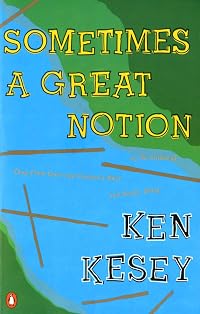
Sometimes a Great Notion
by Ken Kesey
On This Page
Description
A literary icon sometimes seen as a bridge between the Beat Generation and the hippies, Ken Kesey scored an unexpected hit with his first novel One Flew Over the Cuckoo's Nest. His successful follow-up, Sometimes a Great Notion was also transformed into a major motion picture, directed by and starring Paul Newman. Here, Oregon's Stamper family does what it can to survive a bitter strike dividing their tiny logging community. And as tensions rise, delicate family bonds begin to fray and unravel.Tags
Recommendations








Member Recommendations
Member Reviews
First published in 1964, this book follows the Stamper family, who own a mill and logging outfit in coastal Oregon. Primarily, it tells the story of two half brothers; Leland Stamper who has returned to the family house out of a desire to take revenge on his older half brother, Hank, who runs the one logging concern still at work during a brutal strike because the business only employs family members. As the two men work together, they reluctantly form a bond, but Leland is intent on his revenge and finds Hank's wife a convenient target.
This is a novel just seething with testosterone. Kesey chooses to portray striking lumberjacks as lazy and Hank as the stalwart individualist who will do it all himself if he needs to. But the job he show more has set himself is to cut and transport down the river to a large corporate mill a quantity of lumber that requires that he cooperate with other men to succeed. He has one solid friend, the unreliable help of his half brother and assorted family members who begin to peel off as the tension with the striking lumberjacks makes things unpleasant. In the end, he is running short of willing workers, which will make the project harder to complete and a lot more dangerous.
The writing in this book is truly lovely. Kesey can write. It's a long book, with a lot of descriptive passages, but they are the best parts of the book. The story itself is pure soap opera and full of men having big feelings. The thing that renders this book difficult to read is the endless casual racism, especially a particularly egregious portrayal of a Native American woman, as well as how the women in this book exist solely as possessions of men and don't have agency of their own. Hank's wife, Viv, who gets some space in this novel, nonetheless is portrayed as not having choices of her own when it comes to being used in Leland's war against his brother. This is an immersive book, but one that asks the reader to put up with a world in which the only people who matter or who count are white men. show less
This is a novel just seething with testosterone. Kesey chooses to portray striking lumberjacks as lazy and Hank as the stalwart individualist who will do it all himself if he needs to. But the job he show more has set himself is to cut and transport down the river to a large corporate mill a quantity of lumber that requires that he cooperate with other men to succeed. He has one solid friend, the unreliable help of his half brother and assorted family members who begin to peel off as the tension with the striking lumberjacks makes things unpleasant. In the end, he is running short of willing workers, which will make the project harder to complete and a lot more dangerous.
The writing in this book is truly lovely. Kesey can write. It's a long book, with a lot of descriptive passages, but they are the best parts of the book. The story itself is pure soap opera and full of men having big feelings. The thing that renders this book difficult to read is the endless casual racism, especially a particularly egregious portrayal of a Native American woman, as well as how the women in this book exist solely as possessions of men and don't have agency of their own. Hank's wife, Viv, who gets some space in this novel, nonetheless is portrayed as not having choices of her own when it comes to being used in Leland's war against his brother. This is an immersive book, but one that asks the reader to put up with a world in which the only people who matter or who count are white men. show less
This feels like Kesey’s “Great American Novel” and he considered it his masterpiece, but while I liked it, I think “One Flew Over the Cuckoo’s Nest” should hold that honor. It’s remarkable to me that the subject of the novel was a labor dispute between loggers in the rugged forest of Oregon, gritty and not the kind of stuff that generally takes one’s breath away, considering the author would soon be leading his “Merry Pranksters” across the country in a bus, and would become a leading figure in the psychedelic movement. While I admire Kesey taking the road less travelled in his life, it’s a shame that he didn’t write more books, as his talent is certainly on display here.
At over 700 dense pages, this book is show more quite a tome, and if its style throws you off early on, stick with it. Kesey experiments with a technique of switching between perspectives rapidly, sometimes within a sentence, which can be a little disorienting, particularly as the story is being filled in. Ironically, in contrast to this style and the fluidity with which he wields it, he’s at his best with the level of realism in his dialogue, which invariably seems natural and unforced, and the level of detail in his description of the surroundings.
There are two central conflicts in the story, the primary of which is a logging family’s stubborn refusal to join others in a strike, and their attempt to go it alone amidst the rancor of their community. Interestingly, Kesey doesn’t choose sides in describing this struggle, satirizing both union leaders as well as the rugged individuals who disregard the strike, which may have been a part of why initial reactions to the book were mixed. The other conflict is within the family, with the younger son returning from college harboring a secret grudge against his brother, and plotting to have an affair with his wife.
There are topical references scattered in here, such as an allusion to the threat of nuclear war, the love the hip had for jazz music, or popular figures like Alan Watts, but this story mostly feels timeless, and intentionally so. There is something primal in the emotions in play, and it builds to moments of fantastic tension towards the end.
At the same, the book probably could have done with some editing, as it gets rather elongated (bizarrely, including 60 pages between 602 and 662 where a main character goes missing entirely). Worse yet, the female characters are terribly under-developed across the board, which was a serious detractor. As a warning, there are also bits of mild racism, such as the use of N-word between white workers, comments like “what other Caucasian ever moved with that slack-limbed indolence?” and the minor character of “Indian Jenny,” a prostitute who is more of a stereotype than anything else. Aside from the ridiculously terse updates for her throughout the novel, Kesey writes of her expression that it never changes, and is “somewhere between blunt ferocity and brute pathos.” (ugh)
All in all, however, it’s certainly a good book, and one that feels like it should be better known. show less
At over 700 dense pages, this book is show more quite a tome, and if its style throws you off early on, stick with it. Kesey experiments with a technique of switching between perspectives rapidly, sometimes within a sentence, which can be a little disorienting, particularly as the story is being filled in. Ironically, in contrast to this style and the fluidity with which he wields it, he’s at his best with the level of realism in his dialogue, which invariably seems natural and unforced, and the level of detail in his description of the surroundings.
There are two central conflicts in the story, the primary of which is a logging family’s stubborn refusal to join others in a strike, and their attempt to go it alone amidst the rancor of their community. Interestingly, Kesey doesn’t choose sides in describing this struggle, satirizing both union leaders as well as the rugged individuals who disregard the strike, which may have been a part of why initial reactions to the book were mixed. The other conflict is within the family, with the younger son returning from college harboring a secret grudge against his brother, and plotting to have an affair with his wife.
There are topical references scattered in here, such as an allusion to the threat of nuclear war, the love the hip had for jazz music, or popular figures like Alan Watts, but this story mostly feels timeless, and intentionally so. There is something primal in the emotions in play, and it builds to moments of fantastic tension towards the end.
At the same, the book probably could have done with some editing, as it gets rather elongated (bizarrely, including 60 pages between 602 and 662 where a main character goes missing entirely). Worse yet, the female characters are terribly under-developed across the board, which was a serious detractor. As a warning, there are also bits of mild racism, such as the use of N-word between white workers, comments like “what other Caucasian ever moved with that slack-limbed indolence?” and the minor character of “Indian Jenny,” a prostitute who is more of a stereotype than anything else. Aside from the ridiculously terse updates for her throughout the novel, Kesey writes of her expression that it never changes, and is “somewhere between blunt ferocity and brute pathos.” (ugh)
All in all, however, it’s certainly a good book, and one that feels like it should be better known. show less
To know a thing you have to trust what you know, and all that you know, and as far as you know in whatever direction your knowing drags you.
One of the things I know is that Ken Kesey was a one of a kind writer, who knew his craft and invented his own style. Beginning this book can be off-putting, because there isn’t a narrator for the story--Kesey bounces around inside the heads of a dozen characters, switching without warning from one to the other, and making you dizzy with trying to sort out whose thoughts you are following. He also does nothing as mundane as telling a story in a linear fashion, oh no, he bounces time frames almost as much as he does characters in the beginning. But read on! When you have settled into the rhythm of show more what he is doing, he begins to tell a more linear tale and it becomes obvious to you who is speaking and why it is important not to follow this story through the eyes of only one character or even an omniscient being.
I found his descriptions and language beautiful. It was as close to being on an Oregon river in the winter as I would ever want to come; it was closer than I would ever want to get to a logging operation. The prose is beautiful, but there is also a touch of the poetic in his writing, as I think is demonstrated in this passage:
But the breath of memory still plucks such instances, setting the whole web shaking. People fade up the stairs, but to dream of each other’s dreams; of days coming gone and nights past coming; of hard sun-rods crisscrossing back and forward across outspreading circles of water, meaningless-seeming…
The Stamper family are loggers and rugged individualists. They don’t ask for anything and they give little thought to anyone outside their family circle. Henry Stamper is the patriarch of the clan and son, Hank is the heart and the driving force. When all the logging operations unionize and go out on strike, the Stamper’s non-union business takes up the major contract in the area, defying the strikers. Everyone is against them; the town is against them. Youngest son, Leland, is a college kid, raised in the city, away from this world, since the age of twelve. He has a decided problem with his older brother, and much of the angst and tension is heightened by the silent duel Lee is constantly fighting in his mind. He has come home, ostensibly to help with fulfilling the contract, but mostly for the personal satisfaction of proving he is able to dethrone his older brother. As if it were needed to add to the edginess, there is a woman involved.
This is a very long book and not a wasted page in it, with themes that are as large as the outdoorsmen who inhabit it. Sibling rivalry, individuals vs. organizations, brotherhood and the love between men who share daily dangers, how the needs of a woman differ from those of a man, and what love really is anyway, play out in the unwinding of the novel.
For there is always a sanctuary more, a door that can never be forced, a last inviolable stronghold that can never be taken, whatever the attack; your vote can be taken, you name, you innards, or even your life, but that last stonghold can only be surrendered. And to surrender it for any reason other than love is to surrender love.
If you like books that literally transport you to another world and hold you there, this book is for you. I thought about it after I turned the lights out at night. It haunted my sleep and distracted me from my duties. It consumed me. And, it made me twitch with the restlessness of these men and shake and worry for their safety from the environment, from the people around them, and from one another. This is a masterpiece. show less
One of the things I know is that Ken Kesey was a one of a kind writer, who knew his craft and invented his own style. Beginning this book can be off-putting, because there isn’t a narrator for the story--Kesey bounces around inside the heads of a dozen characters, switching without warning from one to the other, and making you dizzy with trying to sort out whose thoughts you are following. He also does nothing as mundane as telling a story in a linear fashion, oh no, he bounces time frames almost as much as he does characters in the beginning. But read on! When you have settled into the rhythm of show more what he is doing, he begins to tell a more linear tale and it becomes obvious to you who is speaking and why it is important not to follow this story through the eyes of only one character or even an omniscient being.
I found his descriptions and language beautiful. It was as close to being on an Oregon river in the winter as I would ever want to come; it was closer than I would ever want to get to a logging operation. The prose is beautiful, but there is also a touch of the poetic in his writing, as I think is demonstrated in this passage:
But the breath of memory still plucks such instances, setting the whole web shaking. People fade up the stairs, but to dream of each other’s dreams; of days coming gone and nights past coming; of hard sun-rods crisscrossing back and forward across outspreading circles of water, meaningless-seeming…
The Stamper family are loggers and rugged individualists. They don’t ask for anything and they give little thought to anyone outside their family circle. Henry Stamper is the patriarch of the clan and son, Hank is the heart and the driving force. When all the logging operations unionize and go out on strike, the Stamper’s non-union business takes up the major contract in the area, defying the strikers. Everyone is against them; the town is against them. Youngest son, Leland, is a college kid, raised in the city, away from this world, since the age of twelve. He has a decided problem with his older brother, and much of the angst and tension is heightened by the silent duel Lee is constantly fighting in his mind. He has come home, ostensibly to help with fulfilling the contract, but mostly for the personal satisfaction of proving he is able to dethrone his older brother. As if it were needed to add to the edginess, there is a woman involved.
This is a very long book and not a wasted page in it, with themes that are as large as the outdoorsmen who inhabit it. Sibling rivalry, individuals vs. organizations, brotherhood and the love between men who share daily dangers, how the needs of a woman differ from those of a man, and what love really is anyway, play out in the unwinding of the novel.
For there is always a sanctuary more, a door that can never be forced, a last inviolable stronghold that can never be taken, whatever the attack; your vote can be taken, you name, you innards, or even your life, but that last stonghold can only be surrendered. And to surrender it for any reason other than love is to surrender love.
If you like books that literally transport you to another world and hold you there, this book is for you. I thought about it after I turned the lights out at night. It haunted my sleep and distracted me from my duties. It consumed me. And, it made me twitch with the restlessness of these men and shake and worry for their safety from the environment, from the people around them, and from one another. This is a masterpiece. show less
The first 150 pages. Oh. My. God. The first 150 pages took me two years and three attempts to break through. Finally, this past summer, I plowed ahead, and I am thankful I did. It's almost like Kesey wrote the beginning as a challenge: I wrote an amazing novel, but only those of you who can pass through the first part are worthy of the entire book.
The shifting point of view and flashes between various times is very difficult to follow, mostly because Kesey gives so few clues when he has done either. It gets easier in the middle and end of the novel, more traditional, and also the reader just becomes more accustomed to his style. By the end it's a page-turner. The novel is so long that I found myself deeply invested in the characters show more lives, desperate to know how this tension that had been building for 400 pages was finally going to break, or not. show less
The shifting point of view and flashes between various times is very difficult to follow, mostly because Kesey gives so few clues when he has done either. It gets easier in the middle and end of the novel, more traditional, and also the reader just becomes more accustomed to his style. By the end it's a page-turner. The novel is so long that I found myself deeply invested in the characters show more lives, desperate to know how this tension that had been building for 400 pages was finally going to break, or not. show less
It's hard to know where to begin - the back of my edition proclaims, "The earthy, torrid story of a lusty, yelling, Paul Bunyan of a man and his battles with society." (In fact, it proclaims that all in caps.) That sort of describes an aspect of the book, but mostly it's kind of like those ads for action movies where they play up the love story angle to try to get the women to come and see it - you know how they cut together the 5 minutes of time actually devoted to the supposed love story and then have a voiceover of something like, "a love that wouldn't be denied"? Like that.
Okay, let me back up and explain a little about the bones of the book. It's about the Stamper family, who came west to Oregon sometime around the turn of the 20th show more century. We get to know Henry, the patriarch of the family, who came to Oregon and found his occupation logging and trying to "whup" the land. He has two sons: Hank, by his first wife, and Leland Stanford by his second. The second wife eventually leaves him (she was from the east and not the kind of woman cut out for living in a shack on the shore of a river in the middle of nowhere Oregon), taking young Lee with her. Lee leaves with not much feeling at all about his father, but a hatred for Hank because Hank has been carrying on an affair with Lee's mother. Years later, Lee is a college student in New York when he receives a postcard from his family in Oregon requesting that he come back and help out with the family business. Lee comes back, much to everyone's surprise, but he returns with complex motivations.
He gets to know his family - irascible Henry; his cousin Joe Ben, who is the self-appointed ray of sunshine; Viv, Hank's wife; and of course brother Hank, who Lee immediately sets about sizing up and deciding how best to take his revenge on. Against this backdrop is the drama the family is embroiled in with the town, involving a loggers' strike and a deal the Stampers have made with a lumber company. A multitude of themes are at work in the book - what family means, loyalty, the need for every man to prove himself, whether any man can truly be an island, revenge and its price, the lines between love, obsession, and duty, strength and weakness and what defines each are just a few.
The writing style is a little confusing at times - Kesey employs a few tactics that can be difficult to follow at first. In order to cover several viewpoints, he will jump between scenes of what different characters are doing and saying at any given moment in time. He uses parenthetical or italicized text to give a character's thoughts on whatever is going on. He also switches from third-person to first-person narration at the drop of a hat, and the first-person narration is not always by the same person, even within the course of a few paragraphs. These techniques can definitely be hard on the reader, but they're very effective once you get into the rhythm of it.
I really loved this one. Recommended for: people who like stories about the wilderness and man's relationship with it, people with daddy issues, people with mommy issues, people with brother issues, lumberjacks, and people who like to read descriptions of rain.
Quote:
"This is an insidious malady chiefly common in that mythical organ that pumps life through the veins of the ego: care, coronary car, complicated by galloping fear. The go-away-closer disease. Starving for contact and calling it poison when it is offered.... Never accept candy from strangers. Or from friends. Sneak off a sack of gumdrops when nobody's looking if you can, but don't accept, never accept ... you want somebody taking advantage? And above all, never care, never never *never* care. Because it is caring that lulls you into letting down your guard and leaving up your shades...." show less
Okay, let me back up and explain a little about the bones of the book. It's about the Stamper family, who came west to Oregon sometime around the turn of the 20th show more century. We get to know Henry, the patriarch of the family, who came to Oregon and found his occupation logging and trying to "whup" the land. He has two sons: Hank, by his first wife, and Leland Stanford by his second. The second wife eventually leaves him (she was from the east and not the kind of woman cut out for living in a shack on the shore of a river in the middle of nowhere Oregon), taking young Lee with her. Lee leaves with not much feeling at all about his father, but a hatred for Hank because Hank has been carrying on an affair with Lee's mother. Years later, Lee is a college student in New York when he receives a postcard from his family in Oregon requesting that he come back and help out with the family business. Lee comes back, much to everyone's surprise, but he returns with complex motivations.
He gets to know his family - irascible Henry; his cousin Joe Ben, who is the self-appointed ray of sunshine; Viv, Hank's wife; and of course brother Hank, who Lee immediately sets about sizing up and deciding how best to take his revenge on. Against this backdrop is the drama the family is embroiled in with the town, involving a loggers' strike and a deal the Stampers have made with a lumber company. A multitude of themes are at work in the book - what family means, loyalty, the need for every man to prove himself, whether any man can truly be an island, revenge and its price, the lines between love, obsession, and duty, strength and weakness and what defines each are just a few.
The writing style is a little confusing at times - Kesey employs a few tactics that can be difficult to follow at first. In order to cover several viewpoints, he will jump between scenes of what different characters are doing and saying at any given moment in time. He uses parenthetical or italicized text to give a character's thoughts on whatever is going on. He also switches from third-person to first-person narration at the drop of a hat, and the first-person narration is not always by the same person, even within the course of a few paragraphs. These techniques can definitely be hard on the reader, but they're very effective once you get into the rhythm of it.
I really loved this one. Recommended for: people who like stories about the wilderness and man's relationship with it, people with daddy issues, people with mommy issues, people with brother issues, lumberjacks, and people who like to read descriptions of rain.
Quote:
"This is an insidious malady chiefly common in that mythical organ that pumps life through the veins of the ego: care, coronary car, complicated by galloping fear. The go-away-closer disease. Starving for contact and calling it poison when it is offered.... Never accept candy from strangers. Or from friends. Sneak off a sack of gumdrops when nobody's looking if you can, but don't accept, never accept ... you want somebody taking advantage? And above all, never care, never never *never* care. Because it is caring that lulls you into letting down your guard and leaving up your shades...." show less
Dear God. Never before have I read a book in which I simultaneously think, "this motherfucker can WRITE" and "this book is so tiresome I'm going to die". Swiftly changing perspectives which only later show themselves to be genius, cannily crafted passages that change the reader's sympathies, and a death scene that breaks one's heart like no other. And so much rain. I'm soggy with the rain.
I read this book bc of book group. And we all hated her a lot until we realized we loved this goddamn book like no other. We still often talk about it at meetings, years later. Seriously, we do. What an impact it's had on me. Then I recommended to my brother and now HE'S obsessed with it. Which is also fun.
Read this goddamn book.
I read this book bc of book group. And we all hated her a lot until we realized we loved this goddamn book like no other. We still often talk about it at meetings, years later. Seriously, we do. What an impact it's had on me. Then I recommended to my brother and now HE'S obsessed with it. Which is also fun.
Read this goddamn book.
Absolutely stunning. Kesey takes a subject I normally wouldn't care about and a group of characters I normally wouldn't like and makes me really care about their outcome. The writing in this is amazing: scenes are written from several points of view simultaneously, so you get an amazing understanding of the characters and their actions. The landscape of Oregon is as active and strong a character as any of the people in the book. It's not the kind of story I generally enjoy, but the writing is just so phenomenal that this ranks among the best books I have ever read.
Members
- Recently Added By
Lists

1001 Books You Must Read Before You Die
1,448 works; 1,134 members

Favourite Books
1,819 works; 316 members

Top Five Books of 2013
1,562 works; 721 members

Favorite Long Books
330 works; 41 members

20th Century Literature
1,161 works; 55 members

Read the book and saw the movie
1,170 works; 192 members

Best family sagas
244 works; 34 members
1960s, Best books published therein
254 works; 22 members

Best of American Literature
146 works; 9 members
1,001 BYMRBYD Concensus
723 works; 27 members
Jordan B. Peterson's Recommended Books
104 works; 5 members

Catalog
41 works; 2 members

Books
85 works; 1 member
Set in the Pacific Northwest
136 works; 7 members

Allie's Wishlist
217 works; 2 members

Blue Pyramid 1,276 Best Books of All Time
1,248 works; 32 members

Books worth rereading
21 works; 1 member

Recommended Reading : 600 Classics Reviewed, Editors of Salem Press, 2015
634 works; 6 members

Books With the Most Memorable Titles
478 works; 158 members
Talk Discussions
Past Discussions
Group Read, March 2020: Sometimes a Great Notion in 1001 Books to read before you die (March 2020)
Author Information

38+ Works 33,302 Members
Ken Kesey, September 17, 1935 - November 10, 2001 Kenneth Elton "Ken" Kesey was born in Colorado on September 17, 1935. He graduated from the University of Oregon, and published two full-length novels that helped to give him a cult following. "One Flew over the Cuckoo's Nest" (1962) owes much to Kesey's own experience as a ward attendant at the show more Menlo Park Veterans' Hospital. This exciting first novel was told from the point of view of a half-Indian man who thinks of himself as the Big Chief pictured on the writing tablets of everybody's school days looking out at the other inmates in a Disneylike world. Its portrayal of the doomed but heroic rebel McMurphy stood for a particular kind of American individualism. The book was adapted into a successful stage play by Dale Wasserman, and in 1975, Milos Forman directed a screen adaptation, which won the "Big Five" Academy Awards: Best Picture, Best Actor (Jack Nicholson), Best Actress (Louise Fletcher), Best Director (Forman) and Best Adapted Screenplay (Lawrence Hauben, Bo Goldman). Kesey's Sometimes a Great Notion (1964) is a long, complex novel that troubled many of his earlier readers. Kesey's most recent novel was Demon Box (1987); although it was somewhat well received, it was still compared unfavorably to his earlier works. His last major work was an essay for Rolling Stone magazine calling for peace in the aftermath of the September 11 attacks. On October 25, 2001, Kesey had surgery on his liver to remove a tumor. He died of complications from the surgery on November 10, 2001. He was 66. (Bowker Author Biography) show less
Some Editions
Awards and Honors
Awards
Notable Lists
Series
Belongs to Publisher Series
Work Relationships
Has the adaptation
Common Knowledge
- Canonical title
- Sometimes a Great Notion
- Original title
- Sometimes a Great Notion
- Original publication date
- 1964
- People/Characters
- Hank Stamper; Leland Stamper; Henry Stamper, Sr.
- Important places
- Wakonda, Oregon, USA; Oregon, USA
- Related movies
- Sometimes a Great Notion (1970 | IMDb)
- Dedication
- To my mother and father –
Who told me songs are for the birds,
Then taught me all the tunes I know
And a good deal of the words. - First words
- Along the wester slopes of the Oregon Coastal Range ... come look: the hysterical crashing of tributaries as they merge into the Wakonda Auga River ...
- Quotations
- Never give a inch!
- Last words
- (Click to show. Warning: May contain spoilers.)"Haw," Jenny says triumphantly, lifting the mud-hemmed garment on off over her head.
- Original language*
- englanti
*Some information comes from Common Knowledge in other languages. Click "Edit" for more information.
Classifications
Statistics
- Members
- 3,070
- Popularity
- 5,741
- Reviews
- 50
- Rating
- (4.19)
- Languages
- 13 — Czech, Danish, Dutch, English, Finnish, French, German, Italian, Polish, Russian, Spanish, Swedish, Turkish
- Media
- Paper, Audiobook, Ebook
- ISBNs
- 44
- UPCs
- 1
- ASINs
- 33