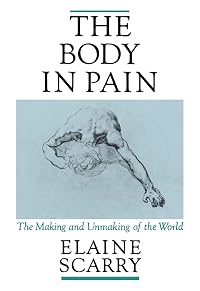
The Body in Pain: The Making and Unmaking of the World
by Elaine Scarry
On This Page
Description
Part philosophical meditation, part cultural critique, The Body in Pain is a profoundly original study that has already stirred excitement in a wide range of intellectual circles. The book is an analysis of physical suffering and its relation to the numerous vocabularies and culturalforces--literary, political, philosophical, medical, religious--that confront it. Elaine Scarry bases her study on a wide range of sources: literature and art, medical case histories, documents on torture show more compiled by Amnesty International, legal transcripts of personal injury trials, and military and strategic writings by such figures as Clausewitz, Churchill, Liddell Hart,and Kissinger, She weaves these into her discussion with an eloquence, humanity, and insight that recall the writings of Hannah Arendt and Jean-Paul Sartre. Scarry begins with the fact of pain's inexpressibility. Not only is physical pain enormously difficult to describe in words--confronted with it, Virginia Woolf once noted, "language runs dry"--it also actively destroys language, reducing sufferers in the most extreme instances to aninarticulate state of cries and moans. Scarry analyzes the political ramifications of deliberately inflicted pain, specifically in the cases of torture and warfare, and shows how to be fictive. From these actions of "unmaking" Scarry turns finally to the actions of "making"--the examples ofartistic and cultural creation that work against pain and the debased uses that are made of it. Challenging and inventive, The Body in Pain is landmark work that promises to spark widespread debate. show lessTags
Recommendations

Member Reviews
The first half of this book is both fascinating and readable, clearly organized and compelling in its arguments surrounding the body, pain, torture, war, and the self. While some of the material is difficult to read material-wise, particularly in the torture section, Scarry's points are smart and carefully explained, and examples are given as needed--not overdone. I'd classify the first half of this book as one of the most thought-provoking works of theory that I've come across, and absolutely recommend it to readers interested in cultural studies and/or writings on the body, the self, identity, torture, war, and/or the relationship of pain to the self and the effects of pain on the self.
As a sidenote, the notes in this book are show more carefully and expertly included--I don't know when I've read another work of nonfiction where the end notes have been not only thorough, but only included as actually of interest to casual readers and giving more than basic citations and/or unnecessary details. These endnotes are elaborations---any point of interest that has an endnote has an endnote of interest, in other words, and that seems a rarity.
Unfortunately, as engaged as I was with the first half of Scarry's book, the second half loses some of the drive from the first. There's some repetition, and much language that seems needlessly complex or academic, more in the line with what I expect of theory as opposed to the clear and direct language of the first portion of the book. The material is still integral to Scarry's points, and worth pursuing certainly, but it does become a progressively more difficult read. It may be to alleviate that difficulty and complexity that Scarry regularly repeats points and ideas from the first portion of the book, but those repetitions make the second half of the book more difficult to get through, nearly in the style of a collection of articles from a single author as opposed to a single composed argument.
In the end, though, I'd certainly recommend the full work to anyone interested, for there's no doubt that this work is smart and thought-provoking, both necessary and worthwhile for anyone willing to work through the ideas. show less
As a sidenote, the notes in this book are show more carefully and expertly included--I don't know when I've read another work of nonfiction where the end notes have been not only thorough, but only included as actually of interest to casual readers and giving more than basic citations and/or unnecessary details. These endnotes are elaborations---any point of interest that has an endnote has an endnote of interest, in other words, and that seems a rarity.
Unfortunately, as engaged as I was with the first half of Scarry's book, the second half loses some of the drive from the first. There's some repetition, and much language that seems needlessly complex or academic, more in the line with what I expect of theory as opposed to the clear and direct language of the first portion of the book. The material is still integral to Scarry's points, and worth pursuing certainly, but it does become a progressively more difficult read. It may be to alleviate that difficulty and complexity that Scarry regularly repeats points and ideas from the first portion of the book, but those repetitions make the second half of the book more difficult to get through, nearly in the style of a collection of articles from a single author as opposed to a single composed argument.
In the end, though, I'd certainly recommend the full work to anyone interested, for there's no doubt that this work is smart and thought-provoking, both necessary and worthwhile for anyone willing to work through the ideas. show less
in an age too full of hunters, scarry is a gatherer (of myths and morels, personal letters and pieces of carved wood, shards of glass and fiber-optic cables). what a beautiful path she forges and leads us down in the process, and as for the meal... OK. all i can say right now is this book is really, really good
Scarry makes some valid (if somewhat self-evident) points about the way hawkish types use rhetoric to mask the real human costs of war. That said, too much of this text is constructed out of dubious assumptions and logical fallacies, all obscured with a lot of handwaving. She defines terms like "pain" and "torture" in counterintuitive ways so that they serve her argument... then she quietly shifts her own definitions to suit different arguments later in the book. The second section, on how creativity is an antidote(?) to pain, is largely unfathomable.
Erudite as it is humane, this book undoes the justifications for war and torture, while offering a much needed manifesto for a committed cultural practice.
This was so good yet so boring, you know?
Mentioned in The Princessa: Machiavelli for Women by Harriet Rubin.
Ratings
Members
- Recently Added By
Lists

Vlogbrothers Book Recommendations
307 works; 4 members

Books in the Bibliography of The Dawn of Everything by Graeber & Wengrow
478 works; 2 members
Author Information

15+ Works 1,911 Members
Elaine Scarry is the Cabot Professor of Aesthetics and the General Theory of Value at Harvard University. Her book The Body in Pain was a National Book Critics Circle Award finalist. She lives in Cambridge, Massachusetts.
Awards and Honors
Awards
Classifications
Statistics
- Members
- 878
- Popularity
- 30,941
- Reviews
- 6
- Rating
- (4.14)
- Languages
- English, German
- Media
- Paper, Audiobook, Ebook
- ISBNs
- 5
- UPCs
- 1
- ASINs
- 2