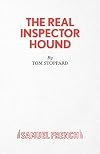
The Real Inspector Hound
by Tom Stoppard
On This Page
Tags
Recommendations


















Member Recommendations
Member Reviews
On receiving the news of the death of Tom Stoppard, I read his play The Real Inspector Hound, a piece that I have never seen performed, although its initial production was around the time of my own birth. Stoppard wrote this play after Rosencrantz & Guildenstern Are Dead, and it uses many of the same techniques of dramatic layering and collapsing of contexts. Where Rosencrantz & Guildenstern relies on the audience to know Shakespeare's Hamlet, The Real Inspector Hound simply hangs its hat on a bog standard murder mystery.
The first two characters, Moon and Birdboot, are theater critics who have come to see the play. As their framing conversations proceed, it becomes evident that the two of them represent homicidal and adulterous show more culpability respectively. The "theater criticism" they offer is largely irrelevant to what is happening in the crime scene at Muldoon Manor, but their private anxieties cross and parallel it with juxtapositions of dialogue.
At the end of the first act, there is an enigmatic suspension, and then the play begins again, but Birdboot is drawn into the scene, taking the role of the suspect Simon. Later still, Moon is conscripted to play as the police inspector who arrived late in the first act. Thus the critics demonstrate their own projection into the drama, which is nothing more than a backdrop to their own preoccupations. A couple of twists ensure that they get their just desserts.
Despite the apparent difficulty of engineering the first reveal of the critics in the reflected house, I think it would be simple enough in the sort of small space where this brief play with a cast of eight would be likely to be staged. It is full of Stoppard's typical wit, and reflection on it does reveal a certain measure of profundity. show less
The first two characters, Moon and Birdboot, are theater critics who have come to see the play. As their framing conversations proceed, it becomes evident that the two of them represent homicidal and adulterous show more culpability respectively. The "theater criticism" they offer is largely irrelevant to what is happening in the crime scene at Muldoon Manor, but their private anxieties cross and parallel it with juxtapositions of dialogue.
At the end of the first act, there is an enigmatic suspension, and then the play begins again, but Birdboot is drawn into the scene, taking the role of the suspect Simon. Later still, Moon is conscripted to play as the police inspector who arrived late in the first act. Thus the critics demonstrate their own projection into the drama, which is nothing more than a backdrop to their own preoccupations. A couple of twists ensure that they get their just desserts.
Despite the apparent difficulty of engineering the first reveal of the critics in the reflected house, I think it would be simple enough in the sort of small space where this brief play with a cast of eight would be likely to be staged. It is full of Stoppard's typical wit, and reflection on it does reveal a certain measure of profundity. show less
Life imitates art. No, really it does!
The Real Inspector Hound plays with the fourth wall phenomenon in the theatre. In theatre the audience sits separated from the performance and unable to influence the outcomes on the stage. That passive relationship was for a long time considered the necessary relationship between actors and audience.
The viewer is also meant to sit back and accept the premise of the play and go with it. This is called the suspension of disbelief, meaning you suspend your critical faculties that tell you you are in a theatre, that the actors are performing and that someone sat at desk and wrote the play very deliberately. Nothing is random as though walking down the street by chance you observed a fascinating drama show more conjured out of thin air.
Back in year nine, I took the drama elective subject at school. It was kind of fun until I heard that we would put on the school play at the end of the semester. I was very nervous. That play was The Real Inspector Hound by Tom Stoppard.
The premise of this play is that two critics, Birdboot and Moon sit to the side of the stage watching from their box, the play called The Real Inspector Hound. The so called ‘play’ at the centre of it all is a real stinker full of cliches like a manor house by the sea surrounded by swamps and fog and impenetrable in and out under the worse weather conditions, a long lost husband that sort of thing. And there’s a madman on the loose making his way to the manor according to the radio. The old servant speaks in a pre-emptive tension building narrative voice so we are constantly kept up to date of live real life ‘developments’.
There’s a body on the stage that everyone except the characters on stage get to see. The audience is already in on things, the fourth wall is pervious. The plot is wet as the weather, everyone knows it. So what is the premise? Well, theatre and its conventions.
But, Birdboot and Moon (I was playing the part of Birdboot by the way) have their own little drama going on. Critic jealousy and competitiveness. Birdboot is a bit of a scoundrel, chasing young actresses, promising them a big future through positive reviews, that sort of thing.
But, as happens in theatre all that real life stuff like love take over and Birdboot falls for one of the actresses on the stage during the ‘performance’. He breaks through the fourth wall, no spoiler here, really, I doubt anyone will watch this with the gasp of horror at what comes next, the broken conventions are now conventions themselves. Everything is up for grabs now.
The performance for some silly reason, left unexplained repeats itself. The drama of the first act starts again as the second act and … well Birdboot insinuates himself on the stage, answers a phone call on the stage, talks to his wife tells her everything is fine and then proceeds to lust after the lady of the house. Of course that’s not all. It’s a murder mystery, a wild denouement follows.
There’s a kissing scene between Birdboot and the lady of the manor near the end.
Now, during year nine rehearsals, I have to tell you, Stoppard's ideas played out in life as it does in art. Birdboot’s love interest, the lady of the manor, played by real life Actress X takes an interest in Birdboot played by your reviewer. Birdboot is planted a serious kiss that everyone notices during rehearsals leading to wild speculations among year nine drama students. What ensues is more theatre with silly year nine real life stuff acted out as a fumbling “love story”. But it doesn’t have as good a denouement as The Real Inspector Hound. I sometimes wish the fourth wall was still there. Oh well, life is more interesting than theatre, but only rarely. I'm pretty sure Actress X won't be reading this review. Our paths diverged very rapidly after sharing the stage. But you never know, people get nostalgic.
When this play was first performed, Ronnie Barker (Two Ronnies) played Birdboot. show less
An amusing send-up of the detective genre, particularly Agatha Christie's locked-room country-house mysteries. I chuckled out loud at some points, notably whenever Mrs. Drudge gave an exposition-heavy speech. The play also does a good job of skewering theatre critics. Overall worth a read if you like absurdist theatre and murder mysteries.
Gotta love this show. I knew someone doing "The Mousetrap" somewhere and was going to tell me about rehearsals but she didn't want to spoil the surprise ending if I'd never seen it. No, I'd never seen "The Mousetrap," but I had been in "The Real Inspector Hound," so I pretty much knew how it all turned out.
Stoppard takes on pre-existing material and turns it on its head. I'd love to actually see this show, see some other Mrs. Drudge answer the phone: "Good morning, the drawing room of Lady Muldoon's country residence one morning in early spring." Derivative? But quite sound. And a sweet revenge on critics. Puckeridge! You cunning bastard!
Stoppard takes on pre-existing material and turns it on its head. I'd love to actually see this show, see some other Mrs. Drudge answer the phone: "Good morning, the drawing room of Lady Muldoon's country residence one morning in early spring." Derivative? But quite sound. And a sweet revenge on critics. Puckeridge! You cunning bastard!
A bouquet of allusions: Tom Stoppard loves multilayered writing and drama, creating comedy or even farce.This play is an allusion to An Inspector Calls. It uses travesties, double or triple identities like Shakespeare in his comedies. It is a direct descendant of Samuel Beckett's absurd drama. It is an allusion to Murder by Death. It is thus a parody of many models and even a parody of a parody.
But it is also built with a mirror projecting the audience onto the stage, then projecting this projected audience into the play, and the actors into this projected audience of critics. This is again a multifaceted mirror.
Finally no one is true, no one is false, no truth is true, and no truth is false. All theories are purely abstract, absurd show more and abscond fantasies. The last layer of parody and criticism is directed at the police of course as for the plot of the play, and the critics as for the performance of the play and the play itself.
Stoppard is a hard hitting satirist cast loose onto the public, the critics and society. Catch out of it what you can. And nothing if you can't catch anything. Too bad for you. Stoppard will not cry.
Dr Jacques COULARDEAU show less
Agatha Christie meets P.G.Wodehouse meets Samuel Beckett meets Franz Kafka.
Brilliant!
Brilliant!
Special to me. The only play I've read without seeing it as well. Maybe some day....
Members
- Recently Added By
Lists

Favourite One-Acts
31 works; 2 members

Books Read in 2021
5,361 works; 114 members

Best Sellers / Popular 1968
237 works; 5 members

Books Read in 2025
4,090 works; 97 members
Author Information

110+ Works 22,484 Members
When the National Theatre needed a last-minute substitute for a canceled production of As You Like It, Kenneth Tynan decided to stage Rosencrantz and Guildenstern Are Dead, a work by an unfamiliar author that had received discouraging notices from provincial critics at its Edinburgh Festival debut. Of course, the play, when it opened in April show more 1967, met with universal acclaim. In New York the next year, it was chosen best play by the Drama Critics Circle. In such an unlikely way, Tom Stoppard came to light. Born in Czechoslovakia, a country he left (for Singapore) when he was an infant, he began his literary career as a journalist in Bristol, where play reviewing led to playwriting. After Rosencrantz and Guildenstern, Stoppard's reputation suffered through the production of a number of minor works, whose intellectual preoccupations were shrugged off by reviewers: Enter a Free Man (1968; "an adolescent twinge of a play," N.Y. Times), The Real Inspector Hound (1968; "lightweight," N.Y. Times), and After Magritte. But in the 1970s, the initial enthusiasms aroused by Rosencrantz and Guildenstern were more than vindicated by the production of two full-length plays, Jumpers (1974) and the antiwar play Travesties (1975), whose immense verbal and theatrical inventiveness made them absolute successes on both sides of the Atlantic. Stoppard's method from the start has been to contrive explanations for highly unlikely encounters---of objects (the ironing board, old lady, and bowler hat of After Magritte), characters (Joyce, Lenin, and Tzara in Travesties), and even plays (Hamlet, Rosencrantz and Guildenstern, The Importance of Being Earnest, Travesties, and The Real Thing, 1982). In the 1970s, Tynan called for Stoppard---as a Czech and as an artist---to engage himself politically. But although political subjects have since found their way into pieces from Every Good Boy Deserves Favor (1977) to Squaring the Circle (1985), politics and art seem to have become just two more of the playwright's irreconcilables, which meet, but never join, in the logical frames of his comedy. The presence of political material---such as the Lenin sections that nearly ruin the second part of Travesties---has occasionally strained the structure of the plays. But in The Real Thing Stoppard is comfortable enough with the satire on art and activism to bring a third subject, love, into the mix. Stoppard has acknowledged his Eastern European heritage nonpolitically, in a series of adaptations of plays by Arthur Schnitzler (see Vol. 2), Johann Nestroy, and Ferenc Molnar. (Bowker Author Biography) Tom Stoppard is the author of many plays, including Rosencrantz and Guildenstern Are Dead, Jumpers, Travesties, and The Invention of Love. He lives in London. (Publisher Provided) show less
Work Relationships
Common Knowledge
- Canonical title
- The Real Inspector Hound
- Original publication date
- 1968
- People/Characters
- Moon; Birdboot; Mrs. Drudge; Simon; Felicity; Cynthia (show all 8); Magnus; Inspector Hound
- First words
- The first thing is that the audience appear to be confronted by their own reflection in a huge mirror.
- Quotations
- Getting away with murder must be quite easy, provided that your motive is sufficiently inscrutable.
Sometimes I dream of revolution, a bloody coup d'etat by the second rank—troupes of actors slaughtered by their understudies, magicians sawn in half by indefatigably smiling glamour girls, cricket teams wiped out by maraudi... (show all)ng bands of twelfth men—I dream of champions chopped down by rabbit-punching sparring partners while eternal bridesmaids turn and rape the bridegrooms over the sausage rolls and parliamentary private secretaries plant bombs in the Minister's Humber—comedians die on provincial stages, robbed of their feeds by mutely triumphant stooges—and march—an army of assistants and deputies, the seconds-in-command, the runners-up, the right-handmen—storming the palace gates wherein the second son has already mounted the throne having committed regicide with a croquet-mallet—stand-ins of the world stand up! - Last words
- (Click to show. Warning: May contain spoilers.)Puckeridge! ... you cunning bastard. (He dies.)
- Blurbers
- Bryden, Ronald
- Original language
- English UK
Classifications
Statistics
- Members
- 364
- Popularity
- 85,906
- Reviews
- 8
- Rating
- (3.96)
- Languages
- English, French
- Media
- Paper
- ISBNs
- 7
- ASINs
- 3