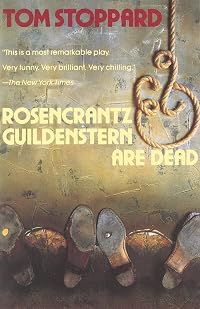
Rosencrantz and Guildenstern Are Dead
by Tom Stoppard
On This Page
Description
Acclaimed as a modern dramatic masterpiece, Rosencrantz & Guildenstern are Dead is the fabulously inventive tale of Hamlet as told from the worm's-eve view of the bewildered Rosencrantz and Guildenstern, two minor characters in Shakespeare's play. In Tom Stoppard's best-known work, this Shakespearean Laurel and Hardy finally get a chance to take the lead role, but do so in a world where echoes of Waiting for Godot resound, where reality and illusion intermix, and where fate leads our two show more heroes to a tragic but inevitable end. Tom Stoppard was catapulted into the front ranks of modem playwrights overnight when Rosencrantz and Guildenstern Are Dead opened in London in 1967. Its subsequent run in New York brought it the same enthusiastic acclaim, and the play has since been performed numerous times in the major theatrical centers of the world. show lessTags
Recommendations






Member Recommendations
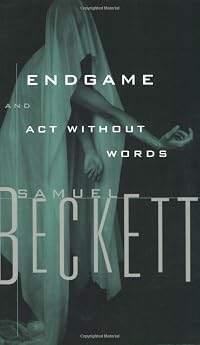
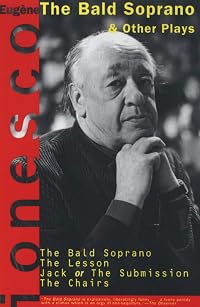
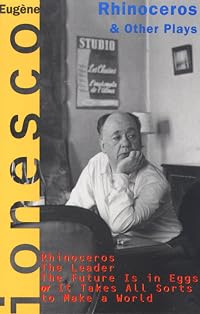
acenturyofsleep Stoppard's play's been called "Waiting for Hamlet," as both are existentialist plays featuring a pair of clueless (yet tragic) idiots.
100


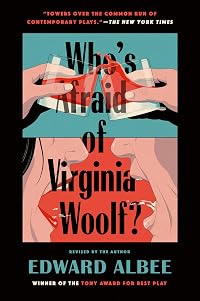
The Persecution and Assassination of Jean-Paul Marat as Performed by the Inmates of the Asylum of Charenton Under the Direction of the Marquis de Sade by Peter Weiss
CGlanovsky Plays about plays with absurdist humor
CGlanovsky Both (in vastly different tones) play with the awareness that the events are part of a play
Member Reviews
My sisters and I were kind of obsessed with this play (and movie) when we were younger. So when I saw this book at a garage sale for ten cents, I had to buy it. Then I spent most of the afternoon in a lawn chair in my yard, reading it.
It was, of course, every bit as clever in this later reading. But it was perhaps more biting in its commentary on how much control we have over our own lives -- and when do we know if we're living our own stories, or are just side stories in someone else's play?
But as my friend Heather points out, "at least there is the comfort of companionship."
It was, of course, every bit as clever in this later reading. But it was perhaps more biting in its commentary on how much control we have over our own lives -- and when do we know if we're living our own stories, or are just side stories in someone else's play?
But as my friend Heather points out, "at least there is the comfort of companionship."
"... we move idly towards eternity, without possibility of reprieve or hope of explanation." (pg. 88)
An odd, oh-so-clever play, and at times I thought I ought to hate it. The dialogue is drawn out and regurgitative, and the jokes are sometimes laboured, like a misfiring comedy sketch. It's hard to piece together what Stoppard is trying to do at times – it can seem a bit throwaway.
Nevertheless, once you do piece together what the play's trying to do, it becomes much more interesting. It takes two bit-part players from Shakespeare's Hamlet – the titular Rosencrantz and Guildenstern – and focuses on them as they wait in the wings and the plot of Hamlet whirls around them. Shakespeare is good material for this – "every exit being an show more entrance somewhere else," Stoppard reasons (pg. 22) – not least because the Bard often referenced plays and parts and players within his plots. He was meta long before that was a thing. Stoppard not only does well to identify this fruitful territory, but has fun with the more obvious jokes too (for example, Ros and Guil are bemused by the fact that Hamlet talks to himself – i.e. in his soliloquies).
Stoppard also takes the opportunity to use his premise to get rather existential. Our two bit-part players are trying to figure things out – what their purpose is, their motivations and loyalties and so on, as kings and princes scheme dramatically around them. They're not given direction, not as characters nor as human beings. "We have not been picked out simply to be abandoned... set loose to find our own way... We are entitled to some direction, I would have thought" (pg. 16). Don't we all feel that way, in life? All the world's a stage, as I believe someone once wrote – though the name escapes me.
Again, this is in the tradition of Hamlet, which gave us those famous lines "to be or not to be", among others. For all his misfiring absurdist tempo, some of Stoppard's own inclusions (such as death being "just a man failing to reappear" (pg. 62)) prove him worthy of his source. Life, and the play, are only bearable due to "the irrational belief that somebody interesting will come on in a minute" (pg. 31), and Stoppard does enough to keep this interest going until the final curtain. That's all any of us can do. show less
An odd, oh-so-clever play, and at times I thought I ought to hate it. The dialogue is drawn out and regurgitative, and the jokes are sometimes laboured, like a misfiring comedy sketch. It's hard to piece together what Stoppard is trying to do at times – it can seem a bit throwaway.
Nevertheless, once you do piece together what the play's trying to do, it becomes much more interesting. It takes two bit-part players from Shakespeare's Hamlet – the titular Rosencrantz and Guildenstern – and focuses on them as they wait in the wings and the plot of Hamlet whirls around them. Shakespeare is good material for this – "every exit being an show more entrance somewhere else," Stoppard reasons (pg. 22) – not least because the Bard often referenced plays and parts and players within his plots. He was meta long before that was a thing. Stoppard not only does well to identify this fruitful territory, but has fun with the more obvious jokes too (for example, Ros and Guil are bemused by the fact that Hamlet talks to himself – i.e. in his soliloquies).
Stoppard also takes the opportunity to use his premise to get rather existential. Our two bit-part players are trying to figure things out – what their purpose is, their motivations and loyalties and so on, as kings and princes scheme dramatically around them. They're not given direction, not as characters nor as human beings. "We have not been picked out simply to be abandoned... set loose to find our own way... We are entitled to some direction, I would have thought" (pg. 16). Don't we all feel that way, in life? All the world's a stage, as I believe someone once wrote – though the name escapes me.
Again, this is in the tradition of Hamlet, which gave us those famous lines "to be or not to be", among others. For all his misfiring absurdist tempo, some of Stoppard's own inclusions (such as death being "just a man failing to reappear" (pg. 62)) prove him worthy of his source. Life, and the play, are only bearable due to "the irrational belief that somebody interesting will come on in a minute" (pg. 31), and Stoppard does enough to keep this interest going until the final curtain. That's all any of us can do. show less
Once again, I thought that I should redress my education and read some of the famous modern playwrights. Tom Stoppard was high on my list because I'd attended a performance of his "Travesties" and been very impressed. (In fact, it might have been watching this play that inspired me to try my own hand at playwriting....and I did have a play produced). But I'm not sure that Rozencrantz and Guildenstern really live up to their fame. I've heard a lot about this play. I think it might have been designated for study by High School students. Hence the fame. But I found it, overall, a little disappointing. Sure, the idea of a play about a play with a play inserted in the original being duplicated in the current play ......gives it a certain show more complexity and layering. But, for me, anyway, it is a bit of a cheat....just using Shakespeare's plot and super-imposing on it extra lines. Yes the introduction of the idea of probability into the plot was a new twist. and yes, there are some great lines there....such as the (wry, gentle...to Alfred) "Thank you we'll let you know". And: "no one gets up after death--there is no applause----there is only silence and some second hand clothes, and that's death". And, another from Rozencrantz...."Half of what he said meant something else, and the other half didn't mean anything at all."
So, yes, some good lines, and some good material with the players imitating life...but more so in imitating death. And this line from the Player: "Don't you see? We're actors---we're the opposite of people". Yes...it does make me think occasionally but, overall, I was underwhelmed. A lot of tricky stuff there from the super-imposition of R&G on Shakespeare's Hamlet. But maybe too much reliance on Shakespeare's ideas. I give it just three stars ...it was going to be two but as I've written this review, I realise that maybe there is a bit more in it than I originally thought. show less
So, yes, some good lines, and some good material with the players imitating life...but more so in imitating death. And this line from the Player: "Don't you see? We're actors---we're the opposite of people". Yes...it does make me think occasionally but, overall, I was underwhelmed. A lot of tricky stuff there from the super-imposition of R&G on Shakespeare's Hamlet. But maybe too much reliance on Shakespeare's ideas. I give it just three stars ...it was going to be two but as I've written this review, I realise that maybe there is a bit more in it than I originally thought. show less
Works like this are proof that the boundary between fanfiction and independent art is completely arbitrary, and perhaps totally meaningless. Yes, this play is a derivative work of Hamlet, but not only does it not really require you to have read its famous forebear (although you certainly should, for many reasons beyond giving this some context), but Stoppard's reflections on mortality, chance, and the contingency of life stand on their own. There is no reason whatsoever that philosophy can't be funny, and even on the page the dialogue and action is hilarious, as poor old R & G wander through this frequently metafictional work that fills in the gaps of Hamlet, meeting their ultimate fate in a way that's both inevitable given what happens show more without their knowledge in Hamlet as well as poignant purely on its own. I could go on and on about how skillfully Stoppard uses tropes like the play-within-a-play, or how he nods to other famous existentialist works like Waiting For Godot, but this is about as close to a perfect comic play as it gets these days. show less
Tom Stoppard has been writing plays for more than a half century. Some that I have had the opportunity to read or see in performance include Arcadia, Travesties, The Invention of Love, Night and Day, and his great trilogy The Coast of Utopia. But before all of these he burst onto the world theater scene with a dramatic masterpiece titled Rosencrantz and Guildenstern are Dead. Both a tragicomedy and a parody of sorts, it focuses on the two courtiers, Ros & Guil (for short), whose existence we owe to William Shakespeare and his tragedy Hamlet. Stoppard's play exists behind the scenes of Shakespeare's play as we follow the two courtiers on their predicted way to death.
As the play opens we meet Ros and Guil in "a place without any visible show more character". Guil is tossing coins and Ros is calling heads, which is unusual only in that the coin keeps coming up heads and apparently has been for some time. This leads them to a brief discussion of the law averages and the law of diminishing returns. One wonders, they wonder, about the nature of reality and time. Has it "stopped dead"? Can they remember what just happened not too long ago. Guil asks:
"'What is the fist thing after all the things you've forgotten?'
Ros: Oh I see. (Pause.) I've forgotten the question.
Guil: Are you happy?
Ros: What?
Guil: Content? At ease?
Ros: I suppose so." (p 16-17)
Guil speculates that they must be operating under supernatural forces and proceeds to provide a lengthy scientific commentary that is as much designed to ward off fear as it is to convince Ros of Guil's point. But instead of reassuring Ros it leads into a discussion of death and what it is like to be dead. Guil's reassurance to Ros: "But you are not dead." is lost among their speculations. Their tenuous connection with reality is quickly established and with the imminent entrance of a group of theatrical players, "The Tragedians", this theme will be expanded through metaphor and wordplay to the point that the whole play appears as a dream, or more likely a nightmare ending in death.
The nature of their existence as characters reminds one of Godot's Vladimir and Estragon. Indeed, the absurdity of their condition and even some of their dialogue demands such comparison. Stoppard’s play goes beyond the hopelessness of Vladimir and Estragon’s absurd condition and provides much more comic entertainment. The two are shown whiling away their time on the fringes of the “major play”, whose echoes they are eager to absorb but whose significance remains enigmatic. Hence, despite all their efforts to “act”, when the crucial moment comes and it rests upon them to warn Hamlet, they fail. They thus fall short of having the text “rewritten” in their favor, and prepare their own untimely, yet (inter)textually predestined, deaths.
The theme of appearance versus reality is sustained by a profound metadramatic discussion on art versus real life. This begins with the entrance of the Tragedians and their playful invitation for Ros and Guil to be not only spectators but, if they are willing to pay a slightly higher price, participants in the performance of a tragedy--performed for their sole benefit. While they do not join the players the question of appearance versus reality which was suggested even earlier continues to vex the two courtiers. Throughout the play their are comic moments, usually redounding from word play. One moment was reminiscent of an Abbot and Costello routine with Ros and Guil going back and forth with confusion over "what" and "why" (p 68).
The play’s enormous theatricality is afforded by the playful handling of Hamlet as well as the abundant use of (comic) reasoning. We even find Guil mimicking Hamlet with the comment, "Words, words. They're all we have to go on."(p 41) But one wonders what value the words are when the existence of the characters is as fragile as it seems in this play. By foregrounding epistemological uncertainty as ethically relevant, Rosencrantz and Guildenstern are Dead announces one of the abiding preoccupations of Stoppard's own future writing. It also entertains the happy reader with a delightfully intellectually stimulating play. show less
As the play opens we meet Ros and Guil in "a place without any visible show more character". Guil is tossing coins and Ros is calling heads, which is unusual only in that the coin keeps coming up heads and apparently has been for some time. This leads them to a brief discussion of the law averages and the law of diminishing returns. One wonders, they wonder, about the nature of reality and time. Has it "stopped dead"? Can they remember what just happened not too long ago. Guil asks:
"'What is the fist thing after all the things you've forgotten?'
Ros: Oh I see. (Pause.) I've forgotten the question.
Guil: Are you happy?
Ros: What?
Guil: Content? At ease?
Ros: I suppose so." (p 16-17)
Guil speculates that they must be operating under supernatural forces and proceeds to provide a lengthy scientific commentary that is as much designed to ward off fear as it is to convince Ros of Guil's point. But instead of reassuring Ros it leads into a discussion of death and what it is like to be dead. Guil's reassurance to Ros: "But you are not dead." is lost among their speculations. Their tenuous connection with reality is quickly established and with the imminent entrance of a group of theatrical players, "The Tragedians", this theme will be expanded through metaphor and wordplay to the point that the whole play appears as a dream, or more likely a nightmare ending in death.
The nature of their existence as characters reminds one of Godot's Vladimir and Estragon. Indeed, the absurdity of their condition and even some of their dialogue demands such comparison. Stoppard’s play goes beyond the hopelessness of Vladimir and Estragon’s absurd condition and provides much more comic entertainment. The two are shown whiling away their time on the fringes of the “major play”, whose echoes they are eager to absorb but whose significance remains enigmatic. Hence, despite all their efforts to “act”, when the crucial moment comes and it rests upon them to warn Hamlet, they fail. They thus fall short of having the text “rewritten” in their favor, and prepare their own untimely, yet (inter)textually predestined, deaths.
The theme of appearance versus reality is sustained by a profound metadramatic discussion on art versus real life. This begins with the entrance of the Tragedians and their playful invitation for Ros and Guil to be not only spectators but, if they are willing to pay a slightly higher price, participants in the performance of a tragedy--performed for their sole benefit. While they do not join the players the question of appearance versus reality which was suggested even earlier continues to vex the two courtiers. Throughout the play their are comic moments, usually redounding from word play. One moment was reminiscent of an Abbot and Costello routine with Ros and Guil going back and forth with confusion over "what" and "why" (p 68).
The play’s enormous theatricality is afforded by the playful handling of Hamlet as well as the abundant use of (comic) reasoning. We even find Guil mimicking Hamlet with the comment, "Words, words. They're all we have to go on."(p 41) But one wonders what value the words are when the existence of the characters is as fragile as it seems in this play. By foregrounding epistemological uncertainty as ethically relevant, Rosencrantz and Guildenstern are Dead announces one of the abiding preoccupations of Stoppard's own future writing. It also entertains the happy reader with a delightfully intellectually stimulating play. show less
Hamlet retold through the point of view of Rosencrantz and Guildenstern, two extremely minor characters who end up dead for no particular reason. Stoppard uses this rich canvas to closely examine themes of time, memory, and mortality. What is it like to be caught up in the torrent of a story and to be swept along without choice or understanding. There is much to relate to in this absurd, surreal, and thoughtful play.
It’s been a really long time – almost a decade – since I’ve tried to decipher the hidden meanings behind a play. But I’m going to try! I’m pretty sure that Rosencrantz and Guildenstern are Dead is about … death. I suppose that shouldn’t be a revelation, since it’s in the title, but man I struggled with this one?
Honestly, this play just made me feel stupid. I feel like there must have been some exciting and deep conversation to be had about this play. Maybe it’s the sort of thing that’s a bit lost in translation? Maybe it’s better with group discussion and guidance? I know plays come across better when they have been seen and not read, but I actually had more trouble figuring out (what I thought) the point of show more Rosencrantz and Guildenstern are Dead was than any other play that comes to mind. But, like I said, it’s be a while?
Also, I don’t suppose it helped this used copy had copies notes on the backside of the front cover about modernism in theatre and the world of the play.
Okay, outside of the confusion about the characters (who were constantly trying to remember who was who and what was happening) I enjoyed the concept of Rosencrantz and Guildenstern are Dead. I think it’s so cool that Stoppard took two minor characters out of Hamlet in order to explore the story more. It’s almost like fan fiction – as a reader, I know there’s been many times where I wanted to know more about a minor character, or else the story abandoned a storyline I really enjoyed and I wish I had gotten to learn more. Rosencrantz and Guildenstern are Dead is great for that. Especially if you’re a fan of Hamlet! It’s always cool to get more.
A lot of this play focused on philosophical conversation. There was talk about the meaning of death, the way other characters mourned, and the knowledge of mortality. The speeches were interesting to me. The idle, repetitive conversation was not. Again, this is something I think would probably come across better in the stage performance as opposed to just reading the lines.
I can see where this could be a good play, and I can see where it would be amusing in person. I don’t think this is the best one to translate to simply reading the play however. If you like Shakespeare, meaningful dialogue, and a smidge of comedy, I do recommend taking in a performance! show less
Honestly, this play just made me feel stupid. I feel like there must have been some exciting and deep conversation to be had about this play. Maybe it’s the sort of thing that’s a bit lost in translation? Maybe it’s better with group discussion and guidance? I know plays come across better when they have been seen and not read, but I actually had more trouble figuring out (what I thought) the point of show more Rosencrantz and Guildenstern are Dead was than any other play that comes to mind. But, like I said, it’s be a while?
Also, I don’t suppose it helped this used copy had copies notes on the backside of the front cover about modernism in theatre and the world of the play.
Okay, outside of the confusion about the characters (who were constantly trying to remember who was who and what was happening) I enjoyed the concept of Rosencrantz and Guildenstern are Dead. I think it’s so cool that Stoppard took two minor characters out of Hamlet in order to explore the story more. It’s almost like fan fiction – as a reader, I know there’s been many times where I wanted to know more about a minor character, or else the story abandoned a storyline I really enjoyed and I wish I had gotten to learn more. Rosencrantz and Guildenstern are Dead is great for that. Especially if you’re a fan of Hamlet! It’s always cool to get more.
A lot of this play focused on philosophical conversation. There was talk about the meaning of death, the way other characters mourned, and the knowledge of mortality. The speeches were interesting to me. The idle, repetitive conversation was not. Again, this is something I think would probably come across better in the stage performance as opposed to just reading the lines.
I can see where this could be a good play, and I can see where it would be amusing in person. I don’t think this is the best one to translate to simply reading the play however. If you like Shakespeare, meaningful dialogue, and a smidge of comedy, I do recommend taking in a performance! show less
Members
- Recently Added By
Published Reviews
This is a most remarkable play. Very funny. Very brilliant. Very chilling.
added by keeper3014
Rosencrantz & Guildenstern are Dead [is] verbally dazzling...the most exciting, witty intellectual treat imaginable.
added by keeper3014
Lists

Plays I Like
230 works; 31 members

Well-Educated Mind
150 works; 3 members

Acclaimed Fanfiction
23 works; 2 members

The Well-Educated Mind Reading Challenge
75 works; 7 members

One Book, Many Authors
441 works; 40 members
Stage Plays/Screenplays/Dialogues/Anything Dialogue-Storytelling Related
81 works; 2 members

Every Non-Musical Play Nominated for a Tony Award
64 works; 3 members
r/acting on Reddit - Essential Plays
44 works; 2 members

Fate vs. Free Will
63 works; 8 members
1:28 p.m.'s 350 Stage Plays Challenge
94 works; 3 members

AP Lit
363 works; 6 members

Stories Inspired by Other Fiction
127 works; 24 members
Essential/Recognized Stage Plays
115 works; 4 members

scav
54 works; 2 members

Books Read in 2024
4,727 works; 128 members

The Well-Educated Mind, Susan Wise Bauer, 2016
179 works; 3 members

Recommended Reading : 600 Classics Reviewed, Editors of Salem Press, 2015
634 works; 6 members
My Play Collection
769 works; 3 members

Books That Changed Our Perspective
423 works; 168 members

School Made Us Read It
380 works; 196 members

Dead narrators
50 works; 4 members

Books Read in 2018
4,360 works; 110 members

Best Satire
188 works; 29 members

Significant works of postmodern fiction
86 works; 25 members

1960s
281 works; 16 members

Best of British Literature
226 works; 41 members

Metafiction
86 works; 23 members

Shakespeare Quote Titles
112 works; 12 members

Retellings of Shakespeare Plays
42 works; 12 members
20th Century Literature
1,161 works; 55 members

Existentialism
90 works; 11 members

Books Read in 2014
2,344 works; 86 members

Read in 2014
334 works; 11 members

Alphabetical Books
211 works; 3 members
Favourite Books
1,820 works; 316 members

KayStJ's to-read list
1,616 works; 11 members
Blue Pyramid 1,276 Best Books of All Time
1,248 works; 32 members
Parallel Novels
37 works; 6 members
1960s, Best books published therein
254 works; 22 members

Modernism
140 works; 9 members

Books Read in 2016
4,666 works; 197 members

Books With Complete Sentence Titles
501 works; 17 members

Books talked about in Pamela Dean's Tam Lin
74 works; 1 member
Author Information

113+ Works 23,635 Members
When the National Theatre needed a last-minute substitute for a canceled production of As You Like It, Kenneth Tynan decided to stage Rosencrantz and Guildenstern Are Dead, a work by an unfamiliar author that had received discouraging notices from provincial critics at its Edinburgh Festival debut. Of course, the play, when it opened in April show more 1967, met with universal acclaim. In New York the next year, it was chosen best play by the Drama Critics Circle. In such an unlikely way, Tom Stoppard came to light. Born in Czechoslovakia, a country he left (for Singapore) when he was an infant, he began his literary career as a journalist in Bristol, where play reviewing led to playwriting. After Rosencrantz and Guildenstern, Stoppard's reputation suffered through the production of a number of minor works, whose intellectual preoccupations were shrugged off by reviewers: Enter a Free Man (1968; "an adolescent twinge of a play," N.Y. Times), The Real Inspector Hound (1968; "lightweight," N.Y. Times), and After Magritte. But in the 1970s, the initial enthusiasms aroused by Rosencrantz and Guildenstern were more than vindicated by the production of two full-length plays, Jumpers (1974) and the antiwar play Travesties (1975), whose immense verbal and theatrical inventiveness made them absolute successes on both sides of the Atlantic. Stoppard's method from the start has been to contrive explanations for highly unlikely encounters---of objects (the ironing board, old lady, and bowler hat of After Magritte), characters (Joyce, Lenin, and Tzara in Travesties), and even plays (Hamlet, Rosencrantz and Guildenstern, The Importance of Being Earnest, Travesties, and The Real Thing, 1982). In the 1970s, Tynan called for Stoppard---as a Czech and as an artist---to engage himself politically. But although political subjects have since found their way into pieces from Every Good Boy Deserves Favor (1977) to Squaring the Circle (1985), politics and art seem to have become just two more of the playwright's irreconcilables, which meet, but never join, in the logical frames of his comedy. The presence of political material---such as the Lenin sections that nearly ruin the second part of Travesties---has occasionally strained the structure of the plays. But in The Real Thing Stoppard is comfortable enough with the satire on art and activism to bring a third subject, love, into the mix. Stoppard has acknowledged his Eastern European heritage nonpolitically, in a series of adaptations of plays by Arthur Schnitzler (see Vol. 2), Johann Nestroy, and Ferenc Molnar. (Bowker Author Biography) Tom Stoppard is the author of many plays, including Rosencrantz and Guildenstern Are Dead, Jumpers, Travesties, and The Invention of Love. He lives in London. (Publisher Provided) show less
Some Editions
Awards and Honors
Awards
Distinctions
Notable Lists
Series
Belongs to Publisher Series
Work Relationships
Has the adaptation
Was inspired by
Inspired
Has as a reference guide/companion
Has as a study
Has as a supplement
Common Knowledge
- Canonical title
- Rosencrantz and Guildenstern Are Dead
- Original title
- Rosencrantz and Guildenstern Are Dead
- Original publication date
- 1966-08-24
- People/Characters
- Rosencrantz; Guildenstern; Hamlet; The Player; Ophelia; Claudius (show all 8); Gertrude; Polonius
- Important places
- Elsinore, Denmark; Denmark
- Related movies
- Rosencrantz & Guildenstern Are Dead (1990 | IMDb)
- First words
- Two ELIZABETHANS passing the time in a place without any visible character.
- Quotations
- Fear! The crack that might flood your brain with light!
I'm demonstrating the misuse of free speech. To prove that it exists.
We are tied down to a language which makes up in obscurity what it lacks in style. - Last words
- (Click to show. Warning: May contain spoilers.)Horatio: ...all this can I truly deliver. (But during the above speech, the play fades out, overtaken by dark and music.)
- Blurbers
- Barnes, Clive; Hewes, Henry
- Original language
- English
- Disambiguation notice
- This is the play. Please do not combine with the movie or the screenplay for the movie.
Classifications
Statistics
- Members
- 8,847
- Popularity
- 1,228
- Reviews
- 105
- Rating
- (4.17)
- Languages
- 5 — Dutch, English, German, Italian, Russian
- Media
- Paper, Audiobook, Ebook
- ISBNs
- 38
- UPCs
- 3
- ASINs
- 46