On This Page
Tags
Recommendations











Member Reviews
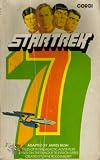
Keeping up the pace, in July 1972 James Blish released his seventh volume of novelizations, Star Trek 7. In this volume are adapted "Who Mourns for Adonais?", "The Changeling", "The Paradise Syndrome", "Metamorphosis", "The Deadly Years", and "Elaan of Troyius".
"Who Mourns for Adonais?" reminds me once again how shockingly often Kirk's first response to a problem is to kill it. Apollo, jealous god that he is, was certainly being obstinate, but except for his severe reactions to Scotty's aggression, he wasn't really doing anything too objectionable. They were all more or less held hostage, sure, but Apollo seemed pretty reasonable, and if Kirk had been willing to try something other than shooting the ship's phasers to get out of the show more situation, they might have all made it through.
Not much to say about "The Changeling". It wasn't my favorite episode--frankly, I'd rather read Star Trek: The Motion Picture. Well, that's coming up--the novelization was published in 1979.
"The Paradise Syndrome" was an interesting episode, since we get a lot of passage of time, plus we see Kirk develop a relationship with Miramanee. He's in a habit of falling suddenly in love, of course, but I believe this is the very longest relationship we ever see Kirk engaged in. A nice change of pace. It is a shame that Miramanee's people are shown as not having advanced in many hundreds of years, though. Necessary, to let Kirk fit in where he did, but not exactly the most positive portrayal of Native Americans. I understand that in the original script Miramanee and the (unborn) child survive, but Blish's adaptation follows the episode as aired to its tragic (if very convenient) end.
"Metamorphosis" is in some ways a good story and in others a dreadful one. We meet Zefram Cochrane (am I the only one who is reminded of Trip from Enterprise?), alive, young, and immortal (for the moment), plus a (temporarily) inscrutable alien energy being, and we get to see love conquer all. Very entertaining. On the other hand, we get to hear Kirk (bizarrely) proclaim "The ideas of male and female are universal constants, Cochrane. The Companion is definitely female." No, Kirk, it's some kind of alien energy being. That doesn't stop it from loving Cochrane, though. Even for the sixties, this seems an astonishingly absolute statement. The character of Hedford exists pretty much exclusively to be shrewish and then to give Cochrane a more acceptable body for his slavishly devoted alien lover. Not the best of Trek. What I said regarding "Who Mourns for Adonais?" about Kirk first trying to kill any problem he encounters goes for this story, too.
"The Deadly Years" was in some ways better in this adaptation than on television. It felt to me that in the episode, the actors were making something of a mockery of age. Without the overdone 'senile old man' performances from the main cast, it's easier to sympathize with Kirk's loss of control over his ship and, by extension, his life. It's still not great, but it has its high points.
"Elaan of Troyius"... as progressive as Trek wanted to be, it took most every opportunity to get it wrong. As anti-slavery as Kirk has shown himself to be in, for example, "Who Mourns for Adonais?", he is here perfectly happy to serve as the enforcer to a woman's being property (never mind the political justification). He even says it himself: "My orders--and yours--say you belong to that other man." And Kirk's only problem with the situation is that he would prefer if she belonged to him, instead. And I need do no more than mention the awful 'taming the savage woman' plot to show just what is wrong with that part of the story. Elaan goes from fiercely independent (and just generally fierce) to utterly submissive in the space of a page or two, for no justifiable reason.
As usual, this volume has its good and its bad parts. I can't fault Blish--much--for the quality of the stories. I presume he wasn't entirely free to simply rewrite them as he saw fit, and at any rate that wasn't in his job description. Star Trek 7 contains enough good to be worth reading, even if it doesn't deliver on the full potential of the stories. show less
"Who Mourns for Adonais?" reminds me once again how shockingly often Kirk's first response to a problem is to kill it. Apollo, jealous god that he is, was certainly being obstinate, but except for his severe reactions to Scotty's aggression, he wasn't really doing anything too objectionable. They were all more or less held hostage, sure, but Apollo seemed pretty reasonable, and if Kirk had been willing to try something other than shooting the ship's phasers to get out of the show more situation, they might have all made it through.
Not much to say about "The Changeling". It wasn't my favorite episode--frankly, I'd rather read Star Trek: The Motion Picture. Well, that's coming up--the novelization was published in 1979.
"The Paradise Syndrome" was an interesting episode, since we get a lot of passage of time, plus we see Kirk develop a relationship with Miramanee. He's in a habit of falling suddenly in love, of course, but I believe this is the very longest relationship we ever see Kirk engaged in. A nice change of pace. It is a shame that Miramanee's people are shown as not having advanced in many hundreds of years, though. Necessary, to let Kirk fit in where he did, but not exactly the most positive portrayal of Native Americans. I understand that in the original script Miramanee and the (unborn) child survive, but Blish's adaptation follows the episode as aired to its tragic (if very convenient) end.
"Metamorphosis" is in some ways a good story and in others a dreadful one. We meet Zefram Cochrane (am I the only one who is reminded of Trip from Enterprise?), alive, young, and immortal (for the moment), plus a (temporarily) inscrutable alien energy being, and we get to see love conquer all. Very entertaining. On the other hand, we get to hear Kirk (bizarrely) proclaim "The ideas of male and female are universal constants, Cochrane. The Companion is definitely female." No, Kirk, it's some kind of alien energy being. That doesn't stop it from loving Cochrane, though. Even for the sixties, this seems an astonishingly absolute statement. The character of Hedford exists pretty much exclusively to be shrewish and then to give Cochrane a more acceptable body for his slavishly devoted alien lover. Not the best of Trek. What I said regarding "Who Mourns for Adonais?" about Kirk first trying to kill any problem he encounters goes for this story, too.
"The Deadly Years" was in some ways better in this adaptation than on television. It felt to me that in the episode, the actors were making something of a mockery of age. Without the overdone 'senile old man' performances from the main cast, it's easier to sympathize with Kirk's loss of control over his ship and, by extension, his life. It's still not great, but it has its high points.
"Elaan of Troyius"... as progressive as Trek wanted to be, it took most every opportunity to get it wrong. As anti-slavery as Kirk has shown himself to be in, for example, "Who Mourns for Adonais?", he is here perfectly happy to serve as the enforcer to a woman's being property (never mind the political justification). He even says it himself: "My orders--and yours--say you belong to that other man." And Kirk's only problem with the situation is that he would prefer if she belonged to him, instead. And I need do no more than mention the awful 'taming the savage woman' plot to show just what is wrong with that part of the story. Elaan goes from fiercely independent (and just generally fierce) to utterly submissive in the space of a page or two, for no justifiable reason.
As usual, this volume has its good and its bad parts. I can't fault Blish--much--for the quality of the stories. I presume he wasn't entirely free to simply rewrite them as he saw fit, and at any rate that wasn't in his job description. Star Trek 7 contains enough good to be worth reading, even if it doesn't deliver on the full potential of the stories. show less
More fun, more or less frivolous adventures with Kirk and the crew, adapted by Blish. I was disappointed to find no preface from Blish in this one; Blish talking about almost anything is interesting, including Star Trek fan mail. Heaps of these books were sold (millions) so I wonder if they made him more money than his other work (combined)?
I am once again impressed by the number of tragic amours Kirk manages to involve himself in.
I am once again impressed by the number of tragic amours Kirk manages to involve himself in.
"On your planet, Mr. Spock, females are logical. No other planet in the galaxy can make that claim."
Enjoyable collection of a half-dozen adaptations of episodes of the television series. I wasn't previously familiar with these particular stories, so I don't know how much Blish embellished. I'm guessing not much as there are points at which things seem to be glossed over due to time constraints, but they read pretty well overall.
"Who Mourns for Adonais?": The Enterprise is pulled to an Earthlike planet and held captive by an entity claiming to be the Greek god Apollo.
"The Changeling": A human-made space probe returns from its long journey, much altered.
"The Paradise Syndrome": Kirk is separated from the rest of the crew and begins a new show more life on a planet populated by the descendants of native Americans.
"Metamorphosis": Kirk and company discover what happened to a missing scientist long believed dead, but who hasn't aged in over a century.
"The Deadly Years": Accelerated aging plagues the crew after they arrive on a planet that has just experienced an unusual astronomical event.
"Elaan of Troyius": The Federation is employed to act as the facilitator to an ill-conceived diplomatic effort. show less
Enjoyable collection of a half-dozen adaptations of episodes of the television series. I wasn't previously familiar with these particular stories, so I don't know how much Blish embellished. I'm guessing not much as there are points at which things seem to be glossed over due to time constraints, but they read pretty well overall.
"Who Mourns for Adonais?": The Enterprise is pulled to an Earthlike planet and held captive by an entity claiming to be the Greek god Apollo.
"The Changeling": A human-made space probe returns from its long journey, much altered.
"The Paradise Syndrome": Kirk is separated from the rest of the crew and begins a new show more life on a planet populated by the descendants of native Americans.
"Metamorphosis": Kirk and company discover what happened to a missing scientist long believed dead, but who hasn't aged in over a century.
"The Deadly Years": Accelerated aging plagues the crew after they arrive on a planet that has just experienced an unusual astronomical event.
"Elaan of Troyius": The Federation is employed to act as the facilitator to an ill-conceived diplomatic effort. show less
The 4th book to finish in my 2020 re-watch / re-read is Star Trek 7, and mix of 2nd and early 3rd season episodes. Since this wasn't published until 1972, well after the show finished, there aren't the major differences here that I found in books 1 thru 3. The only thing that stood out about one of these episodes after so many years was that the sub-plot of diverting the asteroid in "The Paradise Syndrome" was one of the more accurate hard SF stories to be found in original Trek.
I really regret hearing the name "Miramanee," or even reading it. this was not the collection of TOS's finest episodes.
A collection of short stories set in the original Star Trek Enterprise, opening with an encounter with the god Apollo.
What happened to his prefaces? Awww. Still good.
Members
- Recently Added By
Author Information

James Benjamin Blish was born on May 23, 1921 in East Orange, N.J. Blish trained as a biologist at Rutgers and Columbia University, and spent 1942 - 1944 as a medical technician in the United States Army. After the war he became the science editor for the Pfizer pharmaceutical company. His first published story appeared in 1940, and his writing show more career progressed until he gave up his job to become a professional writer. From 1962 to 1968, he worked for the Tobacco Institute. Between 1967 and his death from lung cancer in 1975, Blish wrote authorized short story collections based upon the 1960s TV series Star Trek. He wrote 11 volumes adapting episodes of the series. He died midway through writing Star Trek 12. Perhaps Blish's most famous works were the "Okies" stories, known collectively as Cities in Flight, published in the science-fiction digest magazine Astounding Science Fiction. Some of James Blish's other works include The Vanished Jet, And All the Stars a Stage, The Quincunx of Time, and Flight of Eagles. (Bowker Author Biography) show less
Some Editions
Series

Work Relationships
Is contained in
Common Knowledge
- Canonical title
- Star Trek 7
- Original title
- Star Trek 7
- Alternate titles
- Star Trek 7
- Original publication date
- 1972-07 (eng.) (eng.)
- People/Characters
- James T. Kirk; Leonard McCoy; Spock
- Important places
- USS Enterprise NCC-1701
- Related movies
- Star Trek (1966 | IMDb); Who Mourns for Adonais? (1967 | IMDb); The Changeling (1967 | IMDb); The Paradise Syndrome (1968 | IMDb); Metamorphosis (1967 | IMDb); The Deadly Years (1967 | IMDb) (show all 7); Elaan of Troyius (1968 | IMDb)
- First words
- All heads in the Enterprise bridge turned as the elevator door opened.
- Last words
- (Click to show. Warning: May contain spoilers.)He was not so sure. Not now, anyway.
Classifications
Statistics
- Members
- 643
- Popularity
- 45,298
- Reviews
- 11
- Rating
- (3.57)
- Languages
- English
- Media
- Paper
- ISBNs
- 8
- ASINs
- 10