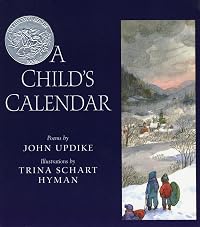
A Child's Calendar
by John Updike
On This Page
Description
A collection of twelve poems describing the activities in a child's life and the changes in the weather as the year moves from January to December.Tags
Recommendations










Member Reviews
Rather than twelve short poems, this book is really more like one long poem in twelve parts, as each transitions naturally to the next (sometimes explicitly referencing what's come before), painting one picture as a unified whole. And the poetry is pretty good, though not great---there are some nice turns of phrase and unusual but evocative imagery (as well as appeals to the other senses!). I especially enjoyed the October poem.
But some parts are pretty bland, and there are some missed opportunities. For example, for the month of July, Updike discusses Independence Day with this stanza: "America / It makes us think / Of hot dogs, fries, / And Coke to drink." Now, I realize this book is for kids, but really? That's all he's got to say show more about what America means...hot dogs, fries, and Coke? That's just weak, in every respect. On the other hand, that month ends with this cute and clever wordplay, quasi-metaphor and part pun: "And Tabby dozes / In a pool / Of fur she sheds / To keep her cool." But a lot of the other months are similarly given to conventional references to church, and God as the author of nature, and so forth. Not that that wouldn't appeal to most of the book's audience, but it struck me as rather trite and meaningless.
The illustrations are nice, interesting to look at, and complement the poems---and one even made me laugh out loud: in August, Updike writes, some people "go to seaside / Bungalows / And take off nearly / All their clothes"...and the accompanying picture shows a rear-view of a boy at the beach who has in fact removed even his bathing suit, arms proudly upraised, as his mother rushes toward him to correct this faux pas.
The accompanying CD narrated by Updike is also pretty good, but something about his voice and intonation or something is at times eerily reminiscent of a creepy clown, or Mormon "prophet" Thomas S. Monson (same difference)...but maybe that's just me. On the whole: cute, and possibly a good way to teach kids about the months of the year...but it could have been better. show less
But some parts are pretty bland, and there are some missed opportunities. For example, for the month of July, Updike discusses Independence Day with this stanza: "America / It makes us think / Of hot dogs, fries, / And Coke to drink." Now, I realize this book is for kids, but really? That's all he's got to say show more about what America means...hot dogs, fries, and Coke? That's just weak, in every respect. On the other hand, that month ends with this cute and clever wordplay, quasi-metaphor and part pun: "And Tabby dozes / In a pool / Of fur she sheds / To keep her cool." But a lot of the other months are similarly given to conventional references to church, and God as the author of nature, and so forth. Not that that wouldn't appeal to most of the book's audience, but it struck me as rather trite and meaningless.
The illustrations are nice, interesting to look at, and complement the poems---and one even made me laugh out loud: in August, Updike writes, some people "go to seaside / Bungalows / And take off nearly / All their clothes"...and the accompanying picture shows a rear-view of a boy at the beach who has in fact removed even his bathing suit, arms proudly upraised, as his mother rushes toward him to correct this faux pas.
The accompanying CD narrated by Updike is also pretty good, but something about his voice and intonation or something is at times eerily reminiscent of a creepy clown, or Mormon "prophet" Thomas S. Monson (same difference)...but maybe that's just me. On the whole: cute, and possibly a good way to teach kids about the months of the year...but it could have been better. show less
A lovely book about the months of the year with poems that should appeal to grade school children, and illustrations that will delight older readers. The marvelous watercolor illustrations are what bumped this up to a four-star read for me.
There are three reasons that I liked the book “A Child’s Calendar” by John Updike. First, I liked how this book was organized. This book contained poems about each of the twelve months of the year. Starting with January and ending with December, each page had a poem about a different month with the page next to it containing a descriptive illustration that went along with the poem. I believe that the organization of this book is what makes it so good.
Next, the poems that encompassed each page were written beautifully. Each of the twelve poems, one for each month of the year, were all a lovely description of the weather, activities, and the passing of seasons that happens with each month. The rhymes that the lines contained made show more the poems all flow very well. Although the poems contained very descriptive words, they were still very easy to read and understand. An example of the descriptive, yet beautiful poems that encompassed this book is a passage from the month of august: “The sprinkler twirls/the summer wanes/the pavement wears/popsicle stains.”
Finally, the illustrations Trina Schart Hyman went along with each months poem very well. The illustrations contained the same family throughout all twelve months. They pictured what each of the months would look like for that family with just enough detail for the reader to imagine himself or herself in each month. In addition, the watercolors that Hyman used were wonderful. They were very vibrant and definitely caught my attention. show less
Next, the poems that encompassed each page were written beautifully. Each of the twelve poems, one for each month of the year, were all a lovely description of the weather, activities, and the passing of seasons that happens with each month. The rhymes that the lines contained made show more the poems all flow very well. Although the poems contained very descriptive words, they were still very easy to read and understand. An example of the descriptive, yet beautiful poems that encompassed this book is a passage from the month of august: “The sprinkler twirls/the summer wanes/the pavement wears/popsicle stains.”
Finally, the illustrations Trina Schart Hyman went along with each months poem very well. The illustrations contained the same family throughout all twelve months. They pictured what each of the months would look like for that family with just enough detail for the reader to imagine himself or herself in each month. In addition, the watercolors that Hyman used were wonderful. They were very vibrant and definitely caught my attention. show less
The poetry and accompanying illustrations are brilliant. Children's poetry, that which captures a child's mind with beauty and simplicity, without condescension or insipid imagery, is rare. I'm glad Updike took the time to write these.
A Child’s Calendar by John Updike is a collection of 12 poems, one for each month of the year. Each double-page spread contains a poem, a full-page illustration, and a small illustration that shares the page with the poem. The poems are between four and five stanzas. I love the rich vocabulary used throughout the book. The illustrations are perfect and allow the children to see the seasons change throughout the book. The illustrations do include diverse children and families. This book received the Caldecott Honor in 2000.
Hyman illustrates fantasy better than the everyday, in my opinion. And the verses were rather sing-songy and superficial. That said, the book is appealing and worthy. I liked the interracial blended family implied by the drawings - and the youngest boy is such a scamp!
A Child’s Calendar is a collection of lyrical poems about each month of the year. Each poem details the weather, activities, and holidays of each month. One particular poem illustrates the month of October. It paints a picture of the tress as their leaves turn, of migrating birds, and all hallows eve.
I really enjoyed this collection, but I found that the months don’t quite match the seasons in my area of the country. However I would still use this book to illustrate lyrical poetry. All of the poems are written in the same way, and would provide a good source of examples for children to look at.
A very easy way to use this book in the classroom would be to have a "poem of the month". For each calendar month, I would post a show more corresponding poem with the classroom calendar. Another idea would be to create a book of poems that match the months and seasons of the classrooms location. The class could work together to write a poem for each month as we get to it. show less
I really enjoyed this collection, but I found that the months don’t quite match the seasons in my area of the country. However I would still use this book to illustrate lyrical poetry. All of the poems are written in the same way, and would provide a good source of examples for children to look at.
A very easy way to use this book in the classroom would be to have a "poem of the month". For each calendar month, I would post a show more corresponding poem with the classroom calendar. Another idea would be to create a book of poems that match the months and seasons of the classrooms location. The class could work together to write a poem for each month as we get to it. show less
Members
- Recently Added By
Lists

Caldecott Honor Books
296 works; 23 members

Children's Books by Adult Authors
26 works; 2 members

Books Read in 2023
5,547 works; 144 members

Lucy's Long List
69 works; 1 member
Author Information

342+ Works 53,725 Members
American novelist, poet, and critic John Updike was born in Reading, Pennsylvania on March 18, 1932. He received an A.B. degree from Harvard University, which he attended on a scholarship, in 1954. After graduation, he accepted a one-year fellowship to study painting at the Ruskin School of Drawing and Fine Art in Oxford, England. After returning show more from England in 1955, he worked for two years on the staff of The New Yorker. This marked the beginning of a long relationship with the magazine, during which he has contributed numerous short stories, poems, and book reviews. Although Updike's first published book was a collection of verse, The Carpentered Hen and Other Tame Creatures (1958), his renown as a writer is based on his fiction, beginning with The Poorhouse Fair (1959). During his lifetime, he wrote more than 50 books and primarily focused on middle-class America and their major concerns---marriage, divorce, religion, materialism, and sex. Among his best-known works are the Rabbit tetrology---Rabbit, Run (1960), Rabbit Redux (1971), Rabbit Is Rich (1981), and Rabbit at Rest (1988). Rabbit, Run introduces Harry "Rabbit" Angstrom as a 26-year-old salesman of dime-store gadgets trapped in an unhappy marriage in a dismal Pennsylvania town, looking back wistfully on his days as a high school basketball star. Rabbit Redux takes up the story 10 years later, and Rabbit's relationship with representative figures of the 1960s enables Updike to provide social commentary in a story marked by mellow wisdom and compassion in spite of some shocking jolts. In Rabbit Is Rich, Harry is comfortably middle-aged and complacent, and much of the book seems to satirize the country-club set and the swinging sexual/social life of Rabbit and his friends. Finally, in Rabbit at Rest, Harry arrives at the age where he must confront his mortality. Updike won the Pulitzer Prize for both Rabbit Is Rich and Rabbit at Rest. Updike's other novels range widely in subject and locale, from The Poorhouse Fair, about a home for the aged that seems to be a microcosm for society as a whole, through The Court (1978), about a revolution in Africa, to The Witches of Eastwick (1984), in which Updike tries to write from inside the sensibilities of three witches in contemporary New England. The Centaur (1963) is a subtle, complicated allegorical novel that won Updike the National Book Award in 1964. In addition to his novels, Updike also has written short stories, poems, critical essays, and reviews. Self-Consciousness (1989) is a memoir of his early life, his thoughts on issues such as the Vietnam War, and his attitude toward religion. He was elected to the American Academy of Arts and Letters in 1977. He died of lung cancer on January 27, 2009 at the age of 76. (Bowker Author Biography) John Updike was born in 1932, in Shillington, Pennsylvania. Since 1957 he has lived in Massachusetts. His novels have won the Pulitzer Prize, the National Book Award, the National Book Critics Circle Award, & the Howells Medal. (Publisher Provided) John Updike was born in 1932 and attended Harvard College and the Ruskin School of Drawing and Fine Art in Oxford, England. Form 1955 to 1957 he was a staff member of The New Yorker, which he contributed numerous writings. Updike's art criticism has appeared in publications including Arts and Antiques, The New Republic, The New York Times Book Review, and Realites, among many others. He is the author of such best-selling novels as Rabbit Run and Rabbit is Rich. His many works of fiction, poetry and criticism have been awarded the Pulitzer Prize, the National Book Award, the American Book Award, and the National Book Critics Circle Award. For the past 40 years he has lived in Massachusetts. (Publisher Provided) John Updike is the author of some 50 books, including collections of short stories, poems, & criticism. His novels have won the Pulitzer Prize, the National Book Award, the National Book Critics Circle Award, & the Howells Medal. Born in Shillington, Pennsylvania, in 1932, he has lived in Massachusetts since 1957. (Publisher Provided) show less
Some Editions
Awards and Honors
Awards
Distinctions
Common Knowledge
- Canonical title
- A Child's Calendar
- Original publication date
- 1965
- Important events
- Winter; Spring; Summer; Autumn; Valentine's Day; Fourth of July (show all 9); Halloween; Thanksgiving; Christmas
- Dedication
- To Liz and Miranda --J. U.
To Michou and Xavier --T. S. H. - First words
- January
The days are short,
The sun a spark
Hung thin between
The dark and dark. - Last words
- (Click to show. Warning: May contain spoilers.)Some miracle.
And then it's here,
Wrapped up in hope --
Another year!
Classifications
Statistics
- Members
- 1,191
- Popularity
- 20,940
- Reviews
- 44
- Rating
- (4.05)
- Languages
- English
- Media
- Paper, Audiobook, Ebook
- ISBNs
- 19
- ASINs
- 10