
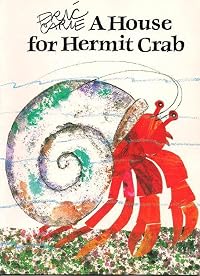
A House for Hermit Crab
by Eric Carle
On This Page
Description
A hermit crab who has outgrown his old shell moves into a new one, which he decorates and enhances with the various sea creatures he meets in his travels.Tags
Recommendations






Member Reviews
Summary:
A House for Hermit Crab is the story of a hermit crab who grows and needs to find a new shell to call home. He is too big for his old shell, but also knows that if he doesn't find a new one he will not be safe from other fish. When he finds a new shell, he thinks it is plain and boring, so he sets off to find things to decorate it with. Each month he decorates it with something new until he has a brand new home all set up for himself. Eventually, the hermit crab grows out of his shell again, but he doesn't want to leave because he has made so many new friends. When a smaller hermit crab stumbles by and is looking for a new shell, the larger hermit crab offers his. He says in order to live there though, the new hermit crab must show more be nice to his friends. The big hermit crab is sad to leave his friends and his home, but eventually finds a bigger shell and becomes excited again to make new friends.
Comments (opinions/arguments):
I thought this story was really adorable! The illustrations are so fun and extremely colorful and the author does a great job depicting the ocean floor with all of its unique creatures like urchins and starfish. Although this is fiction, the story does a good job at providing real information about hermit crabs. Children will learn that hermit crabs grow just like people and eventually need to find new homes. They are also introduced to many sea creatures that they might have never heard of before. The story also uses the months of the year in the proper sequence to teach students months as they turn the pages. This story also has a really valuable message. Through the constant growing, making friends, moving and having to restart all over, the author is showing children that growing up and moving can be fun. A lot of children fear this kind of change and through the fun story of a hermit crab, Eric Carle makes it seem fearless and fun! show less
A House for Hermit Crab is the story of a hermit crab who grows and needs to find a new shell to call home. He is too big for his old shell, but also knows that if he doesn't find a new one he will not be safe from other fish. When he finds a new shell, he thinks it is plain and boring, so he sets off to find things to decorate it with. Each month he decorates it with something new until he has a brand new home all set up for himself. Eventually, the hermit crab grows out of his shell again, but he doesn't want to leave because he has made so many new friends. When a smaller hermit crab stumbles by and is looking for a new shell, the larger hermit crab offers his. He says in order to live there though, the new hermit crab must show more be nice to his friends. The big hermit crab is sad to leave his friends and his home, but eventually finds a bigger shell and becomes excited again to make new friends.
Comments (opinions/arguments):
I thought this story was really adorable! The illustrations are so fun and extremely colorful and the author does a great job depicting the ocean floor with all of its unique creatures like urchins and starfish. Although this is fiction, the story does a good job at providing real information about hermit crabs. Children will learn that hermit crabs grow just like people and eventually need to find new homes. They are also introduced to many sea creatures that they might have never heard of before. The story also uses the months of the year in the proper sequence to teach students months as they turn the pages. This story also has a really valuable message. Through the constant growing, making friends, moving and having to restart all over, the author is showing children that growing up and moving can be fun. A lot of children fear this kind of change and through the fun story of a hermit crab, Eric Carle makes it seem fearless and fun! show less
I have been reading books by Eric Carle for a long time because I am such a fan of his artwork. This book is no exception, but there are many other reasons I love it so much.
My three-year-old grandson was totally interested in hearing me read this book from cover to cover. The story of this hermit crab reminded him of our family vacations at the beach and led him to reminisce about what we do at the beach. The story incorporates some interesting flora and fauna of the sea and even explains some of them in more detail in a glossary at the back of the book.
The story talks about months of the year. We talked about whose birthday was in each month, but there are also other things that can be discussed with a child when talking about show more months. I love books that are fodder for discussion. It makes reading so much more fun.
Because this story is about a hermit crab, it also brings back memories of when my younger son had hermit crabs of his own as pets because it was a time I would not allow any of my children to have larger pets. We had total fun with the two he had (Neptune and Stripey), and this book reminds me of that time.
This is also such a fun story about growing. This is a big deal for preschoolers, and it's fun to see how hermit crab deals with this issue. The hermit crab in the story is aware of beauty in the world and wants to make his home beautiful. This story is also about sharing as the growing hermit crab passes his beautiful shell home to another smaller hermit crab.
As I said, I love this book! show less
My three-year-old grandson was totally interested in hearing me read this book from cover to cover. The story of this hermit crab reminded him of our family vacations at the beach and led him to reminisce about what we do at the beach. The story incorporates some interesting flora and fauna of the sea and even explains some of them in more detail in a glossary at the back of the book.
The story talks about months of the year. We talked about whose birthday was in each month, but there are also other things that can be discussed with a child when talking about show more months. I love books that are fodder for discussion. It makes reading so much more fun.
Because this story is about a hermit crab, it also brings back memories of when my younger son had hermit crabs of his own as pets because it was a time I would not allow any of my children to have larger pets. We had total fun with the two he had (Neptune and Stripey), and this book reminds me of that time.
This is also such a fun story about growing. This is a big deal for preschoolers, and it's fun to see how hermit crab deals with this issue. The hermit crab in the story is aware of beauty in the world and wants to make his home beautiful. This story is also about sharing as the growing hermit crab passes his beautiful shell home to another smaller hermit crab.
As I said, I love this book! show less
I have something a little different today. I've been noticing a growing trend in publishers of taking classic and popular picture book series and reissuing them as easy readers. It started with Fancy Nancy and Pinkalicious and now Jackie Urbanovic's Duck, Rob Scotton's Splat the Cat, Tad Hills' Rocket, and more have jumped on the bandwagon. Going back to the classics, authors whose classic picture books have been made into easy readers so far include Alexandra Day's Carl (which is especially weird since the original is wordless), Leo Lionni, and, of course, Eric Carle. So, today I'm looking at both the original picture book and the new easy reader edition.
If you're not familiar with the story, Hermit Crab grows too big for his shell. He show more quickly finds a new house, but it's plain and boring. One by one, he adds new friends to his shell - sea anemones, starfish, coral, a snail, sea urchins, a lanternfish, and he ends by building pebbles into a wall around his shell. Of course, by that time his perfect shell is too small. He's worried about all his friends, but then finds a smaller crab who is happy to move in and promises to take care of all his friends. Hermit Crab finds a bigger shell and sets off to new possibilities, thinking of all the things he can add to his shell. There is an introductory list of facts about hermit crabs and at the end there are facts about the different friends the hermit crab collected. Eric Carle's signature art is colorful and distinctive, the creatures are easily distinguished, but still have a definite representational quality.
The easy reader version is listed as a level two "super star reader" with "longer sentences, simple chapters, high-interest vocabulary words." The easy reader does not have the swirling paint of the endpages, or the introductory information on the hermit crab. The basic text is the same with only a few minor alterations. The facts at the end are kept as well.
The art is the same, but has been, of course, shrunk to fit into the easy reader. The text is rearranged to fit into the smaller format and some of the pictures are cut or in the case of the last picture, combined into a new page to fit the story. The pages don't have the glossy finish of the picture book, dimming the vibrant colors of the art.
I do feel that the text is generally more advanced than most beginning readers can handle with vocabulary including "debris," rearranged," and "possibilities." Then there's the specific names of the various creatures like anemones, etc. The art doesn't have the same impact once it's compacted into the smaller format and some details of the pictures are lost down the gutter of the book as well.
I can understand why publishers are going this route; with more kids being pressured to read at younger ages, the audience for the classic picture books with longer text is being lost and this is way to introduce them to a new generation as well as generate a new market for these properties. However, I can't help but feel it's a pity to give kids the watered-down version and I doubt that kids who have the higher reading ability necessary to tackle these books will really be interested in the subject matter. They do circulate briskly at my library, but I believe that most of that is parents choosing the titles, not kids.
Verdict: From an aesthetic and librarian perspective, I don't care for these. However, the majority of patrons enjoy them and since I frequently struggle just to keep the easy reader shelves stocked, let alone worry about quality, I will continue to purchase these and would generally advise most libraries to hop on the bandwagon and do the same.
Picture book
ISBN: 9780887080562; This edition published 1991 by Simon and Schuster; Purchased for the library (replacement for worn out copy)
Easy Reader
ISBN: 9781481409162; This edition published 2014 by Simon Spotlight; Purchased for the library show less
If you're not familiar with the story, Hermit Crab grows too big for his shell. He show more quickly finds a new house, but it's plain and boring. One by one, he adds new friends to his shell - sea anemones, starfish, coral, a snail, sea urchins, a lanternfish, and he ends by building pebbles into a wall around his shell. Of course, by that time his perfect shell is too small. He's worried about all his friends, but then finds a smaller crab who is happy to move in and promises to take care of all his friends. Hermit Crab finds a bigger shell and sets off to new possibilities, thinking of all the things he can add to his shell. There is an introductory list of facts about hermit crabs and at the end there are facts about the different friends the hermit crab collected. Eric Carle's signature art is colorful and distinctive, the creatures are easily distinguished, but still have a definite representational quality.
The easy reader version is listed as a level two "super star reader" with "longer sentences, simple chapters, high-interest vocabulary words." The easy reader does not have the swirling paint of the endpages, or the introductory information on the hermit crab. The basic text is the same with only a few minor alterations. The facts at the end are kept as well.
The art is the same, but has been, of course, shrunk to fit into the easy reader. The text is rearranged to fit into the smaller format and some of the pictures are cut or in the case of the last picture, combined into a new page to fit the story. The pages don't have the glossy finish of the picture book, dimming the vibrant colors of the art.
I do feel that the text is generally more advanced than most beginning readers can handle with vocabulary including "debris," rearranged," and "possibilities." Then there's the specific names of the various creatures like anemones, etc. The art doesn't have the same impact once it's compacted into the smaller format and some details of the pictures are lost down the gutter of the book as well.
I can understand why publishers are going this route; with more kids being pressured to read at younger ages, the audience for the classic picture books with longer text is being lost and this is way to introduce them to a new generation as well as generate a new market for these properties. However, I can't help but feel it's a pity to give kids the watered-down version and I doubt that kids who have the higher reading ability necessary to tackle these books will really be interested in the subject matter. They do circulate briskly at my library, but I believe that most of that is parents choosing the titles, not kids.
Verdict: From an aesthetic and librarian perspective, I don't care for these. However, the majority of patrons enjoy them and since I frequently struggle just to keep the easy reader shelves stocked, let alone worry about quality, I will continue to purchase these and would generally advise most libraries to hop on the bandwagon and do the same.
Picture book
ISBN: 9780887080562; This edition published 1991 by Simon and Schuster; Purchased for the library (replacement for worn out copy)
Easy Reader
ISBN: 9781481409162; This edition published 2014 by Simon Spotlight; Purchased for the library show less
I have something a little different today. I've been noticing a growing trend in publishers of taking classic and popular picture book series and reissuing them as easy readers. It started with Fancy Nancy and Pinkalicious and now Jackie Urbanovic's Duck, Rob Scotton's Splat the Cat, Tad Hills' Rocket, and more have jumped on the bandwagon. Going back to the classics, authors whose classic picture books have been made into easy readers so far include Alexandra Day's Carl (which is especially weird since the original is wordless), Leo Lionni, and, of course, Eric Carle. So, today I'm looking at both the original picture book and the new easy reader edition.
If you're not familiar with the story, Hermit Crab grows too big for his shell. He show more quickly finds a new house, but it's plain and boring. One by one, he adds new friends to his shell - sea anemones, starfish, coral, a snail, sea urchins, a lanternfish, and he ends by building pebbles into a wall around his shell. Of course, by that time his perfect shell is too small. He's worried about all his friends, but then finds a smaller crab who is happy to move in and promises to take care of all his friends. Hermit Crab finds a bigger shell and sets off to new possibilities, thinking of all the things he can add to his shell. There is an introductory list of facts about hermit crabs and at the end there are facts about the different friends the hermit crab collected. Eric Carle's signature art is colorful and distinctive, the creatures are easily distinguished, but still have a definite representational quality.
The easy reader version is listed as a level two "super star reader" with "longer sentences, simple chapters, high-interest vocabulary words." The easy reader does not have the swirling paint of the endpages, or the introductory information on the hermit crab. The basic text is the same with only a few minor alterations. The facts at the end are kept as well.
The art is the same, but has been, of course, shrunk to fit into the easy reader. The text is rearranged to fit into the smaller format and some of the pictures are cut or in the case of the last picture, combined into a new page to fit the story. The pages don't have the glossy finish of the picture book, dimming the vibrant colors of the art.
I do feel that the text is generally more advanced than most beginning readers can handle with vocabulary including "debris," rearranged," and "possibilities." Then there's the specific names of the various creatures like anemones, etc. The art doesn't have the same impact once it's compacted into the smaller format and some details of the pictures are lost down the gutter of the book as well.
I can understand why publishers are going this route; with more kids being pressured to read at younger ages, the audience for the classic picture books with longer text is being lost and this is way to introduce them to a new generation as well as generate a new market for these properties. However, I can't help but feel it's a pity to give kids the watered-down version and I doubt that kids who have the higher reading ability necessary to tackle these books will really be interested in the subject matter. They do circulate briskly at my library, but I believe that most of that is parents choosing the titles, not kids.
Verdict: From an aesthetic and librarian perspective, I don't care for these. However, the majority of patrons enjoy them and since I frequently struggle just to keep the easy reader shelves stocked, let alone worry about quality, I will continue to purchase these and would generally advise most libraries to hop on the bandwagon and do the same.
Picture book
ISBN: 9780887080562; This edition published 1991 by Simon and Schuster; Purchased for the library (replacement for worn out copy)
Easy Reader
ISBN: 9781481409162; This edition published 2014 by Simon Spotlight; Purchased for the library show less
If you're not familiar with the story, Hermit Crab grows too big for his shell. He show more quickly finds a new house, but it's plain and boring. One by one, he adds new friends to his shell - sea anemones, starfish, coral, a snail, sea urchins, a lanternfish, and he ends by building pebbles into a wall around his shell. Of course, by that time his perfect shell is too small. He's worried about all his friends, but then finds a smaller crab who is happy to move in and promises to take care of all his friends. Hermit Crab finds a bigger shell and sets off to new possibilities, thinking of all the things he can add to his shell. There is an introductory list of facts about hermit crabs and at the end there are facts about the different friends the hermit crab collected. Eric Carle's signature art is colorful and distinctive, the creatures are easily distinguished, but still have a definite representational quality.
The easy reader version is listed as a level two "super star reader" with "longer sentences, simple chapters, high-interest vocabulary words." The easy reader does not have the swirling paint of the endpages, or the introductory information on the hermit crab. The basic text is the same with only a few minor alterations. The facts at the end are kept as well.
The art is the same, but has been, of course, shrunk to fit into the easy reader. The text is rearranged to fit into the smaller format and some of the pictures are cut or in the case of the last picture, combined into a new page to fit the story. The pages don't have the glossy finish of the picture book, dimming the vibrant colors of the art.
I do feel that the text is generally more advanced than most beginning readers can handle with vocabulary including "debris," rearranged," and "possibilities." Then there's the specific names of the various creatures like anemones, etc. The art doesn't have the same impact once it's compacted into the smaller format and some details of the pictures are lost down the gutter of the book as well.
I can understand why publishers are going this route; with more kids being pressured to read at younger ages, the audience for the classic picture books with longer text is being lost and this is way to introduce them to a new generation as well as generate a new market for these properties. However, I can't help but feel it's a pity to give kids the watered-down version and I doubt that kids who have the higher reading ability necessary to tackle these books will really be interested in the subject matter. They do circulate briskly at my library, but I believe that most of that is parents choosing the titles, not kids.
Verdict: From an aesthetic and librarian perspective, I don't care for these. However, the majority of patrons enjoy them and since I frequently struggle just to keep the easy reader shelves stocked, let alone worry about quality, I will continue to purchase these and would generally advise most libraries to hop on the bandwagon and do the same.
Picture book
ISBN: 9780887080562; This edition published 1991 by Simon and Schuster; Purchased for the library (replacement for worn out copy)
Easy Reader
ISBN: 9781481409162; This edition published 2014 by Simon Spotlight; Purchased for the library show less
I would recommend any book written by Eric Carle. He is an amazing artist and all of his work has been astonishing. This book is about a little hermit crab that has grown too big for his shell, but after finding a new ‘home’ he realizes it is too plain. Each month, Hermit crab discovers a new item and decorates his shell. I like this book because it is great to read to children who are studying the sea or learning about the different months. Although there are no informational segments about the sea, it still involves different animals and visuals for children to look at. I also like this book because of the way Eric Carle decorates each page. I have watched a video about the process that each book goes through before it gets show more published, and it is amazing to see how much time and effort he puts into just the extra textual features. I feel that this book would be a fun lesson for children to describe different changes of their life they've gone through. show less
This is a cute book for younger students about friendship. I could see myself using this book to launch a discussion about how to treat a student who just moved into school. It has a powerful message about how no matter where you are, your friends are always your friends. Carle's signature collage imagery makes this an entertaining read. It could be a good fit for elementary school students of any age.
Poor Hermit Crab! He's outgrown his snug little shell, so he finds himself a larger one -- and many new friends to decorate and protect his new house. But what will happen when he outgrows this shell, and has to say good-bye to all the sea creatures who have made Hermit Crab's house a home?
Children facing change in their own lives will relate to Hermit Crab's story -- and learn a lot about the fascinating world of marine life along the way.
Children facing change in their own lives will relate to Hermit Crab's story -- and learn a lot about the fascinating world of marine life along the way.
Members
- Recently Added By
Lists

Which house?
423 works; 16 members

Early Picture Books
467 works; 9 members

Written and Illustrated By
805 works; 1 member

Move into Children's Picture Books House
25 works; 1 member

Youth: Marine Science
83 works; 1 member
Author Information

585+ Works 194,354 Members
Eric Carle is an award-winning, children's picture book author and illustrator whose most recognized work is The Very Hungry Caterpillar Board Book. Carle was born to German parents in 1929 in Syracuse, New York. The family returned to Germany in 1935, moving to a suburb of Stuttgart. Carle disliked high school, quitting at the age of 16 before show more graduation. He was admitted as the youngest student to the Akademie der bildenden Kunste, an art school. After finishing at the Akademie, he worked as a poster designer for the U.S. Information Center in Germany until 1952, when he moved back to New York City. He was a graphic designer at the New York Times and later worked as an art director at L.W. Frohlich & Co. In 1963, Bill Martin, Jr. saw a poster of a red lobster that Carle had designed and asked him to illustrate Brown Bear, Brown Bear, What Do You See?, thus launching his freelance career. Among his many children's books are Dream Snow, Hello, Red Fox, The Very Clumsy Click Beetle, and Pancakes, Pancakes! His title The Artist Who Painted a Blue Horse made Publisher's Weekly Best Seller List for 2011. His title Brown Bear Brown Bear What to You See? made The New York Times Best Seller List for 2012. In 2015 he made The New Zealand Best Seller List with Love from the Very Hungry Caterpillar. Eric Carle, beloved children's book author and illustrator, died on May 23, 2021. He was 91. (Bowker Author Biography) show less
Awards and Honors
Notable Lists
Work Relationships
Is contained in
Has the adaptation
Common Knowledge
- Canonical title
- A House for Hermit Crab
- Original title
- A House for Hermit Crab
- Original publication date
- 1987
- Dedication
- For my son, Rolf
- First words
- "Time to move," said Hermit Crab one day in January.
- Last words
- (Click to show. Warning: May contain spoilers.)I can't wait to get started!
Classifications
- Genres
- Picture Books, Children's Books
- DDC/MDS
- 092 — Computer science, information & general works Manuscripts & rare books (books about rare books) Block books
- LCC
- PZ7 .C21476 .H — Language and Literature Fiction and juvenile belles lettres Fiction and juvenile belles lettres Juvenile belles lettres
- BISAC
Statistics
- Members
- 7,260
- Popularity
- 1,595
- Reviews
- 103
- Rating
- (4.12)
- Languages
- 7 — Dutch, English, French, German, Italian, Japanese, Spanish
- Media
- Paper, Audiobook, Ebook
- ISBNs
- 68
- UPCs
- 2
- ASINs
- 28