John Henry
by Julius Lester
On This Page
Description
Retells the life of the legendary African American hero who raced against a steam drill to cut through a mountain.Tags
Recommendations
Member Reviews
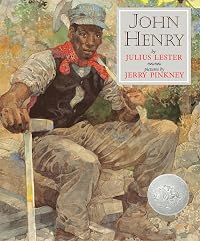
Author Julius Lester and illustrator Jerry Pinkney join forces in this lovely picture-book retelling of the tall tale of John Henry, the legendary African-American steel driver whose contest with a steam-powered drilling machine has been immortalized in American folk music. Extraordinary from the moment he was born, John Henry amazed the woodland animals, his parents, and the sun and moon themselves. Eventually setting out to make his way in the world, he performed marvelous feats, before eventually coming to the mountain in West Virginia where the railroad needed to get through. It was here he triumphed in his race with the machine, only to die in the end...
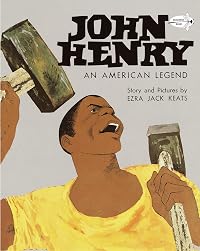
I have always thought of the story of legendary hero John Henry as being a show more meditation on humanity and the human spirit - on our strength and weakness, our ability to perform extraordinary deeds, and ultimately, our mortality. Set in a time of increasing mechanization, the story both upholds the idea of the human being as superior to the machine, and undermines it, by highlighting that our great deeds must come at a price, and cannot be sustained forever. Lester's poetic and poignant retelling in this picture-book captures that feeling for me, while Pinkney's gorgeous watercolor illustrations ably bring out the beauty and power of the central figure's story. The artwork here was definitely worthy of the Caldecott Honor it received! I've long been aware of this retelling, and am glad to have finally picked it up and read it. I will have to seek out the one from Ezra Jack Keats, and see how it compared. Recommended to all young tall-tale lovers, as well as to fellow Pinkney fans. show less
I have always thought of the story of legendary hero John Henry as being a show more meditation on humanity and the human spirit - on our strength and weakness, our ability to perform extraordinary deeds, and ultimately, our mortality. Set in a time of increasing mechanization, the story both upholds the idea of the human being as superior to the machine, and undermines it, by highlighting that our great deeds must come at a price, and cannot be sustained forever. Lester's poetic and poignant retelling in this picture-book captures that feeling for me, while Pinkney's gorgeous watercolor illustrations ably bring out the beauty and power of the central figure's story. The artwork here was definitely worthy of the Caldecott Honor it received! I've long been aware of this retelling, and am glad to have finally picked it up and read it. I will have to seek out the one from Ezra Jack Keats, and see how it compared. Recommended to all young tall-tale lovers, as well as to fellow Pinkney fans. show less
Onto the page bounds the colossus John Henry, man of legend, man of myth (though the preface keeps things off balance on that point).
John was the archetype for the "Just Do It" generation; he was all bustle and business, surrounded by an aura of triumph. Lester hits upon all of John's special moments: his stupendous growth spurt; his humbling of Ferret-Faced Freddy; his smashing the great stone so fast that he creates a natty rainbow around his shoulders; and, of course, the climactic duel with the steam drill deep in the hills of West Virginia. John smoked the drill, but his big heart burst in the process. Lester (The Last Tales of Uncle Remus, p. 70, etc.; The Man Who Knew Too Much, see below) wisely makes it clear that you don't have show more to be John Henry to get things done: You just need the will; there's a bit of John to be tapped in us all. Pinkney's watercolors walk a smart and lovely line between ephemerality and sheer natural energy. The rainbow whispers the lesson here: "Dying ain't important. Everybody does that. What matters is how well you do your living."
Amen . (Folklore/Picture book. All ages)
-Kirkus Review show less
John was the archetype for the "Just Do It" generation; he was all bustle and business, surrounded by an aura of triumph. Lester hits upon all of John's special moments: his stupendous growth spurt; his humbling of Ferret-Faced Freddy; his smashing the great stone so fast that he creates a natty rainbow around his shoulders; and, of course, the climactic duel with the steam drill deep in the hills of West Virginia. John smoked the drill, but his big heart burst in the process. Lester (The Last Tales of Uncle Remus, p. 70, etc.; The Man Who Knew Too Much, see below) wisely makes it clear that you don't have show more to be John Henry to get things done: You just need the will; there's a bit of John to be tapped in us all. Pinkney's watercolors walk a smart and lovely line between ephemerality and sheer natural energy. The rainbow whispers the lesson here: "Dying ain't important. Everybody does that. What matters is how well you do your living."
Amen . (Folklore/Picture book. All ages)
-Kirkus Review show less
Julius Lester’s take on the John Henry legend takes some creative liberties with the story but maintains the core message: that one determined man can do more than any man-made creation. Lester’s writing is simple poetry, incorporating a number of original metaphors and images to complement the John Henry myth, and making cross-temporal references to connect with today’s young readers. Even more powerful than Lester’s text, though, are Jerry Pinkney’s breathtaking illustrations: they capture the majesty and humanity in John Henry’s actions, breathing life into a legend whose origins are still shrouded in mystery. This book, although not perfect, is a masterpiece in the making.
Citation:
Lester, Julius, and Jerry Pinkney. John show more Henry. New York: Dial, 1994. Print. show less
Citation:
Lester, Julius, and Jerry Pinkney. John show more Henry. New York: Dial, 1994. Print. show less
John Henry is a larger-than-life yet utterly human man. When he is born, all sorts of animals (even a unicorn!) come to attend his birth. He grows up to be strong and courageous, and he certainly believes in himself till the very end. John Henry is a the retelling of a folk legend with plenty of markers of a tall tale: the unicorn, the first person narrator, the personification of the Sun, the Moon, and all sorts of objects, the presence of the Almighty who hollers "It's getting too noisy down there." With a delightful voice, a fast pace, and gorgeous illustrations, this book is put together so tenderly. I really loved this book with my whole heart.
I LOVE this book. This book is full of so many good, creative writing ideas for students to emulate in their own writing. This book could be used for an exaggeration minilesson, a personification minilesson, or a voice minilesson, just to name a few. The pictures enhance the memorable, creative language that Lester uses. Lester would be a great author for students to stand on the should of. He would also be interesting to do an Author's study on. The book could also be used to teach the importance and impact of powerful illustrations. I have so many ideas on how to use this book that I'm having a hard time writing them all. This book also packs a punch with a strong hook right at the beginning and a impactful ending. The beginning uses show more a strong (and steady) voice which carries through the whole story until the ending. show less
Although I thought the illustrations were richly imagined and well done, I did not enjoy reading this story. Mostly I found it to be quite dull--I lost interest in it mid-way through. Maybe a folk-hero that is able to dig through a mountain faster than a steam drill just doesn't appeal to me. There were turns of phrase I really liked. In the beginning for instance,
"The next morning John Henry was up at sunrise. The sun wasn't. He was tired and had decided to sleep in. John Henry was going to have none of that. He hollered up into the sky, "get up from there! I got things to do and I need light to do 'em by."
The sun yawned, washed its face, flossed and brushed its teeth, and hurried up over the horizon."
Soon after John Henry was born, show more it was very apparent that he was an oddity--far stronger than other living human being. As he moves on in the world he shows a road crew on incredibly fast he could swing down hammers on boulders. He then goes on to outhammer a steam drill. Another phrases that I liked during this part of the book was "What he saw was a mountain as big as hurt feelings" and "He had a twenty-pound hammer in each and and muscles hard as wisdom in each arm." Ultimately, John Henry hammers so hard that his heart bursts and he dies. He becomes a local hero and his body is sent to Washington D.C. show less
"The next morning John Henry was up at sunrise. The sun wasn't. He was tired and had decided to sleep in. John Henry was going to have none of that. He hollered up into the sky, "get up from there! I got things to do and I need light to do 'em by."
The sun yawned, washed its face, flossed and brushed its teeth, and hurried up over the horizon."
Soon after John Henry was born, show more it was very apparent that he was an oddity--far stronger than other living human being. As he moves on in the world he shows a road crew on incredibly fast he could swing down hammers on boulders. He then goes on to outhammer a steam drill. Another phrases that I liked during this part of the book was "What he saw was a mountain as big as hurt feelings" and "He had a twenty-pound hammer in each and and muscles hard as wisdom in each arm." Ultimately, John Henry hammers so hard that his heart bursts and he dies. He becomes a local hero and his body is sent to Washington D.C. show less
Julius Lester's version of the legend of John Henry is well-told. I laughed out loud when Lester described Ferret-Faced Freddy, a man "so mean, he cried if he had a nice thought." Lester also uses marvelous metaphors. Lester's version is very different from other versions I'm familiar with, but I love it.
.
.
Members
- Recently Added By
Lists

Caldecott Honor Books
296 works; 23 members

Honey For a Child's Heart
1,152 works; 25 members

my children books reading list-from 100 great books
101 works; 7 members

Books Read in 2023
5,638 works; 147 members
Author Information

56+ Works 11,087 Members
Julius Bernard Lester was born in St. Louis, Missouri on January 27, 1939. He received a bachelor's degree in English from Fisk University in 1960. He moved to New York to become a folk singer. He performed on the coffeehouse circuit as a singer and guitarist. He released two albums entitled Julius Lester in 1965 and Departures in 1967. His first show more published book, The Folksinger's Guide to the 12-String Guitar as Played by Leadbelly written with Pete Seeger, was published in 1965. In the 1960s, Lester was closely involved as a writer and photographer with the Student Nonviolent Coordinating Committee. He traveled to the South to document the civil rights movement and to North Vietnam to photograph the effects of American bombardment. He also hosted radio and television talk shows in New York City. He wrote more than four dozen nonfiction and fiction books for adults and children. His books for adults included Look Out, Whitey!: Black Power's Gon' Get Your Mama, Revolutionary Notes, All Is Well, Lovesong: Becoming a Jew, and The Autobiography of God. His children's books included To Be a Slave, Sam and the Tigers, and Day of Tears: A Novel in Dialogue, which won the American Library Association's Coretta Scott King Award in 2006. He also wrote reviews and essays for numerous publications including The New York Times Book Review, The Boston Globe, The Village Voice, Dissent, The New Republic, and the Los Angeles Times Book Review. After teaching for two years at the New School for Social Research in New York, Lester joined the faculty of the University of Massachusetts, Amherst in 1971. He originally taught in the Afro-American studies department, but transferred to the Judaic and Near Eastern studies department when Lester criticized the novelist James Baldwin for what he felt were anti-Semitic remarks. He died from complications of chronic obstructive pulmonary disease on January 18, 2018 at the age of 78. (Bowker Author Biography) show less
All Editions
Awards and Honors
Awards
Distinctions
Work Relationships
Is contained in
Common Knowledge
- Canonical title
- John Henry
- Original publication date
- 1994
- People/Characters
- John Henry; The road crew; Ferret-Faced Freddy
- Dedication
- In memory of my father, James H., my John Henry. – J.P.
- First words
- This tale attempts to be faithful to the indomitable human spirit John Henry embodies.
- Last words
- (Click to show. Warning: May contain spoilers.)RINGGGG!
Classifications
Statistics
- Members
- 1,893
- Popularity
- 11,388
- Reviews
- 103
- Rating
- (4.17)
- Languages
- Czech, English
- Media
- Paper, Audiobook, Ebook
- ISBNs
- 29
- ASINs
- 7