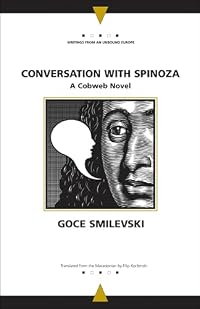
Conversation with Spinoza: A Cobweb Novel
by Goce Smilevski
On This Page
Description
Prizing ideas above all else, radical thinker Baruch Spinoza left little behind in the way of personal facts and furnishings. But what of the tug of necessity, the urgings of the flesh, to which this genius philosopher (and grinder of lenses) might have been no more immune than the next man-or the next character, as Baruch Spinoza becomes in this intriguing novel by the remarkable young Macedonian author Goce Smilevski. Smilevski's novel brings the thinker Spinoza and his inner life into show more conversation with the outer, all-too-real facts of his life and his day--from his connection to the Jewish community of Amsterdam, his excommunication in 1656, and the emergence of his philosophical system to his troubling feelings for his fourteen-year-old Latin teacher Clara Maria van den Enden and later his disciple Johannes Casearius. From this conversation there emerges a compelling and complex portrait of the life of an idea--and of a man who tries to live that idea. show lessTags
Recommendations














Member Reviews
This book is about Baruch Spinoza, the 17th c Dutch Jewish philosopher. The story of his life is structured as a series of conversations between you, the reader, and Spinoza. This sounds like it would be a hard slog, but the book is actually quite engaging. There are some sections which describe Spinoza’s ideas about substance and attributes, which I found rather abstract, but the author tended to relate it to the situation at hand which helped. There were also some long blocks of text in stream-of-consciousness mode, but this is pretty normal to me. I liked the author’s prose and he created a number of striking images as well as a good portrait of a man struggling to focus on the infinite rather than the transient.
The novel is show more divided into several sections, but really splits into two parts – a shorter, earlier section where Spinoza gives an overview of his whole life and a longer section after, where he describes several important scenes in depth. Both parts are quite good. The first half moves along quickly, giving the outlines of Spinoza’s life – parents forced to flee Portugal, his mother dies, he’s forced to abandon his training as a rabbi and work in the family store, meets one mentor Van den Enden and his daughter Clara Maria, is excommunicated from the Jewish community, publishes one treatise, works on his masterpiece until his death. This narrative is very engaging and at times funny – Clara Maria has a dog named Jesus and there’s a ridiculous cameo by Louis XIV.
The second section focuses mostly on three events – the death of his mother and two encounters, one with Clara Maria and the other with a student of his, Johannes Casearius. In all three, Spinoza is threatened with emotions. His mother’s death he immediately puts out of mind, but it comes back later on. His painful rejections of Clara Maria and Johannes demonstrate the difficulty of the focus only on philosophy. In general, the portrait of Spinoza here contrasts with the generic image of him as an ascetic – he’s constantly lonely, wracked with doubt, masturbates and thinks about sex, and, despite his ideas reconciling the body/soul divide, always seems to be engaged in a war between his desires and ideas.
The book has a somewhat obsessive, repetitive tone. It ends and begins in the same manner – intentionally – and with the replay of scenes and repetition of Spinoza’s philosophy, there’s something of a closed feel. This works well as, of course, Spinoza is dead and in general there’s often a tendency to look back on the past and obsess over it and relive it. It also fits with the subtitle of A Cobweb Novel; a cobweb is compared to a labyrinth and the tree of life as a way of looking at things and it’s noted that a web has infinite exits and entrances and every point can be a center. There’s a nice afterward where the author discusses why he chose Spinoza and some of the bits that were wholly fictitious. show less
The novel is show more divided into several sections, but really splits into two parts – a shorter, earlier section where Spinoza gives an overview of his whole life and a longer section after, where he describes several important scenes in depth. Both parts are quite good. The first half moves along quickly, giving the outlines of Spinoza’s life – parents forced to flee Portugal, his mother dies, he’s forced to abandon his training as a rabbi and work in the family store, meets one mentor Van den Enden and his daughter Clara Maria, is excommunicated from the Jewish community, publishes one treatise, works on his masterpiece until his death. This narrative is very engaging and at times funny – Clara Maria has a dog named Jesus and there’s a ridiculous cameo by Louis XIV.
The second section focuses mostly on three events – the death of his mother and two encounters, one with Clara Maria and the other with a student of his, Johannes Casearius. In all three, Spinoza is threatened with emotions. His mother’s death he immediately puts out of mind, but it comes back later on. His painful rejections of Clara Maria and Johannes demonstrate the difficulty of the focus only on philosophy. In general, the portrait of Spinoza here contrasts with the generic image of him as an ascetic – he’s constantly lonely, wracked with doubt, masturbates and thinks about sex, and, despite his ideas reconciling the body/soul divide, always seems to be engaged in a war between his desires and ideas.
The book has a somewhat obsessive, repetitive tone. It ends and begins in the same manner – intentionally – and with the replay of scenes and repetition of Spinoza’s philosophy, there’s something of a closed feel. This works well as, of course, Spinoza is dead and in general there’s often a tendency to look back on the past and obsess over it and relive it. It also fits with the subtitle of A Cobweb Novel; a cobweb is compared to a labyrinth and the tree of life as a way of looking at things and it’s noted that a web has infinite exits and entrances and every point can be a center. There’s a nice afterward where the author discusses why he chose Spinoza and some of the bits that were wholly fictitious. show less
Ratings
Members
- Recently Added By
Author Information

11+ Works 227 Members
Awards and Honors
Notable Lists
Series
Belongs to Publisher Series
Common Knowledge
- Canonical title
- Conversation with Spinoza: A Cobweb Novel
- Original publication date
- 2002 (Macedonian) (Macedonian); 2006 (English) (English)
- People/Characters
- Spinoza, Baruch, 1632-1677
- Important places*
- Macedonië
*Some information comes from Common Knowledge in other languages. Click "Edit" for more information.
Classifications
- Genres
- Fiction and Literature, General Fiction, Historical Fiction
- DDC/MDS
- 891.81936 — Literature & rhetoric Asian Literature East Indo-European and Celtic literatures West and South Slavic languages (Bulgarian, Slovene, Polish, Czech, Slovak, Serbo-Croatian, and Macedonian) Bulgarian and other South Slavic languages Macedonian Macedonian fiction
- LCC
- PG1196.29 .M58 .R3913 — Language and Literature Slavic languages and literatures. Baltic languages. Albanian language Slavic. Baltic. Albanian Macedonian
- BISAC
Statistics
- Members
- 64
- Popularity
- 484,054
- Reviews
- 1
- Rating
- (3.28)
- Languages
- Dutch, English, Finnish
- Media
- Paper
- ISBNs
- 4