On This Page
Description
Owen's parents try to get him to give up his favorite blanket before he starts school, but when their efforts fail, they come up with a solution that makes everyone happy.Tags
Recommendations



Member Reviews
I am highly prejudiced against this book for one simple reason: I didn't have a security blanket as a kid, but a stuffed cat. So you can imagine the visuals my increasingly terrified child self was getting as this was read to me. Up to and including the possibility that one day, I'd find my beloved Carmichael dismembered by some busybody who thought I needed to develop at their pace. I was picturing carrying a severed paw around in my pocket. Great bedtime visual! Frankly, I never understood why the neighbor felt she had any input here, or why Owen's parents never told her to back off, mind her own business, and let the kid grow out of it in his own time.
Soooo, it's quite possible that it deserves a higher rating. But it was a show more traumatic book when I was a kid. My poor parents were grilled about the intentions of everyone we knew re: my cat, and for days afterwards I insisted that he be watched at all times. To say I don't have fond memories of this one is an understatement. show less
Soooo, it's quite possible that it deserves a higher rating. But it was a show more traumatic book when I was a kid. My poor parents were grilled about the intentions of everyone we knew re: my cat, and for days afterwards I insisted that he be watched at all times. To say I don't have fond memories of this one is an understatement. show less
Another mouse child, the tenacious Owen, who has a growing pain involving a favorite blanket, and alternately exasperated, concerned, and indulgent parents. Nosy neighbor, Mrs. Tweezers, who peeks over the fence standing on upside-down flower pots and dispenses whispered advice to Owen's mom and dad about how to get rid of the blanket. "'Haven't you heard of saying no?' Owen's parents hadn't." Mouse version of The Scream hanging on the wall as backdrop to Owen's moment of truth. Gently droll and thoroughly sweet.
I've read three out of the several mouse tales that Henkes has out; they're all excessively pretty, with almost none of the bite and brattiness of Frances the badger, but I love them all the same.
I've read three out of the several mouse tales that Henkes has out; they're all excessively pretty, with almost none of the bite and brattiness of Frances the badger, but I love them all the same.
Here we have another one of those picture books that on its surface appears to be about one thing but has a truly odd undertone running through it.
The issue at hand appears to be another version of childhood separation anxiety, this time with a baby blanket. Owen is on the eve of entering school and it is time for him to put away the blanket he has loved since he was born. But how to separate Owen from his Fuzzy is a delicate issue, and no matter how much they try nothing seems to convince Owen that it's time to give up his friend. In the end his mother comes up with a solution where Owen can have his fuzzy with him at all times... by converting his blanket into a dozen smaller handkerchiefs.
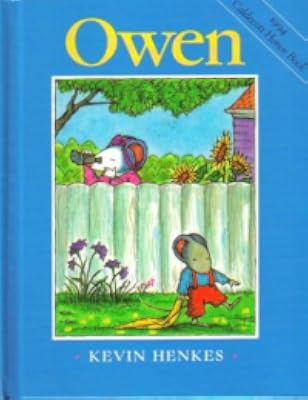
Well, that's all very nice, but there's an show more odd catalyst in this book in the form of a nosy neighbor named Mrs. Tweezers. She's there on page one looking over the fence at a happy Owen playing with Fuzzy, with a glance that can be viewed as either concerned or disapproving. A few pages later when she reappears we know which look it was when she says "Isn't he a little old to be carrying that thing around?" And with this illustration the faces of Owen's parents register concern. A concern they never had before. A concern that suggests perhaps they might be bad parents for not addressing the issue sooner.
Mrs. Tweezers suggests the Blanket Fairy, a ruse designed to help separate Owen from his blanket through trickery. But Owen's attachment to his blanket allows him to unwittingly outwit his parents by hiding the blanket. When he tells his parents the fairy didn't come they attempt to shame him for it by suggesting that Fuzzy's torn, dirty, rattiness are the cause.
Fuzzy continues to accompany Owen until Mrs. Tweezers once again leans over the fence and meddle in her neighbors affairs. "Haven't you heard of the vinegar trick?" And once again Owen's worried, concerned parents feel neglectful for not having heard how to properly raise their son. When dipping Fuzzy into vinegar doesn't work Mrs. Tweezers once again meddles, this time making it personal.
"Haven't you heard of saying no?"
Saying no, without an explanation or any attempt to reason with Owen, has the expected outcome of creating a greater anxiety in Owen. This is when Owen's mother suddenly has the brilliant idea to turn the blanket into handkerchiefs. And in the end, Mrs. Tweezers approves with a wave of her own hankie.
What a horrible message. Listen to your meddling neighbors tell you how to raise your child? Get your child to conform to someone else's expectations? If you can't separate your child from their security blanket through trickery simply say "because I say so" and leave it at that? What really irks me about the Caldecott Honor book is that it seems to send the subtle message that conformity begins in the home, and only bad parents don't know or realize this.
I think we all want to raise children right, however we define "right," but not at the suggestion of a neighbor (who, despite being married, shows no sign of having raised any kids herself). Blanket issues are huge, and I can see the value in a book that deals with them openly, humorously, but not like this. Owen is never told why he cannot bring a blanket to school, never fully prepared for the separation, and seems too ready to accept his blanket begin cut where most kids even resist allowing it to be washed, much less cut.
And all of this is for what? Mrs. Tweezer's approval? She's there on the first and the last page, so clearly she is as important as Owen. So pay attention, children! Your nosy neighbor is a force to be reckoned with. She can manipulate your parents and get them to raise you according to her standards. And without her approval who knows what might happen. She and her chicken-legged house might carry you off to the forest and...
Sorry, got a little carried away there. show less
The issue at hand appears to be another version of childhood separation anxiety, this time with a baby blanket. Owen is on the eve of entering school and it is time for him to put away the blanket he has loved since he was born. But how to separate Owen from his Fuzzy is a delicate issue, and no matter how much they try nothing seems to convince Owen that it's time to give up his friend. In the end his mother comes up with a solution where Owen can have his fuzzy with him at all times... by converting his blanket into a dozen smaller handkerchiefs.
Well, that's all very nice, but there's an show more odd catalyst in this book in the form of a nosy neighbor named Mrs. Tweezers. She's there on page one looking over the fence at a happy Owen playing with Fuzzy, with a glance that can be viewed as either concerned or disapproving. A few pages later when she reappears we know which look it was when she says "Isn't he a little old to be carrying that thing around?" And with this illustration the faces of Owen's parents register concern. A concern they never had before. A concern that suggests perhaps they might be bad parents for not addressing the issue sooner.
Mrs. Tweezers suggests the Blanket Fairy, a ruse designed to help separate Owen from his blanket through trickery. But Owen's attachment to his blanket allows him to unwittingly outwit his parents by hiding the blanket. When he tells his parents the fairy didn't come they attempt to shame him for it by suggesting that Fuzzy's torn, dirty, rattiness are the cause.
Fuzzy continues to accompany Owen until Mrs. Tweezers once again leans over the fence and meddle in her neighbors affairs. "Haven't you heard of the vinegar trick?" And once again Owen's worried, concerned parents feel neglectful for not having heard how to properly raise their son. When dipping Fuzzy into vinegar doesn't work Mrs. Tweezers once again meddles, this time making it personal.
"Haven't you heard of saying no?"
Saying no, without an explanation or any attempt to reason with Owen, has the expected outcome of creating a greater anxiety in Owen. This is when Owen's mother suddenly has the brilliant idea to turn the blanket into handkerchiefs. And in the end, Mrs. Tweezers approves with a wave of her own hankie.
What a horrible message. Listen to your meddling neighbors tell you how to raise your child? Get your child to conform to someone else's expectations? If you can't separate your child from their security blanket through trickery simply say "because I say so" and leave it at that? What really irks me about the Caldecott Honor book is that it seems to send the subtle message that conformity begins in the home, and only bad parents don't know or realize this.
I think we all want to raise children right, however we define "right," but not at the suggestion of a neighbor (who, despite being married, shows no sign of having raised any kids herself). Blanket issues are huge, and I can see the value in a book that deals with them openly, humorously, but not like this. Owen is never told why he cannot bring a blanket to school, never fully prepared for the separation, and seems too ready to accept his blanket begin cut where most kids even resist allowing it to be washed, much less cut.
And all of this is for what? Mrs. Tweezer's approval? She's there on the first and the last page, so clearly she is as important as Owen. So pay attention, children! Your nosy neighbor is a force to be reckoned with. She can manipulate your parents and get them to raise you according to her standards. And without her approval who knows what might happen. She and her chicken-legged house might carry you off to the forest and...
Sorry, got a little carried away there. show less
Genre or Type of Picture Book: Fiction, Classics Recommended for: Primary
Owen by Kevin Henkes, is a classic fiction book, for young readers. The book is about Owen, a young mouse who goes everywhere with a yellow blanky named "Fuzzy." The book illustrates the crossroads of growing up and leaving the blanky behind. At the end of the book, Fuzzy is cut into smaller pieces as handkerchiefs so Owen can still take Fuzzy everywhere he goes while he is growing up. This book is great for most small children, especially ones that are attached to a stuffed animal or even a blanket as well. For parents trying to help their children let go of these items, this book helps. It suggests a change without demanding one. For most young children, they show more can connect with Owen, and their parents can connect with his parents. Kevin Henkes does a superb job incorporating very real themes throughout this small easy reader. The meaning of the text is only enhanced by the beautifully sweet illustrations on every page. show less
Owen by Kevin Henkes, is a classic fiction book, for young readers. The book is about Owen, a young mouse who goes everywhere with a yellow blanky named "Fuzzy." The book illustrates the crossroads of growing up and leaving the blanky behind. At the end of the book, Fuzzy is cut into smaller pieces as handkerchiefs so Owen can still take Fuzzy everywhere he goes while he is growing up. This book is great for most small children, especially ones that are attached to a stuffed animal or even a blanket as well. For parents trying to help their children let go of these items, this book helps. It suggests a change without demanding one. For most young children, they show more can connect with Owen, and their parents can connect with his parents. Kevin Henkes does a superb job incorporating very real themes throughout this small easy reader. The meaning of the text is only enhanced by the beautifully sweet illustrations on every page. show less
I absolutely loved this book. The characters in the book are mice, which helps to eliminate any racial issues such as only having characters with a certain color skin. Another reason why this book is amazing is because it is so relatable to children all over the world. Henkes writes about a topic that is challenging for children at a young age – becoming too old to have a security object. Whether it be a pacifier, blanket or teddy bear, Henkes creates a realistic description of how much Owen loves his blanket. For example, the book shows Owen using his blanket in many different locations such as bedtime, playing in the sandbox, and helping him to hide and “become invisible”. Additionally, this book pushes the reader to see how show more Owen grows at the end of the book and how it is possible to hold on to something that has meaning while still holding on to something special. This is shown in the end of the book when Owen’s mom makes him handkerchiefs out of his fuzzy blanket. He carries the handkerchiefs around with him everywhere. The main idea of the story is that you can still hold on to something that has value, even if it means changing the form of the object. Additionally, the book stresses the topic and message that growing up is hard, and that not every kid is ready to grow up when people want/expect them to. show less
Owen's yellow baby blanket, nicknamed Fuzzy, had been with him all his life - a constant companion through thick and thin. When well-meaning but nosy Mrs. Tweezers suggests to his parents that he is getting too old for such things, a hilarious contest of wills begins. The blanket-fairy, dipping in vinegar, and just "saying no" all fail to separate Owen from his blanket, until finally his mother has an ingenious idea that will keep everyone happy...
Kevin Henkes' picture-book mice are always adorable, whether they're experiencing a name-related crisis like the eponymous Chrysanthemum, or facing the ambiguous feelings that accompany a new sibling, like Lily in Julius, the Baby of the World. In Owen, Henkes turns his attention to the show more question of that beloved childhood artefact known as the "security blanket," producing a charming tale that is sure to both comfort and entertain. The watercolor illustrations, which garnered Henkes a Caldecott Honor, are colorful and expressive. show less
Kevin Henkes' picture-book mice are always adorable, whether they're experiencing a name-related crisis like the eponymous Chrysanthemum, or facing the ambiguous feelings that accompany a new sibling, like Lily in Julius, the Baby of the World. In Owen, Henkes turns his attention to the show more question of that beloved childhood artefact known as the "security blanket," producing a charming tale that is sure to both comfort and entertain. The watercolor illustrations, which garnered Henkes a Caldecott Honor, are colorful and expressive. show less
I would personally like to thank Kevin Henkes for writing the book Owen because it seemed like a gift to me and my son, Owen. The book Owen came out in 1993 and the person Owen came out in 1992. My Owen had a year to establish himself as a little human being and by the time he was a year old he had a comfort "LeLe" -- a Lambchop puppet with a soft wooly fleece and he sucked his thumb. I think maybe Kevin Henkes saw us at the park one day and became inspired by my adorable son, and wrote this beautifully illustrated and sweetly written book about a little mouse named Owen who sucks his thumb and has a comfort blanket named "Fuzzy." Henkes probably changed LeLe into Fuzzy to protect the innocent.
Owen (the book) is the story of a little show more mouse who can't go anywhere or do anything without his "Fuzzy." Fuzzy experiences life with Owen, 'eating and drinking' orange juice, ice cream and applesauce cake. Owen's parents don't think much about their son's attachment to his blanket until a nosey old neighbor -- Mrs. Twitter -- starts to suggest that Owen is too old for such a thing. Soon Owen's parents are telling him that Fuzzy is going to disappear and be replaced by a toy that is for big boys. Owen hides Fuzzy in the pants of his pajamas to avoid losing him. As Owen deals with the daily trials and tribulations of a 4-year-old (going to the dentist, getting a haircut), Fuzzy is called into service on a regular basis.
So begins gentle nudging from Owen's parents to make him give up Fuzzy before he begins going to school. They resort to such tactics like dipping her in vinegar and outright telling Owen he may not take her to school. Owen's tears at losing his friend gives his mother an idea, and soon Owen is able to take Fuzzy to school without anyone realizing it. Owen is once again smiling and happy.
Henkes drawings are delightful, and Owen is as cute as he can be with big mouse ears and a sweet little face. Each picture correspondes with the text so younger listeners will be able to follow along with the words and pictures in a read-aloud. Henkes also captures Owen's imagination as he pretends he's Captain Plunger (in the bathroom), he's marching in a parade, and playing in the backyard. If we remember our own children playing, it'll be easy to see a little bit of Owen in each of them.
One of the things Henkes does so endearingly in this book is show how conflicted Owen's parents are about making their son give up something he loves. As parents a lot of us have been there, and it's broken our heart as much as our children's heart to try and force them to stop doing something that makes them feel good, i.e., suck their thumb, twirl their hair, rub their face with the satiny part of their blankie, or idly thumb the fleece fuzz on their LeLe. I've been there thinking, what difference does it make if my Owen sleeps with LeLe or not? When he goes to college he likely won't take her with him, so was it necessary for me to tell him to be a big boy and give her up? I would've upset Mrs. Twitter because I never took my Owen's LeLe from him.
On a very basic level Kevin Henkes wrote this beautiful story and it will endure the test of time as long as human beings need love and comfort. In fact, one of our most basic human instincts is to comfort ourselves when we're stressed, sad, lonely, or upset. Owen (the book) touches at the heart of that basic need, and I was reminded of that when I watched Owen (my 16-year-old son) idly touch the wool fleece insert in his jacket -- just like he used to touch LeLe when he was three-years-old and needed comfort -- as he was telling me about his girlfriend breaking up with him. It made me want to get out our copy of Owen and read it to him. [close] show less
Owen (the book) is the story of a little show more mouse who can't go anywhere or do anything without his "Fuzzy." Fuzzy experiences life with Owen, 'eating and drinking' orange juice, ice cream and applesauce cake. Owen's parents don't think much about their son's attachment to his blanket until a nosey old neighbor -- Mrs. Twitter -- starts to suggest that Owen is too old for such a thing. Soon Owen's parents are telling him that Fuzzy is going to disappear and be replaced by a toy that is for big boys. Owen hides Fuzzy in the pants of his pajamas to avoid losing him. As Owen deals with the daily trials and tribulations of a 4-year-old (going to the dentist, getting a haircut), Fuzzy is called into service on a regular basis.
So begins gentle nudging from Owen's parents to make him give up Fuzzy before he begins going to school. They resort to such tactics like dipping her in vinegar and outright telling Owen he may not take her to school. Owen's tears at losing his friend gives his mother an idea, and soon Owen is able to take Fuzzy to school without anyone realizing it. Owen is once again smiling and happy.
Henkes drawings are delightful, and Owen is as cute as he can be with big mouse ears and a sweet little face. Each picture correspondes with the text so younger listeners will be able to follow along with the words and pictures in a read-aloud. Henkes also captures Owen's imagination as he pretends he's Captain Plunger (in the bathroom), he's marching in a parade, and playing in the backyard. If we remember our own children playing, it'll be easy to see a little bit of Owen in each of them.
One of the things Henkes does so endearingly in this book is show how conflicted Owen's parents are about making their son give up something he loves. As parents a lot of us have been there, and it's broken our heart as much as our children's heart to try and force them to stop doing something that makes them feel good, i.e., suck their thumb, twirl their hair, rub their face with the satiny part of their blankie, or idly thumb the fleece fuzz on their LeLe. I've been there thinking, what difference does it make if my Owen sleeps with LeLe or not? When he goes to college he likely won't take her with him, so was it necessary for me to tell him to be a big boy and give her up? I would've upset Mrs. Twitter because I never took my Owen's LeLe from him.
On a very basic level Kevin Henkes wrote this beautiful story and it will endure the test of time as long as human beings need love and comfort. In fact, one of our most basic human instincts is to comfort ourselves when we're stressed, sad, lonely, or upset. Owen (the book) touches at the heart of that basic need, and I was reminded of that when I watched Owen (my 16-year-old son) idly touch the wool fleece insert in his jacket -- just like he used to touch LeLe when he was three-years-old and needed comfort -- as he was telling me about his girlfriend breaking up with him. It made me want to get out our copy of Owen and read it to him. [close] show less
Members
- Recently Added By
Lists

Caldecott Honor Books
296 works; 23 members

Top-Rated Children's Books
87 works; 16 members

EEK! A Mouse ::: Best Children's Books
95 works; 12 members

Honey For a Child's Heart
1,152 works; 25 members

Sonlight Books
1,487 works; 25 members

Reading Rainbow
193 works; 10 members

Books Read in 2023
5,547 works; 145 members
Author Information

101+ Works 75,716 Members
Kevin Henkes was born in Racine, Wis. in 1960 and graduated from the University of Wisconsin at Madison. One of four children in his family, Henkes grew up with aspirations of being an artist. As a junior in high school, one of Henkes's teachers awakened his interest in writing. Falling in love with both writing and drawing, Henkes realized that show more he could do both at the same time as a children's book author and illustrator. At the age of 19, Henkes went to New York City to get his first book, All Alone, published. Since that time, he has written and illustrated dozens of picture books including Chrysanthemum, Protecting Marie, and A Weekend with Wendell. A recurring character in several of Henkes's books is Lily, an outrageous, yet delightful, individualist. Lily finds herself the center of attention in the books Chester's Way, Julius, the Baby of the World, and Lily's Purple Plastic Purse. A Weekend With Wendell was named Children's Choice Book by the Children's Book Council in 1986. He recieved the Elizabeth Burr Award for Words of Stone in 1993. Owen was named a Caldicott Honor in 1994. The Year of Billy Miller was named a Newbery Honor book in 2014. (Bowker Author Biography) show less
Some Editions
Awards and Honors
Awards
Distinctions
Series

Work Relationships
Common Knowledge
- Canonical title
- Owen
- Original publication date
- 1993
- People/Characters
- Owen [Kevin Henkes]; Mrs. Tweezers
- Related movies
- Owen (1995 | IMDb)
- Dedication
- For Laura
- First words
- Owen had a fuzzy yellow blanket.
- Last words
- (Click to show. Warning: May contain spoilers.)And Mrs. Tweezers doesn't say a thing.
- Original language
- English
Classifications
Statistics
- Members
- 5,780
- Popularity
- 2,253
- Reviews
- 155
- Rating
- (4.19)
- Languages
- 5 — Chinese, English, French, Korean, Spanish
- Media
- Paper, Audiobook, Ebook
- ISBNs
- 52
- UPCs
- 1
- ASINs
- 14