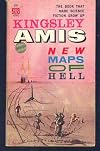
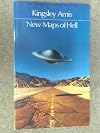
New maps of hell
by Kingsley Amis
On This Page
Description
In this hilarious, inspiring and provocative series of essays, Kingsley Amis introduces every reader to the wonders and value of science fiction writing. From the extraordinary ideas but sexless science of Jules Verne to the power of H. G. Wells's terrifying storytelling; from the brilliance of bad science fiction writing to the potency of their important ideas; from a portrait of the average SF reader to Amis's sad prediction that this genre will never make it in film or television, New show more Maps of Hellis a warm and witty exploration of a world many readers may be yet to discover. show lessTags
Recommendations





























Member Recommendations


Member Reviews
An enjoyable tour of a bygone era of science fiction, back before there was any money in it and it started to be so commercial. There's a sense of a new frontier of fiction in Amis' review of the budding genre.
Here, enjoy his take on Pohl's "The Tunnel Under The World" (and, almost incidentally, on advertising):
" 'Have you got a freezer? IT STINKS! If it's last year's Feckle Freezer, IT STINKS! Only this year's Feckle Freezer is any good at all! You know who owns an Ajax Freezer? Fairies own Ajax Freezers! You know who owns a Triplecold Freezer? Commies own Triplecold Freezers! Every freezer but a brand-new Feckle Freezer STINKS!'
"The effectiveness of that presumably derives not only from the way it dramatises the coercive tendency of show more some actual advertising, nor from the reflection any of us might have that this is how they would like to talk to us if they dared, but also from its having touched on a truth about the whole advertising idea, that it is an outrage, an assault on people's mental privacy." show less
Here, enjoy his take on Pohl's "The Tunnel Under The World" (and, almost incidentally, on advertising):
" 'Have you got a freezer? IT STINKS! If it's last year's Feckle Freezer, IT STINKS! Only this year's Feckle Freezer is any good at all! You know who owns an Ajax Freezer? Fairies own Ajax Freezers! You know who owns a Triplecold Freezer? Commies own Triplecold Freezers! Every freezer but a brand-new Feckle Freezer STINKS!'
"The effectiveness of that presumably derives not only from the way it dramatises the coercive tendency of show more some actual advertising, nor from the reflection any of us might have that this is how they would like to talk to us if they dared, but also from its having touched on a truth about the whole advertising idea, that it is an outrage, an assault on people's mental privacy." show less
In this survey Amis has a slight tendency to emphasize the British practitioners of the field at that time. It is a useful book for those who had access to the USA market, to remind them that there were other points of view and other fanciful explorations than the predominantly American pulp-spawned writers. It remains a useful snap-shot of the pre-1960 selection available to the expanding minds. It has been reprinted several times since my reading.
Have no fear ladies; as long as your man is reading science fiction, his mind will not be on sex. I’m paraphrasing one of Amis’ conclusions of the science fiction genre that was becoming increasingly popular in the late 1950s. Amis succinctly classifies the sub topics in scifi, and provides short stories or novellas and their authors which best exemplify each. Not an easy read by far, but if you’re a scifi addict, then this book will help you catch up on the early history of your obsession.
It's easy to see why this piece is so influential. It's an analysis of science fiction, where most superficially similar pieces are either apologies or attempted definitions.
Nonetheless, it makes for patchy reading. The tone is an odd combination of familiarity (with some contempt) and critical distance, and the humour often didn't quite come off for me. Your mileage, as they say, may vary.
There's been quite a bit of movement in the genre since the 60s, so while the analysis is still interesting it's not necessarily as applicable as it once was. This is particularly noticeable in one respect: sex and romance. Amis says that sf has completely failed to incorporate either in a mature fashion (as opposed to adolescent stereotypes or a show more treatment so casual it essentially disregards the question entirely) -- this is true of the 'Golden Age', certainly, but looking at authors like Miéville we see something quite different. The foreword begins by noting the advances within the genre over 25 years, and I guess it's not surprising that in the 50 years following things have moved on a but further.
In short: despite some stylistic idiosyncracies, it's a good analysis of the genre as it was some decades ago. Certainly should be required reading for anyone tempted towards writing a more up-to-date critical survey. show less
Nonetheless, it makes for patchy reading. The tone is an odd combination of familiarity (with some contempt) and critical distance, and the humour often didn't quite come off for me. Your mileage, as they say, may vary.
There's been quite a bit of movement in the genre since the 60s, so while the analysis is still interesting it's not necessarily as applicable as it once was. This is particularly noticeable in one respect: sex and romance. Amis says that sf has completely failed to incorporate either in a mature fashion (as opposed to adolescent stereotypes or a show more treatment so casual it essentially disregards the question entirely) -- this is true of the 'Golden Age', certainly, but looking at authors like Miéville we see something quite different. The foreword begins by noting the advances within the genre over 25 years, and I guess it's not surprising that in the 50 years following things have moved on a but further.
In short: despite some stylistic idiosyncracies, it's a good analysis of the genre as it was some decades ago. Certainly should be required reading for anyone tempted towards writing a more up-to-date critical survey. show less
wasn't aware that Kingsley Amis had written a book about science fiction. I came across a paperback New English Library edition of New maps of hell, published in 1969, at one of those swap, give, take, pay for little libraries (basically a bookcase) found on some railway stations. The tanned pages were full to the brim with words. It was good. The book starts with a definition of science fiction and then sets about origins and early history before going on to describe the types of people who read and write sci-fi. He even provides some data on circulation of science fiction magazines. The bulk of the book is about themes together with a look ahead to the future. Amis refers to many authors, for instance Ray Bradbury whom he describes as show more 'the Louis Armstrong of science fiction' (page 90). The index is pretty wide ranging: Aeneid, Astounding Science Fiction, Jane Austen, The Blob, Chaucer, Einstein, Fahrenheit 451, Frankenstein, Kafka, New Atlantis, Playboy, Jules Verne, H.G.Wells, the Yellow Pill. show less
“No wife who finds her husband addicting himself to science fiction need fear that he is in search of an erotic outlet, anyway not an overt one.”
In "New Maps of Hell" by Kingsley Amis
To put it in another context, imagine I'd be teaching F. Scott Fitzgerald to undergraduates, some of whom would be of African descent. Do we look at the casual racism found in the books and say "that's wrong?" No, we assume that everyone "gets" that it's wrong. But we look at the fact that this was considered normal/acceptable in F. Scott's day. He's still a magnificent writer, but he reflects his own era. Scott’s similar to Amis. His attitude to women is a reflection of the times. We can't shy away from that and pretend it isn't so, and we can't show more negate him as a writer, because of it.
Imagine yourself living in Lisbon as a young woman; wouldn’t you dread the endless comments, abuse, physical assaults that were part of your everyday experience. Maybe this young woman dreamt of buying an electric cattle prod and zapping those who threatened her. But it was the times in which they lived back then. Women had no rights in the 60s. The literature of the times, reflected that. Shall we zap Amis with a cattle prod for being a man of his time? No. First of all, I believe that all good books, whether niche or mainstream or somewhere in-between, must have an implicit message they are trying to put across, which should stick out almost like a sore thumb. That said, I in no way think this should make books programmatic. Writing a novel with the sole purpose of creating a text more politically correct than anything that has ever been written might take away, all at once, all the drama and conflict that all good novels - needless to say, I am merely expressing my own point of view here - play with to a certain extent. Secondly, SF (fantasy and science-fiction), possibly more so than any other genre, and even at their most mechanically chlichéd, are written and read not simply for "idle entertainment", but as a platform for escapism. And "entertainment" and "escapism" are definitely not the same thing. Sure, escapism includes enjoyment, but there are many other elements to it as well. (Such as creating a world that is only lineally similar to the one you attempting to escape from. Thirdly, if one raises the issue that "creators of fantasy stories [should] have the self-awareness to properly represent gender and race in their work". Whilst I agree that misrepresentation of elements such as race and gender should carefully be avoided in all forms of mass-media, I also believe that what we should tread carefully here. How, for instance, would you propose said careful representation of gender and race in fantasy texts? Would that not constrain the genre further, rather than pushing it to evolve? Also, I can easily think of dystopias (Margaret Atwood's included) where gender and race and misrepresented on purpose, and all for a good cause. (Take a world populated and ruled by physically perfect males, for instance, where restricted numbers of females are carefully kept under lock and key solely for reproductive purposes. Would a book describing such a world be encouraging development of an extremist patriarchal society, then?)
All in all, I think one tends to push the "balanced representation" argument a bit too far. What is a fantasy writer supposed to write? A book about a universe where there is a balanced percentage of elves and orcs, with a 50%-50% number of males and females in each population? And this just for the sake of keeping it all politically correct?
I think it is useful to develop a taxonomy for relatively new genres, I just think some critics have an overemphasis on it - for me pigeonholing a book into a sub-genre is useful shorthand but also the least interesting thing you can say about it.
Thinking about gender, for example I am currently reading a fantasy novel; it is set in a grimy slum city and I have read less than a quarter of it. So far there have been about fifteen named male characters and three female (one of whom is a murder victim who never appeared in the book while she was alive. One of them is the main character's best friend's wife - she is tiny and quiet and has had about one line of dialogue. Meanwhile a squad of soldiers who all die in the same chapter; they are introduced and they're given histories and personalities and distinguishing features because obviously, the author found them cooler/more interesting to think about than a bar man's wife. I'm sure we can all think of genre books where the only female characters are the love interest and a few hookers.
I understand that sometimes books can be tedious because they fail to represent, say, women realistically and they reduce them to whimpering "angels in the house" or worse. That is, indeed, unfortunate and inadvisable. However, correctness, in this sense, would be "representing life as it actually is". Well, my point is precisely that the purpose of many, many SF works are representing the world as it actually isn't, i.e. envisioning forced situations which, as an effect, make the reader think. I am not saying authors should be careless and misogynistic (or, conversely, misandrist) in their approach. But by the same token, a forced political correctness, just for the sake of being politically correct is, I believe, misguided.
To make myself clear - yes, I believe characters should be represented realistically and convincingly. But I also think that authors should be free to represent unrealistic situations realistically and convincingly. Sometimes such situations may include gender and racial imbalance, but that is meant to be part of the story they are trying to tell.
Coming again to Amis’ take on SF’s taxonomies, it's more helpful to think about genres as a group of families than a series of classifications. Using that metaphor, you do away with the need to draw dividing lines, and grey areas become less problematic as you can think on them as cases of interbreeding.
As to the “genre fiction and comfort” catch phrase, there's a case to be made for candy floss vs. more fibrous fare in every genre. SF stories are challenging to precisely the extent they challenge, subvert and change the worldview encoded in the genre's DNA. That's every bit as true in SF as it is Mundane Fiction, sitcoms, period drama, epic poetry or the pop song.
This is of course a very old debate. Tolkien and CS Lewis and others powerfully made the case for fantasy as a serious literary genre back in the 1930s. Tolkien wrote a brilliant essay called "Beowulf: the monsters and the critics" which is still relevant and interesting - the link is here: http://scr.bi/GTjcoo.
I also think no discussion on the literary importance of SF is complete without referencing the important contributions of Ursula Le Guin and Kim Stanley Robinson. Le Guin's books are a sustained examination of patriarchy and injustice and their imaginative and literary power is inseparable from their genre status as science fiction. For her, the language of fantasy is a key tool for critical understanding of the present world. I have this quote from her above my desk: "Those who refuse to listen to dragons will probably spend their lives acting out the nightmares of politicians. We like to think we live in daylight, but half the world is always dark; and fantasy, like poetry, speaks the language of the night." Well said.
Often a good indicator of "gratification" versus more challenging entertainment is the attitude towards change. I like genre fiction that embraces the inevitability of transformation - not suggesting that all change should be enthusiastically welcomed for its own sake, but recognising that change will happen, and can be managed to some extent. What I don't like is fiction about restoring an "old order" or a "natural order", as seems to be the case with a lot of fantasy (and, to be fair, probably a fair amount of space opera too). In reality there are no golden ages, there is no natural order; there is only power and negotiation and moral debate - and the future is not going to resemble the past.
And then this pearl of wisdom from Amis concerning Fred Pohl showed up: “We have now reached the point of departure for the consideration, on some detail, of the work of Frederik Pohl, the most consistently able writer science fiction, in the modern sense, has yet produced.” What? Say again? Even by 60s standards this is a rather bold statement. There's a broad range of critical approaches taken even in the relatively small pool of SF critics and academics. This kind of rhetoric when it comes to SF is a formalist approach. It's a mistake to think that the development of, for instance, a structuralist approach, invalidates prior thinking. They are different lenses for looking at a text, and they show different things. “New Maps of Hell” specifically seeks to be a kind of Structuralist approach, though it's a pretty shoddy one, because I'm not convinced, I must say, that Amis understood much of the theory he tried to use. As with so many of the most acclaimed SF novels and stories, they must stay within the small and, frankly, ignorant little realm where self-referential people just read all this and think it must be the greatest stuff ever. (And it may be, individually, for them. There's nothing wrong with that. But to make all sorts of claims about literature and theory when they don't have a wide and thorough understanding of all the multiplicities is, to say the least, silly.) One can forgive the mediocrity of academics like Amis; the rush to get published so one doesn't perish is not conducive to great thought. But for the mediocre to be celebrated as gobsmackingly insightful by onlookers suggests that the intellectual culture of the onlookers is rather shallow and self-congratulating
The narrowness of Amis’s readings and conceptions is what limits him. Different lenses are useful for different things, but no lens deserves to be celebrated if it is covered with scratches, cracks and mud. There is a distinct lack of 'literary' merit (or, at least, what today is the current vogue for literary merit) in most SF because of the scale involved. SF seems to have to be about grand scale wars or space operas, clashes of good vs evil, and enormous journeys of revelation, whereas a lot of the literary fiction today is focused on the minutiae of daily life, beauty in microcosm, the power of a single word or action or seemingly minor deed. Surely it's not too much to ask for someone to bridge this gap - for the benefit of both genres...
For many of the reasons which I have already provided in some of my other posts concerning SF (and which I will try not to repeat, since repeating myself would be tedious). At the same time I believe that SF encompasses some of the few genres where "fairness" is not always entirely relevant based on the fact that:
a. I find that often, in fantasy, the one who is guiltier of misrepresentation is the reader rather than the writer. That is because he or she may be reading racial stereotypes where the writer didn't intend them to be, out of too zealous a sense of political correctness;
b. Again, science-fiction is often based on issues of unfairness for obvious reasons.
Moreover, some writers put a lot of effort into creating well-rounded characters and balancing out race and gender representations, they still use stereotypes and tropes from time to time. And yet, all of those are used in order to advance the story and push points that are morally valid and politically correct. China Miéville plays nicely with the "white trash" guy who is actually pretty much sentimental and turns out to be the saviour of the world as we know it trope (in "King Rat"). Catherynne Valente serves a succulent array of female prostitutes (we may easily call them that) who give up their bodies in exchange for just one night of bliss (read that as you will) in "Palimpsest". And yet these tropes do what they are meant to do. They push the story forwards and they make a point.
I guess what I am saying is that there is a fine line between "do" and "don't", especially in art/literature. And it might not be such a good idea to completely try to erase the "don't".
As a provision, I would also suggest that the expectation that writers must "treat characters as statements or representatives and not as individuals" is also a presumption and taste of our own particular time, place, and culture. Why "must" this be so? Are allegorical and symbolic modes always somehow less rewarding? I think that the whole palette should be available to the writer and the reader. I also think that imperatives about making fantasy "representative" reveal the degree to which contemporary notions of Realism have saturated aesthetic discussions. Representative values and individuation are certainly not as necessary (or necessary at all) for the success of works such as Dunsany's “The Gods of Pegana”, Cabell's “Jurgen”, Eddison's “The Worm Ouroboros”, or Lindsay's “The Voyage to Arcturus”. And I would maintain that -- viewed retrospectively -- two works that I greatly admire, “A Wizard of Earthsea” and “Perdido Street Station”, now seem as much about "types" as anything else. This is not meant to mark down Le Guin or Mieville. Far from it. Rather, I think that “A Wizard of Earthsea” and “Perdido Street Station” will endure despite their politics or ideology -- which will increasingly date over time -- by virtue of their style, tone, and aesthetic achievement are given accolades within the SF community because few people there care anything about literary criticism after about 1960 (Amis book came out in the 60s). And they're proud of their derriere-garde status. It's easier for them. They can keep arguing about whether dwarves and elves are fantasy or fantastika or whatever other taxonomic neologism they come up with to feel clever. Such criticism will never grow up until it can give up on all the categorizing and move on to something meaningful. But while the writers yearn to be back in the good ol' golden age of their youth, so do the critics, whose understanding of what literature can be hasn't advanced much beyond secondary school.
SF = Speculative Fiction. show less
In "New Maps of Hell" by Kingsley Amis
To put it in another context, imagine I'd be teaching F. Scott Fitzgerald to undergraduates, some of whom would be of African descent. Do we look at the casual racism found in the books and say "that's wrong?" No, we assume that everyone "gets" that it's wrong. But we look at the fact that this was considered normal/acceptable in F. Scott's day. He's still a magnificent writer, but he reflects his own era. Scott’s similar to Amis. His attitude to women is a reflection of the times. We can't shy away from that and pretend it isn't so, and we can't show more negate him as a writer, because of it.
Imagine yourself living in Lisbon as a young woman; wouldn’t you dread the endless comments, abuse, physical assaults that were part of your everyday experience. Maybe this young woman dreamt of buying an electric cattle prod and zapping those who threatened her. But it was the times in which they lived back then. Women had no rights in the 60s. The literature of the times, reflected that. Shall we zap Amis with a cattle prod for being a man of his time? No. First of all, I believe that all good books, whether niche or mainstream or somewhere in-between, must have an implicit message they are trying to put across, which should stick out almost like a sore thumb. That said, I in no way think this should make books programmatic. Writing a novel with the sole purpose of creating a text more politically correct than anything that has ever been written might take away, all at once, all the drama and conflict that all good novels - needless to say, I am merely expressing my own point of view here - play with to a certain extent. Secondly, SF (fantasy and science-fiction), possibly more so than any other genre, and even at their most mechanically chlichéd, are written and read not simply for "idle entertainment", but as a platform for escapism. And "entertainment" and "escapism" are definitely not the same thing. Sure, escapism includes enjoyment, but there are many other elements to it as well. (Such as creating a world that is only lineally similar to the one you attempting to escape from. Thirdly, if one raises the issue that "creators of fantasy stories [should] have the self-awareness to properly represent gender and race in their work". Whilst I agree that misrepresentation of elements such as race and gender should carefully be avoided in all forms of mass-media, I also believe that what we should tread carefully here. How, for instance, would you propose said careful representation of gender and race in fantasy texts? Would that not constrain the genre further, rather than pushing it to evolve? Also, I can easily think of dystopias (Margaret Atwood's included) where gender and race and misrepresented on purpose, and all for a good cause. (Take a world populated and ruled by physically perfect males, for instance, where restricted numbers of females are carefully kept under lock and key solely for reproductive purposes. Would a book describing such a world be encouraging development of an extremist patriarchal society, then?)
All in all, I think one tends to push the "balanced representation" argument a bit too far. What is a fantasy writer supposed to write? A book about a universe where there is a balanced percentage of elves and orcs, with a 50%-50% number of males and females in each population? And this just for the sake of keeping it all politically correct?
I think it is useful to develop a taxonomy for relatively new genres, I just think some critics have an overemphasis on it - for me pigeonholing a book into a sub-genre is useful shorthand but also the least interesting thing you can say about it.
Thinking about gender, for example I am currently reading a fantasy novel; it is set in a grimy slum city and I have read less than a quarter of it. So far there have been about fifteen named male characters and three female (one of whom is a murder victim who never appeared in the book while she was alive. One of them is the main character's best friend's wife - she is tiny and quiet and has had about one line of dialogue. Meanwhile a squad of soldiers who all die in the same chapter; they are introduced and they're given histories and personalities and distinguishing features because obviously, the author found them cooler/more interesting to think about than a bar man's wife. I'm sure we can all think of genre books where the only female characters are the love interest and a few hookers.
I understand that sometimes books can be tedious because they fail to represent, say, women realistically and they reduce them to whimpering "angels in the house" or worse. That is, indeed, unfortunate and inadvisable. However, correctness, in this sense, would be "representing life as it actually is". Well, my point is precisely that the purpose of many, many SF works are representing the world as it actually isn't, i.e. envisioning forced situations which, as an effect, make the reader think. I am not saying authors should be careless and misogynistic (or, conversely, misandrist) in their approach. But by the same token, a forced political correctness, just for the sake of being politically correct is, I believe, misguided.
To make myself clear - yes, I believe characters should be represented realistically and convincingly. But I also think that authors should be free to represent unrealistic situations realistically and convincingly. Sometimes such situations may include gender and racial imbalance, but that is meant to be part of the story they are trying to tell.
Coming again to Amis’ take on SF’s taxonomies, it's more helpful to think about genres as a group of families than a series of classifications. Using that metaphor, you do away with the need to draw dividing lines, and grey areas become less problematic as you can think on them as cases of interbreeding.
As to the “genre fiction and comfort” catch phrase, there's a case to be made for candy floss vs. more fibrous fare in every genre. SF stories are challenging to precisely the extent they challenge, subvert and change the worldview encoded in the genre's DNA. That's every bit as true in SF as it is Mundane Fiction, sitcoms, period drama, epic poetry or the pop song.
This is of course a very old debate. Tolkien and CS Lewis and others powerfully made the case for fantasy as a serious literary genre back in the 1930s. Tolkien wrote a brilliant essay called "Beowulf: the monsters and the critics" which is still relevant and interesting - the link is here: http://scr.bi/GTjcoo.
I also think no discussion on the literary importance of SF is complete without referencing the important contributions of Ursula Le Guin and Kim Stanley Robinson. Le Guin's books are a sustained examination of patriarchy and injustice and their imaginative and literary power is inseparable from their genre status as science fiction. For her, the language of fantasy is a key tool for critical understanding of the present world. I have this quote from her above my desk: "Those who refuse to listen to dragons will probably spend their lives acting out the nightmares of politicians. We like to think we live in daylight, but half the world is always dark; and fantasy, like poetry, speaks the language of the night." Well said.
Often a good indicator of "gratification" versus more challenging entertainment is the attitude towards change. I like genre fiction that embraces the inevitability of transformation - not suggesting that all change should be enthusiastically welcomed for its own sake, but recognising that change will happen, and can be managed to some extent. What I don't like is fiction about restoring an "old order" or a "natural order", as seems to be the case with a lot of fantasy (and, to be fair, probably a fair amount of space opera too). In reality there are no golden ages, there is no natural order; there is only power and negotiation and moral debate - and the future is not going to resemble the past.
And then this pearl of wisdom from Amis concerning Fred Pohl showed up: “We have now reached the point of departure for the consideration, on some detail, of the work of Frederik Pohl, the most consistently able writer science fiction, in the modern sense, has yet produced.” What? Say again? Even by 60s standards this is a rather bold statement. There's a broad range of critical approaches taken even in the relatively small pool of SF critics and academics. This kind of rhetoric when it comes to SF is a formalist approach. It's a mistake to think that the development of, for instance, a structuralist approach, invalidates prior thinking. They are different lenses for looking at a text, and they show different things. “New Maps of Hell” specifically seeks to be a kind of Structuralist approach, though it's a pretty shoddy one, because I'm not convinced, I must say, that Amis understood much of the theory he tried to use. As with so many of the most acclaimed SF novels and stories, they must stay within the small and, frankly, ignorant little realm where self-referential people just read all this and think it must be the greatest stuff ever. (And it may be, individually, for them. There's nothing wrong with that. But to make all sorts of claims about literature and theory when they don't have a wide and thorough understanding of all the multiplicities is, to say the least, silly.) One can forgive the mediocrity of academics like Amis; the rush to get published so one doesn't perish is not conducive to great thought. But for the mediocre to be celebrated as gobsmackingly insightful by onlookers suggests that the intellectual culture of the onlookers is rather shallow and self-congratulating
The narrowness of Amis’s readings and conceptions is what limits him. Different lenses are useful for different things, but no lens deserves to be celebrated if it is covered with scratches, cracks and mud. There is a distinct lack of 'literary' merit (or, at least, what today is the current vogue for literary merit) in most SF because of the scale involved. SF seems to have to be about grand scale wars or space operas, clashes of good vs evil, and enormous journeys of revelation, whereas a lot of the literary fiction today is focused on the minutiae of daily life, beauty in microcosm, the power of a single word or action or seemingly minor deed. Surely it's not too much to ask for someone to bridge this gap - for the benefit of both genres...
For many of the reasons which I have already provided in some of my other posts concerning SF (and which I will try not to repeat, since repeating myself would be tedious). At the same time I believe that SF encompasses some of the few genres where "fairness" is not always entirely relevant based on the fact that:
a. I find that often, in fantasy, the one who is guiltier of misrepresentation is the reader rather than the writer. That is because he or she may be reading racial stereotypes where the writer didn't intend them to be, out of too zealous a sense of political correctness;
b. Again, science-fiction is often based on issues of unfairness for obvious reasons.
Moreover, some writers put a lot of effort into creating well-rounded characters and balancing out race and gender representations, they still use stereotypes and tropes from time to time. And yet, all of those are used in order to advance the story and push points that are morally valid and politically correct. China Miéville plays nicely with the "white trash" guy who is actually pretty much sentimental and turns out to be the saviour of the world as we know it trope (in "King Rat"). Catherynne Valente serves a succulent array of female prostitutes (we may easily call them that) who give up their bodies in exchange for just one night of bliss (read that as you will) in "Palimpsest". And yet these tropes do what they are meant to do. They push the story forwards and they make a point.
I guess what I am saying is that there is a fine line between "do" and "don't", especially in art/literature. And it might not be such a good idea to completely try to erase the "don't".
As a provision, I would also suggest that the expectation that writers must "treat characters as statements or representatives and not as individuals" is also a presumption and taste of our own particular time, place, and culture. Why "must" this be so? Are allegorical and symbolic modes always somehow less rewarding? I think that the whole palette should be available to the writer and the reader. I also think that imperatives about making fantasy "representative" reveal the degree to which contemporary notions of Realism have saturated aesthetic discussions. Representative values and individuation are certainly not as necessary (or necessary at all) for the success of works such as Dunsany's “The Gods of Pegana”, Cabell's “Jurgen”, Eddison's “The Worm Ouroboros”, or Lindsay's “The Voyage to Arcturus”. And I would maintain that -- viewed retrospectively -- two works that I greatly admire, “A Wizard of Earthsea” and “Perdido Street Station”, now seem as much about "types" as anything else. This is not meant to mark down Le Guin or Mieville. Far from it. Rather, I think that “A Wizard of Earthsea” and “Perdido Street Station” will endure despite their politics or ideology -- which will increasingly date over time -- by virtue of their style, tone, and aesthetic achievement are given accolades within the SF community because few people there care anything about literary criticism after about 1960 (Amis book came out in the 60s). And they're proud of their derriere-garde status. It's easier for them. They can keep arguing about whether dwarves and elves are fantasy or fantastika or whatever other taxonomic neologism they come up with to feel clever. Such criticism will never grow up until it can give up on all the categorizing and move on to something meaningful. But while the writers yearn to be back in the good ol' golden age of their youth, so do the critics, whose understanding of what literature can be hasn't advanced much beyond secondary school.
SF = Speculative Fiction. show less
Kingsley Amis es uno de los más destacados novelistas de la nueva generación inglesa de los "jóvenes airados". Sus obras han alcanzado una gran popularidad en los países de habla inglesa en España, sin embargo es casi desconocido si se exceptúa la traducción al catalán de su novela "Lucky Gin". Tras un estudio de los precedentes de la Ciencia Ficción y una original investigación sobre el paralelismo de ésta y la música de jazz, Kingsley Amis realiza el estudio más lúcido y profundo que se ha construido sobre le género novelístico de la Ciencia Ficción.
El estilo de Kingsley Amis es desenfadado e irónico, está salpicado de finas y agudas críticas, el carácter de este ensayo resulta sugerente, por lo inédito en show more nuestra literatura; Amis construye una inteligente apología del género, analiza comparativamente la Ciencia Ficción y la literatura fantástica. show less
El estilo de Kingsley Amis es desenfadado e irónico, está salpicado de finas y agudas críticas, el carácter de este ensayo resulta sugerente, por lo inédito en show more nuestra literatura; Amis construye una inteligente apología del género, analiza comparativamente la Ciencia Ficción y la literatura fantástica. show less
Aug 29, 2022Spanish
Members
- Recently Added By
Lists

Recommend the 20 best books you've read in the last five years
2,168 works; 603 members

Reading LIst
648 works; 1 member
Author Information

104+ Works 19,670 Members
Kingsley Amis is generally considered one of the "angry young men" of the 1950s. He was born in London in 1922 and educated at the City of London School. He received a degree in English language and literature from St. John's College, Oxford, in 1947. Until 1961 Amis lectured in English at University College, Swansea, and for the following two show more years at Cambridge. In 1947 Amis published his first collection of poems, Bright November. Frame of Mind followed in 1953 and Poems: Fantasy Portraits in 1954. His first novel, Lucky Jim (1954), established his reputation as a writer. He followed with That Uncertain Feeling (1956), and I Like It Here (1958). A longtime James Bond devotee, Amis wrote a James Bond adventure after the death of Ian Fleming in 1964. Amis's study of the famous spy was titled The James Bond Dossier (1965). Amis received the Booker Prize for the Old Devils (1986). Amis's later works include Memoirs (1990), and The King's English, a collection of essays on the craft of writing well. Amis was knighted in 1990. He died in 1995. (Bowker Author Biography) show less
All Editions
Some Editions
Common Knowledge
- Canonical title
- New maps of hell
- Original publication date
- 1960
- Epigraph
- What makes us rove that starlit corridor
May the impulse to meet face to face
Our vice and folly shaped into a thing,
And so at least ourselves; what lures us there
Is simpler versions of disaster;
A web confou... (show all)nding time and space,
A world of ocean without shore, A sentence to perpetual journeying,
And simplest, flapping down the poisoned air,
A ten-clawed monster.
In him, perhaps, we see the general ogre - Dedication
- To Bruce Montgomery
- First words
- I have been a devotee of science fiction ever since investigating, at the age of twelve or so, a bin in the neighbourhood Woolworth's with the label YANK MAGAZINES: Interesting Reading.
- Last words
- (Click to show. Warning: May contain spoilers.)That is the path which science fiction, in its faltering way, is just beginning to tread, and if it can contrive to go on moving in that direction, it will not only have secured its future, but may make some contributions to the security of our own.
Classifications
- Genres
- Literature Studies and Criticism, Nonfiction
- DDC/MDS
- 809.38762 — Literature & rhetoric Literature, rhetoric & criticism History, description, critical appraisal of more than two literatures Fiction Genre Fiction Mystery and Speculative Fiction Speculative Fiction Science Fiction
- LCC
- PR830 .S35 .A4 — Language and Literature English English Literature Prose Prose fiction. The novel
- BISAC
Statistics
- Members
- 337
- Popularity
- 94,335
- Reviews
- 8
- Rating
- (3.55)
- Languages
- English, Italian
- Media
- Paper, Ebook
- ISBNs
- 5
- ASINs
- 17