The Candlemass Road
by George MacDonald Fraser
On This Page
Description
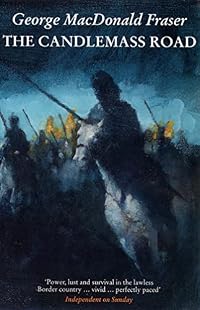
George MacDonald Fraser wrote The Candlemass Road after completing his research and writing The Steel Bonnets, his nonfiction account of the Anglo-Scottish border Reivers. Young Lady Margaret Dacre was brought up in the genteel fashion at the court of Queen Elizabeth I. When her father is murdered, she inherits his lands in the English West March and is plunged into a world where violence and raiding are commonplace. Fraser's characters are, as always, richly developed through vivid show more descriptions and witty dialogues. His novel is true to the spirit of the Anglo-Scottish frontier feud. show lessTags
Recommendations







Member Reviews
A stirring little adventure story, The Candlemass Road possesses all the usual George MacDonald Fraser hallmarks of colourful prose, strong characterization and detailed research to bring the historical period to life. What is unusual for Fraser – but not unwelcome – is that it is also a novel with a single clear theme running throughout. Fraser has always had a love of rogues and knaves, but this short novel addresses the grey morality of such a love (indirectly querying why we instinctively admire them) and the impact such individuals can have on their environments: "the good that evil men may do, by design or more commonly by chance", as his narrator puts it on page 5. Indeed, right from the off, Fraser expertly deconstructs the show more clichéd thought experiment about which historical figures you would invite as the 'perfect dinner party guests', positing that if ruffians were about to gatecrash the party you'd be kicking yourself for having invited Aristotle and not Attila the Hun. "From which pair, in your sore need, shall you hope to have the greater good, the saintly philosophers or the lusty men of war?" (pg. 3).
It's a great introduction to the theme of The Candlemass Road, a variation on the 'it takes a thief to catch a thief' argument. It is the knife-edge between civilization and barbarity – the easy sleep we have only because rough men are ready to do violence on our behalf, as George Orwell put it. And Fraser provides us the perfect setting for this meditation: the lawless borderland between England and Scotland in the Elizabethan Age. Here, Fraser provides us with his own take on the classic wandering-knight-come-to-defend-a-village adventure trope, with a noblewoman employing a rogue to defend one of her settlements from a gang of even blacker rogues. It's not quite a parable and it doesn't pontificate, but it is a tidy little story and the clear theme only sweetens the deal.
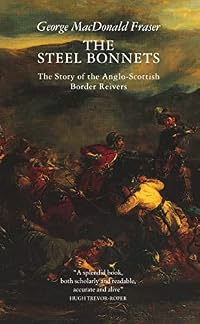
It is enjoyable to read; I've long since become used to Fraser's penchant for regional dialect in his novels but, thankfully, it's not overdone here and the story flows easily whilst still retaining its flavour. If I have one mark against The Candlemass Road, it is still one I am unsure about marking. I read The Steel Bonnets, Fraser's detailed history of the Borderlands, not too many months ago and it is still fresh in my mind. I am not sure how much of Candlemass I understood only because of this background knowledge; I have a suspicion readers who are less familiar might perhaps become more lost reading Candlemass. This short novel is an excellent complement to that earlier book but serves well as an adventure in and of itself (The Reavers, which takes the plot of Candlemass and provides an absurdly comic spin, is also very enjoyable but for different reasons). In his Postscript, Fraser says he wanted Candlemass to provide "an echo of events which happened every day along the border" at that time, and believes historical fiction is the most evocative way of doing so. He succeeds in doing this; The Steel Bonnets made a point of how violence of this sort was seen as a normal way of life in the Border regions at that time, and The Candlemass Road achieves the impressive effect of both showing us how normal it was considered whilst also cutting it through with dash and romance. show less
It's a great introduction to the theme of The Candlemass Road, a variation on the 'it takes a thief to catch a thief' argument. It is the knife-edge between civilization and barbarity – the easy sleep we have only because rough men are ready to do violence on our behalf, as George Orwell put it. And Fraser provides us the perfect setting for this meditation: the lawless borderland between England and Scotland in the Elizabethan Age. Here, Fraser provides us with his own take on the classic wandering-knight-come-to-defend-a-village adventure trope, with a noblewoman employing a rogue to defend one of her settlements from a gang of even blacker rogues. It's not quite a parable and it doesn't pontificate, but it is a tidy little story and the clear theme only sweetens the deal.
It is enjoyable to read; I've long since become used to Fraser's penchant for regional dialect in his novels but, thankfully, it's not overdone here and the story flows easily whilst still retaining its flavour. If I have one mark against The Candlemass Road, it is still one I am unsure about marking. I read The Steel Bonnets, Fraser's detailed history of the Borderlands, not too many months ago and it is still fresh in my mind. I am not sure how much of Candlemass I understood only because of this background knowledge; I have a suspicion readers who are less familiar might perhaps become more lost reading Candlemass. This short novel is an excellent complement to that earlier book but serves well as an adventure in and of itself (The Reavers, which takes the plot of Candlemass and provides an absurdly comic spin, is also very enjoyable but for different reasons). In his Postscript, Fraser says he wanted Candlemass to provide "an echo of events which happened every day along the border" at that time, and believes historical fiction is the most evocative way of doing so. He succeeds in doing this; The Steel Bonnets made a point of how violence of this sort was seen as a normal way of life in the Border regions at that time, and The Candlemass Road achieves the impressive effect of both showing us how normal it was considered whilst also cutting it through with dash and romance. show less
Interesting book. The language, which is very much of the 16th. century when the book is set, is at first a little slowing, but you quickly get used to it and the pace is fast. The plot is really an episode in Border history (border between England and Scotland), based on a few facts and expanded into fiction, written from the point of view of a foreign priest who is an outsider in a nominally Protestant border country, appalled at the violence and cruelty of the region. George MacDonald Fraser was a writer who built action and plot brilliantly, and had enough interest in history and historical accuracy to set them well.
A brief novel about the Scottish Border reivers. It was apparently originally intended as a stage drama. The action is in the 16th century, and centers on the castle of Lord Dacre, recently murdered, but his daughter is sent from court in England to take over. In her first day she learns of an impending raid by some reivers intent on blackmail of her village, but is unable to persuade any official to help her. She finally gains the help of a freelance warrior who has been captured stealing, and forces him to help defend the village by threatening hanging. He does so, violently. Upon his return to the castle, it becomes clear that the authorities will blame him, and he must flee. The story ends abruptly there, but there is an interesting show more afterword on the history of the times. Acquired from "A Common Reader show less
not sure why I did not review this, especially as I decided to sell it. Guess I didn't find it that interesting.
http://www.fireandsword.com/Reviews/candlemass.html
A superlative novella of feuding, outlawry, and border justice by George MacDonald Fraser.
A superlative novella of feuding, outlawry, and border justice by George MacDonald Fraser.
Ratings
Members
- Recently Added By
Author Information

48+ Works 19,651 Members
Author George MacDonald Fraser was born April 2, 1925 in Carlisle. He was refused entrance to the medical faculty of Glasgow University, so he joined the army in 1943. He served as an infantryman with the 17th Indian Division of the XIVth Army in Burma, a lance corporal and was commissioned in the Gordon Highlanders. After the war, he became a show more sports reporter with the Carlisle Journal; and during this time, he met and married Kathleen Hetherington, a reporter from another paper. He worked as a reporter and sub-editor on the Cumberland News and then moved to Glasgow, in 1953, where he worked at the Glasgow Herald as a features editor and deputy editor. Fraser's first novel was "Flashman" (1969), which was followed by nine sequels, so far, that deal with different venues of the 19th century ranging from Russia, Borneo and China to the Great Plains of the America West. Some of the other titles in the Flashman Papers are "Royal Flash" (1970), "Flashman in the Great Game" (1975), "Flashman and the Redskins" (1982), and "Flashman and the Angel of the Lord" (1994). Some of his non-fiction work includes "The Steel Bonnets" (1971), which is a factual study of the Anglo-Scottish border thieves in the seventeenth century, and "Quartered Safe Out Here" (1992). Fraser has also written a number of screenplays that include "The Three Musketeers" (1973), "Royal Flash" (1975), "Octopussy" (1983), and "Return of the Musketeers" (1989). He has also written a series of short stories about Private McAuslan whose titles include "The General Danced at Dawn" (1970), "McAuslan in the Rough" (1974), and "The Sheik and the Dustbin and other McAuslan Stories" (1988). He died of cancer on January 2, 2008. (Bowker Author Biography) show less
Common Knowledge
- Original publication date
- 1993
Classifications
Statistics
- Members
- 194
- Popularity
- 168,225
- Reviews
- 5
- Rating
- (3.17)
- Languages
- English
- Media
- Paper, Audiobook, Ebook
- ISBNs
- 10
- ASINs
- 4