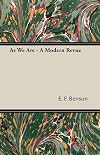
As We Are: A Modern Revue
by E. F. Benson
On This Page
Description
World War I brings about many social changes in Britain that leave Lord and Lady Buryan completely at a loss.Tags
Recommendations






















Member Reviews
As We Are by E. F. Benson is an odd melange of fiction, biography and social commentary. The first ten chapters are a tragicomic novella about the decline of an aristocratic family interspersed with Benson’s personal commentary on the changes wrought in British society by WW1. The last three chapters consist of character sketches of four eminent men, an analysis of contemporary fiction, and a summary of the effects of the war on Britain and Benson’s predictions for the future.
The four eminent men are Balfour, the British Prime Minister, Davidson, the Archbishop of Canterbury, and Ernest Cassell and Sir Edgar Speyer, Jewish businessmen born in Germany, who were naturalised British citizens but suffered from victimisation during WW1. show more Only the last two are clearly linked to Benson’s theme of the effect of WW1 on British society.
In the chapter on contemporary fiction, Benson compares James Joyce and Virginia Woolf unfavourably with Henry James, who is, according to Benson, the first writer to base his works entirely on the stream of consciousness method. James “employed that economy which distinguishes the great artist,” unlike Joyce and Woolf whose books, some thought, were “the uncohering reflections of some isolated and insulated consciousness that droned on, seemingly forever, about the uncensored film picture that passed before it.”
Benson is appalled by the restlessness and superficiality of post-war youth, while remaining compassionate towards the sufferings of the wartime generation. He describes an evening with three returned soldiers. One had married hastily during the war and was stuck in an unsatisfactory marriage. Another was losing his sight, and the third had lost his left hand. Their attention was drawn by a copy of Laurence Binyon’s poem, “For the Fallen” which begins,
“They shall not grow old as we that are left grow old.
Age shall not weary them nor the years condemn.”
The men’s bitter, frenzied response shocks Benson, who writes “even now that sense of the searing horrors they went through,…….of the incomprehension, even in those who loved them best, of what ailed them, of the apathy of the nation……….to the consequences of the war on them, still festers and perhaps will never heal.”
As We Are is one man’s account of the devastation of war on the England he loved. It is inconsistent, biased, emotional and deeply personal. It is these qualities that heighten the impression that the book leaves: a lingering sadness and compassion for a generation destroyed by war. show less
The four eminent men are Balfour, the British Prime Minister, Davidson, the Archbishop of Canterbury, and Ernest Cassell and Sir Edgar Speyer, Jewish businessmen born in Germany, who were naturalised British citizens but suffered from victimisation during WW1. show more Only the last two are clearly linked to Benson’s theme of the effect of WW1 on British society.
In the chapter on contemporary fiction, Benson compares James Joyce and Virginia Woolf unfavourably with Henry James, who is, according to Benson, the first writer to base his works entirely on the stream of consciousness method. James “employed that economy which distinguishes the great artist,” unlike Joyce and Woolf whose books, some thought, were “the uncohering reflections of some isolated and insulated consciousness that droned on, seemingly forever, about the uncensored film picture that passed before it.”
Benson is appalled by the restlessness and superficiality of post-war youth, while remaining compassionate towards the sufferings of the wartime generation. He describes an evening with three returned soldiers. One had married hastily during the war and was stuck in an unsatisfactory marriage. Another was losing his sight, and the third had lost his left hand. Their attention was drawn by a copy of Laurence Binyon’s poem, “For the Fallen” which begins,
“They shall not grow old as we that are left grow old.
Age shall not weary them nor the years condemn.”
The men’s bitter, frenzied response shocks Benson, who writes “even now that sense of the searing horrors they went through,…….of the incomprehension, even in those who loved them best, of what ailed them, of the apathy of the nation……….to the consequences of the war on them, still festers and perhaps will never heal.”
As We Are is one man’s account of the devastation of war on the England he loved. It is inconsistent, biased, emotional and deeply personal. It is these qualities that heighten the impression that the book leaves: a lingering sadness and compassion for a generation destroyed by war. show less
Ratings
Members
- Recently Added By
Author Information

256+ Works 9,850 Members
Some Editions
Common Knowledge
- Canonical title
- As We Are: A Modern Revue
- Alternate titles
- As We Are: A Modern Review
- Original publication date
- 1932
- People/Characters
- Lord Buryan; Lady Buryan; Henry, Lord St. Erth; Lady Helen Morris; Princess Henrietta Amadeo; Josephine Lister (show all 7); Joyce Anstey
- Important places
- Hakluyt, England, UK; London, England, UK
- Important events
- World War I; Interbellum
- First words
- Across the chasm which, in 1914, split time in two, making for the space of a generation at least a new era, A. B. or Anno Belli, from which to date our chronicles, little glimpses of a world, very distinct, but immensely rem... (show all)ote, as if seen through the wrong end of a telescope, occasionally flit across the field of memory.
- Original language
- English
Classifications
Statistics
- Members
- 83
- Popularity
- 385,332
- Reviews
- 1
- Rating
- (3.95)
- Languages
- English
- Media
- Paper
- ISBNs
- 2
- ASINs
- 4