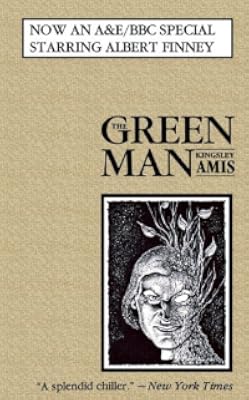
The Green Man
by Kingsley Amis
On This Page
Description
Maurice Allington has reached middle age and is haunted by death. As he says, "I honestly can't see why everybody who isn't a child, everybody who's theoretically old enough to have understood what death means, doesn't spend all his time thinking about it. It's a pretty arresting thought." He also happens to own and run a country inn that is haunted. The Green Man opens as Maurice's father drops dead (had he seen something in the room?) and continues as friends and family convene for the show more funeral.Maurice's problems are many and increasing: How to deal with his own declining health? How to reach out to a teenage daughter who watches TV all the time? How to get his best friend's wife in the sack? How to find another drink? (And another.) And then there is always death.
The Green Man is a ghost story that hits a live nerve, a very black comedy with an uncannily happy ending: in other words, Kingsley Amis at his best.
. Classic Literature. Literature. Fantasy. Fiction. show less
Tags
Recommendations





















Member Reviews
"I thought to myself how much more welcome a faculty of imagination would be if we could tell when it was at work and when not."
Maurice Allington, is the middle-aged proprietor of a 14th-century English inn called 'The Green Man' who lives on site with his second wife, a daughter from his first marriage and his elderly father. Maurice is a habitual heavy-drinker, hypochondriac and philanderer who is also being haunted by strange visions that no one else is able to see. When Maurice’s elderly father suddenly dies, the ghostly visions increase and Maurice starts investigating the possibilities that a wielder of dark magic is haunting his establishment.
No one in Maurice’s circle believes there is a ghost and they all attribute his show more sightings to his drinking, the shock of his father dying, and so forth. When he uncovers an account from 1720 in which a housemaid details her encounter with the 'Underhill' ghost, Maurice becomes ever more determined to prove them all wrong.
The novel also has some fun sexcapades, including Maurice’s ridiculous attempt to get his wife Joyce into a threesome with his best friend’s wife, Diana. Amis’s characters always seem to have plenty of attention from women but they always find a way to mess things up. Amis never really bothers to give his women any depth generally painting them merely as sex objects.
At the same time, an unreliable narrator is something Amis excels at. Maurice isn't a particularly likeable character but he is quite comical in a sozzled Basil Faulty sort of way; you are never certain whether or not he actually sees any apparitions or whether they are simply manifestations of a drink-sodden mind. This a modern Gothic short novel where by today's standards the ghost is quite placid and easily dispensed with but its both comical and exhilarating in parts making it an satisfyingly quick read overall. show less
Maurice Allington, is the middle-aged proprietor of a 14th-century English inn called 'The Green Man' who lives on site with his second wife, a daughter from his first marriage and his elderly father. Maurice is a habitual heavy-drinker, hypochondriac and philanderer who is also being haunted by strange visions that no one else is able to see. When Maurice’s elderly father suddenly dies, the ghostly visions increase and Maurice starts investigating the possibilities that a wielder of dark magic is haunting his establishment.
No one in Maurice’s circle believes there is a ghost and they all attribute his show more sightings to his drinking, the shock of his father dying, and so forth. When he uncovers an account from 1720 in which a housemaid details her encounter with the 'Underhill' ghost, Maurice becomes ever more determined to prove them all wrong.
The novel also has some fun sexcapades, including Maurice’s ridiculous attempt to get his wife Joyce into a threesome with his best friend’s wife, Diana. Amis’s characters always seem to have plenty of attention from women but they always find a way to mess things up. Amis never really bothers to give his women any depth generally painting them merely as sex objects.
At the same time, an unreliable narrator is something Amis excels at. Maurice isn't a particularly likeable character but he is quite comical in a sozzled Basil Faulty sort of way; you are never certain whether or not he actually sees any apparitions or whether they are simply manifestations of a drink-sodden mind. This a modern Gothic short novel where by today's standards the ghost is quite placid and easily dispensed with but its both comical and exhilarating in parts making it an satisfyingly quick read overall. show less
Maurice Allingham, a 1960's Englishman to the core, is one busy man. The Green Man describes, in beautifully delineated prose, his workday in loving detail, as he manages the 17th century hotel he owns on the outskirts of Cambridge. In fact, were it not for the circumstances within its pages, this novel could just as well be the memoir of a brilliant man whose avocation of preparing meals, tending bar, purchasing wine and sundries, and entertaining guests would fit nicely on a shelf with memoirs, say, from Elizabeth Gilbert or Francis Mayles. But Maurice has bigger issues than theirs; for one, his non-stop drinking, becoming more and more pronounced as his day wears on. Second, Maurice is a serial adulterer. Even though he has a show more wonderful, loving, younger, second, 'trophy' wife, he wants more and more. One of the funnier sub-plots is wondering how will Maurice talk his latest 'conquest' into bed with his wife, and, moreover, how can he talk both of them, pardon my poor French, into what I believe is called 'a menage a trois?' (Not that I would even know what that could be...although perhaps, if prompted, I could guess.) Certainly, Maurice has a lot on his mind. But that is nothing, really, as his real crisis turns out to be otherworldly; you see, Maurice's hotel is haunted! And his "haunts" turn out to be a real horror show! I will leave you with this...a year preceding this novels publication, we saw Rosemary's Baby come into print; later, following The Green Man, titles like The Exorcist, The Other, Carrie, and Ghost Story. The Green Man fits right into this sequence, although it is quite the most literary, no surprise considering the source, that is, the written output of Kingsley Amis. show less
Maurice Allington has three main passions: drinking whiskey (and lots of it), trying to get his wife and a friend’s wife into bed for a ménage à trois, and finding out the truth about ghosts who appear to be haunting his pub. He also contemplates death, both somewhat fearfully, and also as a welcome release from all his bothers in life. Overall he’s not a very admirable character, and I found it interesting that Amis once said in an interview that of all his heroes, he was most like Allington. ‘The Green Man’ is a bit of a dense read at times, but at the same time, the story is quite satisfying, and I liked Amis’ dry humor and very British way of ‘speaking’. The ghost story has nice elements of horror which are developed show more with great pace, the outcome of the 3-way is rather funny, and Amis also takes some cracks at religion and 60’s culture in the form of a young of a young reverend. Despite the sex, violence, and weighty theme of death, Amis exercises restraint, and is never lurid. This is a smart, fun ghost story. show less
The Green Man is an enjoyable ghost story laced with the sort of witty dialogue common in Amis novels – and yet it constitutes a more than negligible statement about personality, purpose and ethics in the late-20th century world of its setting. Thomas Underhill’s lust is still evident after three centuries of extra-corporeal existence – his mastery of the black arts and his circumvention of death have not cured him. The protagonist, Maurice Allington, sees something of Underhill in himself when his wife throws up his orchestration of the orgy as just a way of “experimenting” with other people, just as Underhill intended to experiment on Amy, and looks forward, as the novel closes, to the release from his personality that death show more will bring him. It is not a stretch to see in this Amis’s view of the new generation, with its proclivity for “experimental lifestyles” of all sorts that mainly take account only of the individual conducting the experiment (well-represented in the novel by the pseudo-radical priest Tom Rodney Sonnenschein). Indeed, God, as the young man, is seen in the novel as being a sort of experimenter Himself, which earns Him more than a whiff of Amis’s contempt.
The humor and irony abound in this light read from the pen of Kingsley Amis. show less
The humor and irony abound in this light read from the pen of Kingsley Amis. show less
It was pretty much impossible to have any sympathy for the main character in The Green Man by Kingsley Amis as it was established very quickly that he is an alcoholic, a neglectful father, an uncaring and absent-minded husband, a womanizer and, is having an affair with his friend’s wife. As the owner of the ancient inn called The Green Man part of his hosting duties are to impart the rumors of ghostly visitations. But after he himself has an encounter he realizes that the ghosts are not only real but intend malice as well.
This is a man who was already suffering from nocturnal hallucinations and hypochondria so when he declares that he is seeing ghosts his friends and family decide he is experiencing the Dts. Over the course of five show more days this story unfolds partly with humor over life’s foibles and partly with chills over the supernatural occurrences. The Green Man appears to be a macabre parody of life and death and although I was never quite sure if this was a straight up ghost story or a crazy sex comedy, I did enjoy the ride it took me on. This blend of the occult, religion and sexual innuendo reminded me of many of the books that I read during the 1960s when all of these subjects were being closely examined. The Green Man is a short black comedy that I found quite entertaining. show less
This is a man who was already suffering from nocturnal hallucinations and hypochondria so when he declares that he is seeing ghosts his friends and family decide he is experiencing the Dts. Over the course of five show more days this story unfolds partly with humor over life’s foibles and partly with chills over the supernatural occurrences. The Green Man appears to be a macabre parody of life and death and although I was never quite sure if this was a straight up ghost story or a crazy sex comedy, I did enjoy the ride it took me on. This blend of the occult, religion and sexual innuendo reminded me of many of the books that I read during the 1960s when all of these subjects were being closely examined. The Green Man is a short black comedy that I found quite entertaining. show less
It is rare for me to read a work of literature and spontaneously laugh out loud once every few pages - Amis's sense of the absurd has that affect on the reader. And thank god we have people, like both Amis senior and junior, whose powers of observation and sense of mischief combined with powers of expression in English prose can let us laugh at the world.
“I have no novelists, finding theirs a puny and piffling art, one that, even at its best, can render truthfully no more than a few minor parts of the total world it pretends to take as its field of reference.” So declares Mr. Maurice Allington while scanning the books of his personal library in the study of his rustic country inn, The Green Man. And what manner of narrator did Kingsley Amis create to tell his novel’s story?
Maurice is a fifty-three-year-old self-centered boozehound, an accomplished womanizer living with his second wife, thirteen-year-old daughter and eighty-year-old father; Maurice also happens to be charming, articulate, Cambridge educated and in possession of both keen intellect and vivid imagination. Does this show more sound a lot like Kingsley Amis himself? The British author would undoubtedly answer “yes” since he stated directly he could relate to Maurice Allington more than any of his other characters. Above all else, Maurice has one compelling, suspenseful story to tell – I can assure you by the end of the first chapter you will want to keep turning the pages to find out what happens next. As not to spoil the book’s many surprises, I will go light on plot and focus on a number of themes:
SEDUCTION AND SEX
What is a Kingsley Amis novel without a bit of the old slap and tickle? Actually, Maurice doesn’t go in for anything too kinky but he does suggest to Diana, his gorgeous blonde new lover, that she consider a ménage à trois, that is, going to bed with both himself and his wife. For Maurice, the art of seduction is a very fine art indeed (during one fling with Diana he compares his techniques of arousing a woman to a virtuoso playing a concerto), however he acknowledges he is beyond his stud prime, not to mention the fact he must also deal with a batch of distractions, both natural and supernatural. All told, similar to other dimensions of the novel, Maurice’s sex life is laced with large helpings of vintage Kingsley Amis comedy, mostly of the parody and satire variety.
GHOST STORY
The Green Man is most certainly a ghost story and literary critic Michael Dirda outlines in his helpful Introduction to this New York Review Books (NYRB ) edition precisely how the author masterfully incorporates traditional ingredients of atmosphere and crescendo to create his chilling tale. Since this is the 1960s modern world, Maurice’s encounter with ghosts raises the skeptical eyebrows of his family and friends as well as the local parson who judges the supernatural as so much humbug. But Maurice knows what he has seen with his own eyes and grits his teeth when everyone immediately provides psychological explanations of how his visions are the consequence of his own mental states brought about by stress, fatigue and drinking. Ah, the modern world, where science and psychology are king.
MYTHOLOGY OF THE GREEN MAN
The Green Man has been part of many world cultures going back to time immemorial, most usually connected with the forces of the natural world in its vegetable forms – trees, plants, leaves, vines, fruits – and is one of the prime symbols of regeneration and rebirth occurring in spring. Accordingly, many of the sculptures of the Green Man depict the nurturing, helpful, positive qualities he symbolizes. Much different than what we encounter in this Kingsley Amis, where the Green Man is the horrifying, destructive agent of diabolical forces. I wouldn’t want to push the point too far, but we might well consider how on another level the Green Man could also represent the alcohol consumption Maurice must do battle to overcome.
THE BIG GUY PAYS A VISIT
With the entrée of a trim, well-groomed young man in his late twenties via the inclusion of an eerie parallel space/time reality, we have a shift from ghost story to tale of the fantastic. Sitting at ease in an armchair in Maurice’s study, the young visitor informs his host that he is not a representative of God, rather, he is God. As he breezily explains the reasons for his taking corporeal form and outlines the scope of his powers, we are given a clearer picture this gentleman isn’t so much the all-powerful, all-knowing God of the Bible as the less-powerful, less-knowing Demiurge of Plato’s Timaeus. Our young man explains a few things to Maurice, one of which is how the universe is best seen as a play, a work of art in progress. In many ways, this brings to mind the Hindu concept of lila, the creative play of the divine. Also, between sips of scotch, he goes on to suggest how all forms of life will not survive eternally. All things, no matter how soul-filled or divine, dissolve and come to an end? With these words we see an affinity with the Buddhist concept of emptiness. A number of other subjects are addressed - certainly one of the most intriguing sections of the novel.
PHILOSOPHICAL INQUIRY
Maurice is obsessed by the inevitability of death. Maurice’s prime philosophical question: Do we survive in some way, spiritual or otherwise, beyond the grave? I suspect this was also among the foremost of Kingsley Amis’s conundrums about our earthly existence. What better way for a literary novelist to dig deeper into the puzzle of life and death than introducing elements usually confined to various genres such as ghost stories, fantastic stories and science fiction? In this way, I found The Green Man to be a deeply probing expansion of how a literary novel can address fundamental metaphysical questions. And let’s not forget Kingsley Amis was a big fan of genre writing such as mystery and science fiction.
THE HERO’S JOURNEY
Maurice has serious issues in his dealing with the other people in his life. His wife Joyce and his daughter Amy, just to name two. Turns out, toward the end of the novel, Maurice faces life-and-death challenges and unflinchingly take on the role of a hero. Such is the power of love. In this way, his relationship with Amy opens up and we have hints his own life will be transformed. To discover the details, you will have to read for yourself. Highly recommended.
“I thought to myself how much more welcome a faculty the imagination would be if we could tell when it was at work and when not.”
― Kingsley Amis, The Green Man show less
Maurice is a fifty-three-year-old self-centered boozehound, an accomplished womanizer living with his second wife, thirteen-year-old daughter and eighty-year-old father; Maurice also happens to be charming, articulate, Cambridge educated and in possession of both keen intellect and vivid imagination. Does this show more sound a lot like Kingsley Amis himself? The British author would undoubtedly answer “yes” since he stated directly he could relate to Maurice Allington more than any of his other characters. Above all else, Maurice has one compelling, suspenseful story to tell – I can assure you by the end of the first chapter you will want to keep turning the pages to find out what happens next. As not to spoil the book’s many surprises, I will go light on plot and focus on a number of themes:
SEDUCTION AND SEX
What is a Kingsley Amis novel without a bit of the old slap and tickle? Actually, Maurice doesn’t go in for anything too kinky but he does suggest to Diana, his gorgeous blonde new lover, that she consider a ménage à trois, that is, going to bed with both himself and his wife. For Maurice, the art of seduction is a very fine art indeed (during one fling with Diana he compares his techniques of arousing a woman to a virtuoso playing a concerto), however he acknowledges he is beyond his stud prime, not to mention the fact he must also deal with a batch of distractions, both natural and supernatural. All told, similar to other dimensions of the novel, Maurice’s sex life is laced with large helpings of vintage Kingsley Amis comedy, mostly of the parody and satire variety.
GHOST STORY
The Green Man is most certainly a ghost story and literary critic Michael Dirda outlines in his helpful Introduction to this New York Review Books (NYRB ) edition precisely how the author masterfully incorporates traditional ingredients of atmosphere and crescendo to create his chilling tale. Since this is the 1960s modern world, Maurice’s encounter with ghosts raises the skeptical eyebrows of his family and friends as well as the local parson who judges the supernatural as so much humbug. But Maurice knows what he has seen with his own eyes and grits his teeth when everyone immediately provides psychological explanations of how his visions are the consequence of his own mental states brought about by stress, fatigue and drinking. Ah, the modern world, where science and psychology are king.
MYTHOLOGY OF THE GREEN MAN
The Green Man has been part of many world cultures going back to time immemorial, most usually connected with the forces of the natural world in its vegetable forms – trees, plants, leaves, vines, fruits – and is one of the prime symbols of regeneration and rebirth occurring in spring. Accordingly, many of the sculptures of the Green Man depict the nurturing, helpful, positive qualities he symbolizes. Much different than what we encounter in this Kingsley Amis, where the Green Man is the horrifying, destructive agent of diabolical forces. I wouldn’t want to push the point too far, but we might well consider how on another level the Green Man could also represent the alcohol consumption Maurice must do battle to overcome.
THE BIG GUY PAYS A VISIT
With the entrée of a trim, well-groomed young man in his late twenties via the inclusion of an eerie parallel space/time reality, we have a shift from ghost story to tale of the fantastic. Sitting at ease in an armchair in Maurice’s study, the young visitor informs his host that he is not a representative of God, rather, he is God. As he breezily explains the reasons for his taking corporeal form and outlines the scope of his powers, we are given a clearer picture this gentleman isn’t so much the all-powerful, all-knowing God of the Bible as the less-powerful, less-knowing Demiurge of Plato’s Timaeus. Our young man explains a few things to Maurice, one of which is how the universe is best seen as a play, a work of art in progress. In many ways, this brings to mind the Hindu concept of lila, the creative play of the divine. Also, between sips of scotch, he goes on to suggest how all forms of life will not survive eternally. All things, no matter how soul-filled or divine, dissolve and come to an end? With these words we see an affinity with the Buddhist concept of emptiness. A number of other subjects are addressed - certainly one of the most intriguing sections of the novel.
PHILOSOPHICAL INQUIRY
Maurice is obsessed by the inevitability of death. Maurice’s prime philosophical question: Do we survive in some way, spiritual or otherwise, beyond the grave? I suspect this was also among the foremost of Kingsley Amis’s conundrums about our earthly existence. What better way for a literary novelist to dig deeper into the puzzle of life and death than introducing elements usually confined to various genres such as ghost stories, fantastic stories and science fiction? In this way, I found The Green Man to be a deeply probing expansion of how a literary novel can address fundamental metaphysical questions. And let’s not forget Kingsley Amis was a big fan of genre writing such as mystery and science fiction.
THE HERO’S JOURNEY
Maurice has serious issues in his dealing with the other people in his life. His wife Joyce and his daughter Amy, just to name two. Turns out, toward the end of the novel, Maurice faces life-and-death challenges and unflinchingly take on the role of a hero. Such is the power of love. In this way, his relationship with Amy opens up and we have hints his own life will be transformed. To discover the details, you will have to read for yourself. Highly recommended.
“I thought to myself how much more welcome a faculty the imagination would be if we could tell when it was at work and when not.”
― Kingsley Amis, The Green Man show less
Members
- Recently Added By
Lists

1001 Books You Must Read Before You Die
1,448 works; 1,133 members

Best Horror Mega-List
342 works; 6 members

Cawthorn and Moorcock's Fantasy: The 100 Best Books
110 works; 7 members

David Pringle's Modern Fantasy: The 100 Best Novels
100 works; 5 members

Jones and Newman's Horror: The 100 Best Books
100 works; 4 members
Author Information

103+ Works 19,671 Members
Kingsley Amis is generally considered one of the "angry young men" of the 1950s. He was born in London in 1922 and educated at the City of London School. He received a degree in English language and literature from St. John's College, Oxford, in 1947. Until 1961 Amis lectured in English at University College, Swansea, and for the following two show more years at Cambridge. In 1947 Amis published his first collection of poems, Bright November. Frame of Mind followed in 1953 and Poems: Fantasy Portraits in 1954. His first novel, Lucky Jim (1954), established his reputation as a writer. He followed with That Uncertain Feeling (1956), and I Like It Here (1958). A longtime James Bond devotee, Amis wrote a James Bond adventure after the death of Ian Fleming in 1964. Amis's study of the famous spy was titled The James Bond Dossier (1965). Amis received the Booker Prize for the Old Devils (1986). Amis's later works include Memoirs (1990), and The King's English, a collection of essays on the craft of writing well. Amis was knighted in 1990. He died in 1995. (Bowker Author Biography) show less
Some Editions
Awards and Honors
Series
Belongs to Publisher Series
Common Knowledge
- Canonical title*
- Der grüne Mann
- Original title
- The Green Man
- Alternate titles*
- Лесовик
- Original publication date
- 1969
- People/Characters
- Maurice Allington; Dr. Thomas Underhill
- Important places
- The Green Man Inn; England, UK
- Dedication
- To Sargy Mann
- First words
- No sooner has one gone over one's surprise at finding a genuine coaching inn less than 40 miles from London - and 8 from the MI - than one is marveling at the quality of the equally genuine English fare (the occasional disast... (show all)er apart!).
- Last words
- (Click to show. Warning: May contain spoilers.)I put on my dinner-jacket, swallowed a strong whisky, and went downstairs to begin the evening round.
- Original language*
- Englisch
*Some information comes from Common Knowledge in other languages. Click "Edit" for more information.
Classifications
Statistics
- Members
- 1,023
- Popularity
- 25,360
- Reviews
- 23
- Rating
- (3.60)
- Languages
- 7 — Dutch, English, Estonian, French, German, Polish, Spanish
- Media
- Paper, Audiobook, Ebook
- ISBNs
- 23
- ASINs
- 14