Labor and Monopoly Capital: The Degradation of Work in the Twentieth Century
by Harry Braverman
On This Page
Description
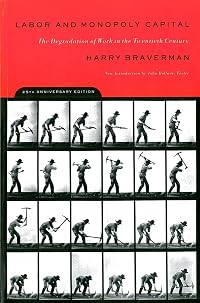
This widely acclaimed book, first published in 1974, was a classic from its first day in print. Written in a direct, inviting way by Harry Braverman, whose years as an industrial worker gave him rich personal insight into work, Labor and Monopoly Capital overturned the reigning ideologies of academic sociology.This new edition features an introduction by John Bellamy Foster that sets the work in historical and theoretical context, as well as two rare articles by Braverman, "The Degradation show more of Work in the Twentieth Century" (1975) and "Two Comments" (1976), that add much to our understanding of the book. show lessTags
Recommendations



































Member Reviews
Braverman's book is subtitled "The Degradation of Work in the Twentieth Century", but it is still very relevant in the twenty-first. It shows the effects of the development of capitalism on the nature of work (the labour process) and on the composition of the working class since Marx's time.
Braverman shows how several factors combine to make the labour process an alienating one under capitalism: capitalist management and control; the way the capitalists use new technology; the division of labour; and the separation of the "conception" or planning side of work from its "execution". Underlying all these, of course, is the lack of control by workers over the means of production.
He shows how the capitalists try to deskill as far as possible show more every new type of skilled job that is thrown up by their ever-changing system, so that they can both reduce wage levels and also more easily control the alienated labour of the workers.
Finally, Braverman was also one of the first Marxists to show in detail how white collar workers have become part of the working class, and how even many "professional" jobs are being proletarianised. show less
Braverman shows how several factors combine to make the labour process an alienating one under capitalism: capitalist management and control; the way the capitalists use new technology; the division of labour; and the separation of the "conception" or planning side of work from its "execution". Underlying all these, of course, is the lack of control by workers over the means of production.
He shows how the capitalists try to deskill as far as possible show more every new type of skilled job that is thrown up by their ever-changing system, so that they can both reduce wage levels and also more easily control the alienated labour of the workers.
Finally, Braverman was also one of the first Marxists to show in detail how white collar workers have become part of the working class, and how even many "professional" jobs are being proletarianised. show less
As a blue collar worker, this book is blowing my fucking mind.
A very readable book. Harry is the poster boy that explains how social polities, social thinking and the fair distribution of economic resources works, smart man who rises from uneducated, blue collar worker to academic.
I still think that the idea that capital always moves towards monopolistic practice and rent seeking is like poetry when I think about it. Today more relevant than in the author's day.
Braverman writes well, in clear concise prose. Pity the markets seem to have won the battle over the control of resources, once again for the benefit of the few.
I read this at university back in around 1986. It still rings delightfully in my ears.
If you can't read Karl in the original, this may be what you need.
I still think that the idea that capital always moves towards monopolistic practice and rent seeking is like poetry when I think about it. Today more relevant than in the author's day.
Braverman writes well, in clear concise prose. Pity the markets seem to have won the battle over the control of resources, once again for the benefit of the few.
I read this at university back in around 1986. It still rings delightfully in my ears.
If you can't read Karl in the original, this may be what you need.
The marxian labor economics book to read if you're reading only one.
Great information packaged in a tirelessly tedious academic presentation. Drink lots of coffee while reading.
Ratings
Members
- Recently Added By
Lists

Labor History
77 works; 5 members

Favourite Books
1,820 works; 316 members
Author Information

8 Works 558 Members
Some Editions
Awards and Honors
Common Knowledge
- Canonical title
- Labor and Monopoly Capital: The Degradation of Work in the Twentieth Century
- Original publication date
- 1974
- Original language
- Inglese
Classifications
- Genres
- Economics, Sociology, Nonfiction, General Nonfiction, History
- DDC/MDS
- 331.0904 — Society, government, & culture Economics Labor economics History, geographic treatment, biography
- LCC
- HD51 .B7 — Social sciences Industries. Land use. Labor Industries. Land use. Labor Management. Industrial management
- BISAC
Statistics
- Members
- 549
- Popularity
- 54,225
- Reviews
- 5
- Rating
- (4.42)
- Languages
- 5 — English, French, Italian, Portuguese, Swedish
- Media
- Paper, Ebook
- ISBNs
- 11
- ASINs
- 11