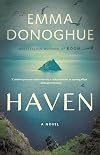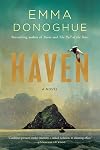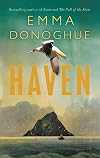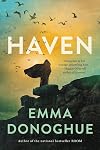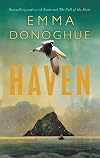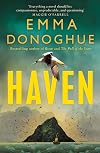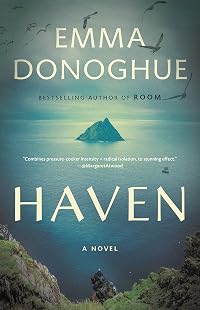
Haven
by Emma Donoghue
On This Page
Description
In this beautiful story of adventure and survival from the New York Times bestselling author of Room, three men vow to leave the world behind them as they set out in a small boat for an island their leader has seen in a dream, with only faith to guide them. In seventh-century Ireland, a scholar and priest called Artt has a dream telling him to leave the sinful world behind. Taking two monks--young Trian and old Cormac--he rows down the river Shannon in search of an isolated spot on which to show more found a monastery. Drifting out into the Atlantic, the three men find an impossibly steep, bare island inhabited by tens of thousands of birds, and claim it for God. In such a place, what will survival mean? show lessTags
Recommendations








Member Recommendations
by anonymous user
Member Reviews
This is the tenth book of Donoghue's I've read, each one better than the last, though I admit I like her historical fiction better than her contemporary stuff. This book is set in the 7th Century. Artt, a respected ascetic saint-wannabe, has a dream that he and two monks live on a deserted island and dedicate their lives to the glory of god. He picks two monks from a monastery he is visiting, Cormac an older story teller and musician and Trian, a younger sailor-worker, musician and decides they will fulfill this dream. The saint wannabe knows god loves nothing more than hard work and self denial. I have little use for religious people, even less for ascetics, and even less for those who impose that asceticism on others. Artt spends the show more book making sure he destroys every bit of happiness he can for the glory of god. Every few pages I found myself saying "Jesus Christ" or "Lord o' Mercy" so you can see it was a very religious experience. show less
Emma Donoghue is brilliant when it comes to creating believable and consuming characters and setting them in unique landscapes that resonate with truth. What a character study this novel is and what an exploration in the meaning of holiness, tolerance and "God's will". Reminded me of The Poisonwood Bible. Readers of Donoghue's other novels may find this one slower, but that's a feature and not a bug: it's a slow and satisfying burn.
Wow, what I love about Emma Donoghue is how she just puts you right there, in the story, from page 1. Perceptive character study and exploration of the limits of human endurance and faith. It's also a wonderful ecocritical text that probes how Christian texts have historically primed humans to see ourselves as holding dominion over nature and challenges us to see that nature does not exist purely to serve humankind. Trian, my dude, tree-hugger, I see you. Cormac is also an interesting character who exemplifies how lived experience and empathy will always trump dogma. A seemingly simple story that feels like a fable, very well done!
When I first read the description of this book, I was planning to make lots of Father Ted jokes in my show more review (I mean, come on! Three priests! On a craggy island! Off the west coast of Ireland!) but it's way too beautiful and haunting to reduce it to a silly gag. Though Artt could surely learn something from Mrs. Doyle: "It doesn't matter what day it is Father. There's always time for a nice cup of tea. Didn't our Lord himself on the cross pause for a nice cup of tea before giving himself up for the world?" show less
When I first read the description of this book, I was planning to make lots of Father Ted jokes in my show more review (I mean, come on! Three priests! On a craggy island! Off the west coast of Ireland!) but it's way too beautiful and haunting to reduce it to a silly gag. Though Artt could surely learn something from Mrs. Doyle: "It doesn't matter what day it is Father. There's always time for a nice cup of tea. Didn't our Lord himself on the cross pause for a nice cup of tea before giving himself up for the world?" show less
"The dream is an instruction to withdraw from the world to set out on a pilgrimage with two companions, find this island, and found a monastic retreat."
This historical fiction novel is set in 7th century Ireland. Artt, a visiting "monk-celebrity" dreams that he must set to sea in search of a remote island and found a monastic retreat. The monastery assigns two monks to accompany Artt, Trian a young red-headed fairly new monk, and Cormac, a former farmer and older monk. They set forth in a small boat with only a minimum of supplies for survival.
When they arrive at a barren island, rising from the sea and inhabited only by birds, Artt declares this to be the place he saw in his dream. They begin to establish a settlement, somehow needing show more to provide sustenance (food) in a place where there is not soil to grow crops, shelter where there in no wood, only a lone stunted rowan tree. But there are plenty of stones (and birds) and Artt's constant refrain is that God will provide. Instead of the practicalities of life, like food and shelter, Artt is more concerned with copying scripture and building a chapel. And Artt is unwilling to let Trian or Cormac, who are more practical about their needs, visit the mainland to trade. And for a while, Trian and Cormac, who are bound by their vow of obedience to Artt, are compliant.
Donohue is a wonderful writer, and for most of the book I loved it. I loved the descriptions of the hostile setting, which is based on a real place (Skellig Michael, which you can google). But then as the book is nearing its crisis point (i.e. will Cormac and Train remain obedient to Artt's command to let God provide, and probably die, or will they disobey and survive?), there is a revelation about Trian relating to why his family placed him in the monastery. SPOILER: It's about Trian's gender ambiguity, and I felt that this issue did not need to be in this book. For me, it caused the intrusion of 20th/21st century sensibilities to a Medieval setting and time. There was plenty enough to provide conflict with Artt's religious obsession and probably insanity without this additional issue to set Artt off. Artt was unsympathetic and irrational enough without having him turn on Trian for this. It took me off the island, out of the story, and back to the present. I don't know if the intrusion of sexual/gender issues was an attempt to draw in more contemporary readers, but it didn't work for me.
First line: "Trian's stomach growls."
Last line: "No one and nothing to bar his way to heaven."
2 stars show less
This historical fiction novel is set in 7th century Ireland. Artt, a visiting "monk-celebrity" dreams that he must set to sea in search of a remote island and found a monastic retreat. The monastery assigns two monks to accompany Artt, Trian a young red-headed fairly new monk, and Cormac, a former farmer and older monk. They set forth in a small boat with only a minimum of supplies for survival.
When they arrive at a barren island, rising from the sea and inhabited only by birds, Artt declares this to be the place he saw in his dream. They begin to establish a settlement, somehow needing show more to provide sustenance (food) in a place where there is not soil to grow crops, shelter where there in no wood, only a lone stunted rowan tree. But there are plenty of stones (and birds) and Artt's constant refrain is that God will provide. Instead of the practicalities of life, like food and shelter, Artt is more concerned with copying scripture and building a chapel. And Artt is unwilling to let Trian or Cormac, who are more practical about their needs, visit the mainland to trade. And for a while, Trian and Cormac, who are bound by their vow of obedience to Artt, are compliant.
Donohue is a wonderful writer, and for most of the book I loved it. I loved the descriptions of the hostile setting, which is based on a real place (Skellig Michael, which you can google). But then as the book is nearing its crisis point (i.e. will Cormac and Train remain obedient to Artt's command to let God provide, and probably die, or will they disobey and survive?), there is a revelation about Trian relating to why his family placed him in the monastery. SPOILER: It's about Trian's gender ambiguity, and I felt that this issue did not need to be in this book. For me, it caused the intrusion of 20th/21st century sensibilities to a Medieval setting and time. There was plenty enough to provide conflict with Artt's religious obsession and probably insanity without this additional issue to set Artt off. Artt was unsympathetic and irrational enough without having him turn on Trian for this. It took me off the island, out of the story, and back to the present. I don't know if the intrusion of sexual/gender issues was an attempt to draw in more contemporary readers, but it didn't work for me.
First line: "Trian's stomach growls."
Last line: "No one and nothing to bar his way to heaven."
2 stars show less
I'm not sure why I loved this book, but I really did. It's an odd premise for a contemporary novel - a well-respected monk, Artt, has a vision of himself living for the glory of god on a remote island off the coast of Ireland with two monks from the monastery he is visiting, an older man named Cormac, and a young man name Trian. They are honored to be chosen and the 3 set off through the ocean with minimal supplies and only Artt's vision in mind. They land on "Great Skellig" a virtually inhabitable island of rock, and Artt declares it their stopping point. Instead of finding food, water, and shelter, Artt insists they keep the focus on God by carving a cross, making an altar, and copying the Bible.
How long will faith alone preserve show more these three?
I was totally enamored with this book. I thought the setting, the exploration of how destructive one man's idea of faith can be, and the survival elements were all so interesting. I just really loved it. Donoghue's books can be hit or miss for me, and this was a huge hit.
I just can't imagine anyone else will like it! show less
How long will faith alone preserve show more these three?
I was totally enamored with this book. I thought the setting, the exploration of how destructive one man's idea of faith can be, and the survival elements were all so interesting. I just really loved it. Donoghue's books can be hit or miss for me, and this was a huge hit.
I just can't imagine anyone else will like it! show less
Haven is a marvel of a book, and it's helped me sort through a topic that's been on my mind lately: slow reads. The last three books I've read, including Haven, have all been slow reads, but with Haven that pace is essential to the nature of the book. With the other two, the slow pace accomplished little more than separating the reader from the narrative. So I want to argue that Haven proves the point that slow reads, like most things in life, can be good, bad, or in between. And with Haven, that slow read is a blessing.
The premise underlying this historical novel is straightforward and summarized aptly in the promotional material for the book: "In seventh-century Ireland, a scholar and priest called Artt has a dream telling him to show more leave the sinful world behind. Taking two monks—young Trian and old Cormac—he rows down the river Shannon in search of an isolated spot on which to found a monastery. Drifting out into the Atlantic, the three men find an impossibly steep, bare island inhabited by tens of thousands of birds, and claim it for God." That's the fast version of the plot, but it doesn't begin to embrace all the novel includes.
Take a moment to think about that plot line. It's slow. It has to be slow. Slow like the journey down a major river in a watertight, but difficult to manoeuvre boat. Slow like the increasing slowness with which that boat travels on the open sea, hidden for days at a time in a fog that obscures the actual journey from those journeying. Slow like the process of finding a livable space on a rocky island with almost no topsoil, with a single tree, with thousands and thousands of birds—more birds than any of our characters could even have imagined.
Now, think about the last few words of the promo material I quoted above: "and claim it for God." Haven becomes a novel not just about an arduous journey, but also about the kinds of actions humans commit when they believe they're being directed by God. Nothing exists except that it has been created for ultimate use by man (I deliberately use the male pronoun here, given the time in which the novel is placed). Birds, their nests and eggs and young, trees, rocks, seaweeds and land weeds, air and water don't exist in their own right. They exist because at some point man will decide they are useful *things* and will treat them like things—with the kind of results one might predict.
So, yes, Haven is a slow read, but that slowness is essential: first, to the narrative, and second, to the reader's experience of that narrative. In Haven, destructive choices aren't made in a single moment; destruction doesn't happen suddenly; destruction of land and soul is a slow, slow, cumulative process.
If you have the patience to for a book that asks you to spend extended time inching forward, if you appreciate the opportunity to consider each of those inch-sized moments thoroughly and thoughtfully, Haven will provide an excellent, if sometimes heart-breaking, read. It will leave you simultaneously crushed, cynical, and hopeful. That mix of crush, cynicism, and hope is as real in our own times as it was in the 7th Century, and we need to examine that reality in detail and at length.
I received a free electronic review copy of this title from the publisher via NetGalley; the opinions are my own. show less
The premise underlying this historical novel is straightforward and summarized aptly in the promotional material for the book: "In seventh-century Ireland, a scholar and priest called Artt has a dream telling him to show more leave the sinful world behind. Taking two monks—young Trian and old Cormac—he rows down the river Shannon in search of an isolated spot on which to found a monastery. Drifting out into the Atlantic, the three men find an impossibly steep, bare island inhabited by tens of thousands of birds, and claim it for God." That's the fast version of the plot, but it doesn't begin to embrace all the novel includes.
Take a moment to think about that plot line. It's slow. It has to be slow. Slow like the journey down a major river in a watertight, but difficult to manoeuvre boat. Slow like the increasing slowness with which that boat travels on the open sea, hidden for days at a time in a fog that obscures the actual journey from those journeying. Slow like the process of finding a livable space on a rocky island with almost no topsoil, with a single tree, with thousands and thousands of birds—more birds than any of our characters could even have imagined.
Now, think about the last few words of the promo material I quoted above: "and claim it for God." Haven becomes a novel not just about an arduous journey, but also about the kinds of actions humans commit when they believe they're being directed by God. Nothing exists except that it has been created for ultimate use by man (I deliberately use the male pronoun here, given the time in which the novel is placed). Birds, their nests and eggs and young, trees, rocks, seaweeds and land weeds, air and water don't exist in their own right. They exist because at some point man will decide they are useful *things* and will treat them like things—with the kind of results one might predict.
So, yes, Haven is a slow read, but that slowness is essential: first, to the narrative, and second, to the reader's experience of that narrative. In Haven, destructive choices aren't made in a single moment; destruction doesn't happen suddenly; destruction of land and soul is a slow, slow, cumulative process.
If you have the patience to for a book that asks you to spend extended time inching forward, if you appreciate the opportunity to consider each of those inch-sized moments thoroughly and thoughtfully, Haven will provide an excellent, if sometimes heart-breaking, read. It will leave you simultaneously crushed, cynical, and hopeful. That mix of crush, cynicism, and hope is as real in our own times as it was in the 7th Century, and we need to examine that reality in detail and at length.
I received a free electronic review copy of this title from the publisher via NetGalley; the opinions are my own. show less
Haven is Emma Donoghue’s latest novel and is quite the departure from her previous novels. The setting is ancient Ireland when Gaelic and Latin still ruled, and Christians were the minority rather than the majority. Following one priest and two monks seeking a new land to claim for Christianity, the story should be rather dull. Instead, a lot is going on within its pages. Ms. Donoghue captures the hypocrisy of modern Christian religions in Artt, the priest who views himself as the leader of his little tribe simply because he has more scholarly knowledge. As Artt’s plans for his new community quickly flounder, we see in Artt much of what we’ve seen in fundamental Christians throughout the US over the past few years. Haven is not so show more much a story to enjoy as it is a story that warns and educates. It is the type of novel I contemplated not finishing because I detest any story with a strong religious undertone, but I am glad I finished it because of its messaging. Descriptive and powerful, Haven may not be everyone’s cup of tea, but it is a life-altering read for a particular reader. show less
Members
- Recently Added By
Published Reviews
Taking one of her regular breaks from contemporary fiction, Donoghue has left behind none of her ability to spin a compelling story and people it with sharp characterizations...Reminiscent of Room (2010) in its portrayal of fraught interactions in a confined space, this medieval excursion lacks its bestselling predecessor’s broad appeal, but the author’s more adventurous fans will show more appreciate her skilled handling of challenging material.
More fine work from the talented Donoghue. show less
More fine work from the talented Donoghue. show less
added by vancouverdeb
Lists

Globe and Mail | Canadian Fiction: September 24, 2022
10 works; 1 member
Globe and Mail | Canadian Fiction: October 1, 2022
10 works; 1 member

Globe and Mail | Canadian Fiction: September 3, 2022
10 works; 1 member
Globe and Mail | Canadian Fiction: September 10, 2022
10 works; 1 member
Globe and Mail | Canadian Fiction: September 17, 2022
10 works; 1 member
Globe and Mail | Canadian Fiction: August 27, 2022
10 works; 1 member

Books Read in 2023
5,638 works; 147 members

Netgalley Reads
468 works; 3 members

Literary Hub Summer 2022 Reading List
19 works; 1 member

Books Mentioned in the A+ Autostraddle Pop Up Discords Nov 2022 & Dec 2022
223 works; 3 members

Dublin Literary Award 2024 Longlist
66 works; 4 members

Picador Books
4 works; 1 member

Books Read in 2024
4,727 works; 128 members

Fiction (Non-Fantasy) by Irish Authors Set in Ireland
87 works; 3 members

Novels set in the Irish Southwest
14 works; 1 member
Author Information

42+ Works 34,726 Members
Emma Donoghue was born on October 24, 1969 in Dublin, Ireland. She received her BA degree from the University College Dublin and PhD in English from University of Cambridge. Her first novel was Stir. Her next novel was Hood which won the 1997 American Library Association's Gay, Lesbian and Bisexual Book Award for Literature. Her novel Slammerkin show more was a finalist in the 2001 Irish Times Irish Literature Prize for Fiction. The Sealed Letter, published in 2008, is a work of historical fiction. This work was the joint winner of the 2009 Lambda Literary Award for Lesbian Fiction. She continued writing several award winning novels including Room which was shortlisted for the Man Booker Prize in September 2010. Some of her other works include Astray, Three and a Half Deaths, and Frog Music. (Bowker Author Biography) show less
Some Editions
Awards and Honors
Awards
Distinctions
Common Knowledge
- Important places
- Ireland
- Dedication
- For Anne Schuurman and Zoe Sinel
- First words
- Trian's stomach growls.
- Quotations
- Trian wonders why men vie to amass possessions when they can't even hold onto their skin for longer than God allots. (12%)
That's the problem with a vow of obedience, it tends to make sheep of men. (13%)
How lonely it is to be the leader, to stand as his own soulfriend, his own confessor his own guide. (22%)
Everything is a sign if you look at it hard enough. (28%)
That's the lesson stoe teaches: even after it falls, it endures. (48%)
Artt dislikes those legends in which God takes away all his followers' troubles. Mere wishful thinking like pagan stories of magic by another name. How do such fantasies fit men to live in this world, or find their way to a b... (show all)etter one? (59%)
It seems to him that nature is God's holiest language. Everything created seems to express its Creator; everything cries out, you made me. (71%) - Last words
- (Click to show. Warning: May contain spoilers.)No one and nothing to bar his way to heaven.
Classifications
Statistics
- Members
- 620
- Popularity
- 47,311
- Reviews
- 40
- Rating
- (3.74)
- Languages
- English
- Media
- Paper, Audiobook, Ebook
- ISBNs
- 22
- ASINs
- 5